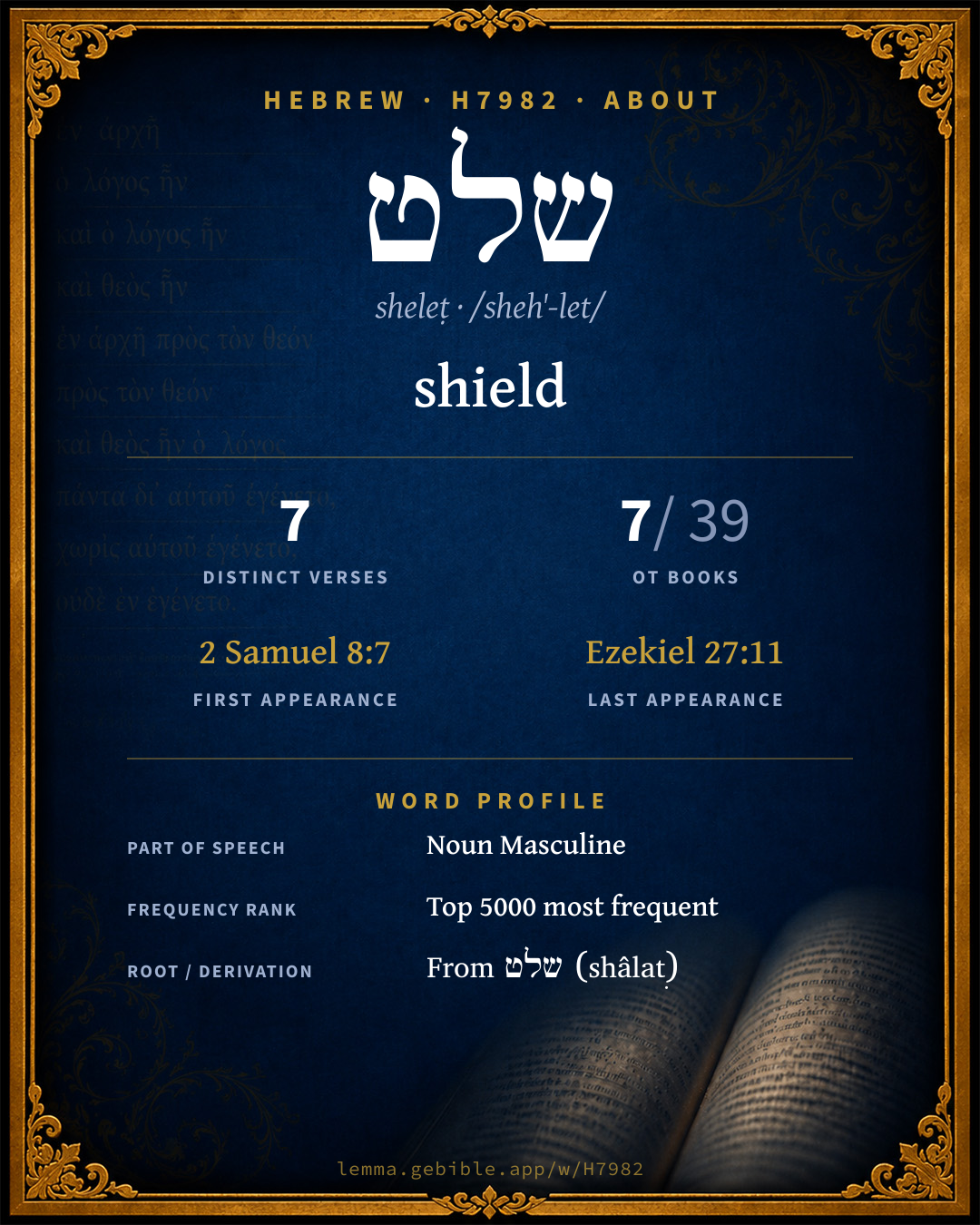
שֶׁ֫לֶט
shield
Full lexicon entry — Brown-Driver-Briggs (BDB)
From Brown-Driver-Briggs (BDB)
Where this word appears
Grammar key — what these labels mean
Part of speech
- Noun
- A naming word — a person, place, thing, or idea.
Noun type
- Common
- A common noun — a general class of person, place, or thing (“king,” “city,” “water”), not a specific name.
State
- Construct
- A noun bound to a following noun in a possessive / “of” relationship (the construct chain).
- Absolute
- The independent form of a noun, not bound to a following word.
Gender
- Masculine
- Grammatically masculine.
Number
- Plural
- More than one (in Hebrew, generally three or more).
Every verse where H7982 appears in the Book of Song of Solomon — 1 distinct verse. Click any verse to open its interlinear word-by-word view. Verse text shown in the World English Bible for context — . Each verse’s Hebrew form is shown with its reference; the English is not keyword-highlighted, since the data carries no word-level English alignment. Use “Compare translations” on any verse to read it across multiple English versions. This concordance covers the Hebrew Bible; Septuagint (Greek Old Testament) occurrences are not indexed here.
Song of Solomon
About this entry
At a glance — auto-summarized from this page’s data, not written by a person. Every figure links to its source below. This summary describes the numbers; it doesn’t interpret them.
שלט (sheleṭ) is a Hebrew noun most often rendered “shield.” It first appears in 2 Samuel 8:7. The Hebrew Bible uses it across 7 verses — uncommon. Sharing its root, it stands alongside שלט, שלט and שלטון. The sections below give every sense, occurrence, and version rendering.
Gloss history
Strong's 1890 vs modern scholarship
About this word
Strong's H7982 catalogs a Hebrew word from the Hebrew Old Testament.
These counts are not copied from any lexicon or concordance. They are computed here, from the morphology-tagged Hebrew Old Testament. What Lemma adds →
- 7
- distinct verses
- The word appears in 7 distinct verses.
- 7 / 39
- OT books
- The word appears in 7 of 39 Old Testament books.
- #2,835
- by frequency
- Top 5000 most frequent Hebrew words (rank 2,835 of 8,640 Hebrew words by occurrence).
View all 7 occurrences in the concordance →
Most concentrated in
- 2 Samuel 1 verse 14%
- 2 Kings 1 verse 14%
- 1 Chronicles 1 verse 14%
By section of the Old Testament
By traditional corpus
Conventional, traditional groupings — biblical authorship is debated, so this is a traditional corpus grouping, not an authorship claim. Each share is this word’s portion of its verses in that division of the Hebrew canon. Each figure is a share of the word’s 7 distinct verses.
- Prophets (Nevi'im) 4 verses · 57%
- Writings (Ketuvim) 3 verses · 43%
How translations render this word
Counts come from each version’s own published word-to-Strong’s tagging or interlinear alignment — an approximate guide to how each version renders this word, not a word-level alignment the data otherwise carries. Because each total is that version’s own tagged count, the per-version totals vary from one another and need not match the appearance or distinct-verse counts above. These counts may also differ from a printed concordance because Lemma counts each distinctly tagged rendering and does not collapse phrase taggings into a single head-word total. This is a fixed set of word-tagged versions (KJV, ASV, BSB, ULT) and does not change with the reading translation you choose elsewhere. Each version’s license is shown beside its name below (and on Sources).
- King James Version: Shields 6×
- American Standard Version: Shields 6×
- Berean Standard Bible: Shields 5×
- unfoldingWord Literal Text: Shields of 3×, Shields 2×
King James Version Public Domain
Renders H7982 across 7 tagged occurrences — most commonly:
Plus 1 rendering that appears only once — usually multi-word phrases or single function words the recovered tagging swept in, not distinct renderings.
American Standard Version Public Domain
Renders H7982 across 7 tagged occurrences — most commonly:
Plus 1 rendering that appears only once — usually multi-word phrases or single function words the recovered tagging swept in, not distinct renderings.
Berean Standard Bible Public Domain
Renders H7982 across 7 tagged occurrences — most commonly:
Plus 2 renderings that appear only once — usually multi-word phrases or single function words the recovered tagging swept in, not distinct renderings.
unfoldingWord Literal Text CC BY-SA 4.0
Renders H7982 across 6 tagged occurrences — most commonly:
Plus 1 rendering that appears only once — usually multi-word phrases or single function words the recovered tagging swept in, not distinct renderings.
Senses in BDB
The 1 sense BDB distinguishes for this word, in lexicon order (not ranked by frequency or importance). The full entry — with sub-senses — is in the Lexicon Entry tab.
- shield
Word origin
Derived from שלט (shâlaṭ) (H7980) — to dominate.
Jastrow Dictionary
A second Hebrew/Aramaic lexicon for comparison, covering Aramaic and post-biblical (Talmudic, Targumic, Midrashic) usage that the biblical-Hebrew BDB does not. Matched by lemma rather than by Strong’s number, so a lemma may carry more than one Jastrow headword (shown separately below), and the entries cover usage well beyond the Bible.
שָׁלַט
- (b. h.) to handle; ש׳ ב־ (cmp. מָשַׁל) to rule, have power over. Y. Ter. VIII, 45ᵈ top כאן האור שׁוֹלֵט וכ׳ here (in the case of bread) the fire comes in direct contact with it (and kills the poison of the serpent), there (in the case of water that has been warmed) the fire does not &c. Y. Maasr. I, 49ᵇ top כאן היד שׁוֹלֶטֶת וכ׳ here (in the case of a vessel into which a boiling dish has been put) the hand can handle it; there (in the case of a vessel taken directly from the fire) the hand cannot handle it; כאן וכאן אין היד שולטת בו in both cases the dish may be too hot for the hand to handle it; Y. Sabb. III, 6ᵇ top. Ib. במקום שהיד שולטת in a place (in the stove) which the hand can get at (to handle the dish placed there); ib. 5ᶜ מפני שהוא שַׁלִּיט במקום שהיד שולטת because he keeps control (to regulate the temperature of the dish) there where the handling is possible. Y. B. Mets. X, beg. 12ᶜ ששולטת היד מצר אחד that the hand can reach it from one side. Ḥull. 16ᵇ; Sabb. 82ᵃ דבר שהאור שולטת בו a thing over which fire has power (which is combustible). Ib. רוח רעה שולטת בו an evil spirit (smell of the mouth) will seize him; רוח זוהמא ש׳ בו (v. Rabb. D. S. a. l. note 30) the spirit of zohăma (internal decay) will seize him. Gen. R. s. 45) שָׁלְטוּ בעצמן they controlled themselves (interrupted their gratification). Y. Ber. IX, 13ᵇ top שולט באיפרכיא וכ׳ if he rules over one province, he does not rule over another province. Gen. R. s. 3 ביום אני שולט I want to rule (have the guard) in day time; (Y. Ber. VIII, 12ᶜ top משמש). Pesik. R. s. 31 אתם שְׁלַטְתֶּם בעצמיכם וכ׳ (not באצבעותיכם) you had power over yourselves and cut your fingers off; a. v. fr.
- same. Y. Naz. IV, 53ᵇ במְשַׁלֶּטֶת על נכסיו when she manages her husband’s property (has power of attorney).
- to give power to, make a ruler. Gen. R. s. 59 (ref. to Gen. XXIV, 1) שהִשְׁלִיטוֹ ביצרו God made him master over his inclinations; Yalk. ib. 103. Num. R. s. 146 השליטו על ארץ וכ׳ the Lord made him governor of the land of Egypt; a. e. e.g. Genesis 24:1
- to be given power; to be empowered to manage. Y. Keth. IX, 33ᵃ bot. נכסים שׁנִשְׁתַּלְּטָה בהן בחיי וכ׳ property which she had been authorized to manage during her husband’s lifetime; ib. 33ᵇ top.
שְׁלַט
- Targ. Gen. I, 16. Targ. O. Ex. XXI, 8 (h. text בבגדו). Targ. Jud. VIII, 21 (h. text פגע); a. fr.
- same, to handle.—Part. pass. מְשַׁלַּט; pl. מְשַׁלְּטֵי. Kidd. 73ᵇ top מש׳ הדמיה if the limbs of the infant have been manipulated, v. שְׁלַב.
- to give power, appoint. Targ. II Chr. XIII, 5. Targ. Am. IV, 1. Targ. Koh. VI, 2; a. fr.
- to be made, or make one’s self a ruler. Targ. Prov. XVII, 2.
שֶׁלֶט
- preced.), pl. שְׁלָטִים (cmp. כֶּלִי) armor, shields; trnsf. arm-bearers; (homilet.) the righteous as the protectors of their generation. Cant. R. to IV, 4 כל שִׁלְטֵי … שהוא עומד וישלט וכ׳ ‘all armors of the mighty’, this includes all those who control their inclinations &c.; Yalk. ib. 988. Cant. R. l. c. ולא אתם … אלא כל שלטי וכ׳ and not you yourselves (directly) are suspended on it (enjoy the protection of the Law), but only ‘all the shields of the mighty’ … as Moses in his time &c.
A Dictionary of the Targumim, the Talmud Babli and Yerushalmi, and the Midrashic Literature (Marcus Jastrow; London, Luzac, 1903) — Public Domain. Digitized via Sefaria. Digitized via Sefaria. Full attribution on Sources.
Forms in the corpus
The 5 distinct written forms H7982 takes in the Hebrew Bible, most frequent first — each parse links to that state’s occurrences in the concordance. Hebrew forms include their vowel points and cantillation, so a single lemma takes many written forms.
| Form | Parsing | Example | Uses |
|---|---|---|---|
| הַ/שְּׁלָטִ֔ים | Noun, Common, Masculine, Plural, Absolute | 2 Chronicles 23:9 | 2 |
| שִׁלְטֵ֣י | Noun, Common, Masculine, Plural, Construct | 1 Chronicles 18:7 | 2 |
| הַ/שְּׁלָטִים֒ | Noun, Common, Masculine, Plural, Absolute | Jeremiah 51:11 | 1 |
| שִׁלְטֵ֥י | Noun, Common, Masculine, Plural, Construct | Song of Solomon 4:4 | 1 |
| שִׁלְטֵי/הֶ֞ם | Noun, Common, Masculine, Plural, Construct | Ezekiel 27:11 | 1 |
Same root — word family
Other BDB entries built from the same root as H7982, grouped by Strong’s listed origin. These share a root / origin per the lexicon — not necessarily a shared meaning. Each links to that word’s own entry.
Derives from
Shares the same root
- שלט shᵉlêṭ H7981 to rule
- שלטון shilṭôwn H7983 mastery
- שלטת shalleṭeth H7986 domineering
- שליט shallîyṭ H7989 ruler
Compare all same-root words → Showing 4 of 6 — not the complete family. They share a root, not necessarily a meaning.
Septuagint verse parallels
This word appears in 7 verses that also exist in the Greek Old Testament (Septuagint), out of the 7 Hebrew verses it occurs in. You can read those verses in Greek by switching the Old Testament edition to the Septuagint.
Read these verses in the Septuagint
- 2 Samuel 8:7
- 2 Kings 11:10
- 1 Chronicles 18:7
- 2 Chronicles 23:9
- Song of Solomon 4:4
- Jeremiah 51:11
- Ezekiel 27:11
This is a verse-level parallel only — the same verses exist in both the Hebrew and Greek Old Testaments. No word-level Hebrew↔Greek correspondence is claimed: the data carries no such alignment, so no Greek word is shown as this Hebrew word’s translation. Coverage is not total — the Septuagint omits the deuterocanon and renumbers the Psalms, so some Hebrew verses have no direct Greek parallel.