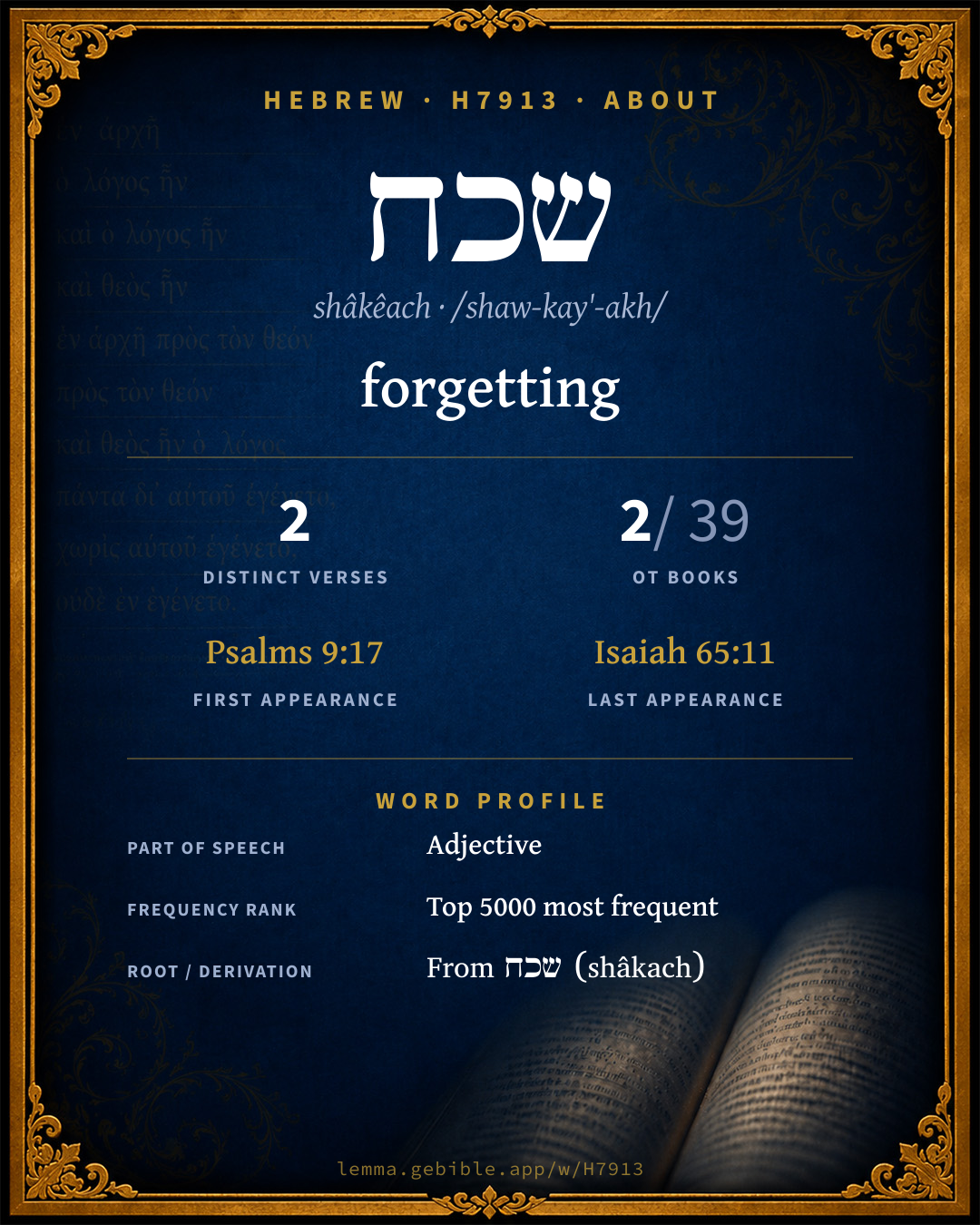
שָׁכֵחַ
forgetting
Full lexicon entry — Brown-Driver-Briggs (BDB)
From Brown-Driver-Briggs (BDB)
Where this word appears
See every Absolute-state word in the Hebrew Bible →
Grammar key — what these labels mean
Part of speech
- Adjective
- A word that describes or qualifies a noun.
State
- Construct
- A noun bound to a following noun in a possessive / “of” relationship (the construct chain).
- Absolute
- The independent form of a noun, not bound to a following word.
Gender
- Masculine
- Grammatically masculine.
Number
- Plural
- More than one (in Hebrew, generally three or more).
1 distinct verse where H7913 appears in the Absolute state, across 1 book. Filtered view — show all forms. Click any verse to open its interlinear word-by-word view. Verse text shown in the World English Bible for context — . Each verse’s Hebrew form is shown with its reference; the English is not keyword-highlighted, since the data carries no word-level English alignment. Use “Compare translations” on any verse to read it across multiple English versions. This concordance covers the Hebrew Bible; Septuagint (Greek Old Testament) occurrences are not indexed here.
Isaiah 1 verse
About this entry
At a glance — auto-summarized from this page’s data, not written by a person. Every figure links to its source below. This summary describes the numbers; it doesn’t interpret them.
The Hebrew adjective שכח centers on the idea of “forgetting.” With only 2 verses it sits in the long tail of Hebrew Bible vocabulary. Psalms dominates its distribution — 1 of 2 verses. First canonically at Psalms 9:17, it enters the text early. Related forms include שכח and שכח. For the data behind this summary, explore the sense tree and the renderings breakdown below.
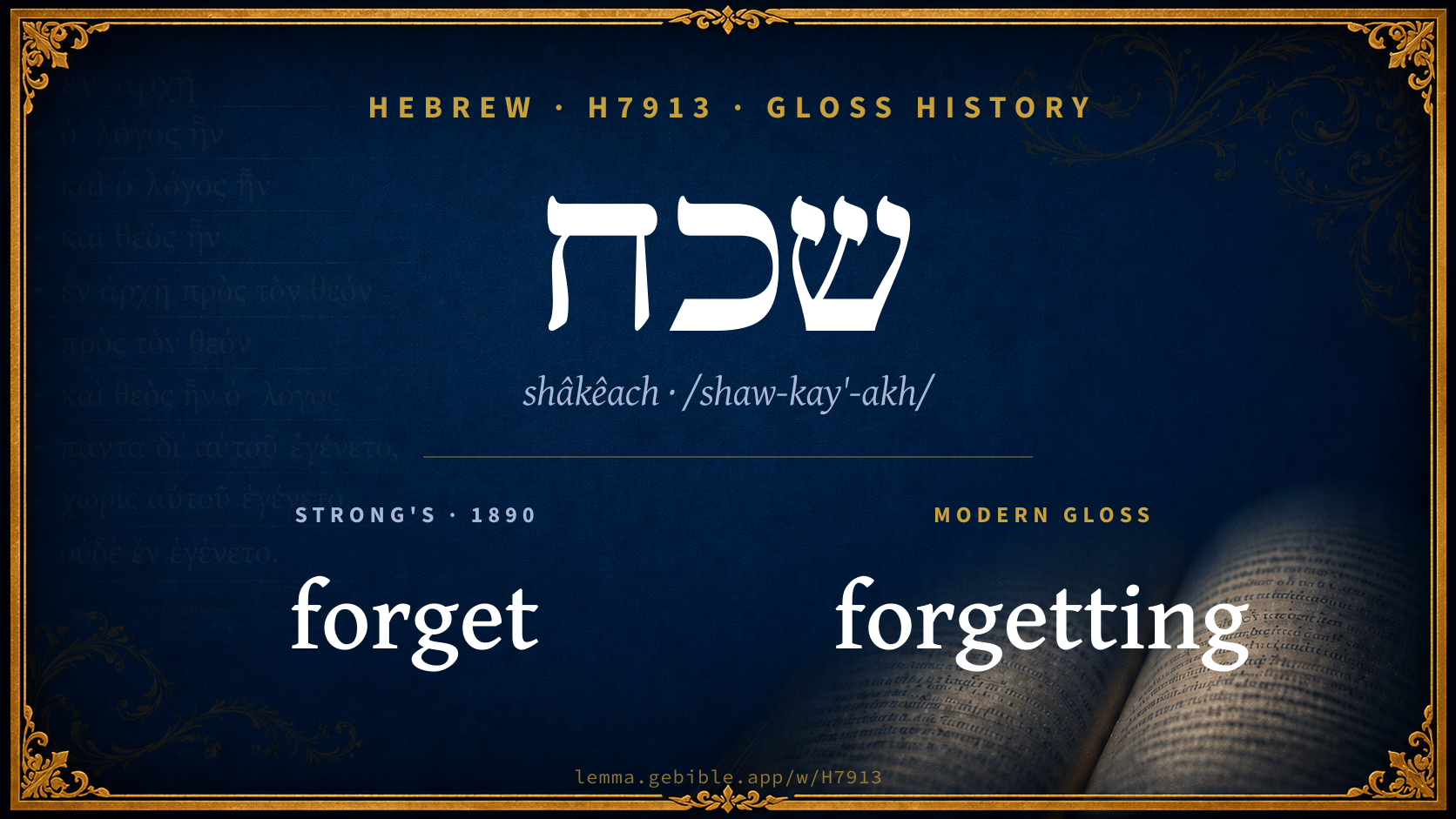
Gloss history
Strong's 1890 vs modern scholarship
About this word
Strong's H7913 catalogs a Hebrew word from the Hebrew Old Testament.
These counts are not copied from any lexicon or concordance. They are computed here, from the morphology-tagged Hebrew Old Testament. What Lemma adds →
- 2
- distinct verses
- The word appears in 2 distinct verses.
- 2 / 39
- OT books
- The word appears in 2 of 39 Old Testament books.
- #4,807
- by frequency
- Top 5000 most frequent Hebrew words (rank 4,807 of 8,640 Hebrew words by occurrence).
View all 2 occurrences in the concordance →
By traditional corpus
Conventional, traditional groupings — biblical authorship is debated, so this is a traditional corpus grouping, not an authorship claim. Each share is this word’s portion of its verses in that division of the Hebrew canon. Each figure is a share of the word’s 2 distinct verses.
- Prophets (Nevi'im) 1 verse · 50%
- Writings (Ketuvim) 1 verse · 50%
How translations render this word
Counts come from each version’s own published word-to-Strong’s tagging or interlinear alignment — an approximate guide to how each version renders this word, not a word-level alignment the data otherwise carries. Because each total is that version’s own tagged count, the per-version totals vary from one another and need not match the appearance or distinct-verse counts above. These counts may also differ from a printed concordance because Lemma counts each distinctly tagged rendering and does not collapse phrase taggings into a single head-word total. This is a fixed set of word-tagged versions (KJV, ASV, BSB, ULT) and does not change with the reading translation you choose elsewhere. Each version’s license is shown beside its name below (and on Sources).
- King James Version: Forget 2×
- American Standard Version: Forget 2×
- Berean Standard Bible: Forget 2×
- unfoldingWord Literal Text: Are forgetful of 1×, Forgetting 1×
King James Version Public Domain
Renders H7913 across 2 tagged occurrences — most commonly:
American Standard Version Public Domain
Renders H7913 across 2 tagged occurrences — most commonly:
Berean Standard Bible Public Domain
Renders H7913 across 2 tagged occurrences — most commonly:
unfoldingWord Literal Text CC BY-SA 4.0
Renders H7913 across 2 tagged occurrences — most commonly:
Senses in BDB
The 1 sense BDB distinguishes for this word, in lexicon order (not ranked by frequency or importance). The full entry — with sub-senses — is in the Lexicon Entry tab.
- forgetting, forgetful, forget
Word origin
[ שָׁכֵחַ ] adj. forgetting, forgetful
— Brown-Driver-Briggs (Oxford 1906, public domain), digitized via Sefaria, supplemented by the OpenScriptures HebrewLexicon (CC BY 4.0). See Sources.
Derived from שכח (shâkach) (H7911) — to forget.
Jastrow Dictionary
A second Hebrew/Aramaic lexicon for comparison, covering Aramaic and post-biblical (Talmudic, Targumic, Midrashic) usage that the biblical-Hebrew BDB does not. Matched by lemma rather than by Strong’s number, so a lemma may carry more than one Jastrow headword (shown separately below), and the entries cover usage well beyond the Bible.
שָׁכַח
- [to sink,] to forget, discard. Ber. 32ᵇ (ref. to Is. XLIX, 14) אדם … אתה עזבתני ושְׁכַחְתָּנִי if a man marries a woman after abandoning his first wife, he remembers the doings of his first wife, but thou hast abandoned me and also forgotten me. Ib. כלום אֶשְׁכַּח עולות וכ׳ will I ever forget the burnt-offerings of rams and the first born that thou didst offer &c.? Ib. שמא תִשְׁכַּח … סיני wilt thou forget what I did at Sinai? Peah V, 7 העומר ששְׁכָחוּהוּ … ולא ש׳ וכ׳ a sheaf which the laborers overlooked in collecting, but the employer had not overlooked. Ib. VII, 1 ושְׁכָחוֹ and he forgot it (left it on the tree). Ab. III, 8 כל השׁוֹכֵחַ וכ׳, v. מִשְׁנָה. Midd. II, 5 שָׁכַחְתִּי מה וכ׳ I forgot what purpose it served; Yoma 16ᵃ; a. v. fr.—Part. pass. שָׁכוּחַ; f. שְׁכוּחָה, a) (cmp. זָכוּר) forgetting. Y. Sabb. VI, 7ᵈ והיא ש׳ and she may forget herself, v. שַׁחֲצָנִית.—b) forgotten. B. Mets. 11ᵃ ש׳ מעיקרו a sheaf forgotten at the start (overlooked in collecting); זכור ולבסוף ש׳, v. זָכַר. Ber. l. c. (ref. to Is. l. c.) היינו עזובה היינו ש׳ is not abandoned the same as forgotten? (Ms. O. עֲזִיבָה … שְׁכִיחָה …). e.g. Isaiah 49:14
- 1. same. Y. Ber. V, 9ᵃ top לא במהרה הוא מְשַׁכֵּחַ will not easily forget it. Snh. 99ᵃ כל … ומְשַׁכְּחָהּ וכ׳ he who studied the Law and neglects it (fails to review it) is like a woman that gives birth and buries; a. e.
- 2. to cause forgetting. Ab. II, 2 שיגיעת … מְשַׁכַּחַת עון (or מַשְׁכַּחַת) the employment of the mind in both of them causes man to forget sin. Tosef. Sot. III, 12 אתם מְשַׁכְּחִין … אני אֲשַׁכֵּחַ וכ׳ you make the law of free trade forgotten among you, I will cause you to be forgotten in the world; Snh. 109ᵃ, a. e. באו ונְשַׁכֵּחַ וכ׳, v. רֶגֶל; a. fr.
- same. Bets. 15ᵇ להַשְׁכִּיחוֹ, v. זָכַר. Ab. l. c., v. supra; a. e.
- , Nithpa. נִשְׁתַּכֵּחַ to be forgotten. Tem. 14ᵇ מוטב … ואל תִּשְׁתַּכֵּחַ וכ׳ (some ed. תִּשָּׁבֵחַ) it is better that a law be uprooted (disregarded) than that the Law be forgotten in Israel. Ib. 15ᵇ שלשה … נִשְׁתַּכְּחוּ וכ׳ three thousand traditional rules were forgotten during the days of mourning for Moses. Ib. 16ᵃ אף … נִשְׁתַּכְּחָה וכ׳ also the rule concerning a sin offering whose owner died (before it was brought) was forgotten during &c. Ib. שלא יִשְׁתַּכֵּחַ … מלבי that what I have learned be not forgotten out of my mind. Pes. 54ᵇ על המת שישתכח מן הלב that the dead should be forgotten out of mind; a. fr.
שְׁכַח
- I ch. (Hebraism) same. Y. B. Kam. IV, 4ᵇ עד דשַׁכְחוּן כולן, v. סוּלָּמָא
- same. Y. Erub. I, 18ᵈ top [read:] דאין … ולא מְשַכַּח יתיה that he may not have forgotten it, if Rab should ask him; a. e.
- to be forgotten. Tem. 15ᵇ דאי׳ להו א׳ וכ׳ that which they forgot remained forgotten &c. B. Mets. 85ᵃ יתיב … דלִשְׁתַּכַּח גמרא וכ׳ he fasted … praying that he may forget the Babylonian teaching. Ib.ᵇ אי מִשְׁתַּכְּחַת תורה וכ׳ (Keth. 103ᵇ אם נשתכחה וכ׳), v. פִּלְפּוּלָא. Ib. עבדי … דלא תִשְׁתַּכַּח וכ׳ I brought it about that the Law be not forgotten &c.; a. e.
שְׁכַח II
- Af. אַשְׁכַּח (הַשְׁכַּח) (preced.) [to uncover,] to find. Targ. Ps. XXXVI, 3 למַשְׁכַּח (ed. Wil. למִ׳). Targ. Koh. I, 17 (ed. Vien. למִ׳). Ib. VIII, 17 (Pe interch. with Af.). Targ. Gen. II, 20. Ib. VIII, 9 (Y. some ed. הַשְׁ׳). Targ. O. ib. XLI, 38 הנַשְׁכַּח ed. Berl. (ed. Vien. a. oth. היִשְׁ׳, corr. acc.); Y. הנִשְׁ׳; a. fr.—Gitt. 56ᵇ ליקלויה … דלא לַשְׁכְּחֵיה וכ׳ burn this man (me, Titus), and scatter the ashes …, that the God of the Jews may not find him and place him before judgment. Y. Erub. I, 18ᵈ top א׳ תני וכ׳ he found that it was taught (in the Boraitha), Rabbi says &c. Yeb. 110ᵇ אַשְׁכְּחִתֵיה לרב וכ׳ I found Rab A. and &c. Ab. Zar. 10ᵃ, a. fr. נפק דק וא׳ וכ׳ he went forth, investigated, and found that &c. Macc. 21ᵇ מי מַשְׁכַּחַת וכ׳ wouldst thou have found the jewel beneath?; B. Mets. 17ᵇ לא משכחת, v. דְּלֵי. Gitt. 68ᵃ אַשְׁכְּחֵיה חמרא he found it to be wine; Midr. Till. to Ps. LXXVIII, 45; Yalk. Kings 182 אשכח. Y. Ḥag. II, 77ᵇ וי דמובדין ולא מַשְׁכְּחִין woe for those who lose and do not find (who suffer an irretrievable loss)!; a. fr.—Macc. l. c., a. fr. היכי משכחת לה how wilt thou find it, i.e. to what practical case can this be applied? Pes. 7ᵃ בשלמא שבת משכחת לה וכ׳ as to the Sabbath, there may be a case, as, for instance, when the fourteenth day occurs on a Sabbath. Ab. Zar. 40ᵇ; a. v. fr.
- to be found. Targ. Ex. XXI, 16. Ib. XXII, 1; 3; a. fr.—Targ. Y. I Deut. XXXIV, 8 הִשְׁתְּכָחוּ אכלין וכ׳ (= h. נמצא) consequently they ate &c., v. מָצָא.—B. Mets. 16ᵇ הנהו … דמִשְׁתַּכְּחֵי בשוקא deeds of purchase that were found in the street. Sabb. 90ᵃ; Nidd. 62ᵃ מִשְׁתַּכַּח, v. אַשְׁלְגָא. Snh. 111ᵃ; Ex. R. s. 6, a. e. ולא מִשְׁתַּכְּחִין and are not found again (cannot be replaced), v. חֲבַל II; a. fr.
A Dictionary of the Targumim, the Talmud Babli and Yerushalmi, and the Midrashic Literature (Marcus Jastrow; London, Luzac, 1903) — Public Domain. Digitized via Sefaria. Digitized via Sefaria. Full attribution on Sources.
Forms in the corpus
The 2 distinct written forms H7913 takes in the Hebrew Bible, most frequent first — each parse links to that state’s occurrences in the concordance. Hebrew forms include their vowel points and cantillation, so a single lemma takes many written forms.
| Form | Parsing | Example | Uses |
|---|---|---|---|
| הַ/שְּׁכֵחִ֖ים | Adjective, Adjective, Masculine, Plural, Absolute | Isaiah 65:11 | 1 |
| שְׁכֵחֵ֥י | Adjective, Adjective, Masculine, Plural, Construct | Psalms 9:17 | 1 |
Same root — word family
Other BDB entries built from the same root as H7913, grouped by Strong’s listed origin. These share a root / origin per the lexicon — not necessarily a shared meaning. Each links to that word’s own entry.
Derives from
Shares the same root
Compare all same-root words → They share a root, not necessarily a meaning.
Septuagint verse parallels
This word appears in 2 verses that also exist in the Greek Old Testament (Septuagint), out of the 2 Hebrew verses it occurs in. You can read those verses in Greek by switching the Old Testament edition to the Septuagint.
Read these verses in the Septuagint
This is a verse-level parallel only — the same verses exist in both the Hebrew and Greek Old Testaments. No word-level Hebrew↔Greek correspondence is claimed: the data carries no such alignment, so no Greek word is shown as this Hebrew word’s translation. Coverage is not total — the Septuagint omits the deuterocanon and renumbers the Psalms, so some Hebrew verses have no direct Greek parallel.