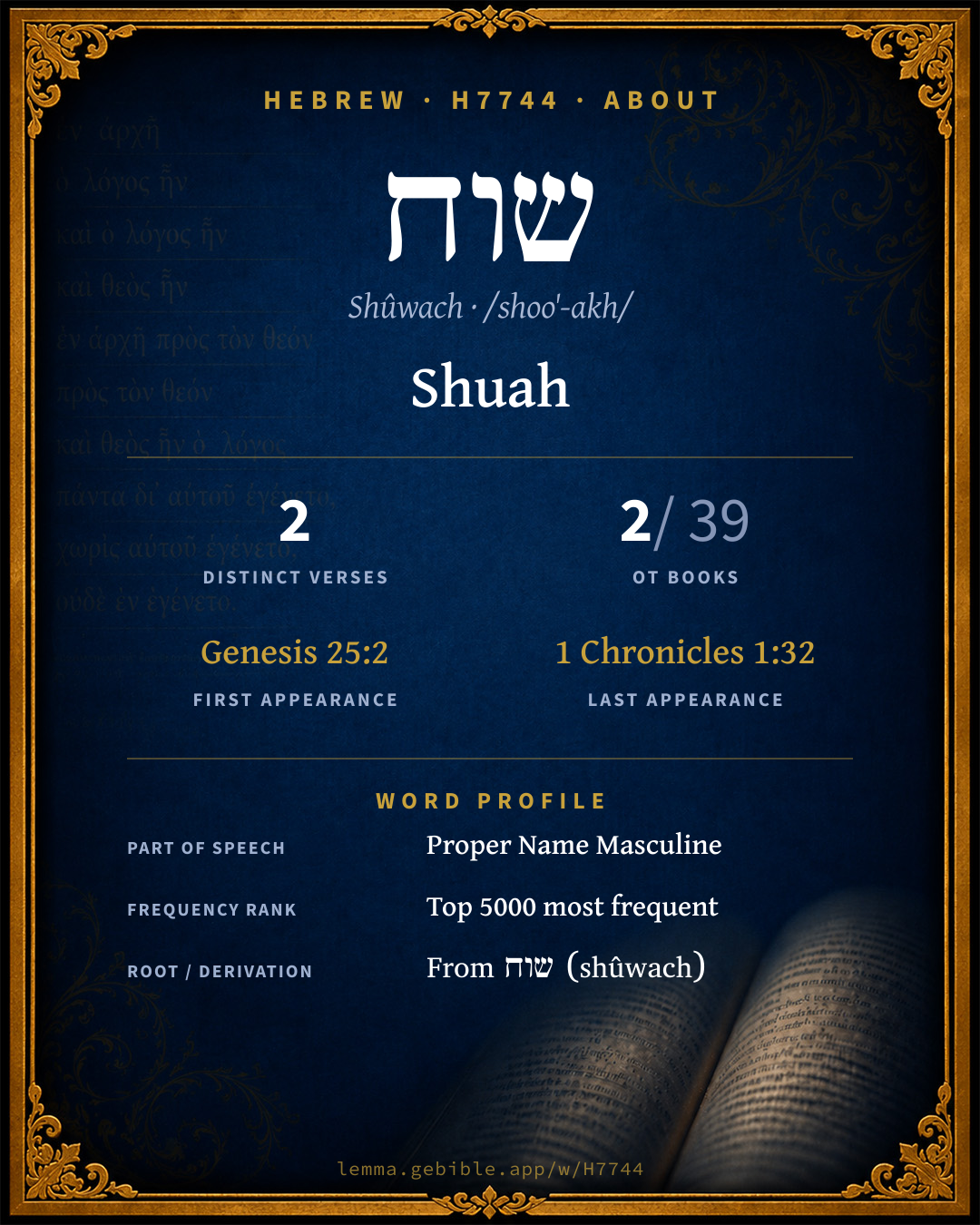
שׁוּחַ
Shuah
BDB lists 2 entries for ‘Shuah’ fuller range ↓
Full lexicon entry — Brown-Driver-Briggs (BDB)
From Brown-Driver-Briggs (BDB)
Where this word appears
Grammar key — what these labels mean
Part of speech
- Noun
- A naming word — a person, place, thing, or idea.
Noun type
- Proper
- A name of a specific person, place, or people (e.g. Abraham, Zion, Israel).
Every verse where H7744 appears in the Book of Genesis — 1 distinct verse. Click any verse to open its interlinear word-by-word view. Verse text shown in the World English Bible for context — . Each verse’s Hebrew form is shown with its reference; the English is not keyword-highlighted, since the data carries no word-level English alignment. Use “Compare translations” on any verse to read it across multiple English versions. This concordance covers the Hebrew Bible; Septuagint (Greek Old Testament) occurrences are not indexed here.
Genesis
About this entry
At a glance — auto-summarized from this page’s data, not written by a person. Every figure links to its source below. This summary describes the numbers; it doesn’t interpret them.
The Hebrew name שוח centers on the idea of “Shuah.” It occurs a mere 2 verses across Scripture. The word gravitates to Genesis (50%), then 1 Chronicles. First canonically at Genesis 25:2, it enters the text early. Dig into 2-verse concordance and the renderings breakdown below.
Gloss history
Strong's 1890 vs modern scholarship
About this word
Strong's H7744 catalogs a Hebrew word from the Hebrew Old Testament.
These counts are not copied from any lexicon or concordance. They are computed here, from the morphology-tagged Hebrew Old Testament. What Lemma adds →
- 2
- distinct verses
- The word appears in 2 distinct verses.
- 2 / 39
- OT books
- The word appears in 2 of 39 Old Testament books.
- #4,807
- by frequency
- Top 5000 most frequent Hebrew words (rank 4,807 of 8,640 Hebrew words by occurrence).
View all 2 occurrences in the concordance →
Most concentrated in
- Genesis 1 verse 50%
- 1 Chronicles 1 verse 50%
By section of the Old Testament
By traditional corpus
Conventional, traditional groupings — biblical authorship is debated, so this is a traditional corpus grouping, not an authorship claim. Each share is this word’s portion of its verses in that division of the Hebrew canon. Each figure is a share of the word’s 2 distinct verses.
- Torah (Pentateuch) 1 verse · 50%
- Writings (Ketuvim) 1 verse · 50%
How translations render this word
Counts come from each version’s own published word-to-Strong’s tagging or interlinear alignment — an approximate guide to how each version renders this word, not a word-level alignment the data otherwise carries. Because each total is that version’s own tagged count, the per-version totals vary from one another and need not match the appearance or distinct-verse counts above. These counts may also differ from a printed concordance because Lemma counts each distinctly tagged rendering and does not collapse phrase taggings into a single head-word total. This is a fixed set of word-tagged versions (KJV, ASV, BSB, ULT) and does not change with the reading translation you choose elsewhere. Each version’s license is shown beside its name below (and on Sources).
BDB lists this Strong’s number as 2 distinct words (homographs). Each count above pools all of them and is not split by sense — see the Senses section below. A low-frequency rendering may belong to a different one of those words, not the primary meaning.
- King James Version†: Shuah 2×
- American Standard Version†: Shuah 2×
- Berean Standard Bible†: Shuah 2×
- unfoldingWord Literal Text†: Shuah 2×
King James Version Public Domain
Renders H7744 across 2† tagged occurrences — most commonly:
American Standard Version Public Domain
Renders H7744 across 2† tagged occurrences — most commonly:
Berean Standard Bible Public Domain
Renders H7744 across 2† tagged occurrences — most commonly:
unfoldingWord Literal Text CC BY-SA 4.0
Renders H7744 across 2† tagged occurrences — most commonly:
Senses in the full BDB
Hebrew verbs can shift meaning by stem (binyan): Qal is the basic action, Niphal is often passive or reflexive, Piel often intensifies or makes it factitive, and Hiphil is typically causative. The senses below are grouped under the stem BDB assigns to each. This entry also uses Hithpael (reflexive or reciprocal).
What do BDB’s symbols mean?
BDB uses these scholarly abbreviations:
| Symbol | Meaning |
|---|---|
| 𝔊 | the Septuagint (the ancient Greek translation, LXX) |
| 𝔙 | the Vulgate (the Latin translation) |
| 𝔖 | the Syriac version (the Peshitta) |
| 𝔗 | the Targum (the Aramaic translation) |
| ψ | the Psalms |
| √ | root (the underlying root or stem) |
| ‖ | parallel passage (a synonymous or contrasted parallel) |
| † | the dagger: every passage where the word occurs is cited |
The 3 senses and sub-senses the full Brown-Driver-Briggs lexicon distinguishes for this word, in lexicon order (not ranked by frequency), with BDB’s own verbatim wording and sub-sense lettering. Shown in Hebrew script with BDB’s own scholarly abbreviations. The condensed entry is in the Lexicon Entry tab. See also the Forms in the corpus table below.
שוח I
Qal
- Pf. 3 fs. שָׁ֫חָה לֶעָפָר נַפְשֵׁנוּ ψ 44:26 (‖ דָּֽבְקָה לָאָרֶץ); שׁ׳ אֶל־מָוֶת בֵּיתָהּ Pr 2:18 (‖ אֶל־רְפָאִים; but ב׳ masc., read שָׁחָה, √ שׁחה, AlbrZAW xvi (1896), 82, so Toy); Impf. 3 fs. תָּשׁוּחַ עָלַי נַפְשִׁי La 3:26 Qr, e.g. Psalms 44:26
Hiphil
- declar. תָּשִׁיחַ Kt, of depression of mind.—ψ 49:15 Gr reads שָׁחוּ for MT שַׁתּוּ but v. שׁתת.— e.g. Psalms 49:15
Hithpael
- ψ 42, 43 v. שׁחח.
שוח II m. son of Abr. and Ḳeturah, Gn 25
Senses from the full Brown-Driver-Briggs lexicon (Brown, Driver, Briggs; Oxford 1906 — public domain), digitized via Sefaria, supplemented by the OpenScriptures HebrewLexicon (CC BY 4.0). Full attribution on Sources.
Word origin
I. vb. sink down (Buhl disting. this as II. שׁ׳ (Arabic وَاخَ (و) sink down, MI 9. 23 אשוח prob. depression, excavation, reservoir, so אשיח Ecclus 50:3), and hence שָׁ֫חָה Pr 2:18, si vera l., and foll. deriv., from I. שׁ׳ melt away (Arabic ساح (ى) flow and spread, melt away, Ethiopic ሴሐ: I. 2 cause to dwindle, ሲሕ: phthisis, Aramaic שׁוּחַ, ܫܳܚ flow or melt away, vanish), whence La 3:20 ψ 44:26; but insuff. evidence for I. שׁ׳ in Heb.);—sink down,
II. n.pr.m. son of Abr. and Ḳeturah, Gn 25:2 1 Ch 1:32; Σωυε, Σωε, Σουε.—In Assyrian Šuḫi is named as Aramaean land on Euphr. (left bank Tiele Gesch. 153 KG 142 f.; it had, however, dependencies on left bank) by TP I. (KB i. 33), Ašurnaṣirp. (id. ib. 99, 101).
— Brown-Driver-Briggs (Oxford 1906, public domain), digitized via Sefaria, supplemented by the OpenScriptures HebrewLexicon (CC BY 4.0). See Sources.
Derived from שוח (shûwach) (H7743) — to sink down.
Jastrow Dictionary
A second Hebrew/Aramaic lexicon for comparison, covering Aramaic and post-biblical (Talmudic, Targumic, Midrashic) usage that the biblical-Hebrew BDB does not. Matched by lemma rather than by Strong’s number, so a lemma may carry more than one Jastrow headword (shown separately below), and the entries cover usage well beyond the Bible.
סוּחַ
- [to think,] to talk; to tell. Shebu. VII, 3; 6 איני יודע מה אתה סָח (Y. ed. שָׂח) I do not know what you are talking about. Ber. 51ᵃ סח לי told me. Sot. 44ᵇ שח בין תפילה וכ׳ if one talks between putting on the T’fillin of the arm and of the head; Men. 36ᵃ סח; a. fr.—Ḥull. 27ᵃ, v. חָטָא I.—[Yalk. Ps. 755, read: שָׁח, v. שׁוּחַ.]
- same. Ber. 51ᵇ אין מְסִיחִין על כוס וכ׳ you must not converse while holding up the cup of benediction. Sabb. 13ᵇ והיתה מְסִיחָה וכ׳ and she told (me) all that happened to her. Y. Gitt. IX, end, 50ᵈ מסיחין, מש׳, v. סִיחָה. Pesik. R. s. 31 עומד ומֵסִיחַ וכ׳ (the text, Is. XLIX, 8 sq.) stands and speaks (is a standing prophecy) of the king Messiah. Deut. R. s. 1 מי אתה מסיח עמי וכ׳ who art thou that art talking to me &c.?—Gen. R. s. 13, beg. (ref. to שיח, Gen. II, 5) כל … כאילו מְשִׂיחִין אלו וכ׳ all trees speak to one another as it were; מש׳ עם הבריות speak to men; Yalk. ib. 20. Ex. R. s. 1 להָשִׂיחַ עלינו to talk against us. Tanḥ. T’rum. 9; Yalk. Mal. 587, v. קָבַע I; a. fr.—מסיח לפי תומו, v. תּוֹם.—Yoma 75ᵃ (ref. to ישחנה, Prov. XII, 25) חד אמר יִשְּׂחֶנָּה מדעתו וחד אמר יְשִׂיחֶנָה לאחרים one says, let him dismiss it (fr. נָשַׂח = נָסַח; Ms. M. 2 יַסִּיחֶנָּה) from his mind; the other says, let him speak it out to others; Sot. 42ᵇ; Snh. 100ᵇ; Yalk. Prov. 950; v. נָסַח. e.g. Isaiah 49:8
שְׁוַוח
- = h. שׁוּחַ,
- 1. to bend, be lowered, sink. Targ. Ps. X, 10 יִשְׁוַוח Ms. (ed. יְשׁוּחַ). Targ. Job XXII, 29 Ms. (ed. שַׁוַּוח, q. v.).—V. שׁוּחַ ch.
- 2. to lower, level, destroy. Targ. Ps. LXXIV, 3 למִשְׁוַוח ed. Lag. (ed. למשווק, למשוק, corr. acc.; Levita למִשְׁוָה, h. text למשאות).
שְׁוַוח ²
- (preced.) pit. Targ. Ps. VII, 16 Ms. (ed. שׁוּחַ).
שַׁוַּוח
- (preced.) low-spirited, worrying. Targ. Job XXII, 29 ש׳ בסורחנא troubled on account of sin (Ms. שְׁוַוח בעיני בירייתא low in the sight of men; h. text שח עינים).
שׂוּחַ
- , v. סוּחַ
שׁוּחַ I
- (b. h.) to bend, sink. Ḥull. 27ᵃ ממקום ששָׁח וכ׳, v. חָטָא I. Ib. שח … והוא שח ועומד הוא ‘where it bends’ implies (that the limb which is to be cut) must be erect (when in its natural condition), but this (the tail) is always hanging down. Y. Taan. II, 65ᶜ top צריך לָשׁוּחַ בכולן (or לָשׁוֹחַ fr. שחח) he must bend down with all of them (the eighteen vertebræ). Ber. 34ᵃ, v. שָׁחָה. Ab. V, 21 בן תשעים לָשׁוּחַ at ninety years (is the time) for being bent (perh. meant as noun לַשּׁוּחַ). Midr. Till. to Ps. XLVIII לבו שח עליו his heart within him is bent (in grief over his sin); Yalk. ib. 755 סח (corr. acc.); a. fr.
- to be bent down, depressed. Midr. Till. to Ps. XLII אני מתקנאה ומִשְׁתּוֹחַחַת וכ׳ I am jealous and desperate, when I see the happiness of the nations &c.
שׁוּחַ
- , v. שְׁוַוח II.—Part. שָׁיֵחַ; f. שָׁיְחָא, שָׁיְי׳ (שִׁיחָא); pl. שָׁיְחָן, שָׁיְי׳; Targ. Ps. XLIV, 26 (ed. Wil. שִׁי׳). Targ. Job IX, 13; a. e.—Sabb. 67ᵃ (in an incantation for a swallowed fish-bone) שִׁיחַ שִׁיחַ (or שְׁיַח) Ar. (ed. שְׁיֵיא) sink down, sink down!
שׁוּחַ II
- (preced.) bending. Ab. V, 21, v. שׁוּחַ I.—בנות ש׳ a species of white figs. Dem. I, 1; a. e., v. בַּת I.
A Dictionary of the Targumim, the Talmud Babli and Yerushalmi, and the Midrashic Literature (Marcus Jastrow; London, Luzac, 1903) — Public Domain. Digitized via Sefaria. Digitized via Sefaria. Full attribution on Sources.
Forms in the corpus
The 2 distinct written forms H7744 takes in the Hebrew Bible, most frequent first — each parse links to that state’s occurrences in the concordance. Hebrew forms include their vowel points and cantillation, so a single lemma takes many written forms.
| Form | Parsing | Example | Uses |
|---|---|---|---|
| וְ/שׁ֑וּחַ | Noun, Proper | 1 Chronicles 1:32 | 1 |
| שֽׁוּחַ | Noun, Proper | Genesis 25:2 | 1 |
Same root — word family
Other BDB entries built from the same root as H7744, grouped by Strong’s listed origin. These share a root / origin per the lexicon — not necessarily a shared meaning. Each links to that word’s own entry.
Derives from
Shares the same root
Proper names from this root
People and places named from this root — a name, not an additional meaning of the word.
Compare all same-root words → Showing 4 of 6 — not the complete family. 2 of the same-root words are proper names (people or places). They share a root, not necessarily a meaning.
Bible dictionary
Public-domain dictionary articles matched to this entry by name (Shuah). A biblical name can be shared by more than one person or place, so an article may treat several.
Easton's Bible Dictionary · M. G. Easton, 1897
Prostration; a pit. (1.) One of Abraham's sons by Keturah (Gen. 25:2; Chr. 1:32). (2.) 1 Chr. 4:11.
Smith's Bible Dictionary · William Smith, 1863
(wealth).
+ Son of Abraham by Keturah. (Genesis 25:2; 1 Chronicles 1:32).) (B.C. before 1820.) + Properly Shuchah brother of Chelub. (1 Chronicles 4:11) + The father of Judah's wife, (Genesis 38:2,12) called also Shua in the Authorized Version. (B.C. before 1725.)
Hitchcock's Bible Names Dictionary · Roswell D. Hitchcock, 1869
ditch; swimming; humiliation
Classic public-domain reference works; full attribution on Sources.
Septuagint verse parallels
This word appears in 2 verses that also exist in the Greek Old Testament (Septuagint), out of the 2 Hebrew verses it occurs in. You can read those verses in Greek by switching the Old Testament edition to the Septuagint.
Read these verses in the Septuagint
This is a verse-level parallel only — the same verses exist in both the Hebrew and Greek Old Testaments. No word-level Hebrew↔Greek correspondence is claimed: the data carries no such alignment, so no Greek word is shown as this Hebrew word’s translation. Coverage is not total — the Septuagint omits the deuterocanon and renumbers the Psalms, so some Hebrew verses have no direct Greek parallel.