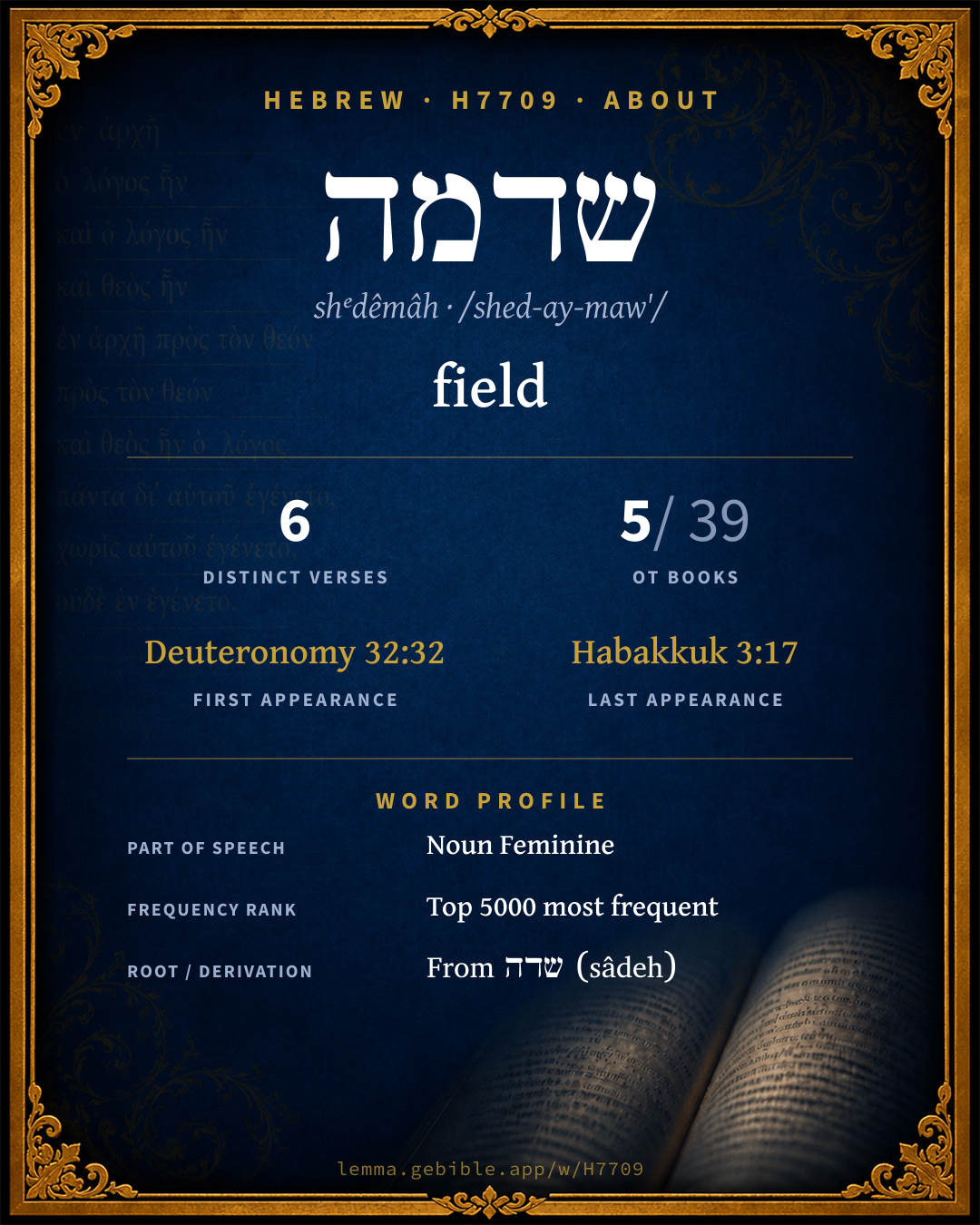
שְׁדֵמָה
field
Full lexicon entry — Brown-Driver-Briggs (BDB)
From Brown-Driver-Briggs (BDB)
Where this word appears
See every Absolute-state word in the Hebrew Bible →
Grammar key — what these labels mean
Part of speech
- Noun
- A naming word — a person, place, thing, or idea.
Noun type
- Common
- A common noun — a general class of person, place, or thing (“king,” “city,” “water”), not a specific name.
State
- Absolute
- The independent form of a noun, not bound to a following word.
- Construct
- A noun bound to a following noun in a possessive / “of” relationship (the construct chain).
Gender
- Feminine
- Grammatically feminine.
Number
- Plural
- More than one (in Hebrew, generally three or more).
- Singular
- One.
3 distinct verses where H7709 appears in the Construct state, across 3 books. Filtered view — show all forms. Click any verse to open its interlinear word-by-word view. Verse text shown in the World English Bible for context — . Each verse’s Hebrew form is shown with its reference; the English is not keyword-highlighted, since the data carries no word-level English alignment. Use “Compare translations” on any verse to read it across multiple English versions. This concordance covers the Hebrew Bible; Septuagint (Greek Old Testament) occurrences are not indexed here.
Deuteronomy 1 verse
2 Kings 1 verse
Isaiah 1 verse
About this entry
At a glance — auto-summarized from this page’s data, not written by a person. Every figure links to its source below. This summary describes the numbers; it doesn’t interpret them.
“field” is the headline sense of the Hebrew noun שדמה (shᵉdêmâh). Its earliest occurrence is Deuteronomy 32:32. It turns up in 6 verses across 5 books, an uncommon footprint. It concentrates in Isaiah, which alone accounts for 33% of its uses. It clusters with שדה, שרמה and שדיאור under a shared root. The sections below give every sense, occurrence, and version rendering.
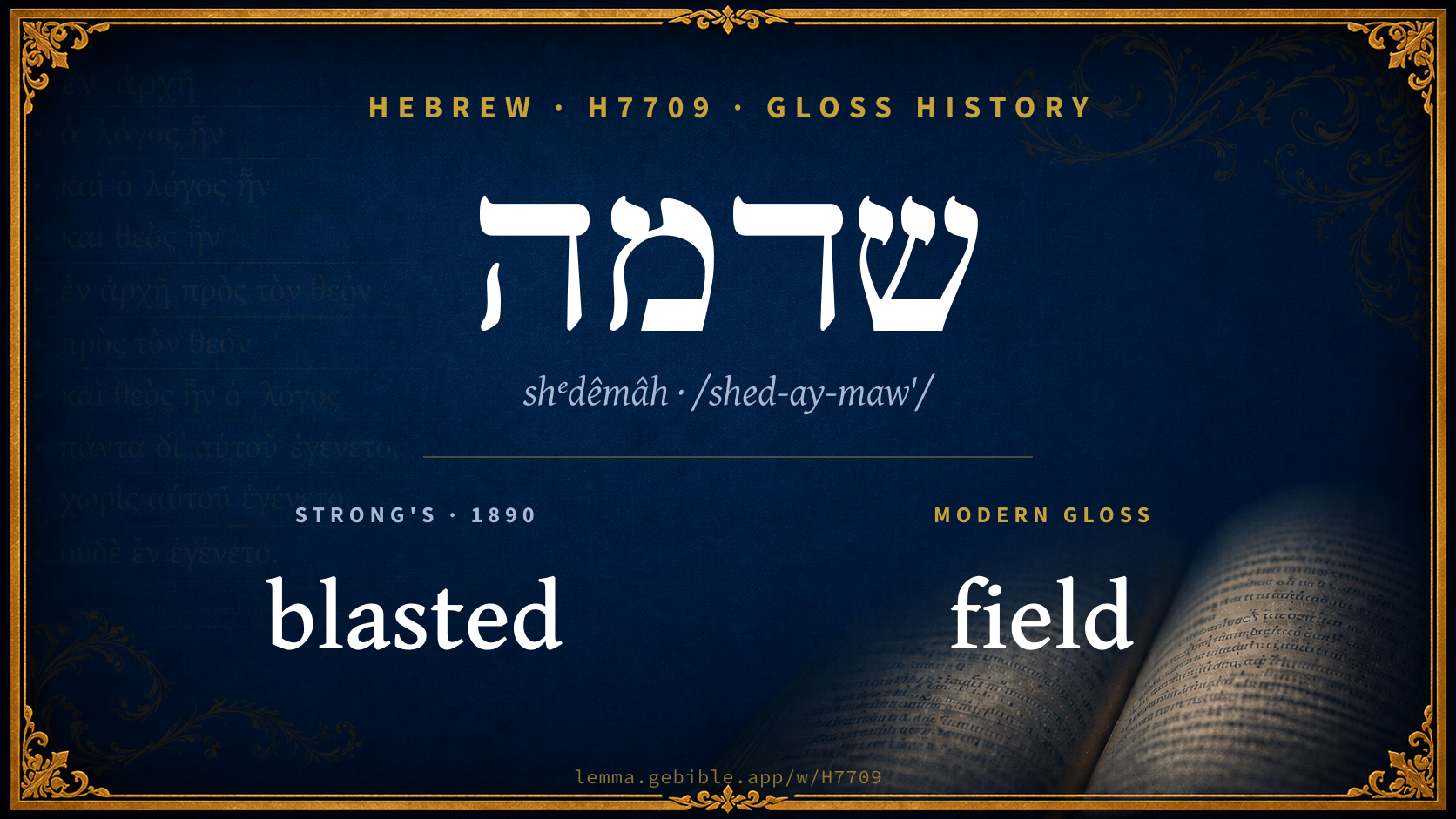
Gloss history
Strong's 1890 vs modern scholarship
About this word
Strong's H7709 catalogs a Hebrew word from the Hebrew Old Testament.
These counts are not copied from any lexicon or concordance. They are computed here, from the morphology-tagged Hebrew Old Testament. What Lemma adds →
- 6
- distinct verses
- The word appears in 6 distinct verses.
- 5 / 39
- OT books
- The word appears in 5 of 39 Old Testament books.
- #3,040
- by frequency
- Top 5000 most frequent Hebrew words (rank 3,040 of 8,640 Hebrew words by occurrence).
View all 6 occurrences in the concordance →
Most concentrated in
- Isaiah 2 verses 33%
- Deuteronomy 1 verse 17%
- 2 Kings 1 verse 17%
By section of the Old Testament
By traditional corpus
Conventional, traditional groupings — biblical authorship is debated, so this is a traditional corpus grouping, not an authorship claim. Each share is this word’s portion of its verses in that division of the Hebrew canon. Each figure is a share of the word’s 6 distinct verses.
- Prophets (Nevi'im) 5 verses · 83%
- Torah (Pentateuch) 1 verse · 17%
How translations render this word
Counts come from each version’s own published word-to-Strong’s tagging or interlinear alignment — an approximate guide to how each version renders this word, not a word-level alignment the data otherwise carries. Because each total is that version’s own tagged count, the per-version totals vary from one another and need not match the appearance or distinct-verse counts above. These counts may also differ from a printed concordance because Lemma counts each distinctly tagged rendering and does not collapse phrase taggings into a single head-word total. This is a fixed set of word-tagged versions (KJV, ASV, BSB, ULT) and does not change with the reading translation you choose elsewhere. Each version’s license is shown beside its name below (and on Sources).
- King James Version: Fields 4×
- American Standard Version: Fields 4×
- Berean Standard Bible: Fields 4×
- unfoldingWord Literal Text: Fields of 2×
King James Version Public Domain
Renders H7709 across 6 tagged occurrences — most commonly:
Plus 2 renderings that appear only once — usually multi-word phrases or single function words the recovered tagging swept in, not distinct renderings.
American Standard Version Public Domain
Renders H7709 across 6 tagged occurrences — most commonly:
Plus 2 renderings that appear only once — usually multi-word phrases or single function words the recovered tagging swept in, not distinct renderings.
Berean Standard Bible Public Domain
Renders H7709 across 5 tagged occurrences — most commonly:
Plus 1 rendering that appears only once — usually multi-word phrases or single function words the recovered tagging swept in, not distinct renderings.
unfoldingWord Literal Text CC BY-SA 4.0
Renders H7709 across 7 tagged occurrences — most commonly:
Plus 5 renderings that appear only once — usually multi-word phrases or single function words the recovered tagging swept in, not distinct renderings.
Senses in BDB
The 1 sense BDB distinguishes for this word, in lexicon order (not ranked by frequency or importance). The full entry — with sub-senses — is in the Lexicon Entry tab.
- field
Word origin
Derived from שדה (sâdeh) (H7704) — field.
Jastrow Dictionary
A second Hebrew/Aramaic lexicon for comparison, covering Aramaic and post-biblical (Talmudic, Targumic, Midrashic) usage that the biblical-Hebrew BDB does not. Matched by lemma rather than by Strong’s number, so a lemma may carry more than one Jastrow headword (shown separately below), and the entries cover usage well beyond the Bible.
דָּמָה
- pr. n. m., v. דָּמָא
דָּמָה ²
- , v. דמי
דמי
- v. דמם,
- 1. to mumble, think (cmp. דבב); to be silent. Denom. (דִּימָה,) דָּמוּת.
- 2. to imagine, compare. Denom. דְּמוּת.
- 3. (denom. of דְּמוּת) to resemble, be like, to imitate. Sabb. 133ᵇ הוי דוֹמֶה לו imitate Him. Ber. 29ᵇ שתפלתו דוֹמָה עליו וכ׳ to whom his prayer appears like a burden. Taan. 22ᵇ אין דורו דומה יפה (v. Rabb. D. S. a. l. note 20) his generation was not considered worthy. B. Kam. 92ᵇ; Yalk. Jud. 67 ובן אדם לדו׳ לו (not ובני) and man associates with his equal. Sifra Sh’mini Par. 10, ch. XII; Ḥull. 76ᵇ הַדֹּומֶה that which resembles the animal specified in the Bible (species); הד׳ לַדֹּומֶה what resembles the animal classified with the animal specified in the Bible (genus); a. fr.—אֵינוֹ דוֹמֶה there is no resemblance, you cannot compare. Yeb. 64ᵃ א׳ ד׳ תפלת … לתפלת וכ׳ you cannot compare the prayer of … to the prayer of &c. Sabb. 119ᵇ; a. fr.—Ḥull. 48ᵇ זו דוֹמָה לזו these are analogous cases, v. Pi.—(משל) למה הדבר דומה (abbrev. מלה"ד, לה"ד) (a simile:) to what can this be compared?, a phrase introducing a simile. Taan. 25ᵇ. Yoma 86ᵇ; a. v. fr.
- [
- 1. (b. h.) to be silenced, undone].].
- 2. to be compared, to be imagined; to appear in the disguise of; to seem. Kidd. 32ᵇ כמה"ש נִדְמוּ לו that they appeared to him as ministering angels; נדמו לו לערביים they appeared to him as if they were Arabs. Succ. 52ᵃ צדיקים נ׳ להם כהר וכ׳ to the righteous sin will appear like a high mount; a. fr.—נִדְמֶה an animal suspected to be a hybrid or looking like one (cmp. דְּמַאי), esp. a lamb looking like a kid, and vice versa. Bekh. 12ᵃ ‘a ewe which gave birth to what looked like a kid’. Ḥull. 38ᵇ; a. fr.
- 1. to compare, judge from analogy. Lev. R. s. 32 דִּמִּיתִיךָ להם I made thee like them (beasts). B. Bath. 130ᵇ ובלבד שלא יְדַמֶּה וכ׳ but one must not decide ritual cases by analogy; v. Ḥull. 48ᵇ
- 2. to have an opinion without authority to refer to. Gitt. 19ᵃ; 37ᵃ מפני שאנו מְדַמִּין because we have such an opinion.—Part. pass. מְדוּמֶּה, pl. מְדוּמִּין; כמ׳ אני it seems to me, כמ׳ אנו it seems to us &c. Men. 18ᵃ. Taan. 23ᵃ; a. fr.—Y. Ber. II, 5ᵇ bot. כמ׳ הייתי I thought.
A Dictionary of the Targumim, the Talmud Babli and Yerushalmi, and the Midrashic Literature (Marcus Jastrow; London, Luzac, 1903) — Public Domain. Digitized via Sefaria. Digitized via Sefaria. Full attribution on Sources.
Forms in the corpus
The 6 distinct written forms H7709 takes in the Hebrew Bible, most frequent first — each parse links to that state’s occurrences in the concordance. Hebrew forms include their vowel points and cantillation, so a single lemma takes many written forms.
| Form | Parsing | Example | Uses |
|---|---|---|---|
| בְּ/שַׁדְמ֣וֹת | Noun, Common, Feminine, Plural, Construct | 2 Kings 23:4 | 1 |
| הַ/שְּׁדֵמוֹת֩ | Noun, Common, Feminine, Plural, Absolute | Jeremiah 31:40 | 1 |
| וּ/מִ/שַּׁדְמֹ֖ת | Noun, Common, Feminine, Plural, Construct | Deuteronomy 32:32 | 1 |
| וּ/שְׁדֵמ֖וֹת | Noun, Common, Feminine, Plural, Absolute | Habakkuk 3:17 | 1 |
| וּ/שְׁדֵמָ֖ה | Noun, Common, Feminine, Singular, Absolute | Isaiah 37:27 | 1 |
| שַׁדְמוֹת֩ | Noun, Common, Feminine, Plural, Construct | Isaiah 16:8 | 1 |
Same root — word family
Other BDB entries built from the same root as H7709, grouped by Strong’s listed origin. These share a root / origin per the lexicon — not necessarily a shared meaning. Each links to that word’s own entry.
Derives from
Derived from this word
Proper names from this root
People and places named from this root — a name, not an additional meaning of the word.
Compare all same-root words → Showing 4 of 5 — not the complete family. 2 of the same-root words are proper names (people or places). They share a root, not necessarily a meaning.
Septuagint verse parallels
This word appears in 6 verses that also exist in the Greek Old Testament (Septuagint), out of the 6 Hebrew verses it occurs in. You can read those verses in Greek by switching the Old Testament edition to the Septuagint.
Read these verses in the Septuagint
This is a verse-level parallel only — the same verses exist in both the Hebrew and Greek Old Testaments. No word-level Hebrew↔Greek correspondence is claimed: the data carries no such alignment, so no Greek word is shown as this Hebrew word’s translation. Coverage is not total — the Septuagint omits the deuterocanon and renumbers the Psalms, so some Hebrew verses have no direct Greek parallel.