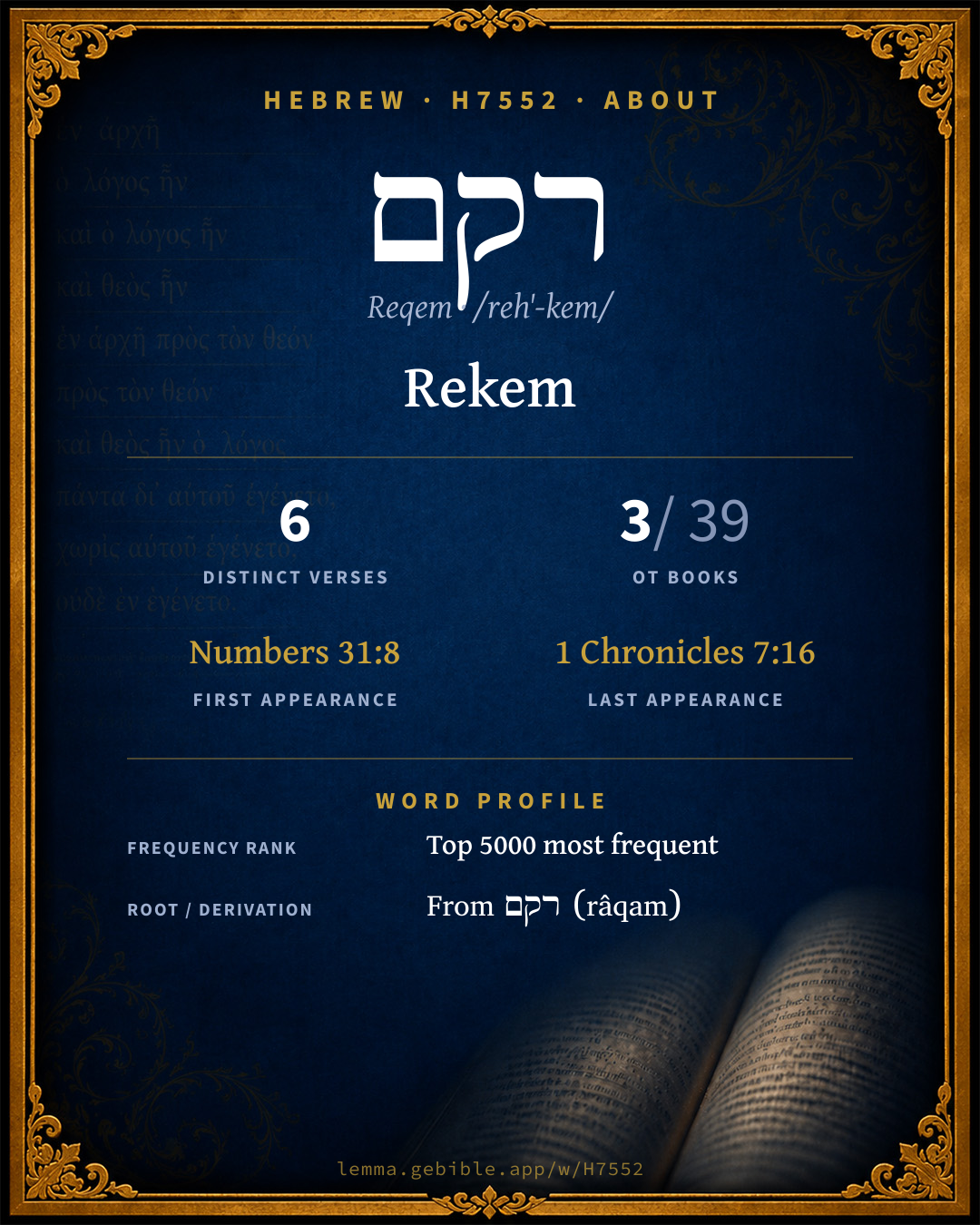
רֶ֫קֶם
Rekem
BDB lists 5 entries for ‘Rekem’ fuller range ↓
Full lexicon entry — Brown-Driver-Briggs (BDB)
From Brown-Driver-Briggs (BDB)
Where this word appears
Grammar key — what these labels mean
Part of speech
- Noun
- A naming word — a person, place, thing, or idea.
Noun type
- Proper
- A name of a specific person, place, or people (e.g. Abraham, Zion, Israel).
Every verse where H7552 appears in the Book of Numbers — 1 distinct verse. Click any verse to open its interlinear word-by-word view. Verse text shown in the World English Bible for context — . Each verse’s Hebrew form is shown with its reference; the English is not keyword-highlighted, since the data carries no word-level English alignment. Use “Compare translations” on any verse to read it across multiple English versions. This concordance covers the Hebrew Bible; Septuagint (Greek Old Testament) occurrences are not indexed here.
Numbers
About this entry
At a glance — auto-summarized from this page’s data, not written by a person. Every figure links to its source below. This summary describes the numbers; it doesn’t interpret them.
At its core, רקם (Reqem) means “Rekem.” The word gravitates to 1 Chronicles (50%), then Joshua and Numbers. It appears 6 verses across 3 books of the Hebrew Bible, among its uncommon vocabulary. First canonically at Numbers 31:8, it enters the text early. Each statement above links to its evidence; the full detail follows below.
Gloss history
Strong's 1890 vs modern scholarship
About this word
Strong's H7552 catalogs a Hebrew word from the Hebrew Old Testament.
These counts are not copied from any lexicon or concordance. They are computed here, from the morphology-tagged Hebrew Old Testament. What Lemma adds →
- 6
- distinct verses
- The word appears in 6 distinct verses.
- 3 / 39
- OT books
- The word appears in 3 of 39 Old Testament books.
- #3,040
- by frequency
- Top 5000 most frequent Hebrew words (rank 3,040 of 8,640 Hebrew words by occurrence).
View all 6 occurrences in the concordance →
Most concentrated in
- 1 Chronicles 3 verses 50%
- Joshua 2 verses 33%
- Numbers 1 verse 17%
By section of the Old Testament
By traditional corpus
Conventional, traditional groupings — biblical authorship is debated, so this is a traditional corpus grouping, not an authorship claim. Each share is this word’s portion of its verses in that division of the Hebrew canon. Each figure is a share of the word’s 6 distinct verses.
- Writings (Ketuvim) 3 verses · 50%
- Prophets (Nevi'im) 2 verses · 33%
- Torah (Pentateuch) 1 verse · 17%
How translations render this word
Counts come from each version’s own published word-to-Strong’s tagging or interlinear alignment — an approximate guide to how each version renders this word, not a word-level alignment the data otherwise carries. Because each total is that version’s own tagged count, the per-version totals vary from one another and need not match the appearance or distinct-verse counts above. These counts may also differ from a printed concordance because Lemma counts each distinctly tagged rendering and does not collapse phrase taggings into a single head-word total. This is a fixed set of word-tagged versions (KJV, ASV, BSB, ULT) and does not change with the reading translation you choose elsewhere. Each version’s license is shown beside its name below (and on Sources).
- King James Version: Rekem 5×
- American Standard Version: Rekem 5×
- Berean Standard Bible: Rekem 6×
- unfoldingWord Literal Text: Rekem 5×
King James Version Public Domain
Renders H7552 across 6 tagged occurrences — most commonly:
Plus 1 rendering that appears only once — usually multi-word phrases or single function words the recovered tagging swept in, not distinct renderings.
American Standard Version Public Domain
Renders H7552 across 6 tagged occurrences — most commonly:
Plus 1 rendering that appears only once — usually multi-word phrases or single function words the recovered tagging swept in, not distinct renderings.
Berean Standard Bible Public Domain
Renders H7552 across 6 tagged occurrences — most commonly:
unfoldingWord Literal Text CC BY-SA 4.0
Renders H7552 across 6 tagged occurrences — most commonly:
Plus 1 rendering that appears only once — usually multi-word phrases or single function words the recovered tagging swept in, not distinct renderings.
Senses in the full BDB
What do BDB’s symbols mean?
BDB uses these scholarly abbreviations:
| Symbol | Meaning |
|---|---|
| 𝔊 | the Septuagint (the ancient Greek translation, LXX) |
| 𝔙 | the Vulgate (the Latin translation) |
| 𝔖 | the Syriac version (the Peshitta) |
| 𝔗 | the Targum (the Aramaic translation) |
| ψ | the Psalms |
| √ | root (the underlying root or stem) |
| ‖ | parallel passage (a synonymous or contrasted parallel) |
| † | the dagger: every passage where the word occurs is cited |
The 5 senses and sub-senses the full Brown-Driver-Briggs lexicon distinguishes for this word, in lexicon order (not ranked by frequency), with BDB’s own verbatim wording and sub-sense lettering. Shown in Hebrew script with BDB’s own scholarly abbreviations. The condensed entry is in the Lexicon Entry tab. See also the Forms in the corpus table below.
- 1. m.
- a. a king of Midian Nu 31:8 (Ροκομ), Jos 13:21 (Ροβοκ, A Ροκομ, 𝔊 Οροκομ). e.g. Numbers 31:8
- b. a ‘son’ of Hebron 1 Ch 2:43, 44, Ρεκομ, Ροκομ, Ρωκημ. e.g. 1 Chronicles 2:43
- c. name in Gilead 1 Ch 7:16, 𝔊L Ρακαμ. e.g. 1 Chronicles 7:16
- 2. loc. in Benj., Jos 18:27, Νακαν, A 𝔊L Ρεκεμ[ν]. e.g. Joshua 18:27
Senses from the full Brown-Driver-Briggs lexicon (Brown, Driver, Briggs; Oxford 1906 — public domain), digitized via Sefaria, supplemented by the OpenScriptures HebrewLexicon (CC BY 4.0). Full attribution on Sources.
Word origin
Derived from רקם (râqam) (H7551) — to variegate.
Jastrow Dictionary
A second Hebrew/Aramaic lexicon for comparison, covering Aramaic and post-biblical (Talmudic, Targumic, Midrashic) usage that the biblical-Hebrew BDB does not. Matched by lemma rather than by Strong’s number, so a lemma may carry more than one Jastrow headword (shown separately below), and the entries cover usage well beyond the Bible.
רָקַם
- (b. h.) to variegate, embroider. Yoma 72ᵇ רוֹקְמִין, v. חָשַׁב. Ib. רוֹקֵם מעשה וכ׳ the embroiderer’s is needle work, therefore it has only one face; a. e.
- same, trnsf. (v. Ps. CXXXIX, 15) to form the limbs of an embryo, shape. Lev. R. s. 29, beg.; Pesik. R. s. 46 שלישית ביום צבר … רִיקְּמוֹ at three hours of the day he gathered his (Adam’s) dust, at four he kneaded him, at five he shaped him; Midr. Till. to Ps. XCII חמשית … ששית רקמו at five he made him a shapeless body, at six he articulated him. Y. Bets. I, 60ᵃ בצים שרִיקֵּימוּ גוזלים שלא העלו עליהן וכ׳ (not העליהן) eggs which developed chicks without a formation of wings. Ḥull. 64ᵃ אם רִיקְּמָה וניקבה if the egg had developed a distinct embryo, and was perforated; a. e.—Part. pass. מְרוּקָּם; f. מְרוּקֶּמֶת. Esth. R. to III, 1 עשה לו צלם מר׳ וכ׳ he (Haman) made himself an image embroidered on his garment over his breast. Nidd. III, 3 (24ᵇ) ואם היה מר׳ and if the fœtus was articulated. Y. ib. 50ᵈ top, v. רָשׁוֹן. Tosef. ib. IV, 12. Ḥull. IX, 6 (126ᵇ) ביצת השרץ המר׳ the egg of a creeping thing (serpent &c.) in a developed state; a. e. e.g. Psalms 139:15
רֶקֶם I
- (preced.) embroidery.—Pl. רְקָמִים, constr. רִקְמֵי, רִי׳. Ab. Zar. 24ᵇ (in an apostrophe to the Ark of the Covenant) המחושקת בר׳ זהב who art lovely in gold-embroidered garments (gold-plated); Gen. R. s. 54; Yalk. Sam. 103; Midr. Sam. ch. XII כרומי (corr. acc.).
רֶקֶם II
- (b. h.) pr. n. pl. Rekem, in Benjamin. Targ. Josh. XVIII, 27.
רְקָם I
- ) pr. n. pl. R’ḳam (or Reḳem);
- 1. also ר׳ דחגרא Sela (Petra) in Edom (v. Hildesh. Beitr. p. 52 sq.) Targ. Gen. XIV, 7 (Y. ed. Vien. רֵיקָם; h. text קדש). Ib. XX, 1; a. e.—Gitt. I, 1 המביא מן הר׳ ומן החגר if a messenger brings a letter of divorce from the district of R. or of Ḥagar. Nidd. VIII, 3; a. e.—Sifré Deut. 51 ר׳ תחגרא (read: דחגרא); Yalk. ib. 874 רגם דח׳; Tosef. Shebi. IV, 11 ed. Zuck. (Var. ורכה דדוגרא, corr. acc.).
- 2. רְקַם גֵּיאָה R’ḳam Geah = Kadesh Barnea. Targ. Num. XXXIV, 4. Targ. Josh. XV, 3; a. e.—Sifré l. c.; Yalk. l. c. (not גאוה); Tosef. l. c. (Var. נאה, corr. acc.); Y. Shebi. V, 36ᶜ ר׳ דגועה.
רְקָם II
- = h. רֶקֶם I, embroidered garment. Targ. Ez. XXVII, 16 (h. text רקמה).
A Dictionary of the Targumim, the Talmud Babli and Yerushalmi, and the Midrashic Literature (Marcus Jastrow; London, Luzac, 1903) — Public Domain. Digitized via Sefaria. Digitized via Sefaria. Full attribution on Sources.
Forms in the corpus
The 4 distinct written forms H7552 takes in the Hebrew Bible, most frequent first — each parse links to that state’s occurrences in the concordance. Hebrew forms include their vowel points and cantillation, so a single lemma takes many written forms.
| Form | Parsing | Example | Uses |
|---|---|---|---|
| וְ/רֶ֥קֶם | Noun, Proper | 1 Chronicles 2:43 | 2 |
| רֶ֨קֶם֙ | Noun, Proper | Joshua 13:21 | 2 |
| וְ/רֶ֖קֶם | Noun, Proper | 1 Chronicles 2:44 | 1 |
| וָ/רָֽקֶם | Noun, Proper | 1 Chronicles 7:16 | 1 |
Same root — word family
Other BDB entries built from the same root as H7552, grouped by Strong’s listed origin. These share a root / origin per the lexicon — not necessarily a shared meaning. Each links to that word’s own entry.
Derives from
Shares the same root
Compare all same-root words → They share a root, not necessarily a meaning.
Bible dictionary
Public-domain dictionary articles matched to this entry by name (Rekem). A biblical name can be shared by more than one person or place, so an article may treat several.
Easton's Bible Dictionary · M. G. Easton, 1897
Embroidered; variegated. (1.) One of the five Midianite kings whom the Israelites destroyed (Num. 31:8).
(2.) One of the sons of Hebron (1 Chr. 2:43, 44).
(3.) A town of Benjamin (Josh. 18:27).
Smith's Bible Dictionary · William Smith, 1863
one of the towns of the allotment of Benjamin. (Joshua 18:27) Its existing site is unknown.
(variegation).
+ One of the five kings or chieftains of Midian slain by the Israelites. (Numbers 31:8; Joshua 13:21) + One of the four sons of Hebron, and father of Shammai. (1 Chronicles 2:43,44)
Hitchcock's Bible Names Dictionary · Roswell D. Hitchcock, 1869
vain pictures; divers picture
Classic public-domain reference works; full attribution on Sources.
Septuagint verse parallels
This word appears in 6 verses that also exist in the Greek Old Testament (Septuagint), out of the 6 Hebrew verses it occurs in. You can read those verses in Greek by switching the Old Testament edition to the Septuagint.
Read these verses in the Septuagint
This is a verse-level parallel only — the same verses exist in both the Hebrew and Greek Old Testaments. No word-level Hebrew↔Greek correspondence is claimed: the data carries no such alignment, so no Greek word is shown as this Hebrew word’s translation. Coverage is not total — the Septuagint omits the deuterocanon and renumbers the Psalms, so some Hebrew verses have no direct Greek parallel.