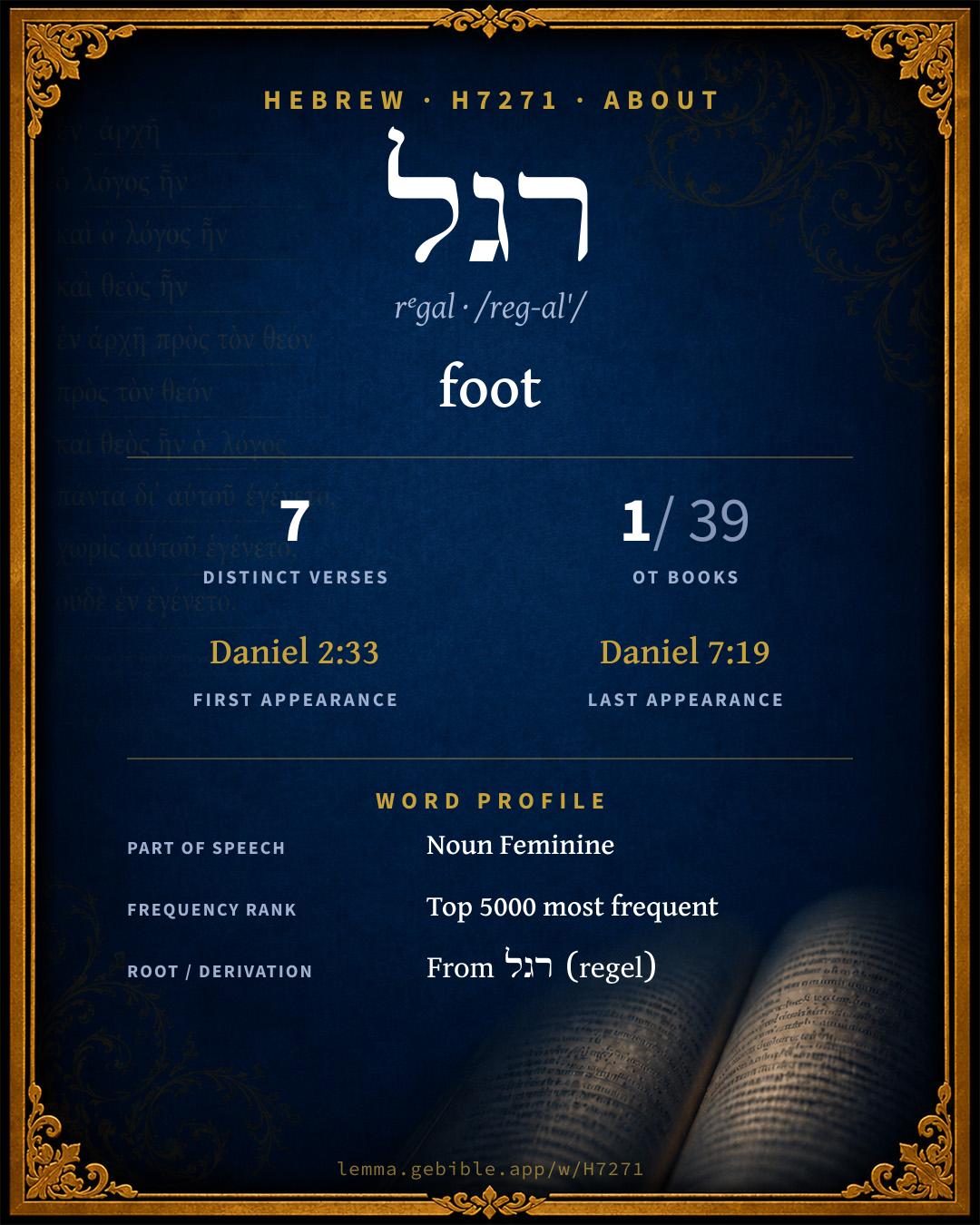
רְגַל
foot
Full lexicon entry — Brown-Driver-Briggs (BDB)
From Brown-Driver-Briggs (BDB)
Where this word appears
See every Construct-state word in the Hebrew Bible →
Grammar key — what these labels mean
Part of speech
- Noun
- A naming word — a person, place, thing, or idea.
Noun type
- Common
- A common noun — a general class of person, place, or thing (“king,” “city,” “water”), not a specific name.
State
- Construct
- A noun bound to a following noun in a possessive / “of” relationship (the construct chain).
- Absolute
- The independent form of a noun, not bound to a following word.
Gender
- Feminine
- Grammatically feminine.
Number
- Plural
- More than one (in Hebrew, generally three or more).
- Dual
- Exactly two — for natural pairs and some measures of time.
- Singular
- One.
Grammatical forms
- Noun, Common, Feminine, Plural, Construct 3 times (38%)
- Particle, Definite Article 3 times (38%)
- Noun, Common, Feminine, Dual, Absolute 1 time (13%)
- Noun, Common, Feminine, Singular, Construct 1 time (13%)
Parsed forms decoded from the imported morphology (morphhb / Westminster Leningrad Codex — WLC text public domain, morphhb tagging CC BY 4.0), counted across 8 parsed occurrences — not distinct verses.
Every verse where H7271 appears — 7 distinct verses across 1 book. Click any verse to open its interlinear word-by-word view. Verse text shown in the World English Bible for context — . Each verse’s Hebrew form is shown with its reference; the English is not keyword-highlighted, since the data carries no word-level English alignment. Use “Compare translations” on any verse to read it across multiple English versions. This concordance covers the Hebrew Bible; Septuagint (Greek Old Testament) occurrences are not indexed here.
Daniel 7 verses
- Daniel 2:33 רַגְל֕וֹ/הִי n c fp cs + sfx pers 3ms its legs of iron, its feet part of iron, and part of clay.
- Daniel 2:34 רַגְל֔וֹ/הִי n c fp cs + sfx pers 3ms You saw until a stone was cut out without hands, which struck the image on its feet that were of iron and clay, and broke them in pieces.
- Daniel 2:41 רַגְלַיָּ֣/א n c fp det + ptcl def.art Whereas you saw the feet and toes, part of potters' clay, and part of iron, it shall be a divided kingdom; but there shall be in it of the strength of the iron, because you saw the iron mixed with miry clay.
- Daniel 2:42 רַגְלַיָּ֔/א n c fp det + ptcl def.art As the toes of the feet were part of iron, and part of clay, so the kingdom shall be partly strong, and partly broken.
- Daniel 7:4 רַגְלַ֨יִן֙ n c fd The first was like a lion, and had eagle's wings: I saw until the wings of it were plucked, and it was lifted up from the earth, and made to stand on two feet as a man; and a man's heart was given to it.
- Daniel 7:7 ב/רגלי/ה בְּ/רַגְלַ֣/הּ prep + n c fp det + ptcl def.art prep + n c fs cs + sfx pers 3fs After this I saw in the night-visions, and, behold, a fourth animal, awesome and powerful, and strong exceedingly; and it had great iron teeth; it devoured and broke in pieces, and stamped the residue with its feet: and it was diverse from all the animals that were before it; and it had ten horns.
- Daniel 7:19 בְּ/רַגְלַ֥י/הּ prep + n c fp cs + sfx pers 3fs Then I desired to know the truth concerning the fourth animal, which was diverse from all of them, exceedingly terrible, whose teeth were of iron, and its nails of brass; which devoured, broke in pieces, and stamped the residue with its feet;
About this entry
At a glance — auto-summarized from this page’s data, not written by a person. Every figure links to its source below. This summary describes the numbers; it doesn’t interpret them.
רגל — transliterated rᵉgal — is a Hebrew noun carrying the sense “foot.” More than three-quarters of its appearances fall in Daniel. The Hebrew Bible uses it across 7 verses — uncommon. Debuting at Daniel 2:33, it then recurs through the corpus. It shares a root with רגל, מרגלה and רגלי. Each statement above links to its evidence; the full detail follows below.
Gloss history
Strong's 1890 vs modern scholarship
About this word
Strong's H7271 catalogs a Hebrew word from the Hebrew Old Testament.
These counts are not copied from any lexicon or concordance. They are computed here, from the morphology-tagged Hebrew Old Testament. What Lemma adds →
- 7
- distinct verses
- The word appears in 7 distinct verses.
- 1 / 39
- OT books
- The word appears in 1 of 39 Old Testament books.
- #2,625
- by frequency
- Top 5000 most frequent Hebrew words (rank 2,625 of 8,640 Hebrew words by occurrence).
View all 7 occurrences in the concordance →
Most concentrated in
- Daniel 7 verses 100%
By section of the Old Testament
By traditional corpus
Conventional, traditional groupings — biblical authorship is debated, so this is a traditional corpus grouping, not an authorship claim. Each share is this word’s portion of its verses in that division of the Hebrew canon. Each figure is a share of the word’s 7 distinct verses.
- Writings (Ketuvim) 7 verses · 100%
How translations render this word
Counts come from each version’s own published word-to-Strong’s tagging or interlinear alignment — an approximate guide to how each version renders this word, not a word-level alignment the data otherwise carries. Because each total is that version’s own tagged count, the per-version totals vary from one another and need not match the appearance or distinct-verse counts above. These counts may also differ from a printed concordance because Lemma counts each distinctly tagged rendering and does not collapse phrase taggings into a single head-word total. This is a fixed set of word-tagged versions (KJV, ASV, BSB, ULT) and does not change with the reading translation you choose elsewhere. Each version’s license is shown beside its name below (and on Sources).
- King James Version: Feet 7×
- American Standard Version: Feet 6×
- Berean Standard Bible: Feet 4×, Underfoot 2×
- unfoldingWord Literal Text: Feet 6×
King James Version Public Domain
Renders H7271 across 7 tagged occurrences — most commonly:
American Standard Version Public Domain
Renders H7271 across 7 tagged occurrences — most commonly:
Plus 1 rendering that appears only once — usually multi-word phrases or single function words the recovered tagging swept in, not distinct renderings.
Berean Standard Bible Public Domain
Renders H7271 across 7 tagged occurrences — most commonly:
Plus 1 rendering that appears only once — usually multi-word phrases or single function words the recovered tagging swept in, not distinct renderings.
unfoldingWord Literal Text CC BY-SA 4.0
Renders H7271 across 7 tagged occurrences — most commonly:
Plus 1 rendering that appears only once — usually multi-word phrases or single function words the recovered tagging swept in, not distinct renderings.
Senses in BDB
The 1 sense BDB distinguishes for this word, in lexicon order (not ranked by frequency or importance). The full entry — with sub-senses — is in the Lexicon Entry tab.
- foot
Word origin
Derived from רגל (regel) (H7272) — foot.
Jastrow Dictionary
A second Hebrew/Aramaic lexicon for comparison, covering Aramaic and post-biblical (Talmudic, Targumic, Midrashic) usage that the biblical-Hebrew BDB does not. Matched by lemma rather than by Strong’s number, so a lemma may carry more than one Jastrow headword (shown separately below), and the entries cover usage well beyond the Bible.
רָגַל
- (b. h.) to move on, run.—[Part. pass., v. רָגוּל.]
- (v. רָגִיל) to be wont to. Nidd. 16ᵇ שרֹ הנִרְגָּל וכ׳ a magistrate (a scholar) who is an habitual visitor of drinking houses; v. רָגַז a. רָגַן.
- 1. (denom. of (denom. of רֶגֶל) to flay an animal from its feet upward (in order to use the skin as a bag, v. חֵמֶת). Ḥull. IX, 3 המַרְגִּיל וכ׳ if one flays from the feet upward, the entire skin is considered as connected (with the flesh, as long as the process lasts) for purposes of levitical cleanness. Tosef. Bets. II, 11 אין מַרְגִּילִין וכ׳ we must not flay from the feet on a Holy Day, nor on a week day when the animal is a firstborn &c.; Bekh. 33ᵃ; Tem. 24ᵃ
- 2. to make familiar, to accustom. Sabb. 13ᵃ שמא יַרְגִּילֶנּוּ אצלו lest he make him accustomed to associate with him. Ib. וכי מַרְגִּילוֹ וכ׳ and if he does accustom him, what of it? Ab. III, 13 שחוק … מַרְגִּילִין וכ׳, v. קַלּוּת; a. e.
- 3. to lead; to persuade. Ber. 60ᵇ ותַרְגִּילֵנִי לידי מצוה ואל תרגילני וכ׳ and lead me into the power (to the opportunity) of good deeds, and lead me not into the power of sin. Ib. שתרגילני בתורתך that thou mayest lead me by thy Law.—Yeb. 85ᵇ זהו מַרְגִּילוֹ וזוהי מַרְגִּילָתוֹ in the one case he leads (persuades) her to marry him, in the other case she persuades him; a. fr.
- 4. to bring about; cause. Ber. 22ᵃ, sq. המרגיל (sub. קרי) who causes an effusion of semen, opp. לאונסו.
- to accustom one’s self, get used to. Y. Sabb. I, 3ᶜ top שהוא מִתְרַגֵּל עמו וכ׳ when he gets used to associate with him when he is unclean himself, he is likely to associate with him when he is clean. Y. Ned. XI, end, 42ᵈ יעשו סעודה והן מִתְרַגְּלִין לַבָּא וכ׳ (some ed. לבוא) let a banquet be arranged, and they (the disaffected couple) will get used in future to associate with each other through the influence of the banquet.
רְגַל
- , to move, run. Part. רָגֵיל. Bekh. 11ᵃ, v. רִגְיָא.—Part. pass. רָגִיל used, q. v.—Sabb. 119ᵃ דר׳ דזבן who is wont to buy (fish for the Sabbath). Ib. bot. אי רְגִילִיתוּ וכ׳ if you are accustomed to &c., v. קְרַם; a. e.
- to cause to run. Y. Ab. Zar. V, 45ᵃ אהו דמְרַגֵּל זיקא וכ׳ he that makes the jet of wine run from above downward.
- to lead; to accustom. Yeb. 85ᵇ היא מַרְגְּלָא ליה she leads (persuades) him, v. preced.—Part. pass. מַרְגַּל; f. מַרְגְּלָא, v. מַרְגְּלָא I.
- to accustome one’s self, make it a habit. Ned. 66ᵇ כי היכי דלא לִתְרַגְּלֵי למנדר (Rashi לִירַגְּלֵי) that they may not make it a habit to vow.
רֶגֶל
- preced.)
- 1. foot; leg; (of quadrupeds) hindleg. Sabb. 31ᵃ כשאני עומד על ר׳ אחת within the time that I can stand on one leg. Ḥull. II, 6, v. פִּרְכֵּס II; a. v. fr.—Esp. (sub. נזק) the damage done by an animal’s foot, treading, stamping. B. Kam. 2ᵇ, v. שֵׁן. Ib. 3ᵃ; a. fr.—תורת (ה)ר׳ the law for the protection of travellers, permission to trade. Tanḥ. B’shall. 12 (the Sodomites said) בואו ונשכח ת׳ הר׳ וכ׳ come, let us make the law of free trade forgotten in our land; Snh. 109ᵃ; a. e.—לר׳ (v. next w.) in the wake of, for the sake of (cmp. שְׁבִיל). Gen. R. s. 97 (ref. to רגלי, Num. XI, 21) כולן לרַגְלִי עלו they all came up (from Egypt) for my sake. Yalk. Sam. 143 יצחק … לרַגְלוֹ Isaac went down to Gerar, and blessing came down for his sake, a. e.—Du. רַגְלַיִם; pl. רְגָלִים. Nidd. 31ᵃ, v. הִילּוּךְ. Ber. 10ᵇ המתפלל … את רַגְלָיו he that says the prayers (תְּפִלָּה) must direct his feet (stand straight). Ḥull. III, 7, v. קַרְסוּל. Ib. IV, 6 בהמה … רַגְלֶיהָ an animal that had its hindlegs cut off. Ber. 32ᵃ כסא של שלש ר׳ a chair with three legs (the merits of the three patriarchs); a. v. fr.—מאין הר׳, v. אַיִן II.—מי ר׳, v. מַיִם.—ר׳ לדבר (the thing has feet to stand on,) there is a basis, a reason for it. Naz. IX, 3 שר׳ לד׳ for there is a reason (to assume that the field once was a burial ground). Ib. 4; a. fr. e.g. Numbers 11:21
- 2. [pilgrimage,] one of the three festivals (Ex. XXIII, 14). M. Kat. III, 5 שלשה … קודם לר׳ three days before a festival. Ib. 19ᵃ, sq. ערב הר׳ the eve of a festival. Ib. 20ᵃ כל שהוא משום אבל הר׳ מפסיקו וכ׳ an intervening festival interrupts whatever concerns the mourning itself (and the mourning observances must be continued after the festival). Num. R. s. 19 ועשו את הר׳ וכ׳ they observed the festival in Tishri, and after the festive season they took up the war against Sihon. Yoma 21ᵃ בשעה … עולין לר׳ when the Israelites went to the Temple for the festive visit. R. Hash. 4ᵇ, a. fr. שמיני ר׳ בפני וכ׳ the eighth day of Succoth is an independent festival; a. v. fr.—ר׳ רדופין, v. רָדַף.—Pl. as ab. R. Hash. I, 1 the first of Nisan is ראש השנה … ולר׳ is the beginning of the year for the date of the years of kings and for the order of the festivals (making Passover the first). Pes. 8ᵇ, a. fr. עולי ר׳ pilgrims to the Temple, v. supra. Erub. 40ᵇ, a. fr. שלשה ר׳ the three festivals. Ib. לא איקרו ר׳ they (New Year and Day of Atonement) are not called r’galim (pilgrims’ festivals); a. fr. e.g. Exodus 23:14
רֶגֶל ²
- 1. foot, leg; pace. Targ. Lev. XXI, 19. Targ. Gen. XXXIII, 14 (O. ed. Berl. לרֵיגַל); a. fr.—Y. Maas. Sh. IV, end, 55ᶜ רִגְלִי, v. קַטִּין II, a. סַרְבֵּל. Y. Shebi. IX, 39ᵃ top ר׳ צלילא, v. צְלַל; a. fr.—Trnsf. good or bad luck coming in the wake of. Targ. Y. Gen. XXX, 30.—Y. Ber. II, 5ᵃ ברִגְלֵיה חריב וברגליה וכ׳ in his luck (when he was born) the Temple was destroyed, and in his luck it will be rebuilt; Lam. R. to I, 16 על רִיגְלוֹי (pl.). Y. Ab. Zar. III, 42ᵈ top ריגליה דיעקב, v. נֵרְגַל.—Pl. רִגְלַיָּא, רִגְלִין, רִגְלָן, רִי׳, רַגְ׳. Targ. Lev. XI, 42. Targ. Ps. XXVI, 12 Ms. (ed. sing.). Targ. Esth. V, 1 מוי דר׳ = מי רגלים, v. מַיִם. Targ. Y. Lev. IX, 14; ib. VIII, 21 ריגלאה (corr. acc.); a. fr.—Y. Kil. IX, 32ᶜ bot. רִיגְלוֹי דבר וכ׳; Succ. 53ᵃ רִגְלוֹהִי וכ׳, v. עֲרַב I; a. fr.
- 2. festival, festive season, esp. the season of the Babylonian academies in Adar and Elul. Bekh. 60ᵃ תירגמה … בר׳ R. H. bar S. interpreted it before Raba at the college session (on the Sabbath preceding a festival, Rashi). Snh. 7ᵇ בשבתא דר׳ on the first Sabbath of the season; a. fr.
- 3. (from its shape) a forked carrying pole which can be fixed in the ground when the carrier is resting. Bets. 30ᵃ, a. e., v. דִּגְלָא.—[Targ. Prov. XIV, 5; XXIV, 28 (ed. Wil. רַגָלָא); XIX, 28 (ed. Wil. רגלאה); Ab. Zar. 22ᵇ, v. דַּגָּלָא.]
A Dictionary of the Targumim, the Talmud Babli and Yerushalmi, and the Midrashic Literature (Marcus Jastrow; London, Luzac, 1903) — Public Domain. Digitized via Sefaria. Digitized via Sefaria. Full attribution on Sources.
Forms in the corpus
The 8 distinct written forms H7271 takes in the Hebrew Bible, most frequent first — each parse links to that state’s occurrences in the concordance. Hebrew forms include their vowel points and cantillation, so a single lemma takes many written forms.
| Form | Parsing | Example | Uses |
|---|---|---|---|
| ב/רגלי/ה | Particle, Definite Article | Daniel 7:7 | 1 |
| בְּ/רַגְלַ֣/הּ | Noun, Common, Feminine, Singular, Construct | Daniel 7:7 | 1 |
| בְּ/רַגְלַ֥י/הּ | Noun, Common, Feminine, Plural, Construct | Daniel 7:19 | 1 |
| רַגְל֔וֹ/הִי | Noun, Common, Feminine, Plural, Construct | Daniel 2:34 | 1 |
| רַגְל֕וֹ/הִי | Noun, Common, Feminine, Plural, Construct | Daniel 2:33 | 1 |
| רַגְלַ֨יִן֙ | Noun, Common, Feminine, Dual, Absolute | Daniel 7:4 | 1 |
| רַגְלַיָּ֔/א | Particle, Definite Article | Daniel 2:42 | 1 |
| רַגְלַיָּ֣/א | Particle, Definite Article | Daniel 2:41 | 1 |
Same root — word family
Other BDB entries built from the same root as H7271, grouped by Strong’s listed origin. These share a root / origin per the lexicon — not necessarily a shared meaning. Each links to that word’s own entry.
Derives from
Shares the same root
Compare all same-root words → They share a root, not necessarily a meaning.
Septuagint verse parallels
This word appears in 7 verses that also exist in the Greek Old Testament (Septuagint), out of the 7 Hebrew verses it occurs in. You can read those verses in Greek by switching the Old Testament edition to the Septuagint.
Read these verses in the Septuagint
This is a verse-level parallel only — the same verses exist in both the Hebrew and Greek Old Testaments. No word-level Hebrew↔Greek correspondence is claimed: the data carries no such alignment, so no Greek word is shown as this Hebrew word’s translation. Coverage is not total — the Septuagint omits the deuterocanon and renumbers the Psalms, so some Hebrew verses have no direct Greek parallel.