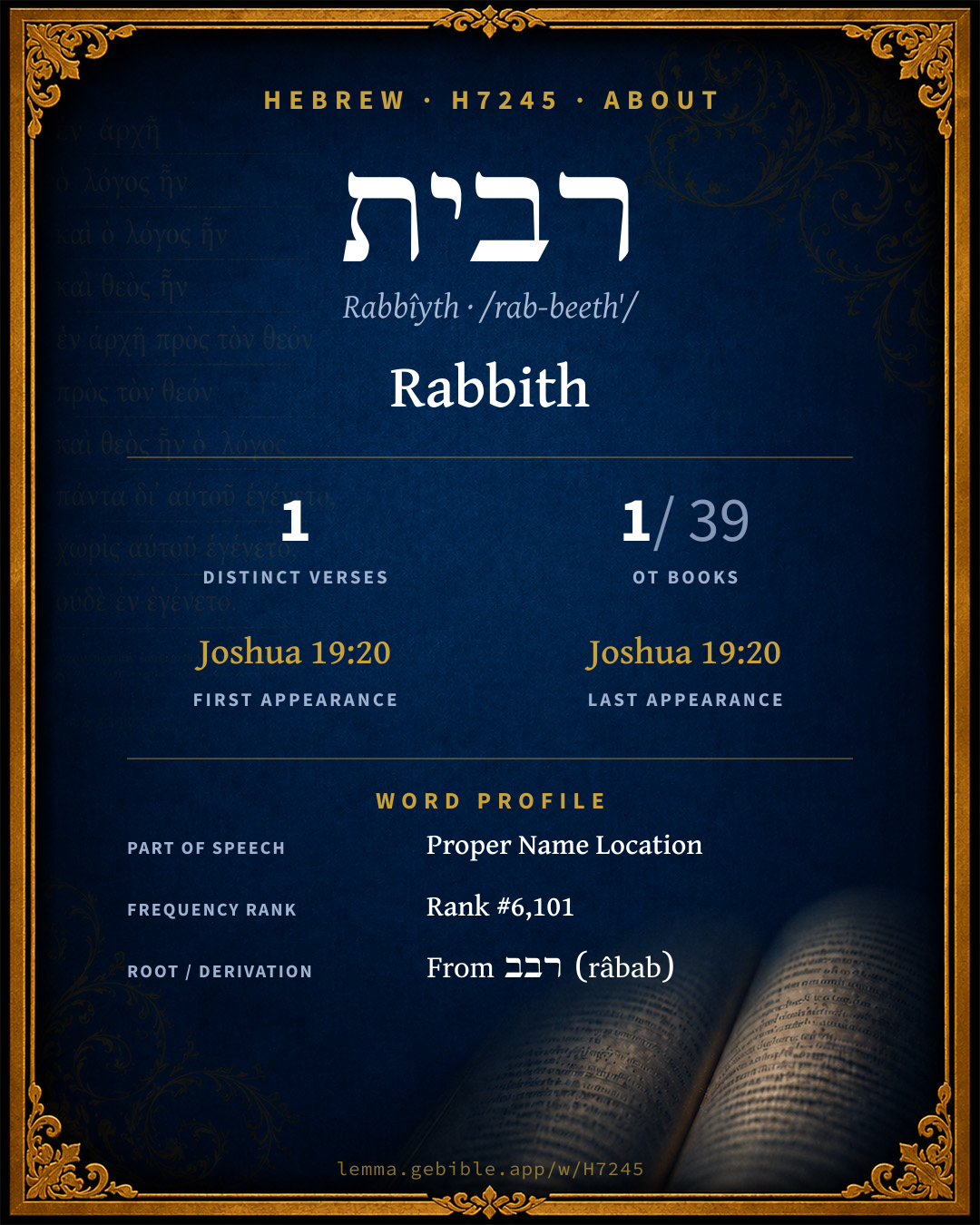
רַבִּית
Rabbith
BDB lists 2 entries for ‘Rabbith’ fuller range ↓
Full lexicon entry — Brown-Driver-Briggs (BDB)
From Brown-Driver-Briggs (BDB)
Where this word appears
Grammar key — what these labels mean
Noun type
- Proper
- A name of a specific person, place, or people (e.g. Abraham, Zion, Israel).
Every verse where H7245 appears — 1 distinct verse across 1 book. Click any verse to open its interlinear word-by-word view. Verse text shown in the World English Bible for context — . Each verse’s Hebrew form is shown with its reference; the English is not keyword-highlighted, since the data carries no word-level English alignment. Use “Compare translations” on any verse to read it across multiple English versions. This concordance covers the Hebrew Bible; Septuagint (Greek Old Testament) occurrences are not indexed here.
Joshua 1 verse
About this entry
At a glance — auto-summarized from this page’s data, not written by a person. Every figure links to its source below. This summary describes the numbers; it doesn’t interpret them.
The Hebrew name רבית centers on the idea of “Rabbith.” With only 1 verse it sits in the long tail of Hebrew Bible vocabulary. The word gravitates to Joshua (100%). A true hapax — its single appearance is Joshua 19:20. Dig into 1-verse concordance and the renderings breakdown below.
Gloss history
Strong's 1890 vs modern scholarship
About this word
Strong's H7245 catalogs a Hebrew word from the Hebrew Old Testament.
These counts are not copied from any lexicon or concordance. They are computed here, from the morphology-tagged Hebrew Old Testament. What Lemma adds →
- 1
- distinct verses
- The word appears in 1 distinct verse.
- 1 / 39
- OT books
- The word appears in 1 of 39 Old Testament books.
- #6,101
- by frequency
- Rank #6,101 (rank 6,101 of 8,640 Hebrew words by occurrence).
View all 1 occurrence in the concordance →
Most concentrated in
- Joshua 1 verse 100%
By section of the Old Testament
By traditional corpus
Conventional, traditional groupings — biblical authorship is debated, so this is a traditional corpus grouping, not an authorship claim. Each share is this word’s portion of its verses in that division of the Hebrew canon. Each figure is a share of the word’s 1 distinct verse.
- Prophets (Nevi'im) 1 verse · 100%
How translations render this word
Counts come from each version’s own published word-to-Strong’s tagging or interlinear alignment — an approximate guide to how each version renders this word, not a word-level alignment the data otherwise carries. Because each total is that version’s own tagged count, the per-version totals vary from one another and need not match the appearance or distinct-verse counts above. These counts may also differ from a printed concordance because Lemma counts each distinctly tagged rendering and does not collapse phrase taggings into a single head-word total. This is a fixed set of word-tagged versions (KJV, ASV, BSB, ULT) and does not change with the reading translation you choose elsewhere. Each version’s license is shown beside its name below (and on Sources).
- King James Version: Rabbith 1×
- American Standard Version: Rabbith 1×
- Berean Standard Bible: Rabbith 1×
- unfoldingWord Literal Text: Rabbith 1×
King James Version Public Domain
Renders H7245 across 1 tagged occurrence — most commonly:
American Standard Version Public Domain
Renders H7245 across 1 tagged occurrence — most commonly:
Berean Standard Bible Public Domain
Renders H7245 across 1 tagged occurrence — most commonly:
unfoldingWord Literal Text CC BY-SA 4.0
Renders H7245 across 1 tagged occurrence — most commonly:
Senses in BDB
The 2 senses BDB distinguishes for this word, in lexicon order (not ranked by frequency or importance). The full entry — with sub-senses — is in the Lexicon Entry tab.
- Rabbith = "multitude"
- a town in Issachar
Word origin
Derived from רבב (râbab) (H7231) — to become many.
Jastrow Dictionary
A second Hebrew/Aramaic lexicon for comparison, covering Aramaic and post-biblical (Talmudic, Targumic, Midrashic) usage that the biblical-Hebrew BDB does not. Matched by lemma rather than by Strong’s number, so a lemma may carry more than one Jastrow headword (shown separately below), and the entries cover usage well beyond the Bible.
רִבִּית
- (רָבַב = b. h. תַּרְבִּית) [profit,] interest on a loan, usury. B. Kam. 61ᵇ, v. קָצַץ, a. אָבָק. Tosef. ib. IV, 3, v. הַעֲרָמָה. Ex. R. s. 31, a. fr. מלוה (ב)ר׳, v. לָוָה. Tosef. l. c. יש דברים שהן ר׳ ואינן ר׳ there are such transactions as have the appearance of usury, but are not usury (are not forbidden). B. Mets. 63ᵃ, a. fr. צד אחד בר׳ one-sided (eventual) usury, a transaction which may eventually result in paying interest on a loan, e.g. advanced payment for fruit to be delivered at some future time at present prices with the option, in case of a rise in the market, of returning the money and paying the difference, in which latter case it looks like paying interest on a loan; a. v. fr.—Pl. רִבִּיּוֹת, רִי׳. Tosef. B. Mets. VI, 17 מלוי ר׳ כופרין וכ׳ those who lend on interest deny the essence &c. (v. עִיקָּר); (Y. ib. V, end, 10ᵈ מלוה ברבית). Tosef. l. c. 18.
רִבִּית ²
- Targ. O. Deut. XXIII, 20. Targ. Y. ib. 21 (ed. Vien. רִיבִי׳). Targ. Ez. XVIII, 8; 13; 17 (ed. Wil. רַבִּי׳; ed. Lag. ריב׳); a. e.—Lev. R. s. 3, beg. (prov.) דיזיף בר׳ וכ׳ (not בריביתיה) he that borrows money on interest (to carry on his business), loses his own and other people’s money.—Pl. רִבְיָין, רִי׳. Targ. Y. I Ex. XXII, 24; Y. II רַבְיָיא (?). Targ. Y. Lev. XXV, 37. Ib. 36 (some ed. ריפיין, corr. acc.).
A Dictionary of the Targumim, the Talmud Babli and Yerushalmi, and the Midrashic Literature (Marcus Jastrow; London, Luzac, 1903) — Public Domain. Digitized via Sefaria. Digitized via Sefaria. Full attribution on Sources.
Same root — word family
Other BDB entries built from the same root as H7245, grouped by Strong’s listed origin. These share a root / origin per the lexicon — not necessarily a shared meaning. Each links to that word’s own entry.
Derives from
Shares the same root
- רב rab H7227 many
- רב rôb H7230 multitude
- רבב râbab H7232 to shoot
- רבבה rᵉbâbâh H7233 myriad
- רבו ribbôw H7239 ten thousand
- רביב râbîyb H7241 heavy showers
Proper names from this root
People and places named from this root — a name, not an additional meaning of the word.
Compare all same-root words → Showing 4 of 9 — not the complete family. 1 of the same-root words is a proper name (a person or place). They share a root, not necessarily a meaning.
Bible dictionary
Public-domain dictionary articles matched to this entry by name (Rabbith). A biblical name can be shared by more than one person or place, so an article may treat several.
Smith's Bible Dictionary · William Smith, 1863
(multitude) a town in the territory, perhaps on the boundary, of Issachar. (Joshua 18:20) only.
Classic public-domain reference works; full attribution on Sources.
Septuagint verse parallels
This word appears in 1 verse that also exists in the Greek Old Testament (Septuagint), out of the 1 Hebrew verse it occurs in. You can read those verses in Greek by switching the Old Testament edition to the Septuagint.
Read these verses in the Septuagint
This is a verse-level parallel only — the same verses exist in both the Hebrew and Greek Old Testaments. No word-level Hebrew↔Greek correspondence is claimed: the data carries no such alignment, so no Greek word is shown as this Hebrew word’s translation. Coverage is not total — the Septuagint omits the deuterocanon and renumbers the Psalms, so some Hebrew verses have no direct Greek parallel.