
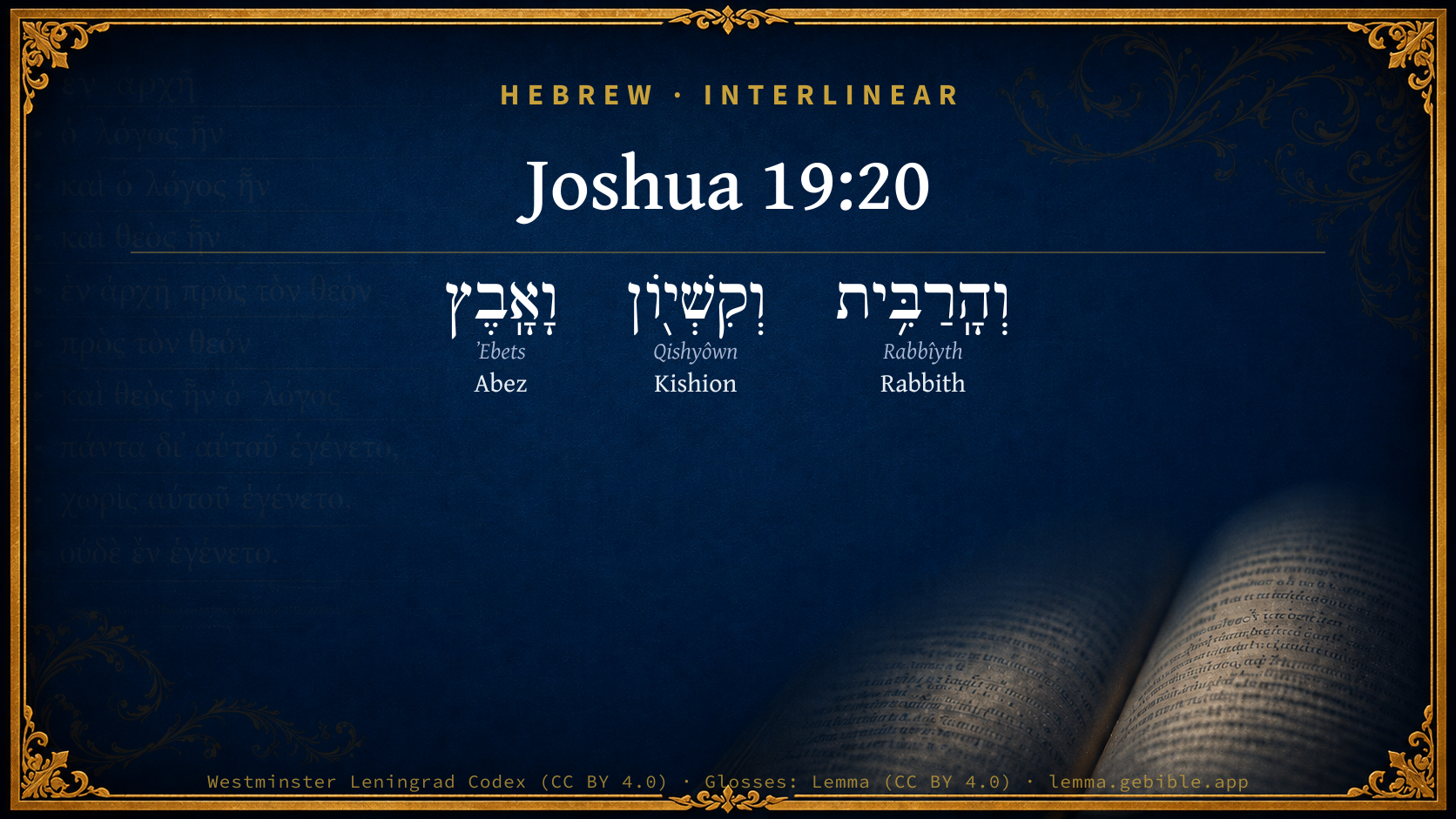
Joshua 19:20

Hebrew (Westminster Leningrad Codex) Joshua 19:20 appears in the Hebrew Old Testament. The text above is from the Westminster Leningrad Codex. Each word links to its Strong’s number, a concise gloss, and parsing drawn from the Open Scriptures Hebrew Bible morphology. Click any word for its full Brown-Driver-Briggs (BDB) entry.
Download image
Cite this verse

Joshua 19:20 (World English Bible). Public Domain. Lemma interlinear Bible study tool, https://lemma.gebible.app/v/joshua/19/20.

Show BibTeX & RIS
BibTeX
RIS
English Translation
and Rabbith, and Kishion, and Ebez,
World English Bible · Public Domain
Highlights
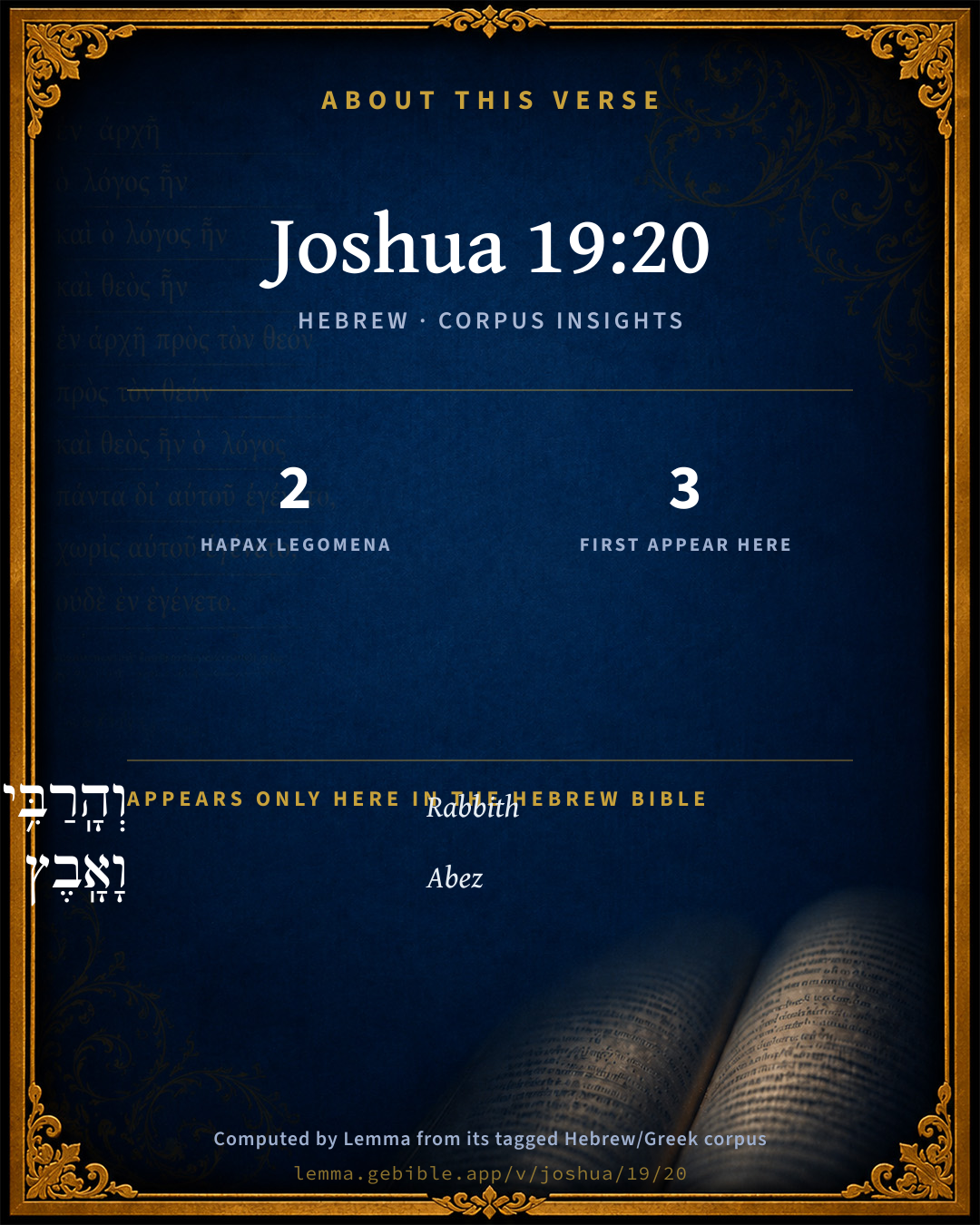
  • 2 hapax legomena — only here in the Hebrew Bible
  • 3 first appearances in the Hebrew Bible
Full analysis ↓
Download a study sheet

One document with this verse’s original text, its word-by-word gloss line, the meaning frame, cross-references with their text, attributed commentary, and full source and license credits — printable, and it pastes into notes with its structure intact.

This verse Autodidact and up

Study sheet (.html) Plain text (.txt)

A passage Seminary Student

Up to 50 verses in one chapter. A passage sheet keeps up to 6 commentary sources and 12 cross-references per verse, in the order this page ranks them, and says so on the sheet whenever that leaves anything out. Ask for a single verse and you get the Autodidact verse sheet above.

Everything on this page stays free to read, with no account — the sheet is a download of what is already on screen, not access to it.

Want to remove ads? Support Godless Engineer
Compare translations 3

The same verse in 3 English versions, stacked beneath the original-language interlinear above. Click any original word for its lexicon entry.

Each is an independent rendering of the whole verse — the interlinear is not word-aligned to these translations.

Highlighted words mark where these versions differ — a whole-verse word diff, not a word-by-word alignment.

  • World English Bible Public Domain
    and Rabbith, and Kishion, and Ebez,
  • King James Version Public Domain
    And Rabbith, and Kishion, and Abez,
  • unfoldingWord Literal Text CC BY-SA 4.0
    and Rabbith and Kishion and Ebez

unfoldingWord Literal Text — © unfoldingWord, licensed CC BY-SA 4.0. Word-aligned USFM3 via Door43 (git.door43.org/unfoldingWord/en_ult).

Versions to compare (up to 4)

3 of 4 selected

Show all 18 translations

Every available English version of this verse, each an independent rendering of the whole verse.

  • World English Bible Public Domain
    and Rabbith, and Kishion, and Ebez,
  • Berean Standard Bible Public Domain
    Rabbith, Kishion, Ebez,
  • Majority Standard Bible Public Domain
    Rabbith, Kishion, Ebez,
  • King James Version Public Domain
    And Rabbith, and Kishion, and Abez,
  • American Standard Version (1901) Public Domain
    and Rabbith, and Kishion, and Ebez,
  • Revised Version (1885) Public Domain
    and Rabbith, and Kishion, and Ebez;
  • Geneva Bible (1599) Public Domain
    And Harabbith, and Kishion, and Abez,
  • Douay-Rheims (1899) Public Domain
    And Rabboth and Cesion, Abes,
  • Young's Literal Translation Public Domain
    and Rabbith, and Kishion, and Abez,
  • Literal Standard Version CC BY-SA 4.0
    and Rabbith, and Kishion, and Abez,
  • Unlocked Literal Bible CC BY-SA 4.0
    It also included Rabbith, Kishion, Ebez,
  • unfoldingWord Literal Text CC BY-SA 4.0
    and Rabbith and Kishion and Ebez
  • Darby Bible Public Domain
    and Rabbith, and Kishion, and Ebez,
  • World Messianic Bible Public Domain
    Rabbith, Kishion, Ebez,
  • Webster's Bible Public Domain
    And Rabbith, and Kishion, and Abez,
  • Free Bible Version CC BY-SA 4.0
    Rabbith, Kishion, Ebez,
  • Bible in Basic English Public Domain
    And Rabbith and Kishion and Ebez
  • JPS Tanakh (1917) Public Domain
    and Rabbith, and Kishion, and Ebez;

Literal Standard Version (2020), Covenant Press — licensed CC BY-SA 4.0. Text via the HelloAO Bible API (eBible.org). Unlocked Literal Bible (unfoldingWord) — licensed CC BY-SA 4.0. Text via the HelloAO Bible API (eBible.org). unfoldingWord Literal Text — © unfoldingWord, licensed CC BY-SA 4.0. Word-aligned USFM3 via Door43 (git.door43.org/unfoldingWord/en_ult). Free Bible Version, Dr. Jonathan Gallagher — licensed CC BY-SA 4.0. Text via the HelloAO Bible API (eBible.org).

Word by word

More ways to search: Search by grammar → Find every occurrence → Compare this word →

Practice this passage: Drill this verse → Learn its vocabulary →

וְהָֽרַבִּ֥ית
Rabbîyth
H7245
“and · the · Rabbith”
Conjunction + Particle, Definite Article + Noun, Proper
Part of Speech
Conjunction + Particle + Noun
Type
Proper
Full BDB Definition

Origin: from H7231

TWOT: None

Rabbith = "multitude" - a town in Issachar
  1. וְקִשְׁי֖וֹן Qishyôwn H7191 “and · Kishion” Conjunction + Noun, Proper
  2. וָאָֽבֶץ ʼEbets H77 “and · Abez” Conjunction + Noun, Proper

About this verse

These counts appear in no published source. They are computed here, from the morphology-tagged text and Lemma’s own curated glosses. What Lemma adds →

3
words
3
distinct lemmas
Historical
section

Notable vocabulary

2 hapax legomena — words that appear only here in the entire Hebrew Bible:

  • וְהָֽרַבִּ֥ית Rabbith H7245
  • וָאָֽבֶץ Abez H77

First appearance in Scripture

These words make their first canonical appearance in the Hebrew Bible here:

  • וְהָֽרַבִּ֥ית Rabbith H7245
  • וְקִשְׁי֖וֹן Kishion H7191
  • וָאָֽבֶץ Abez H77

Shared distinctive vocabulary

וְקִשְׁי֖וֹן Kishion H7191 occurs in 2 verses of the Hebrew Bible. Also found in:

Grammatical profile

  • 3 nouns

Hebrew & Septuagint length

In English translation the verse runs 6 words from the Hebrew and 8 from the Septuagint (LXX English) — closely comparable.

A rough comparison of the two English renderings, which tokenize alike — not a word-level alignment.

Word counts can differ between the Hebrew and the Greek without any difference in meaning — e.g. the Hebrew direct-object marker אֵת has no separate Greek word, and Greek often adds the article ὁ.

Hebrew and Greek witnesses Masoretic Hebrew ↔ Greek Septuagint

The same verse in the two great witnesses to the Old Testament, shown verse-for-verse.

These are two independent witnesses, not word-aligned to each other, and the Septuagint is shown in lemma (dictionary) form.

Hebrew Joshua 19:20 Masoretic · Westminster Leningrad Codex

וְהָֽרַבִּ֥ית וְקִשְׁי֖וֹן וָאָֽבֶץ

and Rabbith, and Kishion, and Ebez,

World English Bible · Public Domain

Greek LXX Joshua 19:20 Septuagint · lemma form

καί δαβιρων καί κισων καί ρεβες

and Anachereth, and Dabiron, and Kison, and Rebes,

LXX2012 (modern English Septuagint) · Public Domain

On this verse, The Cambridge Bible for Schools and Colleges discusses the Septuagint’s reading. Read the note in Commentary ↓

Hebrew: Westminster Leningrad Codex (CC BY 4.0). Greek: Septuagint (public domain); English from LXX2012 (modern English Septuagint) (Public Domain). How the Septuagint differs from the Hebrew →

Targum (Aramaic paraphrase)

1

The Targum is the ancient Jewish Aramaic paraphrase of the Hebrew Scriptures — an interpretive translation, not the Hebrew text itself. Onkelos (literal) and Pseudo-Jonathan (expansive) render the Torah, and Jonathan the Prophets. Coverage is partial: where no permissively-licensed English translation exists for a verse, only the Aramaic is shown. This is verse-level text, not a word-by-word alignment to the Hebrew.

  1. Targum Jonathan Prophets (Joshua–Malachi)
    וְהָרַבִּית וְקִשְׁיוֹן וָאָבֶץ:

    (no public-domain English translation for this verse)

    Targum Jonathan — Aramaic: “Mikraot Gedolot” (public domain). English: “Sefaria Community Translation” (CC0 1.0 (public-domain dedication)); “London "Chaldee Paraphrase," 1871” (public domain). Text via Sefaria.

Commentary

Notes on Joshua 19:20 from classic Christian and Jewish commentators (each source and its license shown beneath its notes). The classic Christian expositions comment on the surrounding passage and are grouped to its opening verse, so a note may address several verses; the Jewish commentaries on the Tanakh (Rashi and others) are per-verse, so they appear only where the commentator wrote on this verse.

Lemma curates 59 commentaries, every one of them public domain or Creative Commons licensed, each selected and text-cleaned for this edition rather than reprinted as found. About our sources →

Ellicott's Commentary for English Readers

(20) Râba (sheet 12), El Beida (sheet 5).

A Bible Commentary for English Readers, edited by Charles John Ellicott (1878–1897) — public domain. Text from a community e-Sword module.

The Cambridge Bible for Schools and Colleges

gen. ed. J. J. S. Perowne

20, 21. Rabbith, Kishion (1Ch_6:72), Abez, Remeth (1Ch_6:73), are all unknown.

En-gannim] = the spring of the gardens, the modern Jenîn. Even now it justifies its ancient name; for the village lies, according to Robinson, Bib. Res. iii. 155, “in the midst of gardens of fruit trees, which are surrounded by hedges of the prickly pear.” But its most remarkable feature is a flowing, public fountain, rising in the hills at the back of the town, and brought down so that it issues in a copious stream in the midst of the place. Ahaziah was driving towards the mountain-pass by En-gannim (2Ki_9:27—the Bethgan of the LXX. = En-gannim), when he was overtaken by Jehu, and fled to die of his wounds at Megiddo.

En-haddah and Beth-pazzez are not known.

The Cambridge Bible for Schools and Colleges (gen. ed. J. J. S. Perowne; Cambridge University Press, 1878–1918) — public domain. Text from a community e-Sword module.

John Gill's Exposition

And Remeth,.... Remeth seems to be the same with Jarmuth, Jos 21:29; and with Ramoth, Ch1 6:73,

and Engannim seems to be the same with Anem in Ch1 6:73, there were several of this name, which seem to have been places full of gardens, and well watered; for the word signifies a fountain of gardens. Engannim is now called Jenine, distant from Tabor twenty two miles, a place of gardens, of water, and of pleasure, as a traveller (b) of ours tells us; who also declares (c), that, in his whole journey from Damascus to Jerusalem, he saw not more fruitful ground, and so much together, than he did in twenty two miles of riding between Mount Tabor and Engannim. This seems to be the same place Mr. Maundrell (d) calls Jeneen, a large old town on the outskirts of Esdraelon. Dr. Lightfoot (e) is inclined to believe, that Nain, where the widow's son was raised to life, Luk 7:11, is the same with Engannim, for which he gives various reasons:

and Enhaddah; Jerom says, in his time (f) there was a village called Enadda, ten miles from Eleutheropolis, as you go from thence to Aelia; but seems not to be the same with Enhaddah here:

and Bethpazzez; of Bethpazzez no mention is made elsewhere. "Beth" signifies a "house", and "Pazzez" in the Arabic tongue signifies "silver"; so this with the old Canaanites might be a treasure city, like those in Egypt, Exo 1:11. But where a word begins with "Beth", as the name of a place, I always suspect there was an idol temple there; now as the word in Hebrew signifies the same as "Peor", opening, here might be a temple to that deity, or to one that was similar to the god of the Moabites, and design a Priapus, among the Canaanites like that; or as the word in the Syriac and Chaldee languages signifies to redeem, deliver, and save, this temple might be dedicated to some idol as their deliverer and saviour.

(b) Biddulph apud Lightfoot. Talmud. Exercitat. in John iv. 1. (c) lb. apud Fuller's Pisgah Sight, p. 161. (d) Journey from Aleppo, &c. p. 111. (e) Chorograph. notes in Luke, p. 370. (f) Ut supra. (De. loc. Heb. fol. 94. B.)

John Gill's Exposition of the Whole Bible (1746–1763) — public domain (CC PDM 1.0). Text via the HelloAO Bible API.

Haydock's Catholic Bible Commentary

Rabbath. These four cities formed the western boundary, though Serarius observes, this tribe extended as far as the Mediterranean, being in possession of Carmel, which lay close to the shore. (Menochius)

George Leo Haydock (1774–1849), Haydock's Catholic Family Bible and Commentary, 1859 edition — public domain. Excludes Psalms (Douay-Rheims chapter numbering differs from Protestant) and Deuterocanonical books (Catholic canon only).

unfoldingWord translationNotes

Door43 World Missions Community

Rabbith ... Kishion ... Ebez ... Remeth ... En Gannim ... En Haddah ... Beth Pazzez ... Shahazumah

These are names of cities. (See: How to Translate Names)

Tabor

This is the name of a mountain. (See: How to Translate Names)

translationWords

Beth Shemesh

Jordan River

unfoldingWord translationNotes — © Distant Shores Media and the Door43 World Missions Community, licensed CC BY-SA 4.0. Source: git.door43.org/Door43/en_tn.

Lesson kit

Teaching starters — assembled from the data on this page, not authored interpretation. Every prompt links to the verse data it draws on. Edit before teaching.

Joshua, in the Historical, opens this verse with 3 words (3 distinct Hebrew lemmas). Its most distinctive word is Rabbîyth (“Rabbith”). A historical commentator’s framing appears above. Read the whole chapter for the surrounding context.

Discussion questions

  1. How does “Rabbith” (Rabbîyth) shape what this verse is saying?
  2. This verse holds 2 words here found nowhere else in the Hebrew Bible. What might the rare words draw attention to?
  3. 3 words here appear for the first time in Scripture. What is being introduced at this debut?
  4. Joshua 21:28 shares the word «Kishion» with this verse. How do the two illuminate each other?
  5. These translations render this verse differently; the difference is in the English rendering, not the original. What questions does that raise?
  6. Reading how Ellicott's Commentary for English Readers and The Cambridge Bible for Schools and Colleges read this verse, where do the two commentators agree and where do they part?

Things to notice

  • 2 words in this verse appear nowhere else in the Hebrew Bible.
  • 3 words make their first canonical appearance in Scripture here.
  • These translations choose different wording for 2 words in this verse.
  • 3 distinct Hebrew lemmas span 3 words in this verse.

Reading settings

Reading text

Shown beneath each verse's original-language words.

Old Testament
Old Testament edition

Read the OT as the Masoretic Hebrew (MT) or the Greek Septuagint (LXX).

English shown for the Greek Septuagint (in the Hebrew ↔ Greek comparison).

Comparing translations? Open the Compare panel on any verse page to stack up to four side by side.