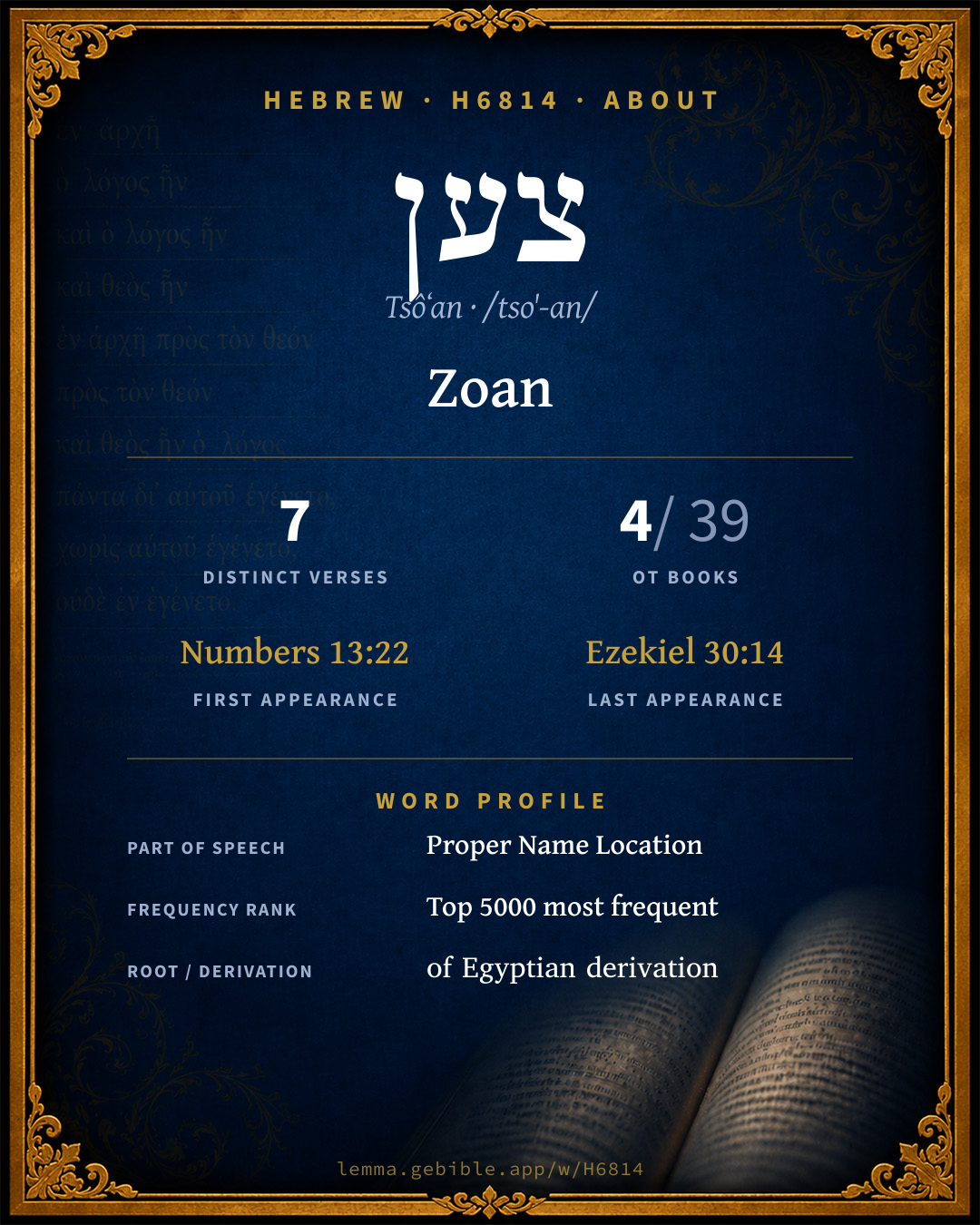
צֹ֫עַן
Zoan
BDB lists 2 entries for ‘Zoan’ fuller range ↓
Full lexicon entry — Brown-Driver-Briggs (BDB)
From Brown-Driver-Briggs (BDB)
Where this word appears
Grammar key — what these labels mean
Part of speech
- Noun
- A naming word — a person, place, thing, or idea.
Noun type
- Proper
- A name of a specific person, place, or people (e.g. Abraham, Zion, Israel).
Every verse where H6814 appears in the Book of Numbers — 1 distinct verse. Click any verse to open its interlinear word-by-word view. Verse text shown in the World English Bible for context — . Each verse’s Hebrew form is shown with its reference; the English is not keyword-highlighted, since the data carries no word-level English alignment. Use “Compare translations” on any verse to read it across multiple English versions. This concordance covers the Hebrew Bible; Septuagint (Greek Old Testament) occurrences are not indexed here.
Numbers
About this entry
At a glance — auto-summarized from this page’s data, not written by a person. Every figure links to its source below. This summary describes the numbers; it doesn’t interpret them.
“Zoan” is the headline sense of the Hebrew name צען (Tsôʻan). Its earliest occurrence is Numbers 13:22. The Hebrew Bible uses it across 7 verses — uncommon. More than a third of its appearances fall in Isaiah. See 7-verse concordance and the renderings breakdown below.
Gloss history
Strong's 1890 vs modern scholarship
About this word
Strong's H6814 catalogs a Hebrew word from the Hebrew Old Testament.
These counts are not copied from any lexicon or concordance. They are computed here, from the morphology-tagged Hebrew Old Testament. What Lemma adds →
- 7
- distinct verses
- The word appears in 7 distinct verses.
- 4 / 39
- OT books
- The word appears in 4 of 39 Old Testament books.
- #2,835
- by frequency
- Top 5000 most frequent Hebrew words (rank 2,835 of 8,640 Hebrew words by occurrence).
View all 7 occurrences in the concordance →
By section of the Old Testament
By traditional corpus
Conventional, traditional groupings — biblical authorship is debated, so this is a traditional corpus grouping, not an authorship claim. Each share is this word’s portion of its verses in that division of the Hebrew canon. Each figure is a share of the word’s 7 distinct verses.
- Prophets (Nevi'im) 4 verses · 57%
- Writings (Ketuvim) 2 verses · 29%
- Torah (Pentateuch) 1 verse · 14%
How translations render this word
Counts come from each version’s own published word-to-Strong’s tagging or interlinear alignment — an approximate guide to how each version renders this word, not a word-level alignment the data otherwise carries. Because each total is that version’s own tagged count, the per-version totals vary from one another and need not match the appearance or distinct-verse counts above. These counts may also differ from a printed concordance because Lemma counts each distinctly tagged rendering and does not collapse phrase taggings into a single head-word total. This is a fixed set of word-tagged versions (KJV, ASV, BSB, ULT) and does not change with the reading translation you choose elsewhere. Each version’s license is shown beside its name below (and on Sources).
- King James Version: Zoan 6×
- American Standard Version: Zoan 6×
- Berean Standard Bible: Zoan 7×
- unfoldingWord Literal Text: Zoan 7×
King James Version Public Domain
Renders H6814 across 7 tagged occurrences — most commonly:
Plus 1 rendering that appears only once — usually multi-word phrases or single function words the recovered tagging swept in, not distinct renderings.
American Standard Version Public Domain
Renders H6814 across 7 tagged occurrences — most commonly:
Plus 1 rendering that appears only once — usually multi-word phrases or single function words the recovered tagging swept in, not distinct renderings.
Berean Standard Bible Public Domain
Renders H6814 across 7 tagged occurrences — most commonly:
unfoldingWord Literal Text CC BY-SA 4.0
Renders H6814 across 7 tagged occurrences — most commonly:
Senses in BDB
The 2 senses BDB distinguishes for this word, in lexicon order (not ranked by frequency or importance). The full entry — with sub-senses — is in the Lexicon Entry tab.
- Zoan = "place of departure"
- an ancient city of lower Egypt called Tanis by the Greeks…
Word origin
n.pr.loc. Τανις: Tanis, in Egypt (Egyptian D̲aʿnĕ(t) SteindBAS 600, in Assyrian Ṣiʾinu, Saʾanu Ibid. 598 ff. DlPa 315); it was built 7 years after Hebron according to Nu 13:22; Is 19:11, 13; 30:4; Ez 30:14 ψ 78:12, 43; mod. Ṣân, in NW. part of Delta; v. also EbGS 512 ff. Bd.Lower Egyptian 3 (1895), 228 PetrieTanis (1885).
— Brown-Driver-Briggs (Oxford 1906, public domain), digitized via Sefaria, supplemented by the OpenScriptures HebrewLexicon (CC BY 4.0). See Sources.
Origin: of Egyptian derivation
Forms in the corpus
The 5 distinct written forms H6814 takes in the Hebrew Bible, most frequent first — each parse links to that state’s occurrences in the concordance. Hebrew forms include their vowel points and cantillation, so a single lemma takes many written forms.
| Form | Parsing | Example | Uses |
|---|---|---|---|
| צֹ֔עַן | Noun, Proper | Isaiah 19:11 | 2 |
| צֹֽעַן | Noun, Proper | Psalms 78:12 | 2 |
| בְ/צֹ֖עַן | Noun, Proper | Isaiah 30:4 | 1 |
| בְּ/צֹ֑עַן | Noun, Proper | Ezekiel 30:14 | 1 |
| צֹ֥עַן | Noun, Proper | Numbers 13:22 | 1 |
Bible dictionary
Public-domain dictionary articles matched to this entry by name (Zoan). A biblical name can be shared by more than one person or place, so an article may treat several.
Easton's Bible Dictionary · M. G. Easton, 1897
(Old Egypt. Sant= "stronghold," the modern San). A city on the Tanitic branch of the Nile, called by the Greeks Tanis. It was built seven years after Hebron in Palestine (Num. 13:22). This great and important city was the capital of the Hyksos, or Shepherd kings, who ruled Egypt for more than 500 years. It was the frontier town of Goshen. Here Pharaoh was holding his court at the time of his various interviews with Moses and Aaron. "No trace of Zoan exists; Tanis was built over it, and city after city has been built over the ruins of that" (Harper, Bible and Modern Discovery). Extensive mounds of ruins, the wreck of the ancient city, now mark its site (Isa. 19:11, 13; 30:4; Ezek. 30:14). "The whole constitutes one of the grandest and oldest ruins in the world."
This city was also called "the Field of Zoan" (Ps. 78:12, 43) and "the Town of Rameses" (q.v.), because the oppressor rebuilt and embellished it, probably by the forced labour of the Hebrews, and made it his northern capital.
Smith's Bible Dictionary · William Smith, 1863
(place of departure), an ancient city of lower Egypt, called Tanis by the Greeks. It stood on the eastern bank of the Tanitic branch of the Nile. Its name indicates a place of departure from a country, and hence it has been identified with Avaris (Tanis, the modern San), the capital of the Shepherd dynasty in Egypt, built seven years after Hebron and existing before the time of Abraham. It was taken by the Shepherd kings in their invasion of Egypt, and by them rebuilt, and garrisoned, according to Manetho, with 240,000 men. This cite is mentioned in connection with the plagues in such a manner as to leave no doubt that it is the city spoken of in the narrative in Exodus as that where Pharaoh dwelt, (Psalms 78:42,43) and where Moses wrought his wonders on the field of Zoan a rich plain extending thirty miles toward the east. Tanis gave its name to the twenty-first and twenty-third dynasties and hence its mention in Isaiah. (Isaiah 19:13; 30:4) (The present "field of Zoan" is a barren waste, very thinly inhabited. "One of the principal capitals of Pharaoh is now the habitation of fishermen the resort of wild beasts, and infested with reptiles and malignant fevers." There have been discovered a great number of monuments here which throw light upon the Bible history. Brugsch refers to two statues of colossal size of Mermesha of the thirteenth dynasty, wonderfully perfect in the execution of the individual parts and says that memorials of Rameses the Great lie scattered broadcast like the mouldering bones of generations slain long ago. The area of the sacred enclosure of the temple is 1500 feet by 1250.-ED.)
Hitchcock's Bible Names Dictionary · Roswell D. Hitchcock, 1869
motion
Classic public-domain reference works; full attribution on Sources.
Septuagint verse parallels
This word appears in 6 verses that also exist in the Greek Old Testament (Septuagint), out of the 7 Hebrew verses it occurs in. You can read those verses in Greek by switching the Old Testament edition to the Septuagint.
Read these verses in the Septuagint
This is a verse-level parallel only — the same verses exist in both the Hebrew and Greek Old Testaments. No word-level Hebrew↔Greek correspondence is claimed: the data carries no such alignment, so no Greek word is shown as this Hebrew word’s translation. Coverage is not total — the Septuagint omits the deuterocanon and renumbers the Psalms, so some Hebrew verses have no direct Greek parallel.