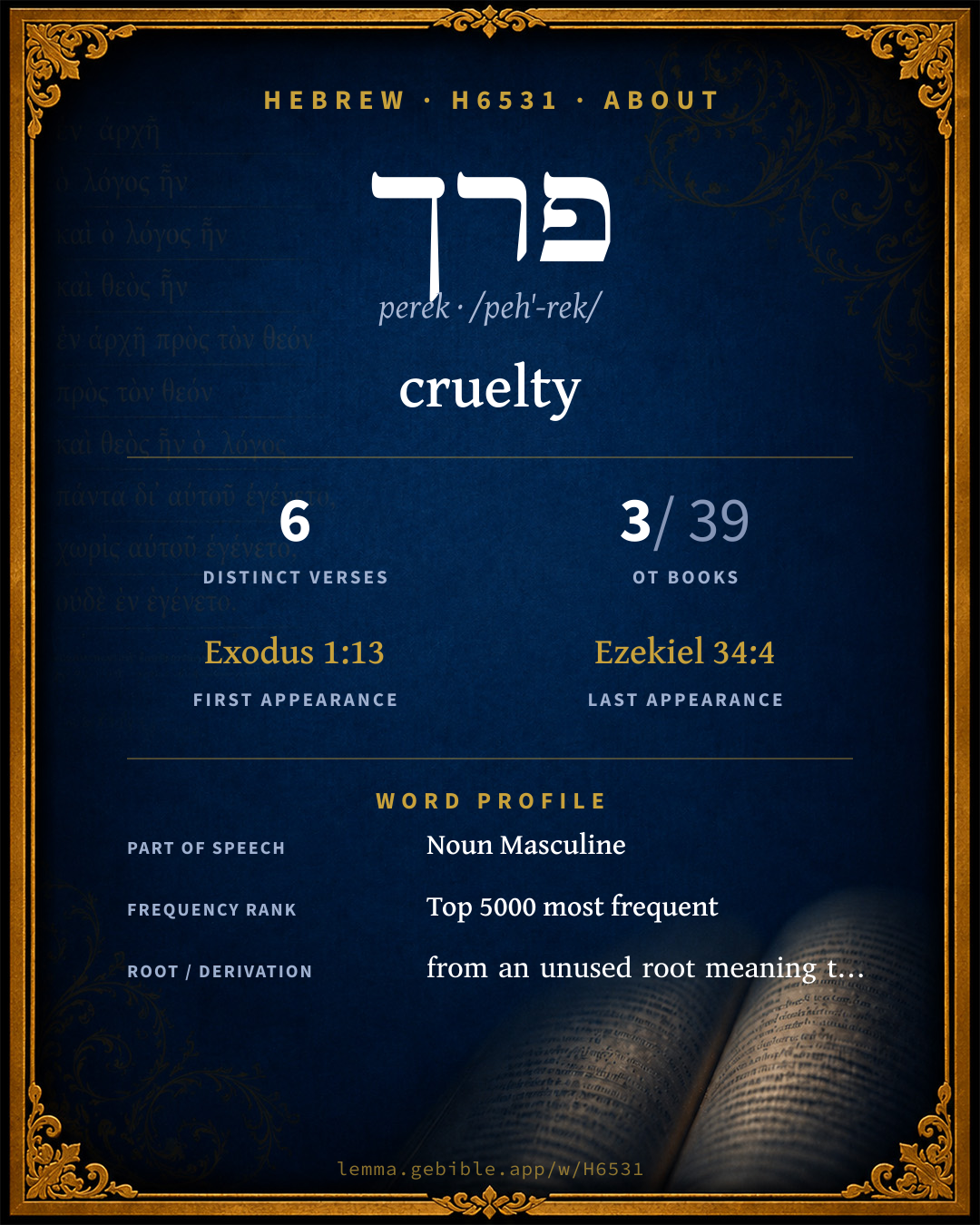
פֶּ֫רֶךְ
cruelty
Full lexicon entry — Brown-Driver-Briggs (BDB)
From Brown-Driver-Briggs (BDB)
Where this word appears
Grammar key — what these labels mean
Noun type
- Common
- A common noun — a general class of person, place, or thing (“king,” “city,” “water”), not a specific name.
State
- Absolute
- The independent form of a noun, not bound to a following word.
Gender
- Masculine
- Grammatically masculine.
Number
- Singular
- One.
Every verse where H6531 appears in the Book of Ezekiel — 1 distinct verse. Click any verse to open its interlinear word-by-word view. Verse text shown in the World English Bible for context — . Each verse’s Hebrew form is shown with its reference; the English is not keyword-highlighted, since the data carries no word-level English alignment. Use “Compare translations” on any verse to read it across multiple English versions. This concordance covers the Hebrew Bible; Septuagint (Greek Old Testament) occurrences are not indexed here.
Ezekiel
About this entry
At a glance — auto-summarized from this page’s data, not written by a person. Every figure links to its source below. This summary describes the numbers; it doesn’t interpret them.
פרך — transliterated perek — is a Hebrew noun carrying the sense “cruelty.” More than half of its appearances fall in Leviticus. The Hebrew Bible uses it across 6 verses — uncommon. Debuting at Exodus 1:13, it then recurs through the corpus. It shares a root with פרכת. Each statement above links to its evidence; the full detail follows below.
Gloss history
Strong's 1890 vs modern scholarship
About this word
Strong's H6531 catalogs a Hebrew word from the Hebrew Old Testament.
These counts are not copied from any lexicon or concordance. They are computed here, from the morphology-tagged Hebrew Old Testament. What Lemma adds →
- 6
- distinct verses
- The word appears in 6 distinct verses.
- 3 / 39
- OT books
- The word appears in 3 of 39 Old Testament books.
- #3,040
- by frequency
- Top 5000 most frequent Hebrew words (rank 3,040 of 8,640 Hebrew words by occurrence).
View all 6 occurrences in the concordance →
By section of the Old Testament
By traditional corpus
Conventional, traditional groupings — biblical authorship is debated, so this is a traditional corpus grouping, not an authorship claim. Each share is this word’s portion of its verses in that division of the Hebrew canon. Each figure is a share of the word’s 6 distinct verses.
- Torah (Pentateuch) 5 verses · 83%
- Prophets (Nevi'im) 1 verse · 17%
How translations render this word
Counts come from each version’s own published word-to-Strong’s tagging or interlinear alignment — an approximate guide to how each version renders this word, not a word-level alignment the data otherwise carries. Because each total is that version’s own tagged count, the per-version totals vary from one another and need not match the appearance or distinct-verse counts above. These counts may also differ from a printed concordance because Lemma counts each distinctly tagged rendering and does not collapse phrase taggings into a single head-word total. This is a fixed set of word-tagged versions (KJV, ASV, BSB, ULT) and does not change with the reading translation you choose elsewhere. Each version’s license is shown beside its name below (and on Sources).
- King James Version: Rigour 3×
- American Standard Version: Rigor 4×
- Berean Standard Bible: Harshly 3×
- unfoldingWord Literal Text: Harshness 3×
King James Version Public Domain
Renders H6531 across 6 tagged occurrences — most commonly:
Plus 3 renderings that appear only once — usually multi-word phrases or single function words the recovered tagging swept in, not distinct renderings.
American Standard Version Public Domain
Renders H6531 across 6 tagged occurrences — most commonly:
Plus 2 renderings that appear only once — usually multi-word phrases or single function words the recovered tagging swept in, not distinct renderings.
Berean Standard Bible Public Domain
Renders H6531 across 6 tagged occurrences — most commonly:
Plus 3 renderings that appear only once — usually multi-word phrases or single function words the recovered tagging swept in, not distinct renderings.
unfoldingWord Literal Text CC BY-SA 4.0
Renders H6531 across 6 tagged occurrences — most commonly:
Plus 3 renderings that appear only once — usually multi-word phrases or single function words the recovered tagging swept in, not distinct renderings.
Senses in BDB
The 1 sense BDB distinguishes for this word, in lexicon order (not ranked by frequency or importance). The full entry — with sub-senses — is in the Lexicon Entry tab.
- harshness, severity, cruelty
Word origin
פֶּ֫רֶךְ n.[m.] harshness, severity
— Brown-Driver-Briggs (Oxford 1906, public domain), digitized via Sefaria, supplemented by the OpenScriptures HebrewLexicon (CC BY 4.0). See Sources.
Origin: from an unused root meaning to break apart
Jastrow Dictionary
A second Hebrew/Aramaic lexicon for comparison, covering Aramaic and post-biblical (Talmudic, Targumic, Midrashic) usage that the biblical-Hebrew BDB does not. Matched by lemma rather than by Strong’s number, so a lemma may carry more than one Jastrow headword (shown separately below), and the entries cover usage well beyond the Bible.
פָּרַךְ
- 1. to split, divide off. Denom. (cmp. מְחִיצָה) פָּרוֹכֶת.
- 2. to split (grist &c.); to crush, rub, grind. Ber. 37ᵇ פּוֹרְכָן, v. infra. Ex. R. s. 31 באחרונה אדם פּוֹרְכוֹ בידו וכ׳ at last (when silver has been worked over several times) one may crumble it in one’s hand, and it is no longer fit for any work. B. Mets. 89ᵇ יִפְרוֹךְ Ms. R., v. infra; a. e.—Part. pass. פָּרוּךְ; pl. פְּרוּכִים, פְּרוּכִין. Midr. Till. to Ps. CXVIII, 10-13 (ref. to אמילם ib., v. מָלַל) והמה פ׳ and they were (shall be) crushed.
- 1. to split, demolish. Yalk. Gen. 39, v. פָּכַר.
- 2. to crush, grind; to crack; to husk. Men. 75ᵇ מְפָרְכָן עד וכ׳ (Ber. 37ᵇ פּוֹרְכָן) he crushes them until he has reduced them to the fineness of the flour of which they had been made. Bets. 12ᵇ מְפָרְכִין קטניות וכ׳ you may husk peas on the Holy Day. Sabb. 53ᵇ סכין ומפרכין לאדם וכ׳ Ar. a. early eds. (v. Rabb. D. S. a. l. note 70; ed. a. Mss. מפרכסין, v. פִּרְכֵּס I) you may oint a sore and scrape the scab off for a human being (on the Sabbath), but not for a beast; a. e.—[Ib. 155ᵇ מפרכין תבן, v. פְּרַךְ II.]
- same, to smash, crack &c. B. Mets. 89ᵇ לא יַפְרִיךְ … מַפְרִיךְ וכ׳ (Ms. R. יִפְרוֹךְ) the laborer must not smash fruits against a rock and eat them, but he may smash them one by one (with his hand) and eat; a. e.—[Yalk. Gen. 130 מפריכין, read: מפרינין, v. פָּרַן.]
- to be crumbled; to be cracked; to be scraped, peeled. Bekh. 37ᵇ יבישה כדי שתהא נִפְרֶכֶת a sore is called dry, when it can be scraped. Ḥull. 46ᵇ כדי שתִּיפָּרֵךְ וכ׳ that it can be scraped off with the nail. Ber. 25ᵃ כל זמן שזורקה ואינה נפרכת when he throws it down, and it is not crumbled. Pesik. R. s. 11 שנִיפְרָךְ, v. פֶּרֶךְ; a. e.
- to be crumbled, threshed. Y. B. Mets. X, end, 12ᶜ כדי שיִתְפָּרֵךְ ברגלו וכ׳ in order that it (the dung) be trodden down by the feet of men and beasts; (Bab. ib. 118ᵇ שיהא נישוף; Tosef. ib. XI, 8 שיישוף).
פְּרַךְ I
- , to break, smash, crumble. —Part. pass. פְּרִיךְ, פְּרִיכָא crushed; peeling, brittle. Targ. Lam. IV, 8 (h. text יבש, v. Bekh. 37ᵇ, quot. in preced.).—Lev. R. s. 8, beg., v. אַצִּיל. Pes. 68ᵇ יבשה מִפְּרִיךְ פ׳ a dry wart is scraped off (and not cut). B. Mets. 70ᵃ דהבא פ׳ broken gold-ware (gold dust); B. Bath. 166ᵃ; a. fr.—Trnsf. to refute, raise an objection. B. Kam. 5ᵇ, a. fr. דאיכא למִיפְרַךְ וכ׳ it may be objected (against this analogy) &c.; v. infra.
- same. [Targ. Koh. III, 3. v. פְּכַר.) Targ. Y. II, Num. XXXIII, 52 תְּפָרְכוּן (not תתפ׳).—Y. Sabb. VII, 10ᵃ bot. כד מְפָרֵךְ ברישייא when he husks the heads of garlic. Bets. 12ᵇ מהו לפָרוּכֵי וכ׳ dare one husk by rubbing and eat the seeds?; a. e.—Trnsf. to refute, raise an objection. Kidd. 13ᵃ, a. fr. פ׳ רב אחא וכ׳ Rab A. objected &c. Ned. 51ᵃ כל … פָּרְכָהּ וכ׳ whatever interpretation of toʿebah Rabbi offered, Bar Ḳ. refuted it. Sot. 7ᵃ ופָרְכוּהָ Rashi a. Tosaf. (ed. ופֵירְכוּהָ Hebr. form) and he refuted it. Pes. 69ᵃ; a. fr.
- , אִיפְּרִיךְ to be crushed; to be dry, parched, easily peeled. Targ. Is. XXIV, 7 (h. text אמלל׳). Targ. Ps. XC, 5. Ib. LXXX, 17 מִיפַּרְכָא Ms. (ed. מופרכא, corr. acc.; ed. Wil. מְפָרְכָא Part. pass. Pa.; h. text כסוחה).—[Targ. Y. II, Num. XXXIII, 52, v. supra.]—Sabb. 20ᵇ אִיפָּרוּכֵי מִפָּרְכָן (or מְפָרְכָן) they are brittle (unfit to be twisted into wicks). Pes. 68ᵇ, v. supra; a. e.—Trnsf. to be refuted. Hor. 14ᵃ כל דאמר מילתא ולא מִיפְּרַךְ וכ׳ whoever will say something and not be refuted, let him be the chief; דכולהו אִיפְּרִיךְ וכ׳ what every one of them said was refuted, what A. said was not; a. e.
פְּרַךְ II
- (v. פֵּירוּכְיָיא), Pa. פָּרֵיךְ
- 1. to tie dry ears; to bind sheaves. Targ. Y. Gen. XXXVII, 7 (v. כְּרִיכָא II).—
- *2. to untie sheaves or bundles. Sabb. 155ᵇ מפָרְכִינָן תבן וכ׳ (Ms. M. מפרכין; Ms. O. מפספסין) we may untie bundles of straw and of clover and mix them.
- to be tied up. Y. Ḥag. II, 77ᶜ (ref. to תאלמנה, Ps. XXXI, 19) יִתְפַּרְכַן let them (their lips) be tied up (with ref. to מאלמים, Gen. XXXVII, 7, v. supra); [v. חֲרַשׁ, a. correct tied for crushed]; Gen. R. s. 1 אִתְפַּרְכַן. e.g. Psalms 31:19
פֶּרֶךְ
- (פָּרַךְ)
- 1. (b. h.) tyranny, rigor, v. פְּרִיכָה. Y. Sot. V, 20ᶜ top שהיו משעבדין בהן בפ׳ וכ׳ who had made them serve with rigor and hard labor. Ex. R. s. 5, a. e., v. פָּנוּי; a. e.
- 2. that which is easily crushed, brittle shell, husk. Orl. III, 7, a. fr. אגוזי פ׳ nuts with brittle shells, crack-nuts. Pesik. R. s. 11 האגוז יש בו ג׳ מינים אגוזי פ׳ וכ׳ there are three kinds of nuts: soft-shell nuts, middling nuts &c.; של פ׳ שניפרך מעצמו the perekh nut which bursts open of itself; כך הוא ישראל … מעצמם אלו של פ׳ so are the Israelites: those among them who do good of their own accord are the crack-nuts; Yalk. Cant. 992.—Pl. פְּרָכִים, פְּרָכִין. R. Hash. 13ᵇ עשויין פ׳ פ׳ they (the peas) are husked as you need them.
- 3. pl. as ab. [crushers,] bars of a grate (through which the poking is done). Kel. XII, 3; Tosef. Kel. B. Mets. II, 10.
A Dictionary of the Targumim, the Talmud Babli and Yerushalmi, and the Midrashic Literature (Marcus Jastrow; London, Luzac, 1903) — Public Domain. Digitized via Sefaria. Digitized via Sefaria. Full attribution on Sources.
Forms in the corpus
The 4 distinct written forms H6531 takes in the Hebrew Bible, most frequent first — each parse links to that state’s occurrences in the concordance. Hebrew forms include their vowel points and cantillation, so a single lemma takes many written forms.
| Form | Parsing | Example | Uses |
|---|---|---|---|
| בְּ/פָֽרֶךְ | Noun, Common, Masculine, Singular, Absolute | Exodus 1:13 | 3 |
| בְּ/פֶ֖רֶךְ | Noun, Common, Masculine, Singular, Absolute | Leviticus 25:53 | 1 |
| בְּ/פָ֑רֶךְ | Noun, Common, Masculine, Singular, Absolute | Leviticus 25:43 | 1 |
| וּ/בְ/פָֽרֶךְ | Noun, Common, Masculine, Singular, Absolute | Ezekiel 34:4 | 1 |
Same root — word family
Other BDB entries built from the same root as H6531, grouped by Strong’s listed origin. These share a root / origin per the lexicon — not necessarily a shared meaning. Each links to that word’s own entry.
Derived from this word
Compare all same-root words → They share a root, not necessarily a meaning.
Septuagint verse parallels
This word appears in 6 verses that also exist in the Greek Old Testament (Septuagint), out of the 6 Hebrew verses it occurs in. You can read those verses in Greek by switching the Old Testament edition to the Septuagint.
Read these verses in the Septuagint
This is a verse-level parallel only — the same verses exist in both the Hebrew and Greek Old Testaments. No word-level Hebrew↔Greek correspondence is claimed: the data carries no such alignment, so no Greek word is shown as this Hebrew word’s translation. Coverage is not total — the Septuagint omits the deuterocanon and renumbers the Psalms, so some Hebrew verses have no direct Greek parallel.