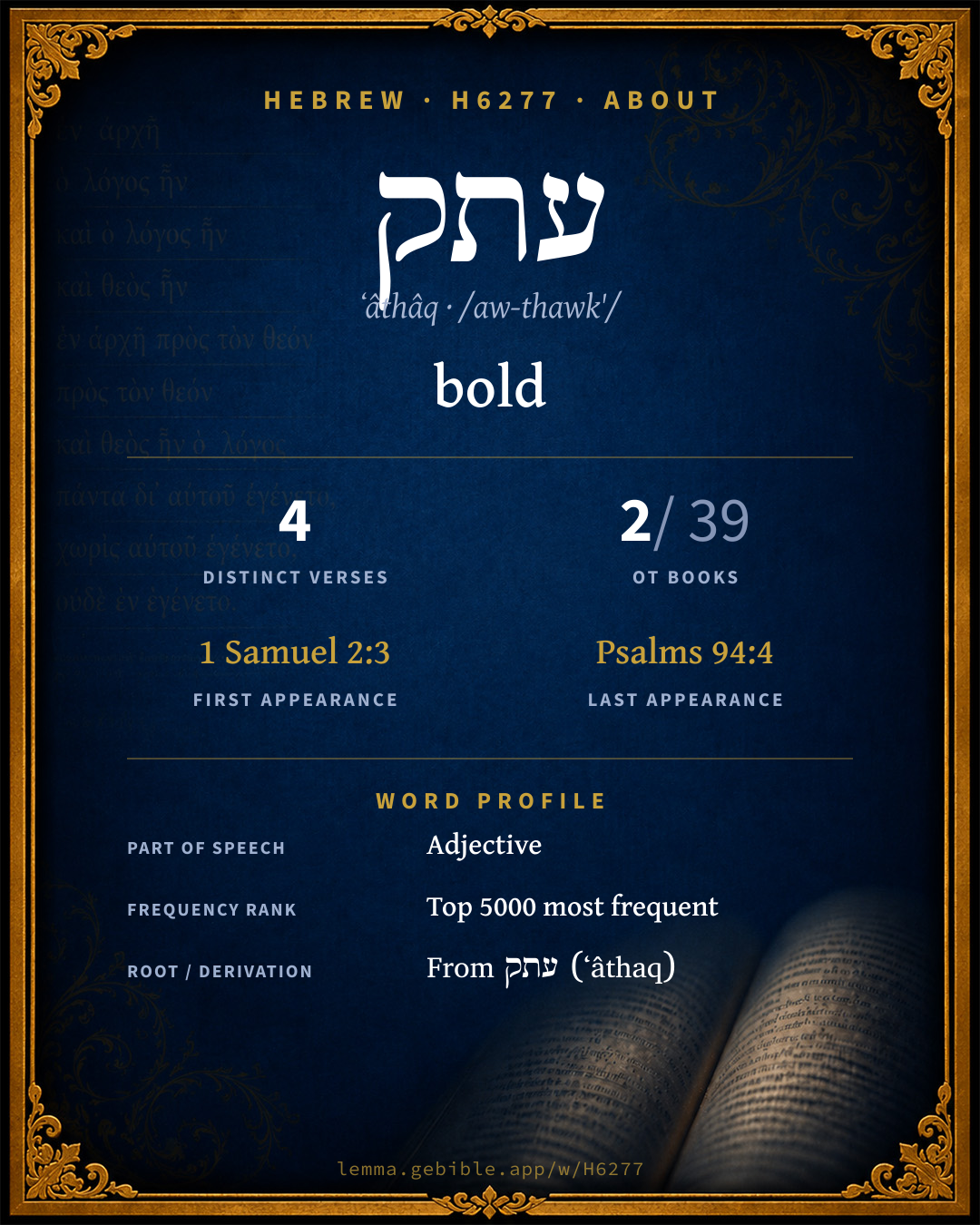
עָתָק
bold
also: forward, arrogant fuller range ↓
Full lexicon entry — Brown-Driver-Briggs (BDB)
From Brown-Driver-Briggs (BDB)
Where this word appears
Grammar key — what these labels mean
Part of speech
- Adjective
- A word that describes or qualifies a noun.
- Noun
- A naming word — a person, place, thing, or idea.
Noun type
- Common
- A common noun — a general class of person, place, or thing (“king,” “city,” “water”), not a specific name.
State
- Absolute
- The independent form of a noun, not bound to a following word.
Gender
- Masculine
- Grammatically masculine.
Number
- Singular
- One.
Every verse where H6277 appears in the Book of Psalms — 3 distinct verses. Click any verse to open its interlinear word-by-word view. Verse text shown in the World English Bible for context — . Each verse’s Hebrew form is shown with its reference; the English is not keyword-highlighted, since the data carries no word-level English alignment. Use “Compare translations” on any verse to read it across multiple English versions. This concordance covers the Hebrew Bible; Septuagint (Greek Old Testament) occurrences are not indexed here.
Psalms
- Psalms 31:18 עָתָ֗ק n c ms Let the lying lips be mute, Which speak against the righteous insolently, with pride and contempt.
- Psalms 75:5 עָתָֽק n c ms Don't lift up your horn on high. Don't speak with a stiff neck."
- Psalms 94:4 עָתָ֑ק adj Adjective ms They pour out arrogant words. All the evil-doers boast.
About this entry
At a glance — auto-summarized from this page’s data, not written by a person. Every figure links to its source below. This summary describes the numbers; it doesn’t interpret them.
“bold” is the headline sense of the Hebrew adjective עתק (ʻâthâq). The Hebrew Bible uses it only 4 verses. It clusters heavily in Psalms, which alone accounts for 75% of its uses. First canonically at 1 Samuel 2:3, it enters the text early. Lexicons map it across 2 senses — beyond “bold” it also covers “forward” and “arrogant”. See the sense tree, 4-verse concordance, and the renderings breakdown below.
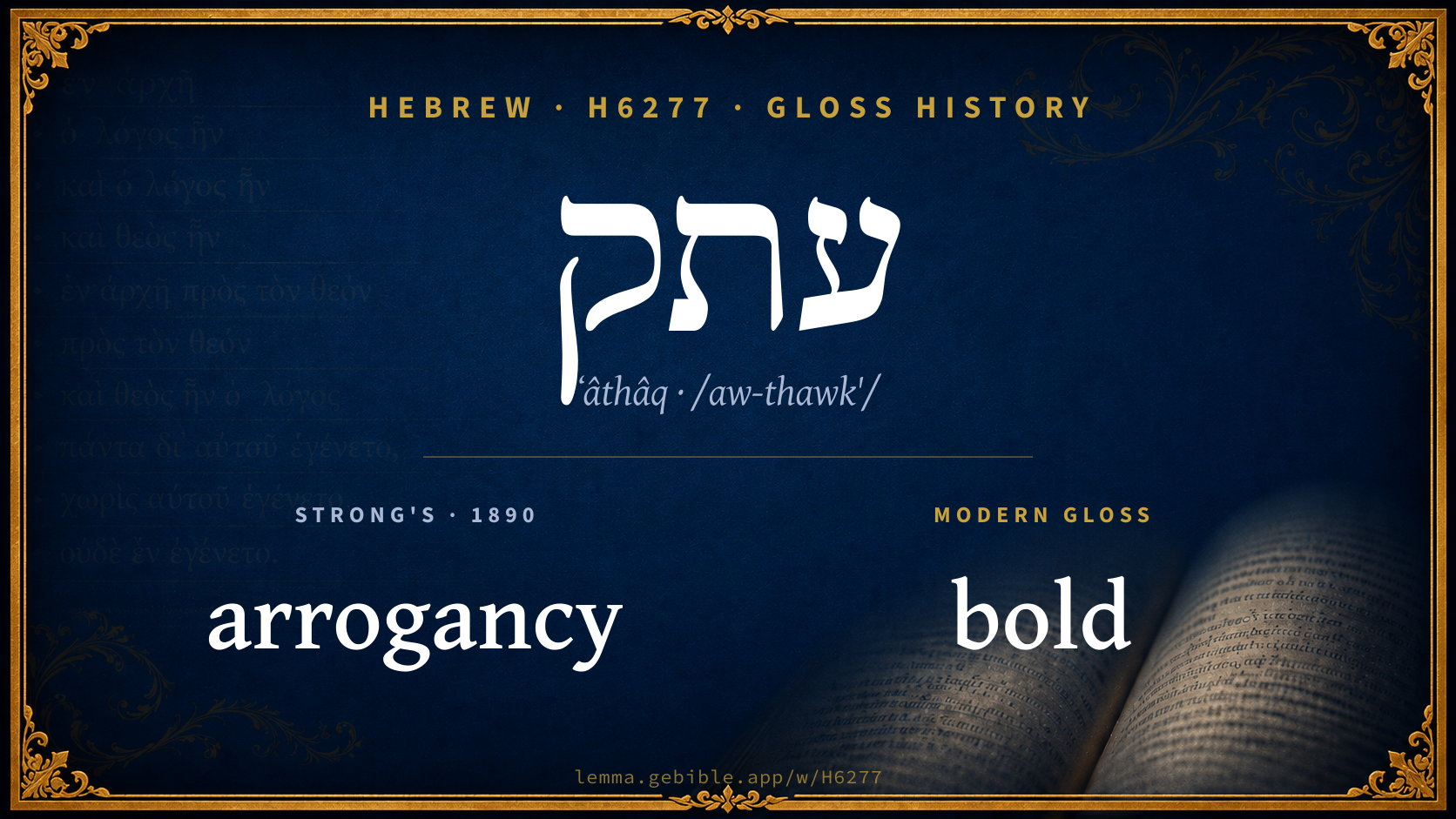
Gloss history
Strong's 1890 vs modern scholarship
About this word
Strong's H6277 catalogs a Hebrew word from the Hebrew Old Testament.
These counts are not copied from any lexicon or concordance. They are computed here, from the morphology-tagged Hebrew Old Testament. What Lemma adds →
- 4
- distinct verses
- The word appears in 4 distinct verses.
- 2 / 39
- OT books
- The word appears in 2 of 39 Old Testament books.
- #3,696
- by frequency
- Top 5000 most frequent Hebrew words (rank 3,696 of 8,640 Hebrew words by occurrence).
View all 4 occurrences in the concordance →
By traditional corpus
Conventional, traditional groupings — biblical authorship is debated, so this is a traditional corpus grouping, not an authorship claim. Each share is this word’s portion of its verses in that division of the Hebrew canon. Each figure is a share of the word’s 4 distinct verses.
- Writings (Ketuvim) 3 verses · 75%
- Prophets (Nevi'im) 1 verse · 25%
How translations render this word
Counts come from each version’s own published word-to-Strong’s tagging or interlinear alignment — an approximate guide to how each version renders this word, not a word-level alignment the data otherwise carries. Because each total is that version’s own tagged count, the per-version totals vary from one another and need not match the appearance or distinct-verse counts above. These counts may also differ from a printed concordance because Lemma counts each distinctly tagged rendering and does not collapse phrase taggings into a single head-word total. This is a fixed set of word-tagged versions (KJV, ASV, BSB, ULT) and does not change with the reading translation you choose elsewhere. Each version’s license is shown beside its name below (and on Sources).
- King James Version: Grievous 1×, Hard things 1×, Let not arrogancy 1×
- American Standard Version: Arrogantly 1×, Insolently 1×, Let not arrogancy 1×
- Berean Standard Bible: Arrogance 1×, Arrogant 1×, Or let arrogance 1×
- unfoldingWord Literal Text: Arrogant 2×
King James Version Public Domain
Renders H6277 across 4 tagged occurrences — most commonly:
American Standard Version Public Domain
Renders H6277 across 4 tagged occurrences — most commonly:
Berean Standard Bible Public Domain
Renders H6277 across 4 tagged occurrences — most commonly:
unfoldingWord Literal Text CC BY-SA 4.0
Renders H6277 across 4 tagged occurrences — most commonly:
Plus 2 renderings that appear only once — usually multi-word phrases or single function words the recovered tagging swept in, not distinct renderings.
Senses in BDB
The 2 senses BDB distinguishes for this word, in lexicon order (not ranked by frequency or importance). The full entry — with sub-senses — is in the Lexicon Entry tab.
- forward, bold, arrogant
- of speech
Word origin
adj. forward, arrogant (of speech) (Thes free (v. Arabic), unrestrained);—1 S 2:3 ψ 31:19; 94:4; so also 75:6 (cf. צַוָּאר).
— Brown-Driver-Briggs (Oxford 1906, public domain), digitized via Sefaria, supplemented by the OpenScriptures HebrewLexicon (CC BY 4.0). See Sources.
Derived from עתק (ʻâthaq) (H6275) — to advance.
Jastrow Dictionary
A second Hebrew/Aramaic lexicon for comparison, covering Aramaic and post-biblical (Talmudic, Targumic, Midrashic) usage that the biblical-Hebrew BDB does not. Matched by lemma rather than by Strong’s number, so a lemma may carry more than one Jastrow headword (shown separately below), and the entries cover usage well beyond the Bible.
עָתַק I
- (b. h.) to move. Gen. R. s. 52, beg. (expl. יעתק, Job XIV, 18) פנה ממקומו he (Abraham) moved from where he was; Yalk. ib. 87; Yalk. Job 906. e.g. Job 14:18
- to remove, transfer. Y. Ḥag. II, 77ᶜ top (ref. to Ps. XXXI, 19 הדוברות … עתק) הדוברות על צדיקי של עולם דברים שה׳ מבריותיו who speak concerning the Righteous One of the world words which he has withheld from his creatures (esoteric philosophy); Yalk. Ps. 715; Gen. R. s. 1 שה׳ בבריותיו (corr. acc., v. ‘Rashi’ a. l.). Ruth R. to I, 1 (ref. to I Chr. IV, 22) דברים הללו נאמרו ממַעְתִּיקוֹ של עולם וכ׳ these words were spoken by Him who moves the world (by ref. to ויעתק, Gen. XII, 8); (Yalk. Chr. 1074 דברים הללו מעתיקו, v. עַתִּיק). Yalk. Prov. 961 (ref. to העתיקו, Prov. XXV, 1) העתיקו מלמד שגנוזים היו ‘hʿetiḳu’ (they removed), this shows that they were suppressed (v. גָּנַז). Ib. דבר אחר אין העתיקו אלא פירשו וכ׳ another interpretation is, hʿetiḳu means ‘they set aside’ (ref. to Gen. XII, 8), i.e. translated, interpreted (v. פָּרַשׁ, a. cmp. the later use of העתיק to edit, to translate); Ab. d’R. N. ch. I, 2ⁿᵈ Vers. (ed. Schechter, p. 3) אין העתיקו אלא שפרשו; ib. 1ˢᵗ Vers. לא שהמתינו אלא שפירשו, v. next w. e.g. Psalms 31:19
- to be removed. Koh. R. to I, 8 (in enigmatic speech) ואני הוּעְתַּקְתִּי לכאן להחיש מחיה and I have come here to accelerate the growth (of hair).
- to be removed, transferred. Esth. R. to I, 1 הנֶעְתָּקִין, v. קִינְסִין. Yalk. Chr. 1076 (ref. to I Chr. l. c.) אפי׳ … שנִתְעַתְּקוּ מהם החזירם even things which had been removed from them (esoteric thoughts) did he bring back; Ruth R. l. c. (not שנתעסקו).
עָתַק II
- to be substantial, strong; (cmp. יָשִׁישׁ) to be old.—Denom. עַתִּיק.
- (denom. of עַתִּיק; cmp. זָקַן Nithpa.) to be long in deliberating, mature. Ab. d’R. N. ch. I (expl. העתיקו, Prov. XXV, 1) ולא שהעתיקו אלא שהמתינו and hʿetiḳu means, ‘which they considered maturely’; אבא שאול אומר לא שהמתינו אלא שפירשו Abba S. says, it does not mean ‘which they considered maturely’, but ‘which they set aside’, v. preced. e.g. Proverbs 25:1
עֲתַק
- , to be old, worn out. Targ. Lam. III, 4 (h. text בלה).
- 1. to remain long, be settled permanently. Targ. Deut. IV, 25 (h. text ונושנתם). Targ. Ez. XXXIV, 25 (h. text וְיָשְׁנוּ!).
- 2. to grow old. Targ. Y. Lev. XXVI, 10 דמִיעַתַּק (ed. Vien. דמְעַתַּק Part. pass. Pa.).—Targ. Y. Deut. XXVIII, 59 דמִתְעַתְּקִין (inveterate, chronic).
A Dictionary of the Targumim, the Talmud Babli and Yerushalmi, and the Midrashic Literature (Marcus Jastrow; London, Luzac, 1903) — Public Domain. Digitized via Sefaria. Digitized via Sefaria. Full attribution on Sources.
Forms in the corpus
The 4 distinct written forms H6277 takes in the Hebrew Bible, most frequent first — each parse links to that state’s occurrences in the concordance. Hebrew forms include their vowel points and cantillation, so a single lemma takes many written forms.
| Form | Parsing | Example | Uses |
|---|---|---|---|
| עָתָ֑ק | Adjective, Adjective, Masculine, Singular, Absolute | Psalms 94:4 | 1 |
| עָתָ֖ק | Adjective, Adjective, Masculine, Singular, Absolute | 1 Samuel 2:3 | 1 |
| עָתָ֗ק | Noun, Common, Masculine, Singular, Absolute | Psalms 31:18 | 1 |
| עָתָֽק | Noun, Common, Masculine, Singular, Absolute | Psalms 75:5 | 1 |
Same root — word family
Other BDB entries built from the same root as H6277, grouped by Strong’s listed origin. These share a root / origin per the lexicon — not necessarily a shared meaning. Each links to that word’s own entry.
Derives from
Shares the same root
Compare all same-root words → Showing 4 of 5 — not the complete family. They share a root, not necessarily a meaning.
Septuagint verse parallels
This word appears in 3 verses that also exist in the Greek Old Testament (Septuagint), out of the 4 Hebrew verses it occurs in. You can read those verses in Greek by switching the Old Testament edition to the Septuagint.
Read these verses in the Septuagint
This is a verse-level parallel only — the same verses exist in both the Hebrew and Greek Old Testaments. No word-level Hebrew↔Greek correspondence is claimed: the data carries no such alignment, so no Greek word is shown as this Hebrew word’s translation. Coverage is not total — the Septuagint omits the deuterocanon and renumbers the Psalms, so some Hebrew verses have no direct Greek parallel.