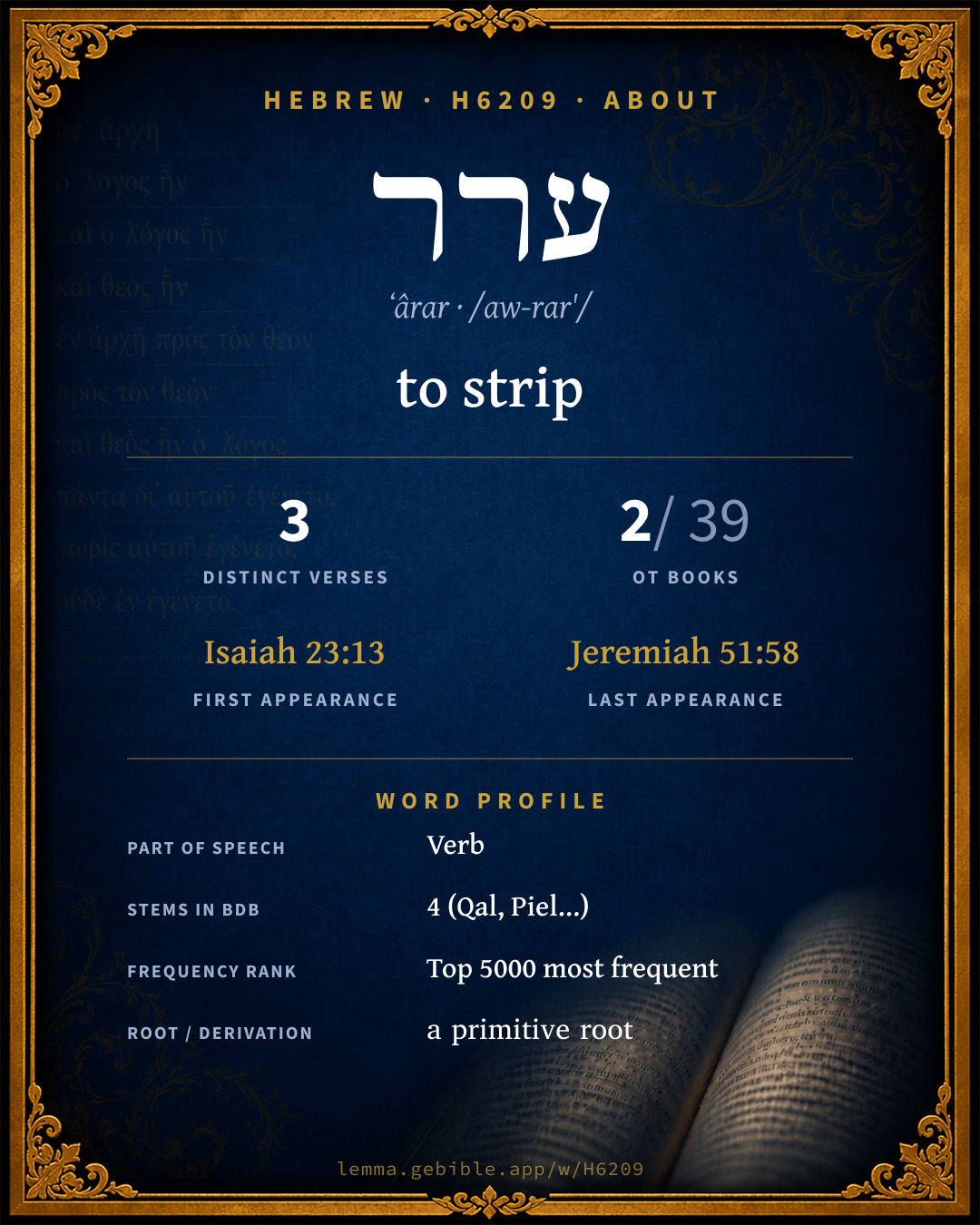
עָרַר
to strip
also: make bare, strip oneself fuller range ↓
Full lexicon entry — Brown-Driver-Briggs (BDB)
From Brown-Driver-Briggs (BDB)
Where this word appears
See every Hithpalpel verb in the Hebrew Bible →
Grammar key — what these labels mean
Part of speech
- Verb
- An action or state-of-being word.
Stem
- Qal
- The basic, simple active stem — the plain form of the verb (“he wrote”).
- Pilpel
- A reduplicated intensive stem of two-letter or hollow roots.
Form
- Imperative
- A direct command (“write!”).
- Imperfect
- An incomplete, ongoing, or future action (“he will / would write”).
- Infinitive Absolute
- An unbound verbal noun, often intensifying or standing in for a finite verb.
- Perfect
- A completed action or state — Hebrew marks aspect (completeness) more than strict tense (“he wrote”).
Person
- 2nd Person
- The one addressed (“you”).
- 3rd Person
- The one spoken about (“he / she / it / they”).
Gender
- Feminine
- Grammatically feminine.
- Common
- Either gender — not distinguished for this form.
Number
- Plural
- More than one (in Hebrew, generally three or more).
- Singular
- One.
1 distinct verse where H6209 appears in the Qal stem, across 1 book. Filtered view — show all forms. Click any verse to open its interlinear word-by-word view. Verse text shown in the World English Bible for context — . Each verse’s Hebrew form is shown with its reference; the English is not keyword-highlighted, since the data carries no word-level English alignment. Use “Compare translations” on any verse to read it across multiple English versions. This concordance covers the Hebrew Bible; Septuagint (Greek Old Testament) occurrences are not indexed here.
Isaiah 1 verse
About this entry
At a glance — auto-summarized from this page’s data, not written by a person. Every figure links to its source below. This summary describes the numbers; it doesn’t interpret them.
At its core, ערר (ʻârar) means “to strip.” The Hebrew Bible uses it only 3 verses. The word gravitates to Isaiah (67%), then Jeremiah. Scripture first uses it in Isaiah 23:13. The verb spans 4 stems, from Qal to Piel. Each statement above links to its evidence; the full detail follows below.
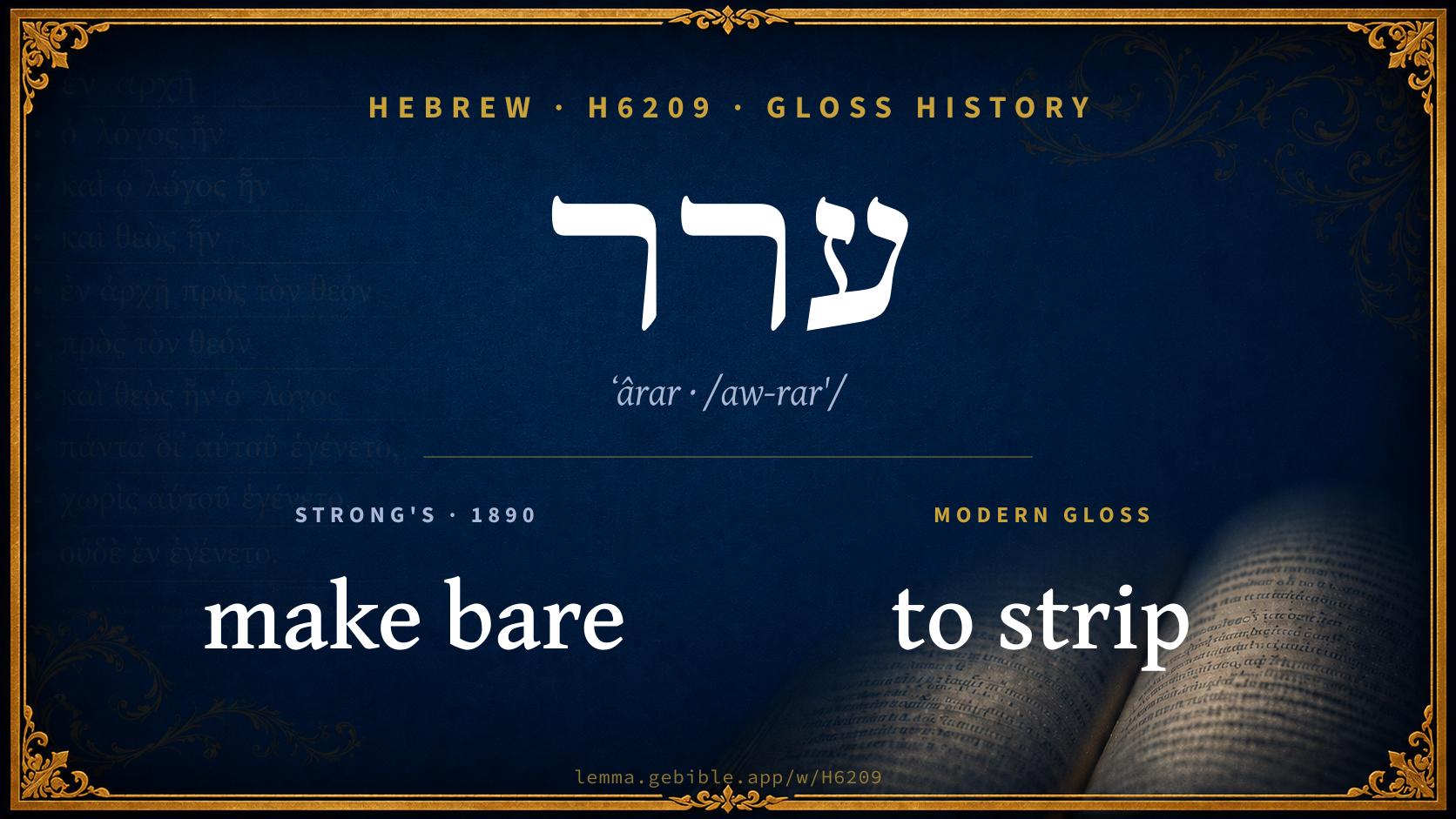
Gloss history
Strong's 1890 vs modern scholarship
About this word
Strong's H6209 catalogs a Hebrew word from the Hebrew Old Testament.
These counts are not copied from any lexicon or concordance. They are computed here, from the morphology-tagged Hebrew Old Testament. What Lemma adds →
- 3
- distinct verses
- The word appears in 3 distinct verses.
- 2 / 39
- OT books
- The word appears in 2 of 39 Old Testament books.
- #3,696
- by frequency
- Top 5000 most frequent Hebrew words (rank 3,696 of 8,640 Hebrew words by occurrence).
View all 3 occurrences in the concordance →
By traditional corpus
Conventional, traditional groupings — biblical authorship is debated, so this is a traditional corpus grouping, not an authorship claim. Each share is this word’s portion of its verses in that division of the Hebrew canon. Each figure is a share of the word’s 3 distinct verses.
- Prophets (Nevi'im) 3 verses · 100%
How translations render this word
Counts come from each version’s own published word-to-Strong’s tagging or interlinear alignment — an approximate guide to how each version renders this word, not a word-level alignment the data otherwise carries. Because each total is that version’s own tagged count, the per-version totals vary from one another and need not match the appearance or distinct-verse counts above. These counts may also differ from a printed concordance because Lemma counts each distinctly tagged rendering and does not collapse phrase taggings into a single head-word total. This is a fixed set of word-tagged versions (KJV, ASV, BSB, ULT) and does not change with the reading translation you choose elsewhere. Each version’s license is shown beside its name below (and on Sources).
- King James Version: Broken 1×, Shall be utterly 1×, Thereof they raised up 1×
- American Standard Version: Overthrown 1×, Shall be utterly 1×, They overthrew 1×
- Berean Standard Bible: Stripped 1×, Will be leveled 1×, Yourselves bare 1×
- unfoldingWord Literal Text: Bare 1×, They stripped 1×, Yourselves 1×
King James Version Public Domain
Renders H6209 across 4 tagged occurrences — most commonly:
American Standard Version Public Domain
Renders H6209 across 4 tagged occurrences — most commonly:
Berean Standard Bible Public Domain
Renders H6209 across 3 tagged occurrences — most commonly:
Not rendered by a distinct English word in 1 further occurrence.
unfoldingWord Literal Text CC BY-SA 4.0
Renders H6209 across 3 tagged occurrences — most commonly:
Senses in the full BDB
Hebrew verbs can shift meaning by stem (binyan): Qal is the basic action, Niphal is often passive or reflexive, Piel often intensifies or makes it factitive, and Hiphil is typically causative. The senses below are grouped under the stem BDB assigns to each. This entry also uses one or more reduplicated stems (the Pōlēl/Pilpēl type), which for hollow or geminate roots behave much like Piel — often intensive or iterative.
What do BDB’s symbols mean?
BDB uses these scholarly abbreviations:
| Symbol | Meaning |
|---|---|
| 𝔊 | the Septuagint (the ancient Greek translation, LXX) |
| 𝔙 | the Vulgate (the Latin translation) |
| 𝔖 | the Syriac version (the Peshitta) |
| 𝔗 | the Targum (the Aramaic translation) |
| ψ | the Psalms |
| √ | root (the underlying root or stem) |
| ‖ | parallel passage (a synonymous or contrasted parallel) |
| † | the dagger: every passage where the word occurs is cited |
The 4 senses and sub-senses the full Brown-Driver-Briggs lexicon distinguishes for this word, in lexicon order (not ranked by frequency), with BDB’s own verbatim wording and sub-sense lettering. Shown in Hebrew script with BDB’s own scholarly abbreviations. The condensed entry is in the Lexicon Entry tab. See also the Forms in the corpus table below.
Qal
- Imv. עֹ֫רָה Is 32:11 (‖ פְּשֹׁ֫טָה; according to Ges§ 110 k Hi De al. ms. with fpl. subj.; according to Ew§ 226 a Du Di al. fpl., shortened from ערנה etc.). Pōʿ. Pf. 3 pl. עוֹרְרוּ אַרְמְנוֹתֶיהָ Is 23:13 they have laid bare (the foundations of) her palaces, i.e. destroyed them; so e.g. Isaiah 32:11
Pilp
- Inf. abs. +
Hithpalp
- Impf. 3 fs. עַרְעֵר תִּתְעַרְעַר Je 51:58 be laid utterly bare, cf. ערה e.g. Jeremiah 51:58
Piel
- 1.
Senses from the full Brown-Driver-Briggs lexicon (Brown, Driver, Briggs; Oxford 1906 — public domain), digitized via Sefaria, supplemented by the OpenScriptures HebrewLexicon (CC BY 4.0). Full attribution on Sources.
Word origin
vb. strip oneself (‖ form of ערה, II. עור);—
— Brown-Driver-Briggs (Oxford 1906, public domain), digitized via Sefaria, supplemented by the OpenScriptures HebrewLexicon (CC BY 4.0). See Sources.
Origin: a primitive root
Jastrow Dictionary
A second Hebrew/Aramaic lexicon for comparison, covering Aramaic and post-biblical (Talmudic, Targumic, Midrashic) usage that the biblical-Hebrew BDB does not. Matched by lemma rather than by Strong’s number, so a lemma may carry more than one Jastrow headword (shown separately below), and the entries cover usage well beyond the Bible.
עָרַר
- , Pi. עֵירֵר (v. עִרְעֵר I) [to stir up,] to protest, contest, object. Y. Gitt. I, 43ᶜ top אם בא ועי׳ עררו בטל if the husband comes and contests (the validity of his letter of divorce), his objection is null and void. Ib. הוא ערר משנישאת הוא ע׳ וכ׳ it is all the same whether he objects after she has remarried or before it. Y. Keth. II, beg. 26ᵃ נתאלמנה מי עוֹרֵר וכ׳ if she is a widow, who objects (opposes the woman’s claim)? Gitt. I, 3 אם יש עליו עוֹרְרִים if there are contestants against it (the letter of divorce); a. fr.
- to be stirred up. Tosef. Sot. II, 2 אפי׳ … המים מִתְעָרְרִין עליה Var. (ed. Zuck. המים היה מִתְרַעְרְעִין, read: המים מתר׳ or מִתְעַרְעֲרִין) even if she goes astray twenty years afterwards, the waters will be stirred up (work injury) in her body.
עֲרַר I
- , to object. Y. Keth. VII, 31ᶜ top הויין קריביה עַרְרִין ואמרין וכ׳ the relatives objected (to the verdict) and said &c. Ib. VI, 30ᵈ top אשכחינון עֲרִירִין he found them disputing (about the amount to be allowed for the wife’s toilet).
- to stir up, incite. Targ. Is. IX, 10.
עֲרָר
- = עַרְעָר, protest, objection, claim. Y. Gitt. I, 43ᶜ top עֲרָרוֹ בטל, v. עָרַר. Y. Keth. IX, beg. 32ᵈ כל ע׳ שיש לי בשדה זו whatever claim I may have on this field. Y. R. Hash. III, 58ᵈ top קרא ע׳ על וכ׳ if objection was raised against the signature &c. Y. Gitt. I, 43ᶜ bot ע׳ שבגיפו an objection based on an alleged informality of the document itself; ע׳ שחוץ לגופו an objection not concerning the document itself (e.g. that the letter of divorce was given conditionally).
עֲרַר II
- Targ. Y. Deut. XXII, 14; 17 (not ערד; h. text עלילת).—[עֲרָר, Targ. Y. II, Gen. XX, 2 (ed. Vien. ערד), read: גְּרָר.]
A Dictionary of the Targumim, the Talmud Babli and Yerushalmi, and the Midrashic Literature (Marcus Jastrow; London, Luzac, 1903) — Public Domain. Digitized via Sefaria. Digitized via Sefaria. Full attribution on Sources.
Forms in the corpus
The 4 distinct written forms H6209 takes in the Hebrew Bible, most frequent first — each parse links to that stem’s occurrences in the concordance. Hebrew forms include their vowel points and cantillation, so a single lemma takes many written forms.
| Form | Parsing | Example | Uses |
|---|---|---|---|
| וְ/עֹ֔רָה | Verb, Qal, Imperative, 2nd Person, Feminine, Plural | Isaiah 32:11 | 1 |
| עַרְעֵ֣ר | Verb, Pilpel, Infinitive Absolute | Jeremiah 51:58 | 1 |
| עֹרְרוּ֙ | Verb, Poel, Perfect, 3rd Person, Common, Plural | Isaiah 23:13 | 1 |
| תִּתְעַרְעָ֔ר | Verb, Hithpalpel, Imperfect, 3rd Person, Feminine, Singular | Jeremiah 51:58 | 1 |
Same root — word family
Other BDB entries built from the same root as H6209, grouped by Strong’s listed origin. These share a root / origin per the lexicon — not necessarily a shared meaning. Each links to that word’s own entry.
Derived from this word
Compare all same-root words → They share a root, not necessarily a meaning.
Septuagint verse parallels
This word appears in 2 verses that also exist in the Greek Old Testament (Septuagint), out of the 3 Hebrew verses it occurs in. You can read those verses in Greek by switching the Old Testament edition to the Septuagint.
Read these verses in the Septuagint
This is a verse-level parallel only — the same verses exist in both the Hebrew and Greek Old Testaments. No word-level Hebrew↔Greek correspondence is claimed: the data carries no such alignment, so no Greek word is shown as this Hebrew word’s translation. Coverage is not total — the Septuagint omits the deuterocanon and renumbers the Psalms, so some Hebrew verses have no direct Greek parallel.