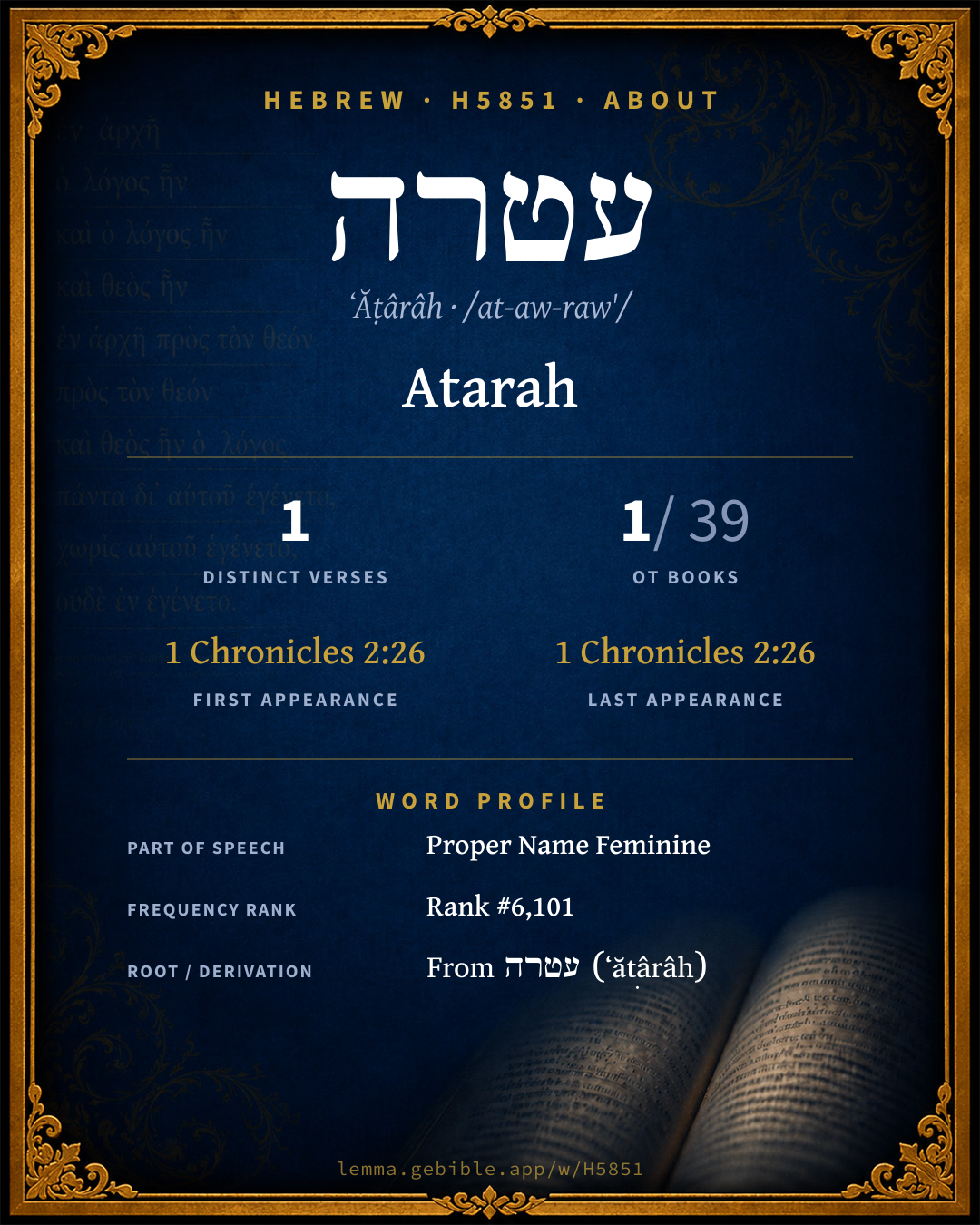
עֲטָרָה
Atarah
BDB lists 2 entries for ‘Atarah’ fuller range ↓
Full lexicon entry — Brown-Driver-Briggs (BDB)
From Brown-Driver-Briggs (BDB)
Where this word appears
Grammar key — what these labels mean
Part of speech
- Noun
- A naming word — a person, place, thing, or idea.
Noun type
- Proper
- A name of a specific person, place, or people (e.g. Abraham, Zion, Israel).
Every verse where H5851 appears — 1 distinct verse across 1 book. Click any verse to open its interlinear word-by-word view. Verse text shown in the World English Bible for context — . Each verse’s Hebrew form is shown with its reference; the English is not keyword-highlighted, since the data carries no word-level English alignment. Use “Compare translations” on any verse to read it across multiple English versions. This concordance covers the Hebrew Bible; Septuagint (Greek Old Testament) occurrences are not indexed here.
1 Chronicles 1 verse
About this entry
At a glance — auto-summarized from this page’s data, not written by a person. Every figure links to its source below. This summary describes the numbers; it doesn’t interpret them.
עטרה — transliterated ʻĂṭârâh — is a Hebrew name carrying the sense “Atarah.” It occurs a mere 1 verse across Scripture. Its uses cluster heavily in 1 Chronicles (100% of all occurrences). Scripture uses it exactly once, at 1 Chronicles 2:26. See 1-verse concordance and the renderings breakdown below.
Gloss history
Strong's 1890 vs modern scholarship
About this word
Strong's H5851 catalogs a Hebrew word from the Hebrew Old Testament.
These counts are not copied from any lexicon or concordance. They are computed here, from the morphology-tagged Hebrew Old Testament. What Lemma adds →
- 1
- distinct verses
- The word appears in 1 distinct verse.
- 1 / 39
- OT books
- The word appears in 1 of 39 Old Testament books.
- #6,101
- by frequency
- Rank #6,101 (rank 6,101 of 8,640 Hebrew words by occurrence).
View all 1 occurrence in the concordance →
Most concentrated in
- 1 Chronicles 1 verse 100%
By section of the Old Testament
By traditional corpus
Conventional, traditional groupings — biblical authorship is debated, so this is a traditional corpus grouping, not an authorship claim. Each share is this word’s portion of its verses in that division of the Hebrew canon. Each figure is a share of the word’s 1 distinct verse.
- Writings (Ketuvim) 1 verse · 100%
How translations render this word
Counts come from each version’s own published word-to-Strong’s tagging or interlinear alignment — an approximate guide to how each version renders this word, not a word-level alignment the data otherwise carries. Because each total is that version’s own tagged count, the per-version totals vary from one another and need not match the appearance or distinct-verse counts above. These counts may also differ from a printed concordance because Lemma counts each distinctly tagged rendering and does not collapse phrase taggings into a single head-word total. This is a fixed set of word-tagged versions (KJV, ASV, BSB, ULT) and does not change with the reading translation you choose elsewhere. Each version’s license is shown beside its name below (and on Sources).
BDB lists this Strong’s number as 2 distinct words (homographs). Each count above pools all of them and is not split by sense — see the Senses section below. A low-frequency rendering may belong to a different one of those words, not the primary meaning.
- King James Version†: Was atarah 1×
- American Standard Version†: Was atarah 1×
- Berean Standard Bible†: Atarah 1×
- unfoldingWord Literal Text†: Was atarah 1×
King James Version Public Domain
Renders H5851 across 1† tagged occurrence — most commonly:
American Standard Version Public Domain
Renders H5851 across 1† tagged occurrence — most commonly:
Berean Standard Bible Public Domain
Renders H5851 across 1† tagged occurrence — most commonly:
unfoldingWord Literal Text CC BY-SA 4.0
Renders H5851 across 1† tagged occurrence — most commonly:
Senses in the full BDB
What do BDB’s symbols mean?
BDB uses these scholarly abbreviations:
| Symbol | Meaning |
|---|---|
| 𝔊 | the Septuagint (the ancient Greek translation, LXX) |
| 𝔙 | the Vulgate (the Latin translation) |
| 𝔖 | the Syriac version (the Peshitta) |
| 𝔗 | the Targum (the Aramaic translation) |
| ψ | the Psalms |
| √ | root (the underlying root or stem) |
| ‖ | parallel passage (a synonymous or contrasted parallel) |
| † | the dagger: every passage where the word occurs is cited |
The 3 senses and sub-senses the full Brown-Driver-Briggs lexicon distinguishes for this word, in lexicon order (not ranked by frequency), with BDB’s own verbatim wording and sub-sense lettering. Shown in Hebrew script with BDB’s own scholarly abbreviations. The condensed entry is in the Lexicon Entry tab.
- 1. of idol-image (Milcom, 𝔊 We Klo Dr Kit Löhr HPS) 2 S 12:30 = 1 Ch 20:2; golden, ע׳ פָּז ψ 21:4; ע׳ תִּפְאַרְתְּכֶם of king and queen, Je 13:18 the crown of your splendour; cf. Ez 21:31; wedding-crown Ct 3:11. e.g. 2 Samuel 12:30
- 2. ע׳ זָהָב Est 8:15 (of Mordecai); of silver and gold Zc 6:11, 14; ע׳ תִּפְאֶרֶת crown of splendour, on personif. Jerus. Ez 16:12 (in allegory), Jerus. and Samaria 23:42; ע׳ as appos. (= sim.) Jb 31:36. e.g. Esther 8:15
- 3. fig. of honour, etc., Jb 19:9 (‖ כְּבוֹדִי) La 5:16; אֵשֶׁת חַיִל ע׳ בַּעְלָהּ Pr 12:4, cf. 14:24; 17:6; ע׳ תִּפְאֶרֶת 16:31 (of שֵׂיבָה); gift of wisdom 4:9; fig. of Jerus. Is 62:3 (‖ צְנִיף מְלוּכָה), cf. ע׳ גֵאוּת 28:1, 3 fig. of Samaria; fig. of י׳, ע׳ צְבִי v 5 (‖ צְפִירַת תִּפְאָרָה). e.g. Job 19:9
Senses from the full Brown-Driver-Briggs lexicon (Brown, Driver, Briggs; Oxford 1906 — public domain), digitized via Sefaria, supplemented by the OpenScriptures HebrewLexicon (CC BY 4.0). Full attribution on Sources.
Word origin
I. n.f. crown, wreath;—abs. ע׳ Ez 21:31; Ct 3:11; cstr. עֲטֶרֶת 2 S 12:30 + 17 times; pl. עֲטָרוֹת Zc 6:11; Jb 31:36, עֲטָרֹת Zc 6:14;—crown:
II. n.pr.f. 1 Ch 2:26, Αταρα.
— Brown-Driver-Briggs (Oxford 1906, public domain), digitized via Sefaria, supplemented by the OpenScriptures HebrewLexicon (CC BY 4.0). See Sources.
Derived from עטרה (ʻăṭârâh) (H5850) — crown.
Jastrow Dictionary
A second Hebrew/Aramaic lexicon for comparison, covering Aramaic and post-biblical (Talmudic, Targumic, Midrashic) usage that the biblical-Hebrew BDB does not. Matched by lemma rather than by Strong’s number, so a lemma may carry more than one Jastrow headword (shown separately below), and the entries cover usage well beyond the Bible.
עֲטָרָה
- 1. protection. Gen. R. s. 63, beg. (ref. to Prov. XVII, 6) האבות ע׳ לבנים והבנים ע׳ וכ׳ the fathers are a protection to their children (who are saved for their parents’ sake), and the children are a protection to their fathers; v. עָטַר Hithpa. e.g. Proverbs 17:6
- 2. wreath, crown, decoration. Ex. R. s. 5 לא היה יודע לשלח לי ע׳ did (your God) not have sense enough to send me a crown? Y. Sot. IX, 24ᵇ bot. ע׳ של זית a wreath of olive leaves; Lam. R. to V, 16 עֲטֶרֶת זית. Tosef. Sot. XV, 3 בטלה עטרת חכמים שעטרת חכמים עושרם the crown (or protection) of the scholars ceased, for the crown of the scholars is their wealth (independence, Prov. XIV, 24); Sot. 49ᵇ בטלו עַטְרוֹת וכ׳. Y. Dem. II, 22ᶜ bot., v. עָטַר Hithpa.—Yoma 69ᵇ החזירו ע׳ ליושנה they restored the crown (the praise of the Lord) to its original condition (by re-introducing the phrase האל הגדול הגבור והנורא; Y. Ber. VII, 11ᶜ הַגְּדוּלָּה). Ned. 62ᵃ; Ab. IV, 5 אל תעשם ע׳ וכ׳, v. גָּדַל. Meg. 15ᵇ; Snh. 111ᵇ עתיד הקב"ה להיות ע׳ וכ׳ the Lord, in the time to come, shall be a crown on the head of every righteous man (ref. to Is. XXVIII, 5); a. fr.—Pl. עֲטָרוֹת. Ab. Zar. IV, 2 ע׳ של שבלים wreaths of ears (used for idolatrous purposes); Y. ib. IV, 43ᵈ עַטְרוֹת שיבולים. Ib. ע׳ של וורד rose garlands. Sot. IX, 14 גזרו על ע׳ חתנים they forbade bridegrooms’ garlands; ע׳ כלות brides’ crowns. Ib. 49ᵇ איזהו ע׳ כלות עיר וכ׳ what brides’ crowns were forbidden? A golden representation of the city (of Jerusalem); a. fr.—Sabb. 87ᵇ אותו יום נטל עשר ע׳ that day carried off ten distinctions. e.g. Proverbs 14:24
- 3. a) brickwork of an oven. Kel. V, 3 עטרת כירה, v. טִירָה.—b) moulding, sill, cornice.—Pl. as ab. Ohol. XIV, 1. Midd. III, 8.—c) corona of the membrum virile. Yeb. 55ᵇ, a. e., v. הַכְנָסָה.—d) the ring around the teat of a woman, as a symptom of puberty. Nidd. 47ᵃ; 52ᵇ עד שתקיף הע׳ until a ring is formed around &c.; Tosef. ib. VI, 4 משתקיף הע׳ (not משיקיף); ib. 5; a. e.
A Dictionary of the Targumim, the Talmud Babli and Yerushalmi, and the Midrashic Literature (Marcus Jastrow; London, Luzac, 1903) — Public Domain. Digitized via Sefaria. Digitized via Sefaria. Full attribution on Sources.
Same root — word family
Other BDB entries built from the same root as H5851, grouped by Strong’s listed origin. These share a root / origin per the lexicon — not necessarily a shared meaning. Each links to that word’s own entry.
Derives from
Proper names from this root
People and places named from this root — a name, not an additional meaning of the word.
Compare all same-root words → 1 of the same-root words is a proper name (a person or place). They share a root, not necessarily a meaning.
Bible dictionary
Public-domain dictionary articles matched to this entry by name (Atarah). A biblical name can be shared by more than one person or place, so an article may treat several.
Smith's Bible Dictionary · William Smith, 1863
(a crown) a wife of Jerahmeel, and mother of Onam. (1 Chronicles 2:26)
Hitchcock's Bible Names Dictionary · Roswell D. Hitchcock, 1869
a crown
Classic public-domain reference works; full attribution on Sources.
Septuagint verse parallels
This word appears in 1 verse that also exists in the Greek Old Testament (Septuagint), out of the 1 Hebrew verse it occurs in. You can read those verses in Greek by switching the Old Testament edition to the Septuagint.
Read these verses in the Septuagint
This is a verse-level parallel only — the same verses exist in both the Hebrew and Greek Old Testaments. No word-level Hebrew↔Greek correspondence is claimed: the data carries no such alignment, so no Greek word is shown as this Hebrew word’s translation. Coverage is not total — the Septuagint omits the deuterocanon and renumbers the Psalms, so some Hebrew verses have no direct Greek parallel.