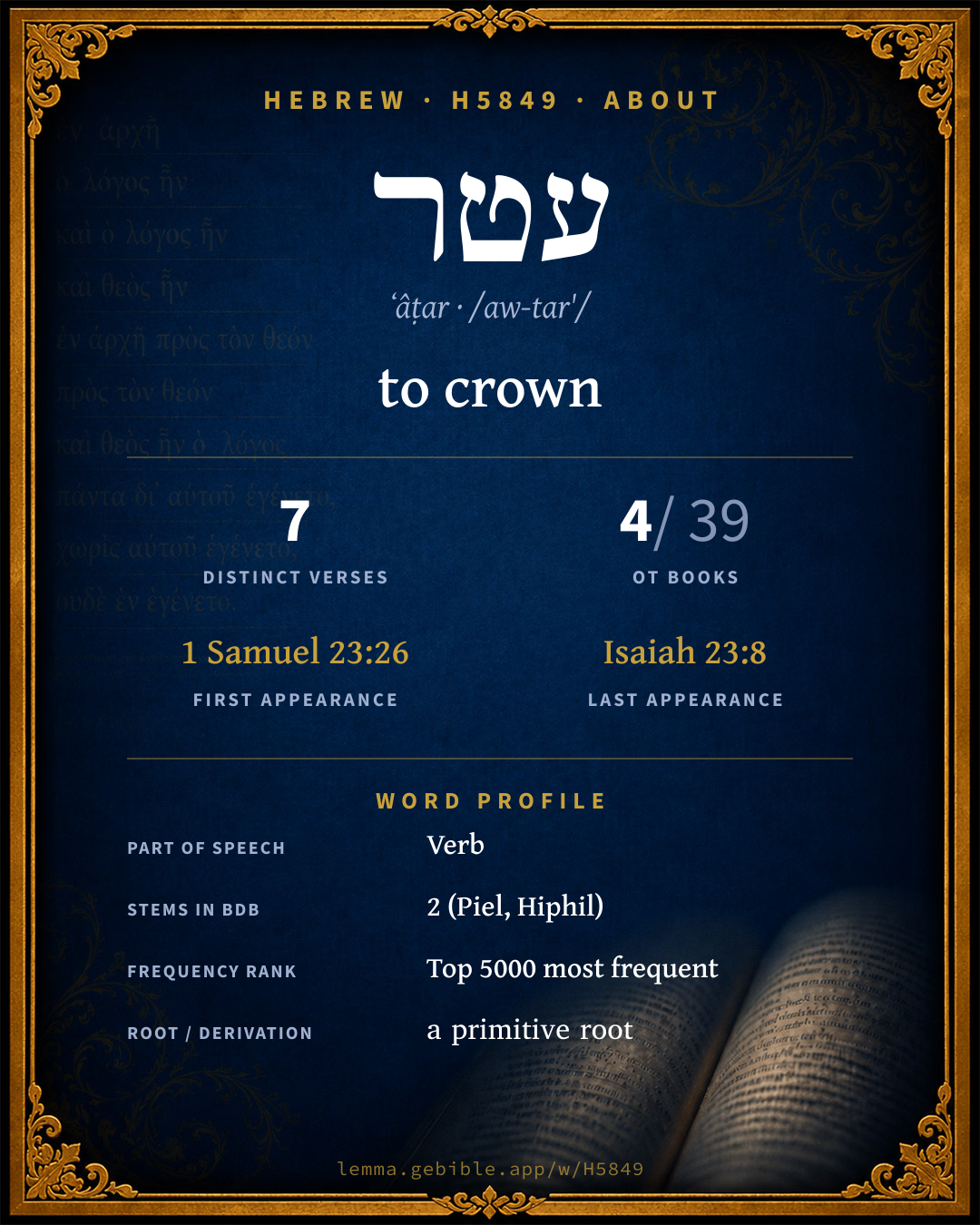
עָטַר
to crown
‘to crown’ is one of 3 main senses fuller range ↓
Full lexicon entry — Brown-Driver-Briggs (BDB)
From Brown-Driver-Briggs (BDB)
Where this word appears
See every Piel verb in the Hebrew Bible →
Grammar key — what these labels mean
Part of speech
- Verb
- An action or state-of-being word.
Stem
- Hiphil
- The causative active stem (“he caused / brought about”).
- Piel
- An intensive or resultative active stem.
- Qal
- The basic, simple active stem — the plain form of the verb (“he wrote”).
Form
- Participle Active
- A verbal adjective expressing ongoing or characteristic action (“writing / one who writes”).
- Perfect
- A completed action or state — Hebrew marks aspect (completeness) more than strict tense (“he wrote”).
- Imperfect
- An incomplete, ongoing, or future action (“he will / would write”).
State
- Absolute
- The independent form of a noun, not bound to a following word.
- Construct
- A noun bound to a following noun in a possessive / “of” relationship (the construct chain).
Person
- 3rd Person
- The one spoken about (“he / she / it / they”).
- 2nd Person
- The one addressed (“you”).
Gender
- Feminine
- Grammatically feminine.
- Masculine
- Grammatically masculine.
Number
- Singular
- One.
- Plural
- More than one (in Hebrew, generally three or more).
3 verses where H5849 appears in the Piel stem in the Book of Psalms. Filtered view — show all forms. Click any verse to open its interlinear word-by-word view. Verse text shown in the World English Bible for context — . Each verse’s Hebrew form is shown with its reference; the English is not keyword-highlighted, since the data carries no word-level English alignment. Use “Compare translations” on any verse to read it across multiple English versions. This concordance covers the Hebrew Bible; Septuagint (Greek Old Testament) occurrences are not indexed here.
Psalms
- Psalms 8:5 תְּעַטְּרֵֽ/הוּ Piel impf 2ms + sfx pers 3ms For you have made him a little lower than God, And crowned him with glory and honor.
- Psalms 65:11 עִ֭טַּרְתָּ Piel pf 2ms You crown the year with your bounty. Your carts overflow with abundance.
- Psalms 103:4 הַֽ֝/מְעַטְּרֵ֗/כִי ptcl def.art + Piel ptcp.act ms cs + sfx pers 2fs Who redeems your life from destruction; Who crowns you with loving kindness and tender mercies;
About this entry
At a glance — auto-summarized from this page’s data, not written by a person. Every figure links to its source below. This summary describes the numbers; it doesn’t interpret them.
עטר (ʻâṭar) is a Hebrew verb most often rendered “to crown.” Psalms dominates its distribution — 4 of 7 verses. The Hebrew Bible uses it across 7 verses — uncommon. It first appears in 1 Samuel 23:26. The verb spans 2 stems, from Piel to Hiphil. For the data behind this summary, explore the sense tree and the renderings breakdown below.
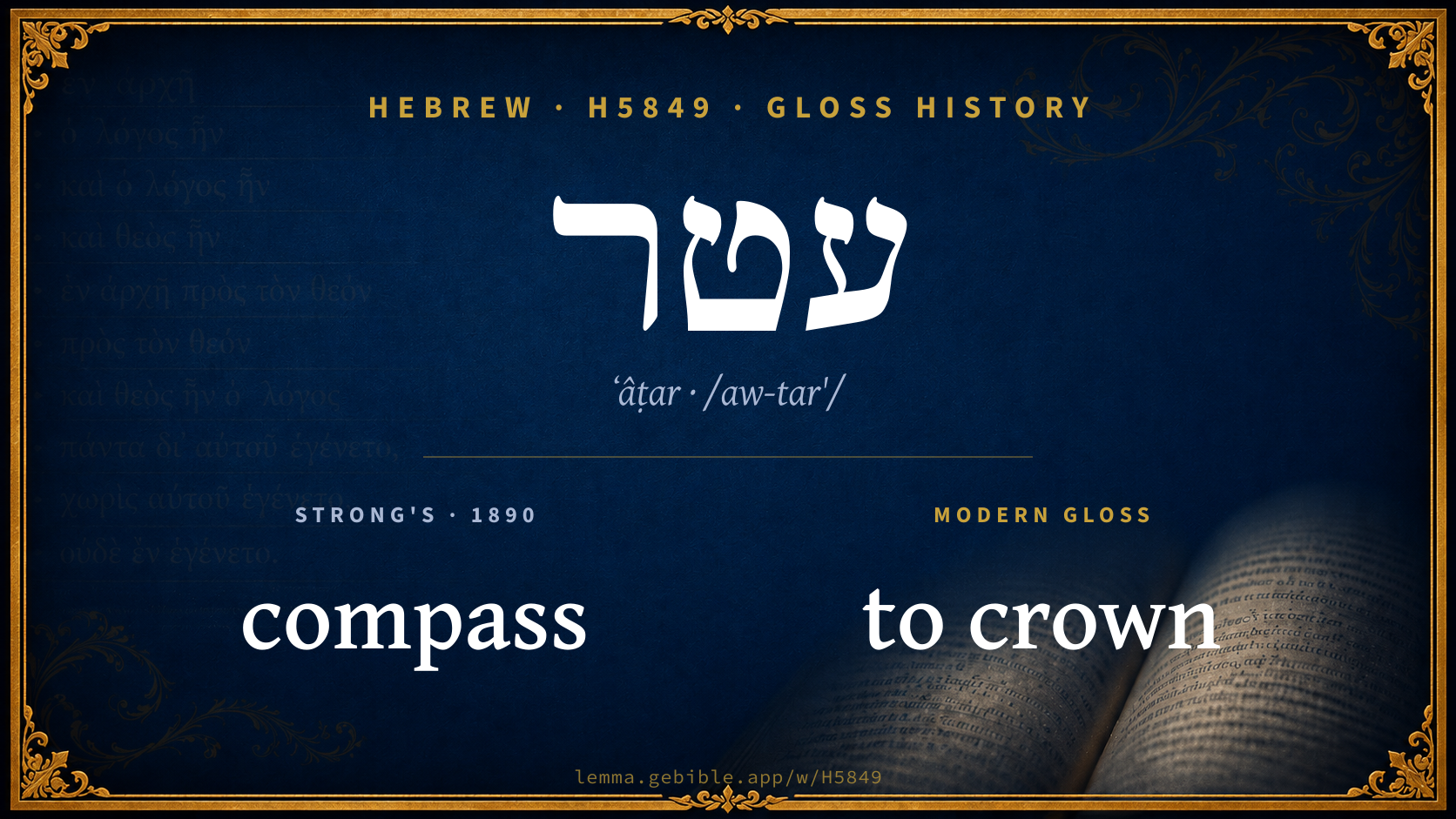
Gloss history
Strong's 1890 vs modern scholarship
About this word
Strong's H5849 catalogs a Hebrew word from the Hebrew Old Testament.
These counts are not copied from any lexicon or concordance. They are computed here, from the morphology-tagged Hebrew Old Testament. What Lemma adds →
- 7
- distinct verses
- The word appears in 7 distinct verses.
- 4 / 39
- OT books
- The word appears in 4 of 39 Old Testament books.
- #2,835
- by frequency
- Top 5000 most frequent Hebrew words (rank 2,835 of 8,640 Hebrew words by occurrence).
View all 7 occurrences in the concordance →
Most concentrated in
- Psalms 4 verses 57%
- 1 Samuel 1 verse 14%
- Song of Solomon 1 verse 14%
By section of the Old Testament
By traditional corpus
Conventional, traditional groupings — biblical authorship is debated, so this is a traditional corpus grouping, not an authorship claim. Each share is this word’s portion of its verses in that division of the Hebrew canon. Each figure is a share of the word’s 7 distinct verses.
- Writings (Ketuvim) 5 verses · 71%
- Prophets (Nevi'im) 2 verses · 29%
How translations render this word
Counts come from each version’s own published word-to-Strong’s tagging or interlinear alignment — an approximate guide to how each version renders this word, not a word-level alignment the data otherwise carries. Because each total is that version’s own tagged count, the per-version totals vary from one another and need not match the appearance or distinct-verse counts above. These counts may also differ from a printed concordance because Lemma counts each distinctly tagged rendering and does not collapse phrase taggings into a single head-word total. This is a fixed set of word-tagged versions (KJV, ASV, BSB, ULT) and does not change with the reading translation you choose elsewhere. Each version’s license is shown beside its name below (and on Sources).
BDB lists this Strong’s number as 2 distinct words (homographs). Each count above pools all of them and is not split by sense — see the Senses section below. A low-frequency rendering may belong to a different one of those words, not the primary meaning.
- King James Version†: Compassed 1×, Crowned 1×, Crowneth 1×
- American Standard Version†: Bestower of crowns 1×, Compassed 1×, Crownest 1×
- Berean Standard Bible†: Bestower of crowns 1×, Crowned 1×, Crowns 1×
- unfoldingWord Literal Text†: Crowned 1×, One crowning 1×, One crowning you with 1×
King James Version Public Domain
Renders H5849 across 8† tagged occurrences — most commonly:
American Standard Version Public Domain
Renders H5849 across 8† tagged occurrences — most commonly:
Berean Standard Bible Public Domain
Renders H5849 across 7† tagged occurrences — most commonly:
unfoldingWord Literal Text CC BY-SA 4.0
Renders H5849 across 8† tagged occurrences — most commonly:
Senses in the full BDB
Hebrew verbs can shift meaning by stem (binyan): Qal is the basic action, Niphal is often passive or reflexive, Piel often intensifies or makes it factitive, and Hiphil is typically causative. The senses below are grouped under the stem BDB assigns to each.
What do BDB’s symbols mean?
BDB uses these scholarly abbreviations:
| Symbol | Meaning |
|---|---|
| 𝔊 | the Septuagint (the ancient Greek translation, LXX) |
| 𝔙 | the Vulgate (the Latin translation) |
| 𝔖 | the Syriac version (the Peshitta) |
| 𝔗 | the Targum (the Aramaic translation) |
| ψ | the Psalms |
| √ | root (the underlying root or stem) |
| ‖ | parallel passage (a synonymous or contrasted parallel) |
| † | the dagger: every passage where the word occurs is cited |
The 2 senses and sub-senses the full Brown-Driver-Briggs lexicon distinguishes for this word, in lexicon order (not ranked by frequency), with BDB’s own verbatim wording and sub-sense lettering. Shown in Hebrew script with BDB’s own scholarly abbreviations. The condensed entry is in the Lexicon Entry tab. See also the Forms in the corpus table below.
עטר I surround
עטר II crown
Piel
- . with which his mother crowned him
Hiphil
- . usu. Tyre the crown-bestower
Senses from the full Brown-Driver-Briggs lexicon (Brown, Driver, Briggs; Oxford 1906 — public domain), digitized via Sefaria, supplemented by the OpenScriptures HebrewLexicon (CC BY 4.0). Full attribution on Sources.
Word origin
[ עָטַר ] vb. denom. crown
— Brown-Driver-Briggs (Oxford 1906, public domain), digitized via Sefaria, supplemented by the OpenScriptures HebrewLexicon (CC BY 4.0). See Sources.
Origin: a primitive root
Jastrow Dictionary
A second Hebrew/Aramaic lexicon for comparison, covering Aramaic and post-biblical (Talmudic, Targumic, Midrashic) usage that the biblical-Hebrew BDB does not. Matched by lemma rather than by Strong’s number, so a lemma may carry more than one Jastrow headword (shown separately below), and the entries cover usage well beyond the Bible.
עָטַר
- [to cut off, surround,] to wreathe, adorn.—Part. pass. עָטוּר. Pesik. R. s. 9, beg. כוס … שיהא מודח ושיהא ע׳ וכ׳ the goblet of benediction must be cleansed (shining), wreathed and full; Y. Ber. VII, end, 11ᵈ מלא ע׳ ומודח (not עיטור), v. infra.
- 1. same. Ber. 51ᵃ ר׳ י׳ מְעַטְּרֵהוּ בתלמידים R. J. wreathed it (the goblet of benediction) by placing scholars around it (v. supra). Bicc. III, 9 מְעַטְּרִין את וכ׳ the first fruits must be decorated with plants not belonging to the seven kinds of fruits. Y. ib. 65ᶜ היה מְעַטְּרָן תאנים decorated them with figs. Y. Taan. IV, 68ᵇ bot. Bets. 5ᵃ כדי לעַטֵּר שוקי וכ׳ in order to have the markets of Jerusalem decorated with fruits; a. fr.—Part. pass. מְעוּטָּר; f. מְעוּטֶּרֶת; pl. מְעוּטָּרִים, מְעוּטָּרִין; מְעוּטָרוֹת. Ab. Zar. I, 4 (12ᵇ) חניות מע׳ wreathed shops (in honor of the deity of the bazaar). Y. ib. I, 39ᵈ במה מע׳ wherewith are they wreathed (in order to be recognized as dedicated to a deity)?; a. e.
- 2. to crown, offer a crown. Tanḥ. Vaëra 5 והיו … ומְעַטְּרִין אותו and all the chiefs came and crowned him (Pharaoh); Ex. R. s. 5 מַעֲטִירִין (Hif.). Ib. משעִטְּרוּ אותו after they had crowned him. Ex. R. s. 42 מדינה … לעַטֵּר למלך a country that sent a delegate to offer the king a crown (of fealty); a. fr.
- 1. to be surrounded, protected, saved. Tanḥ. Tol’doth 4 (ref. to Prov. XVII, 6) הצדיקים מִתְעַטְּרִין בבני בניהם ובניהם מתעטרין באבותם the righteous are saved for the sake of their grandchildren, and their children for the sake of their fathers; אברהם נתע בזכות וכ׳ Abraham was saved (from the furnace) for the sake of Jacob &c. Ib. יצחק נתע׳ וכ׳ Isaac was protected through Abraham, and Abraham through Isaac. Gen. R. s. 47, beg. (ref. to Prov. XII, 4, as applied to Sarah) בעלה נתע׳ בה והיא לא נִתְעַטְּרָה בבעלה her husband was protected through her, but she was not protected through him; a. e. e.g. Proverbs 17:6
- 2. to be crowned, adorned, distinguished. Y. Snh. II, 20ᵇ top (ref. to I Chr. II, 24; 26) הוא ירחמאל קדמוי גויה להִתְעַטֵּר בה … it is the Jerahmeel mentioned before, only that he married a gentile woman (named עטרה) to be ennobled through her; Ruth R. end. Y. Dem. II, 22ᶜ bot. אותה עטרה … להתעטר בה the Lord has left to him this crown to be crowned with it (this distinction to become renowned by it), v. גָּדַר; a. e. e.g. 1 Chronicles 2:24
עֲטַר I
- same. Targ. Ps. LXXIII, 6 עֲטַרְתִּנוּן וכ׳ pride adoms them (some ed. עטרתהין, v. עֲטַרְתָּא).—Part. pass. עָטִיר a) surrounded, guarded. Gitt. 86ᵃ, v. חֲרוּרי (v., however, next w.).—b) distinguished. Y. Nidd. II, end, 50ᵇ [read:] חמיתיה ע׳ מני dost thou see him (Rab)?—He is more distinguished than I am, i.e. let him decide.
- same, to wreathe, decorate. Targ. Y. I Deut. XXVI, 3. Targ. I Chr. II, 54. Targ. Y. I Gen. L, 26 עַטְּרוּן יתיה they decorated his body. Targ. Y. Ex. III, 22 ותְעַטְּרוּן על וכ׳ and put them as ornaments on your children.—Ber. 51ᵃ מְעַטֵּר, v. נַטְלָא. Sot. 5ᵃ ומְעַטְּרָא ליה וכ׳ and it (a little pride) adorns (or protects) man as the awn protects the ear.
- to be wreathed (with flowers). Targ. Joel II, 22 (h. text דשאו).
עַטַר II
- (v. preced.; cmp. כָּלָה a. כְּלִילָא) to be gone; tocease entirely. Targ. I Sam. IX, 7 עַטְרוּ ממננא (h. text אזל מכלינו); (ed. Wil. עֲדַן עֲטָרוּ מננא, corr. acc.; v. עֲדֵי I). Targ. I Kings XV, 14 (h. text סור); a. fr.—Part. pass. עָטִיר removed. Gitt. 86ᵃ Rashi (v. preced.).
- to abolish entirely. Targ. II Chr. XXX, 14 (h. text הסיר). Targ. Y. Gen. XXXV, 2; a. fr.
עֲטַר III
- (preced. wds., cmp. קטר) [to whirl around,] to smoke. Targ. Y. II, Ex. XIX, 18.—V. עַטִּיר.
A Dictionary of the Targumim, the Talmud Babli and Yerushalmi, and the Midrashic Literature (Marcus Jastrow; London, Luzac, 1903) — Public Domain. Digitized via Sefaria. Digitized via Sefaria. Full attribution on Sources.
Forms in the corpus
The 7 distinct written forms H5849 takes in the Hebrew Bible, most frequent first — each parse links to that stem’s occurrences in the concordance. Hebrew forms include their vowel points and cantillation, so a single lemma takes many written forms.
| Form | Parsing | Example | Uses |
|---|---|---|---|
| הַ/מַּֽעֲטִירָ֑ה | Verb, Hiphil, Participle Active, Feminine, Singular, Absolute | Isaiah 23:8 | 1 |
| הַֽ֝/מְעַטְּרֵ֗/כִי | Verb, Piel, Participle Active, Masculine, Singular, Construct | Psalms 103:4 | 1 |
| עִ֭טַּרְתָּ | Verb, Piel, Perfect, 2nd Person, Masculine, Singular | Psalms 65:11 | 1 |
| עֹֽטְרִ֛ים | Verb, Qal, Participle Active, Masculine, Plural, Absolute | 1 Samuel 23:26 | 1 |
| שֶׁ/עִטְּרָה | Verb, Piel, Perfect, 3rd Person, Feminine, Singular | Song of Solomon 3:11 | 1 |
| תְּעַטְּרֵֽ/הוּ | Verb, Piel, Imperfect, 2nd Person, Masculine, Singular | Psalms 8:5 | 1 |
| תַּעְטְרֶֽ/נּוּ | Verb, Qal, Imperfect, 2nd Person, Masculine, Singular | Psalms 5:12 | 1 |
Same root — word family
Other BDB entries built from the same root as H5849, grouped by Strong’s listed origin. These share a root / origin per the lexicon — not necessarily a shared meaning. Each links to that word’s own entry.
Derived from this word
Compare all same-root words → They share a root, not necessarily a meaning.
Septuagint verse parallels
This word appears in 7 verses that also exist in the Greek Old Testament (Septuagint), out of the 7 Hebrew verses it occurs in. You can read those verses in Greek by switching the Old Testament edition to the Septuagint.
Read these verses in the Septuagint
This is a verse-level parallel only — the same verses exist in both the Hebrew and Greek Old Testaments. No word-level Hebrew↔Greek correspondence is claimed: the data carries no such alignment, so no Greek word is shown as this Hebrew word’s translation. Coverage is not total — the Septuagint omits the deuterocanon and renumbers the Psalms, so some Hebrew verses have no direct Greek parallel.