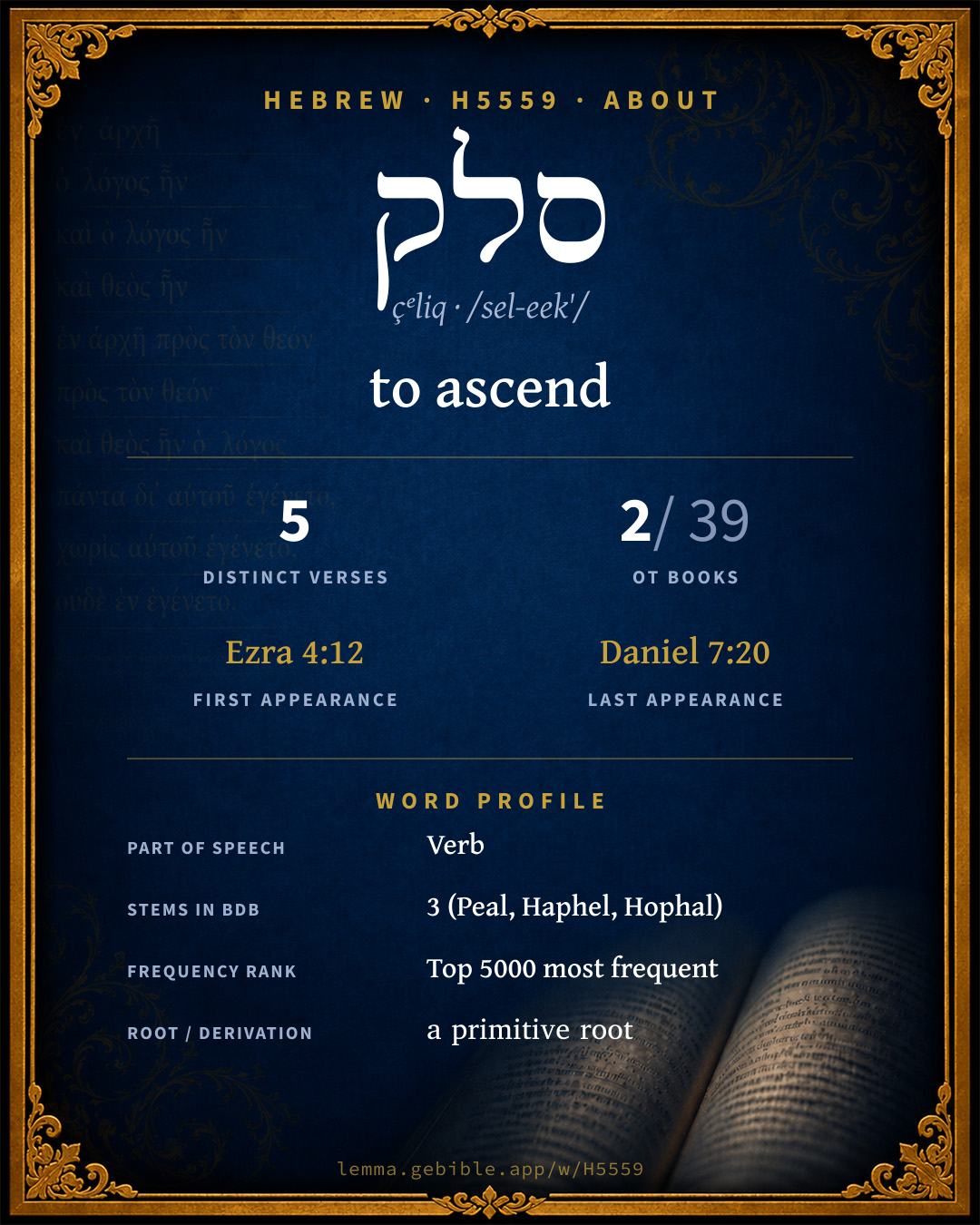
סְלֵק
to ascend
‘to ascend’ is one of 3 main senses fuller range ↓
Full lexicon entry — Brown-Driver-Briggs (BDB)
From Brown-Driver-Briggs (BDB)
Where this word appears
Grammar key — what these labels mean
Part of speech
- Verb
- An action or state-of-being word.
Stem
- Qal
- The basic, simple active stem — the plain form of the verb (“he wrote”).
Form
- Perfect
- A completed action or state — Hebrew marks aspect (completeness) more than strict tense (“he wrote”).
- Participle Active
- A verbal adjective expressing ongoing or characteristic action (“writing / one who writes”).
State
- Absolute
- The independent form of a noun, not bound to a following word.
Person
- 3rd Person
- The one spoken about (“he / she / it / they”).
Gender
- Feminine
- Grammatically feminine.
- Masculine
- Grammatically masculine.
Number
- Singular
- One.
- Plural
- More than one (in Hebrew, generally three or more).
Every verse where H5559 appears in the Book of Ezra — 1 distinct verse. Click any verse to open its interlinear word-by-word view. Verse text shown in the World English Bible for context — . Each verse’s Hebrew form is shown with its reference; the English is not keyword-highlighted, since the data carries no word-level English alignment. Use “Compare translations” on any verse to read it across multiple English versions. This concordance covers the Hebrew Bible; Septuagint (Greek Old Testament) occurrences are not indexed here.
Ezra
About this entry
At a glance — auto-summarized from this page’s data, not written by a person. Every figure links to its source below. This summary describes the numbers; it doesn’t interpret them.
At its core, סלק (çᵉliq) means “to ascend.” The Hebrew Bible uses it only 5 verses. The word gravitates to Daniel (80%), then Ezra. It first appears in Ezra 4:12. Different stems carry different senses — BDB groups them under 3 stems, among them Peal and Haphel. Dig into 5-verse concordance and the renderings breakdown below.
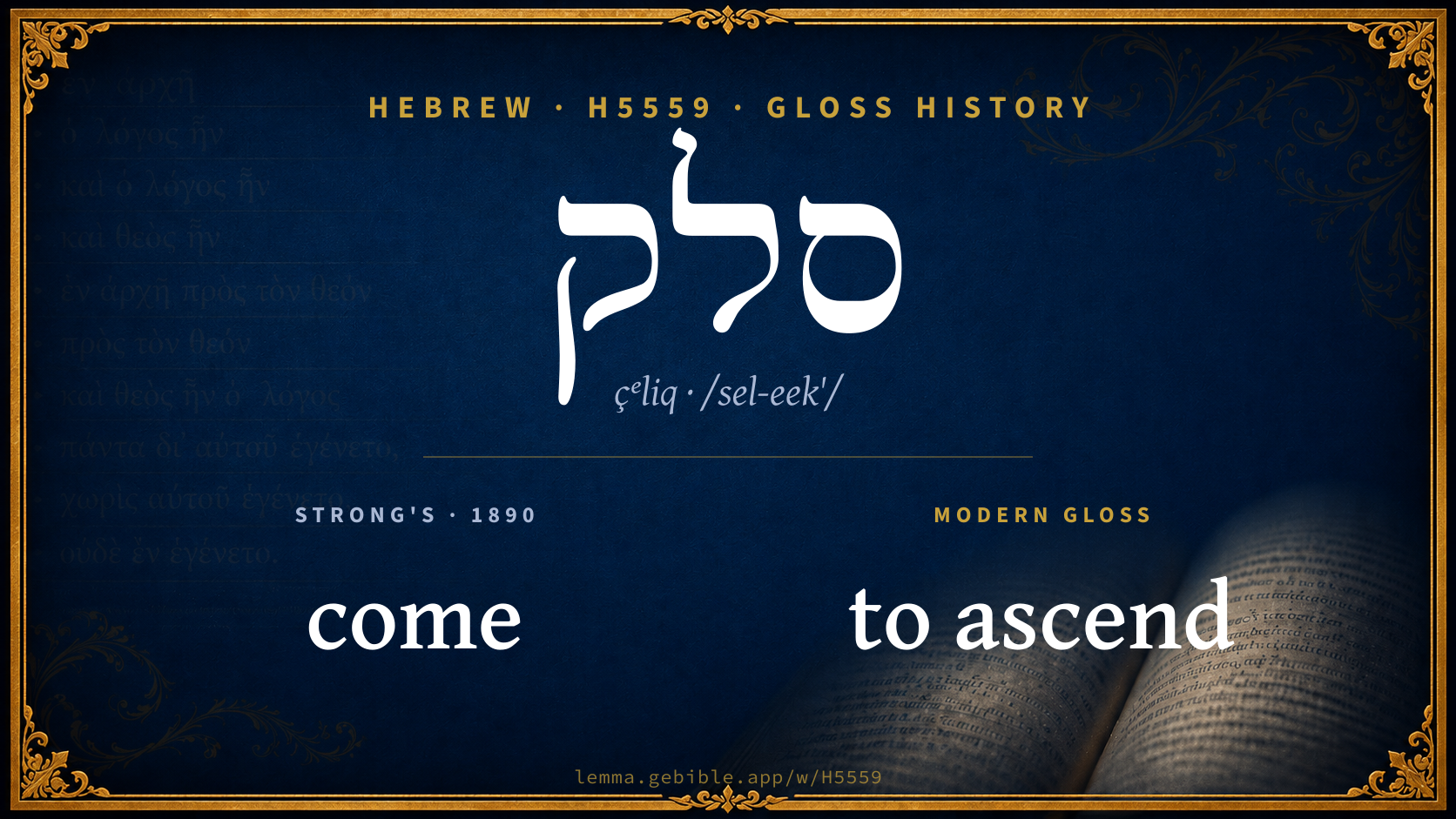
Gloss history
Strong's 1890 vs modern scholarship
About this word
Strong's H5559 catalogs a Hebrew word from the Hebrew Old Testament.
These counts are not copied from any lexicon or concordance. They are computed here, from the morphology-tagged Hebrew Old Testament. What Lemma adds →
- 5
- distinct verses
- The word appears in 5 distinct verses.
- 2 / 39
- OT books
- The word appears in 2 of 39 Old Testament books.
- #3,337
- by frequency
- Top 5000 most frequent Hebrew words (rank 3,337 of 8,640 Hebrew words by occurrence).
View all 5 occurrences in the concordance →
By traditional corpus
Conventional, traditional groupings — biblical authorship is debated, so this is a traditional corpus grouping, not an authorship claim. Each share is this word’s portion of its verses in that division of the Hebrew canon. Each figure is a share of the word’s 5 distinct verses.
- Writings (Ketuvim) 5 verses · 100%
How translations render this word
Counts come from each version’s own published word-to-Strong’s tagging or interlinear alignment — an approximate guide to how each version renders this word, not a word-level alignment the data otherwise carries. Because each total is that version’s own tagged count, the per-version totals vary from one another and need not match the appearance or distinct-verse counts above. These counts may also differ from a printed concordance because Lemma counts each distinctly tagged rendering and does not collapse phrase taggings into a single head-word total. This is a fixed set of word-tagged versions (KJV, ASV, BSB, ULT) and does not change with the reading translation you choose elsewhere. Each version’s license is shown beside its name below (and on Sources).
- King James Version: Came up 4×
- American Standard Version: Came up 2×
- Berean Standard Bible: Came up 3×
- unfoldingWord Literal Text: Came up 2×
King James Version Public Domain
Renders H5559 across 5 tagged occurrences — most commonly:
Plus 1 rendering that appears only once — usually multi-word phrases or single function words the recovered tagging swept in, not distinct renderings.
American Standard Version Public Domain
Renders H5559 across 5 tagged occurrences — most commonly:
Plus 3 renderings that appear only once — usually multi-word phrases or single function words the recovered tagging swept in, not distinct renderings.
Berean Standard Bible Public Domain
Renders H5559 across 8 tagged occurrences — most commonly:
Plus 5 renderings that appear only once — usually multi-word phrases or single function words the recovered tagging swept in, not distinct renderings.
unfoldingWord Literal Text CC BY-SA 4.0
Renders H5559 across 5 tagged occurrences — most commonly:
Plus 3 renderings that appear only once — usually multi-word phrases or single function words the recovered tagging swept in, not distinct renderings.
Senses in the full BDB
Hebrew verbs can shift meaning by stem (binyan): Qal is the basic action, Niphal is often passive or reflexive, Piel often intensifies or makes it factitive, and Hiphil is typically causative. The senses below are grouped under the stem BDB assigns to each. This entry also uses Peal (the basic Aramaic stem, parallel to Qal), Haphel (the causative Aramaic stem, parallel to Hiphil), and Hophal (the passive of Hiphil).
What do BDB’s symbols mean?
BDB uses these scholarly abbreviations:
| Symbol | Meaning |
|---|---|
| 𝔊 | the Septuagint (the ancient Greek translation, LXX) |
| 𝔙 | the Vulgate (the Latin translation) |
| 𝔖 | the Syriac version (the Peshitta) |
| 𝔗 | the Targum (the Aramaic translation) |
| ψ | the Psalms |
| √ | root (the underlying root or stem) |
| ‖ | parallel passage (a synonymous or contrasted parallel) |
| † | the dagger: every passage where the word occurs is cited |
The 3 senses and sub-senses the full Brown-Driver-Briggs lexicon distinguishes for this word, in lexicon order (not ranked by frequency), with BDB’s own verbatim wording and sub-sense lettering. Shown in Hebrew script with BDB’s own scholarly abbreviations. The condensed entry is in the Lexicon Entry tab. See also the Forms in the corpus table below.
Peal
- . come up
Haphel
- . lift, take up
Hophal
- . be taken up
Senses from the full Brown-Driver-Briggs lexicon (Brown, Driver, Briggs; Oxford 1906 — public domain), digitized via Sefaria, supplemented by the OpenScriptures HebrewLexicon (CC BY 4.0). Full attribution on Sources.
Word origin
[ סְלֵק ] vb. come up
— Brown-Driver-Briggs (Oxford 1906, public domain), digitized via Sefaria, supplemented by the OpenScriptures HebrewLexicon (CC BY 4.0). See Sources.
Origin: a primitive root
Jastrow Dictionary
A second Hebrew/Aramaic lexicon for comparison, covering Aramaic and post-biblical (Talmudic, Targumic, Midrashic) usage that the biblical-Hebrew BDB does not. Matched by lemma rather than by Strong’s number, so a lemma may carry more than one Jastrow headword (shown separately below), and the entries cover usage well beyond the Bible.
סָלַק
- 1. to go up, go away.—[
- 2. to pile up. Tam. II, 1 סוֹלְקִין Talm. ed., v. סָנַק.]
- 1. to remove; to cause cessation, suspend. Sabb. XX, 4 גורפין … ומְסַלְּקִין לצדדין you may rake … and remove to the corners. Nidd. IV, 7, a. e. מְסַלֶּקֶת suspends, v. חֲרָדָה. Ex. R. s. 3 סִלַּקְתָּ אותו thou hast discarded him (omitted to mention him in connection with the Lord); a. fr.—Part. pass. מְסוּלָּק; f. מְסוּלֶּקֶת; pl. מְסוּלָּקִים, מְסוּלָּקִין; מְסוּלָּקוֹת. Nidd. 68ᵇ דמיה מס׳ her menstruation is suspended. Y. Keth. IX, beg. 32ᵈ if one uses the expression ידיי מס׳ וכ׳ my hands are removed, my feet are removed from this field, he has said nothing (has not thereby renounced his rights); a. e.
- 2. to lift up, raise, esp. to tuck up the trail of a garment. Zeb. 18ᵇ מרושלין שסִילְּקָן … כשרין trailing (priestly) garments when tucked up by the belt, are fit for service; a. e.—Part. pass. as ab. lifted up, too short. Tosef. Men. I, 8; Zeb. 18ᵃ, sq., v. רָשַׁל.
- to be dismissed, removed; to rise. Erub. 54ᵇ נ׳ אהרן וכ׳ Aaron was dismissed (got up) and took his seat to the left of Moses; נִסְתַּלְּקוּ בניו when his sons were dismissed. Yeb. 64ᵃ גורם … שתִּסְתַּלֵּק מישראל causes the Divine Presence to withdraw from Israel. Lev. R. s. 34 וראשון ראשון מִסְתַּלֵּק and one after the other rose (from the meal). Ab. I, 16 עשה לך רב והִסְתַּלֵּק מן הספק get thyself a teacher so as to be removed from (to escape) doubt; a. fr.—Esp. (with or without מן העולם) to be called away from this world, to die. Tosef. Ḥag. II, 5. Gen. R. s. 62 הקב"ה יודע … להִסְתַּלֵּק העולם ומְסַלְּקָן the Lord knows when it is time for the righteous to be called away …, and he does call them away. Ex. R. s. 52 היה מִסְתַּלֵּק וכ׳ was about to die; a. fr.
סְלֵק
- , ch. same, (corresp. to h. עָלָה)
- 1. to rise, go up; to go away. Targ. Gen. XIX, 28 (Y. ed. Amst. סַלִּיק). Ib. XXXII, 27 (Y. ed. Amst. סַלִּיק). Targ. Ex. XIII, 18; a. fr.—Bets. 38ᵃ, a. fr. כי ס׳ ר׳ וכ׳ when R. A. went up (from Babylonia to Palestine); ib. כי ס׳ להתם Ms. M. when he arrived there; a. fr.
- 2. to occur. Taan. 21ᵃ כל מילתא דהוה סַלְקָא ליה הוה אמר וכ׳ (Ms. M. כל דהוה ס׳ ביה) whatever happened to him, he said, this, too, is for good; Snh. 108ᵇ bot.; a. fr.
- 3. (interch. with Pa.) to stop, hush, keep silence. Targ. Jud. III, 19; Targ. Am. VI, 10; VIII, 3 (h. text הס).
- 4. to turn out, result, (with אליבא) to agree with. Targ. I Chr. XI, 11.—B. Kam. 92ᵃ bot. לא הוה סלקא ליה שמעתא וכ׳ Ms. H. (ed. סליק, v. Rabb. D. S. a. l. note 30) whatever tradition he reported turned out not to be in agreement with the halakha
- 5. with על ליבא, דעתא &c. (= h. עלה על לב) to occur to the mind; to desire; to entertain an opinion. Targ. II Chr. VII, 11.—In Talm. סלקא דעתא = סלק אד׳, v. דַּעְתָּא.—Ḥull. 64ᵇ, a. fr. לא ס"ד that cannot rise in your mind, no idea of it.
- 6. (cmp. עלתה ארוכה העלה ארוכה, v. אֲרוּכָה II) to grow, heal up. Sabb. 134ᵇ, a. e., v. הַיָיא.
- 1. to remove. Targ. Ez. XLV, 9 (not סְלִי׳). Targ. Job XXXIV, 29 (not ויסלף). Targ. Ps. CII, 25; a. fr.—Nidd. 51ᵇ בתר דסַלִּיקוּ וכ׳ after they have taken off their phylacteries. Gitt. 52ᵇ ואֵיסַלְּקִינֵיה and I shall remove him (from office). Ib. מְסַלְּקִינָן ליה we (the court) must discharge him; a. fr.
- 2. (with or without בזוזא) to dismiss with payment; to settle, satisfy. B. Mets. 68ᵃ מצי מְסַלֵּק ליה he has a right to settle with him (satisfy the mortgage). Ib. 67ᵃ, v. מַשְׁכַּנְתָּא; a. fr.
- 1. to remove one’s self, rise, go away; to be removed, taken away; to die. Targ. Gen. XII, 8. Targ. I Chr. V, 1 (ed. Lag. a. oth. אשתקלת); a. fr.—Targ. Y. Ex. XII, 43 דא׳ who deserted the Jewish faith (O. ed. Berl. דאשתמד; oth. ed. דאסתלק; h. text בן נכר).—Keth. 106ᵃ כיון דעבד הכי א׳ after he had done this, he (Elijah) stayed away (ceased to appear to him); a. fr.
- 2. to be accounted. R. Hash. 27ᵃ תִּיסְּלֵק לה בתרתי let it be accounted as two notes.—[Ber. 56ᵇ אסתליק Ms. M., v. צְלַק.]
סְלַק
- (= שְׁלַק) to boil down. Gitt. 68ᵇ, sq. Ar. (ed. ש׳).—Part. pass. סָלִיק; f. סְלִיקָא, סְלִיקְתָּא; pl. סְלִיקָתָא. Pes. 34ᵃ top בס׳ ומאיסתא Ar. (ed. Koh. סִלְקָתָא; Ms. M. 2 סלקיתא; ed. שליקתא) when the wheat has been boiled (in the brewery) and become repulsive; v. סְלִיקוּסְתָּא II.
A Dictionary of the Targumim, the Talmud Babli and Yerushalmi, and the Midrashic Literature (Marcus Jastrow; London, Luzac, 1903) — Public Domain. Digitized via Sefaria. Digitized via Sefaria. Full attribution on Sources.
Forms in the corpus
The 5 distinct written forms H5559 takes in the Hebrew Bible, most frequent first — each parse links to that stem’s occurrences in the concordance. Hebrew forms include their vowel points and cantillation, so a single lemma takes many written forms.
| Form | Parsing | Example | Uses |
|---|---|---|---|
| סְלִ֔קוּ | Verb, Qal, Perfect, 3rd Person, Masculine, Plural | Daniel 2:29 | 1 |
| סְלִ֨קוּ֙ | Verb, Qal, Perfect, 3rd Person, Masculine, Plural | Ezra 4:12 | 1 |
| סִלְקַ֔ת | Verb, Qal, Perfect, 3rd Person, Feminine, Singular | Daniel 7:20 | 1 |
| סִלְקָ֣ת | Verb, Qal, Perfect, 3rd Person, Feminine, Singular | Daniel 7:8 | 1 |
| סָלְקָ֖ן | Verb, Qal, Participle Active, Feminine, Plural, Absolute | Daniel 7:3 | 1 |
Septuagint verse parallels
This word appears in 5 verses that also exist in the Greek Old Testament (Septuagint), out of the 5 Hebrew verses it occurs in. You can read those verses in Greek by switching the Old Testament edition to the Septuagint.
Read these verses in the Septuagint
This is a verse-level parallel only — the same verses exist in both the Hebrew and Greek Old Testaments. No word-level Hebrew↔Greek correspondence is claimed: the data carries no such alignment, so no Greek word is shown as this Hebrew word’s translation. Coverage is not total — the Septuagint omits the deuterocanon and renumbers the Psalms, so some Hebrew verses have no direct Greek parallel.