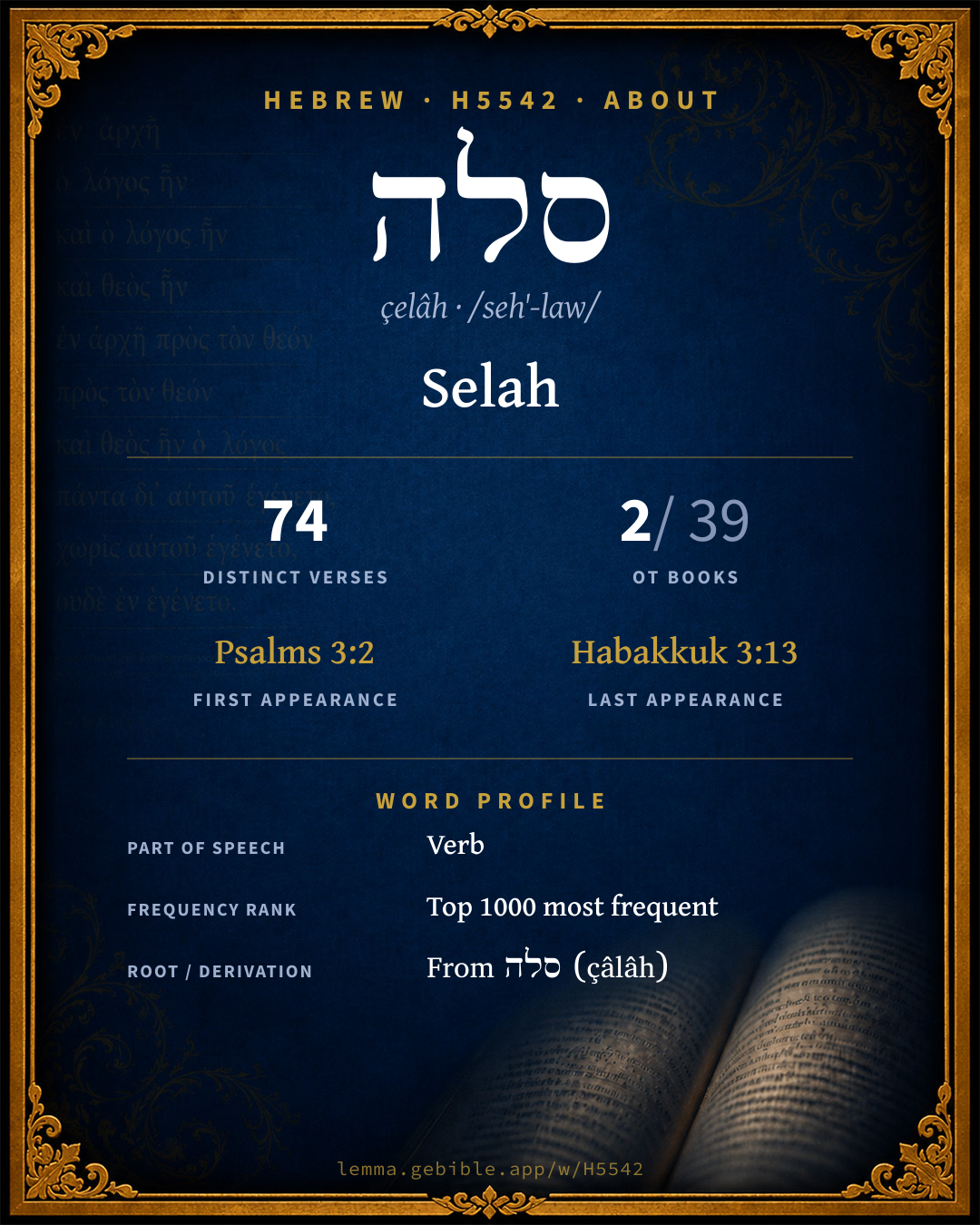
סֶ֫לָה
Selah
BDB lists 2 entries for ‘Selah’ fuller range ↓
Full lexicon entry — Brown-Driver-Briggs (BDB)
From Brown-Driver-Briggs (BDB)
Where this word appears
Grammar key — what these labels mean
Part of speech
- Particle
- A short function word — article, negation, interrogative, the sign of the direct object, and the like.
Every verse where H5542 appears in the Book of Habakkuk — 3 distinct verses. Click any verse to open its interlinear word-by-word view. Verse text shown in the World English Bible for context — . Each verse’s Hebrew form is shown with its reference; the English is not keyword-highlighted, since the data carries no word-level English alignment. Use “Compare translations” on any verse to read it across multiple English versions. This concordance covers the Hebrew Bible; Septuagint (Greek Old Testament) occurrences are not indexed here.
Habakkuk
- Habakkuk 3:3 סֶ֑לָה ptcl intj God came from Teman, The Holy One from Mount Paran. Selah. His glory covered the heavens, And his praise filled the earth.
- Habakkuk 3:9 סֶ֑לָה ptcl intj You uncovered your bow. You called for your sworn arrows. Selah. You split the earth with rivers.
- Habakkuk 3:13 סֶֽלָה ptcl intj You went forth for the salvation of your people, For the salvation of your anointed. You crushed the head of the land of wickedness. You stripped them head to foot. Selah.
About this entry
At a glance — auto-summarized from this page’s data, not written by a person. Every figure links to its source below. This summary describes the numbers; it doesn’t interpret them.
The Hebrew name סלה centers on the idea of “Selah.” Psalms dominates its distribution — 71 of 74 verses. The Hebrew Bible uses it across 74 verses — moderately common. First canonically at Psalms 3:2, it enters the text early. Dig into 74-verse concordance and the renderings breakdown below.
Gloss history
Strong's 1890 vs modern scholarship
About this word
Strong's H5542 catalogs a Hebrew word from the Hebrew Old Testament.
These counts are not copied from any lexicon or concordance. They are computed here, from the morphology-tagged Hebrew Old Testament. What Lemma adds →
- 74
- distinct verses
- The word appears in 74 distinct verses.
- 2 / 39
- OT books
- The word appears in 2 of 39 Old Testament books.
- #536
- by frequency
- Top 1000 most frequent Hebrew words (rank 536 of 8,640 Hebrew words by occurrence).
View all 74 occurrences in the concordance →
By traditional corpus
Conventional, traditional groupings — biblical authorship is debated, so this is a traditional corpus grouping, not an authorship claim. Each share is this word’s portion of its verses in that division of the Hebrew canon. Each figure is a share of the word’s 74 distinct verses.
- Writings (Ketuvim) 71 verses · 96%
- Prophets (Nevi'im) 3 verses · 4%
How translations render this word
Counts come from each version’s own published word-to-Strong’s tagging or interlinear alignment — an approximate guide to how each version renders this word, not a word-level alignment the data otherwise carries. Because each total is that version’s own tagged count, the per-version totals vary from one another and need not match the appearance or distinct-verse counts above. These counts may also differ from a printed concordance because Lemma counts each distinctly tagged rendering and does not collapse phrase taggings into a single head-word total. This is a fixed set of word-tagged versions (KJV, ASV, BSB, ULT) and does not change with the reading translation you choose elsewhere. Each version’s license is shown beside its name below (and on Sources).
- King James Version: Selah 66×, Themselves selah 3×, Thee selah 2×
- American Standard Version: Selah 16×, Me 2×, Thee 2×
- Berean Standard Bible: Selah 74×
- unfoldingWord Literal Text: Selah 74×
King James Version Public Domain
Renders H5542 across 74 tagged occurrences — most commonly:
Plus 3 renderings that appear only once — usually multi-word phrases or single function words the recovered tagging swept in, not distinct renderings.
American Standard Version Public Domain
Renders H5542 across 30 tagged occurrences — most commonly:
Plus 6 renderings that appear only once — usually multi-word phrases or single function words the recovered tagging swept in, not distinct renderings. Not rendered by a distinct English word in 44 further occurrences.
Berean Standard Bible Public Domain
Renders H5542 across 74 tagged occurrences — most commonly:
unfoldingWord Literal Text CC BY-SA 4.0
Renders H5542 across 74 tagged occurrences — most commonly:
Senses in BDB
The 2 senses BDB distinguishes for this word, in lexicon order (not ranked by frequency or importance). The full entry — with sub-senses — is in the Lexicon Entry tab.
- to lift up, exalt
- Selah
Word origin
vb. lift up (voices in ברוך לעולם), or exalt (לעולם י׳) (Imv. of סָלַל (cf. Pr 4:8 ψ 68:5; הִגָּיוֹן סלה 9:17, v. הִגּ׳), properly סֹ֫לָּה, סֶ֫לָה poss. Qr = נֶצַח, Hexapla σελ; but cf. הֶ֫רָה Ew554 Köii 1, 539; 𝔊 Sym Theod διάψαλμα, expl. Suidas μέλους ἐναλλαγή; Theodoret Hippolytus μέλους μεταβολή (cf. Hexapla Hb 3:3 μεταβολὴ διαψάλματος; Syriac Hexapla Aq. עוניתא in 5 ψ ψ, Field in ψ 38:12); 𝔊 adds διάψαλμα, e.g. 2:2; 34:11; 94:15, after final editing of Heb. Psalter; so Psalms of Solomon 17:21; 18:10 on same principles as in MT; used therefore with full knowledge that it indicated some kind of interruption or change in the regular rendering. סלה is used in שמונה עשרה after Benedictions 3, 18, and after other early Jewish prayers, shewing knowledge, c. 100 a.d.; Aq gives ἀεί (Theod. also ψ 9:17); Sexta διαπαντός (except 20:4 εἰς τέλος); Quinta εἰς τοὺς αἰῶνας; Jer. semper, 𝔗 usually לעלמא, לעלמין; but 39:6 לחיי עלמא, 44:9 לעלמי עלמין, 48:9 עד עלמי עלמין, 49:14 לעלמא דאתי; uniform tradition best expl. by closing contents of the Benedictions, מהעולם ועד העולם. So Jer. classes sela with amen and salom; and Jacob of Edessa in Bar Hebr 10:1 cp. Christian Amen of the people after Gloria);—this interpr. agrees with usage: 71 times in 39 ψψ, 3 times Hb 3 (taken from Minor Psalter למנצח, v. נצח); it occurs at end of 3:9; 24:10; 46:12 (om. 𝔊), 9:21 (𝔊 combines 9 and 10); elsewhere at close of strophe, 3:3, 5; 4:3, 5; 7:6; 9:17; 24:6; 32:4, 5, 7; 39:6, 12; 46:4, 8; 47:5; 48:9; 49:13 (so read MT v 14 by error) v 16; 50:6; 52:5, 7; 54:5; 59:6, 14; 61:5; 62:5, 9; 66:4, 7, 15; 67:5; 68:20; 76:4, 10; 77:4, 10, 16; 81:8; 82:2; 83:9; 84:5, 9; 88:8, 11; 89:38, 46; 140:4, 6, 9; 143:6; or where citations have been made, 44:9; 55:8; 57:7; 60:6; 67:2; 68:8, 33; 89:5; Hb 3:3, 9; or where extracts might be made for liturgical purposes, 20:4; 21:3; 55:20; 75:4; 85:3; 87:3, 6; 89:49; so 57:3 (𝔊 for MT v 4) Hb 3:13.—Of ψψ c. סֶלָה, 23 used in Elohistic Psalter, 28 in Director’s Psalter, 39 in final editing of Psalter. These editors found it in earlier Psalters. Davidic Psalter uses 20 of them, so few in proportion that it is not characteristic of this Psalter; but Korahite 9 (out of 12), and Asaph 7 + 80:8 [𝔊] (prob. 8 out of 12); appar. it came into use in time of these editors. In Director’s Psalter musical terms are added to 19 of the 28 it uses (and only to ten others, of which some could hardly use סלה); ψψ with סלה all (except 61, 81) name the kind of ψ in title: 3 מִכְתָּם, 7 מַשְׂכִּיל, 10 שִׁיר, 26 (27) others מִזְמוֹר, Hb 3 תְּפִלָּה; ס׳ is especially frequent with שִׁיר and מַשְׂכִּיל, terms associated with musical rendering. It prob. came into use in late Persian period in connexion with ψψ used with musical accompaniment in public worship, to indicate place of benedictions. It was not added by later editors to other psalms; but was revived in first century b.c., and continued in use for some time (v. JacobZAW xvi (1896), 129 f. BrJBL 1899 EG BriggsAm. J. Sem. Lang. Oct. 1899, 1 ff.).
— Brown-Driver-Briggs (Oxford 1906, public domain), digitized via Sefaria, supplemented by the OpenScriptures HebrewLexicon (CC BY 4.0). See Sources.
Derived from סלה (çâlâh) (H5541) — to make light of.
Jastrow Dictionary
A second Hebrew/Aramaic lexicon for comparison, covering Aramaic and post-biblical (Talmudic, Targumic, Midrashic) usage that the biblical-Hebrew BDB does not. Matched by lemma rather than by Strong’s number, so a lemma may carry more than one Jastrow headword (shown separately below), and the entries cover usage well beyond the Bible.
סֶלָה
- (b. h.) selah (supposed to be a musical direction); forever. Erub. 54ᵃ, v. נֶצַח.
סלי
- (b. h.) to swing.
- 1. [ [to make rise,] to balance, outweigh. Snh. 82ᵇ (play on סלוא, Num. XXV, 14) על שה׳ וכ׳ because he outweighed the sins of his family; [oth. opin.: he caused the sins of his family to rise, i.e. become notorious]; Tanḥ. Pinḥ. 2; Yalk. Num. 772; Num. R. s. 21 בן שסילא וכ׳. e.g. Numbers 25:14
- 2. to throw away, reject. Snh. 104ᵇ, v. פָּסַל.
A Dictionary of the Targumim, the Talmud Babli and Yerushalmi, and the Midrashic Literature (Marcus Jastrow; London, Luzac, 1903) — Public Domain. Digitized via Sefaria. Digitized via Sefaria. Full attribution on Sources.
Forms in the corpus
The 4 distinct written forms H5542 takes in the Hebrew Bible, most frequent first — each parse links to that state’s occurrences in the concordance. Hebrew forms include their vowel points and cantillation, so a single lemma takes many written forms.
| Form | Parsing | Example | Uses |
|---|---|---|---|
| סֶֽלָה | Particle, Interjection | Habakkuk 3:13 | 62 |
| סֶּֽלָה | Particle, Interjection | Psalms 3:8 | 8 |
| סֶ֑לָה | Particle, Interjection | Habakkuk 3:3 | 3 |
| סֶ֥לָה | Particle, Interjection | Psalms 55:19 | 1 |
Same root — word family
Other BDB entries built from the same root as H5542, grouped by Strong’s listed origin. These share a root / origin per the lexicon — not necessarily a shared meaning. Each links to that word’s own entry.
Derives from
Shares the same root
Proper names from this root
People and places named from this root — a name, not an additional meaning of the word.
Compare all same-root words → Showing 4 of 5 — not the complete family. 1 of the same-root words is a proper name (a person or place). They share a root, not necessarily a meaning.
Bible dictionary
Public-domain dictionary articles matched to this entry by name (Selah). A biblical name can be shared by more than one person or place, so an article may treat several.
Easton's Bible Dictionary · M. G. Easton, 1897
A word frequently found in the Book of Psalms, and also in Hab. 3:9, 13, about seventy-four times in all in Scripture. Its meaning is doubtful. Some interpret it as meaning "silence" or "pause;" others, "end," "a louder strain," "piano," etc. The LXX. render the word by daplasma i.e., "a division."
Smith's Bible Dictionary · William Smith, 1863
This word, which is found only in the poetical books of the Old Testament, occurs seventy-one times in the Psalms and three times in Habakkuk. It is probably a term which had a meaning in the musical nomenclature of the Hebrews, though what that meaning may have been is now a matter of pure conjecture. (Gesenius and Ewald and others think it has much the same meaning as our interlude,--a pause in the voices singing, while the instruments perform alone.)
Hitchcock's Bible Names Dictionary · Roswell D. Hitchcock, 1869
the end; a pause
Classic public-domain reference works; full attribution on Sources.
Septuagint verse parallels
This word appears in 68 verses that also exist in the Greek Old Testament (Septuagint), out of the 74 Hebrew verses it occurs in. You can read those verses in Greek by switching the Old Testament edition to the Septuagint.
Read these verses in the Septuagint
This is a verse-level parallel only — the same verses exist in both the Hebrew and Greek Old Testaments. No word-level Hebrew↔Greek correspondence is claimed: the data carries no such alignment, so no Greek word is shown as this Hebrew word’s translation. Coverage is not total — the Septuagint omits the deuterocanon and renumbers the Psalms, so some Hebrew verses have no direct Greek parallel.