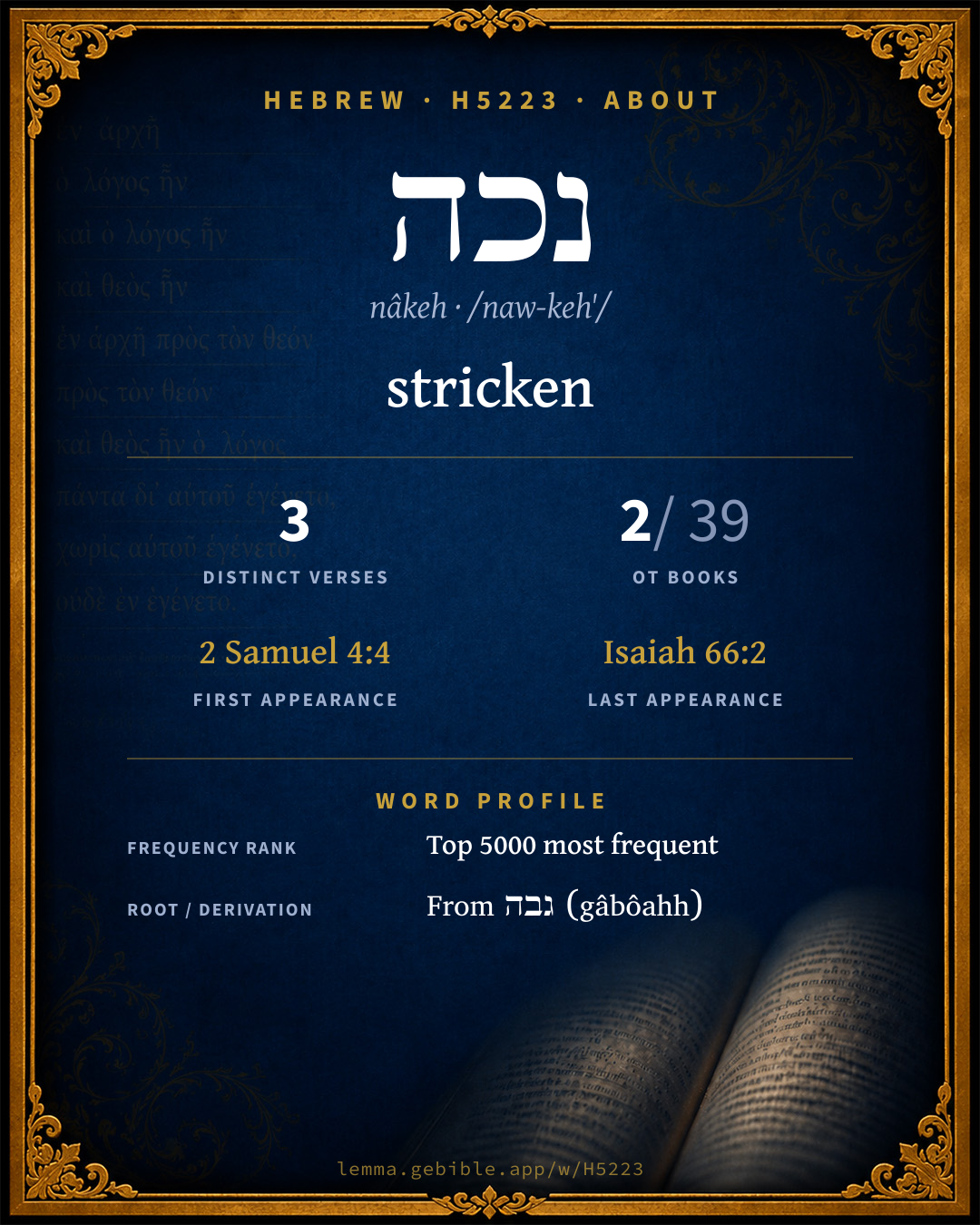
נָכֵה
stricken
Full lexicon entry — Brown-Driver-Briggs (BDB)
From Brown-Driver-Briggs (BDB)
Where this word appears
Grammar key — what these labels mean
Part of speech
- Adjective
- A word that describes or qualifies a noun.
State
- Construct
- A noun bound to a following noun in a possessive / “of” relationship (the construct chain).
Gender
- Masculine
- Grammatically masculine.
Number
- Singular
- One.
Every verse where H5223 appears in the Book of 2 Samuel — 2 distinct verses. Click any verse to open its interlinear word-by-word view. Verse text shown in the World English Bible for context — . Each verse’s Hebrew form is shown with its reference; the English is not keyword-highlighted, since the data carries no word-level English alignment. Use “Compare translations” on any verse to read it across multiple English versions. This concordance covers the Hebrew Bible; Septuagint (Greek Old Testament) occurrences are not indexed here.
2 Samuel
- 2 Samuel 4:4 נְכֵ֣ה adj Adjective ms cs Now Jonathan, Saul's son, had a son who was lame of his feet. He was five years old when the news came of Saul and Jonathan out of Jezreel; and his nurse took him up, and fled: and it happened, as she made haste to flee, that he fell, and became lame. His name was Mephibosheth.
- 2 Samuel 9:3 נְכֵ֥ה adj Adjective ms cs The king said, Is there not yet any of the house of Saul, that I may show the kindness of God to him? Ziba said to the king, Jonathan has yet a son, who is lame of his feet.
About this entry
At a glance — auto-summarized from this page’s data, not written by a person. Every figure links to its source below. This summary describes the numbers; it doesn’t interpret them.
The Hebrew word נכה centers on the idea of “stricken.” It is rare — just 3 verses in the entire Hebrew Bible. 2 Samuel dominates its distribution — 2 of 3 verses. Its earliest occurrence is 2 Samuel 4:4. For the data behind this summary, explore the sense tree and the renderings breakdown below.
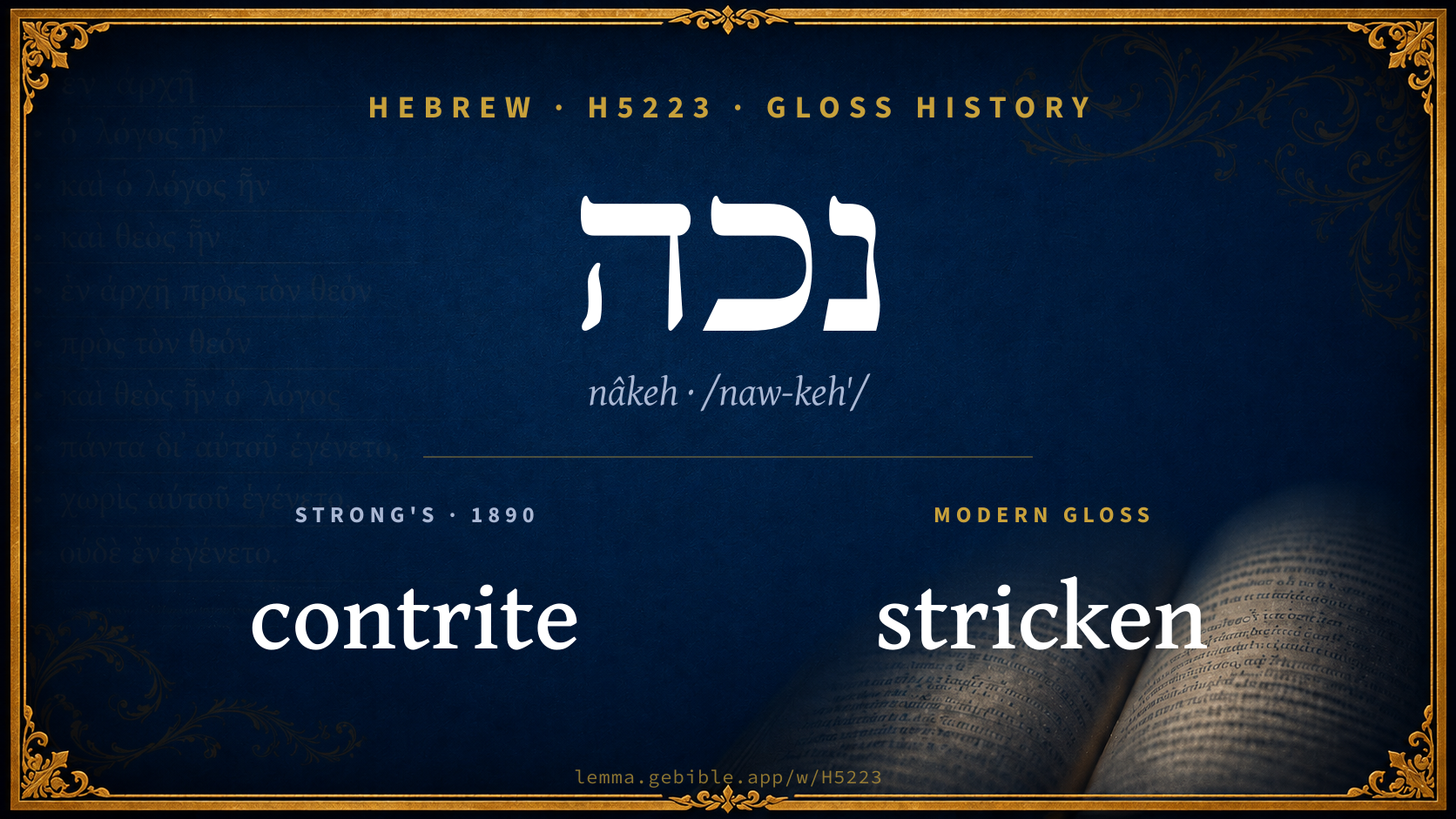
Gloss history
Strong's 1890 vs modern scholarship
About this word
Strong's H5223 catalogs a Hebrew word from the Hebrew Old Testament.
These counts are not copied from any lexicon or concordance. They are computed here, from the morphology-tagged Hebrew Old Testament. What Lemma adds →
- 3
- distinct verses
- The word appears in 3 distinct verses.
- 2 / 39
- OT books
- The word appears in 2 of 39 Old Testament books.
- #4,179
- by frequency
- Top 5000 most frequent Hebrew words (rank 4,179 of 8,640 Hebrew words by occurrence).
View all 3 occurrences in the concordance →
By traditional corpus
Conventional, traditional groupings — biblical authorship is debated, so this is a traditional corpus grouping, not an authorship claim. Each share is this word’s portion of its verses in that division of the Hebrew canon. Each figure is a share of the word’s 3 distinct verses.
- Prophets (Nevi'im) 3 verses · 100%
How translations render this word
Counts come from each version’s own published word-to-Strong’s tagging or interlinear alignment — an approximate guide to how each version renders this word, not a word-level alignment the data otherwise carries. Because each total is that version’s own tagged count, the per-version totals vary from one another and need not match the appearance or distinct-verse counts above. These counts may also differ from a printed concordance because Lemma counts each distinctly tagged rendering and does not collapse phrase taggings into a single head-word total. This is a fixed set of word-tagged versions (KJV, ASV, BSB, ULT) and does not change with the reading translation you choose elsewhere. Each version’s license is shown beside its name below (and on Sources).
- King James Version: Contrite 1×, Is lame 1×, Was lame 1×
- American Standard Version: Contrite 1×, Is lame 1×, Was lame 1×
- Berean Standard Bible: Contrite 1×, Lame 1×, Lame in 1×
- unfoldingWord Literal Text: Lame of 2×
King James Version Public Domain
Renders H5223 across 3 tagged occurrences — most commonly:
American Standard Version Public Domain
Renders H5223 across 3 tagged occurrences — most commonly:
Berean Standard Bible Public Domain
Renders H5223 across 3 tagged occurrences — most commonly:
unfoldingWord Literal Text CC BY-SA 4.0
Renders H5223 across 3 tagged occurrences — most commonly:
Plus 1 rendering that appears only once — usually multi-word phrases or single function words the recovered tagging swept in, not distinct renderings.
Senses in BDB
The 1 sense BDB distinguishes for this word, in lexicon order (not ranked by frequency or importance). The full entry — with sub-senses — is in the Lexicon Entry tab.
- stricken, smitten
Word origin
adj. smitten, stricken (cf. [נָכָא]);—only cstr.: נְכֵה רַגְלַיִם 2 S 4:4; 9:3 crippled of feet; נְכֵה־רוּחַ Is 66:2 contrite of spirit (+ עָנִי).
— Brown-Driver-Briggs (Oxford 1906, public domain), digitized via Sefaria, supplemented by the OpenScriptures HebrewLexicon (CC BY 4.0). See Sources.
Derived from גבה (gâbôahh) (H1364) — high.
Jastrow Dictionary
A second Hebrew/Aramaic lexicon for comparison, covering Aramaic and post-biblical (Talmudic, Targumic, Midrashic) usage that the biblical-Hebrew BDB does not. Matched by lemma rather than by Strong’s number, so a lemma may carry more than one Jastrow headword (shown separately below), and the entries cover usage well beyond the Bible.
נָכָה
- , v. נכי
נֵכֶה
- crippled, נְכֵה רגלים paralyzed, lame. Yalk. Deut. 933. משל לנ׳ ר׳ וכ׳ like a lame person that disturbed the peace of &c., opp. שָׁלֵם.—Pl. נֵכִים. Pesik. R. s. 13, v. צָלַע.
נְכֹה
- (b. h.) pr. n. m. Pharaoh Necho (II), King of Egypt. Sot. 9ᵃ; a. e.
נכי
- (b. h.) to be lessened.—[Lev. R. s. 33 אלא נכה, some ed., v. אָנָךְ.]
- to deduct. Ḥull. X, 3 ואינו מְנַכֶּה לו וכ׳ and the seller is not bound to allow him a reduction for the priest’s share. B. Bath. VII, 2, sq. יְנַכֶּה he must make an allowance for what there is less than specified in the contract. Num. R. s. 20 (ref. to נכה, ib. XXII, 6) כמי שמְנַכֶּה אחד מכ"ד לסאה as one (purchasing grain) is prepared for a deficiency of one twenty-fourth for each S’ah (allowance for chaff, v. טִינֹּופֶת); Tanḥ. Balak 4 (not למאה); ed. Bub. 6; a. fr.—[Cant. R. to III, 4 שנכה מסנחריב some ed., read שנָכַת, v. נְכִיתָה.]
- 1. to injure, knock, strike. B. Kam. VIII, 1 הִכָּהוּ חייב וכ׳ if he hit him (created a sore), he must pay for curing him. Ib. 3 המַכֶּה את וכ׳ if a person strikes his father &c. Snh. IX, 2 נתכוין להַכֹּותוֹ וכ׳ if he intended to hit him on his loins. Y. Peah I, 16ᵃ bot. (ref. to Ps. CXX, 3, sq.) כל כלי זיין מַכִּין וכ׳ all weapons strike in their place, but this (calumny) strikes at a distance; a. v. fr.—Part. pass. מוּכֶּה; f. מוּכָּה; pl. מוּכִּים, מוּכִּין; מוּכֹּות. Keth. VII, 10, a. fr. מוּכֵּה שהין afflicted with leprosy. Ib. I, 3, a. fr. מוּכַּת עץ one who lost her hymen through an accidentallesion. Par. VIII, 9; Mikv. I, 8, v. מַיִם. e.g. Psalms 120:3
- 2. (trnsf.) to strike, produce sound, play. Yoma I, 7 מַכִּין לפניו באצבע וכ׳ snap their middle-fingers. Arakh. II, 3, v. חָלִיל; a. fr.
A Dictionary of the Targumim, the Talmud Babli and Yerushalmi, and the Midrashic Literature (Marcus Jastrow; London, Luzac, 1903) — Public Domain. Digitized via Sefaria. Digitized via Sefaria. Full attribution on Sources.
Forms in the corpus
The 3 distinct written forms H5223 takes in the Hebrew Bible, most frequent first — each parse links to that state’s occurrences in the concordance. Hebrew forms include their vowel points and cantillation, so a single lemma takes many written forms.
| Form | Parsing | Example | Uses |
|---|---|---|---|
| וּ/נְכֵה | Adjective, Adjective, Masculine, Singular, Construct | Isaiah 66:2 | 1 |
| נְכֵ֣ה | Adjective, Adjective, Masculine, Singular, Construct | 2 Samuel 4:4 | 1 |
| נְכֵ֥ה | Adjective, Adjective, Masculine, Singular, Construct | 2 Samuel 9:3 | 1 |
Septuagint verse parallels
This word appears in 3 verses that also exist in the Greek Old Testament (Septuagint), out of the 3 Hebrew verses it occurs in. You can read those verses in Greek by switching the Old Testament edition to the Septuagint.
Read these verses in the Septuagint
This is a verse-level parallel only — the same verses exist in both the Hebrew and Greek Old Testaments. No word-level Hebrew↔Greek correspondence is claimed: the data carries no such alignment, so no Greek word is shown as this Hebrew word’s translation. Coverage is not total — the Septuagint omits the deuterocanon and renumbers the Psalms, so some Hebrew verses have no direct Greek parallel.