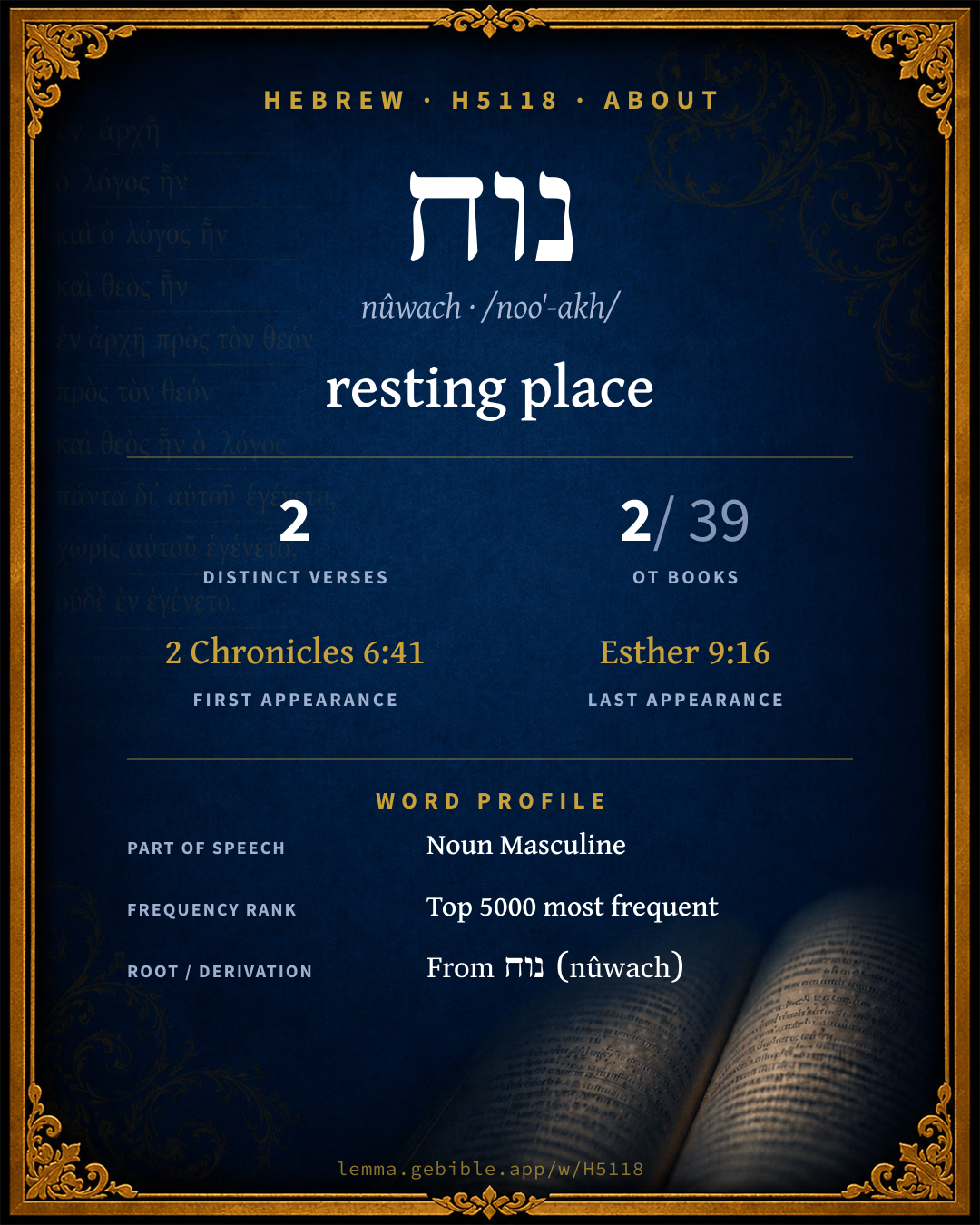
נוּחַ
resting place
Full lexicon entry — Brown-Driver-Briggs (BDB)
From Brown-Driver-Briggs (BDB)
Where this word appears
Grammar key — what these labels mean
Noun type
- Common
- A common noun — a general class of person, place, or thing (“king,” “city,” “water”), not a specific name.
Stem
- Qal
- The basic, simple active stem — the plain form of the verb (“he wrote”).
Form
- Infinitive Absolute
- An unbound verbal noun, often intensifying or standing in for a finite verb.
State
- Construct
- A noun bound to a following noun in a possessive / “of” relationship (the construct chain).
Gender
- Masculine
- Grammatically masculine.
Number
- Singular
- One.
Every verse where H5118 appears in the Book of 2 Chronicles — 1 distinct verse. Click any verse to open its interlinear word-by-word view. Verse text shown in the World English Bible for context — . Each verse’s Hebrew form is shown with its reference; the English is not keyword-highlighted, since the data carries no word-level English alignment. Use “Compare translations” on any verse to read it across multiple English versions. This concordance covers the Hebrew Bible; Septuagint (Greek Old Testament) occurrences are not indexed here.
2 Chronicles
About this entry
At a glance — auto-summarized from this page’s data, not written by a person. Every figure links to its source below. This summary describes the numbers; it doesn’t interpret them.
At its core, נוח (nûwach) means “resting place.” The Hebrew Bible uses it only 2 verses. The word gravitates to 2 Chronicles (50%), then Esther. First canonically at 2 Chronicles 6:41, it enters the text early. It shares a root with נוח, הנחה and מנוח. Dig into 2-verse concordance and the renderings breakdown below.
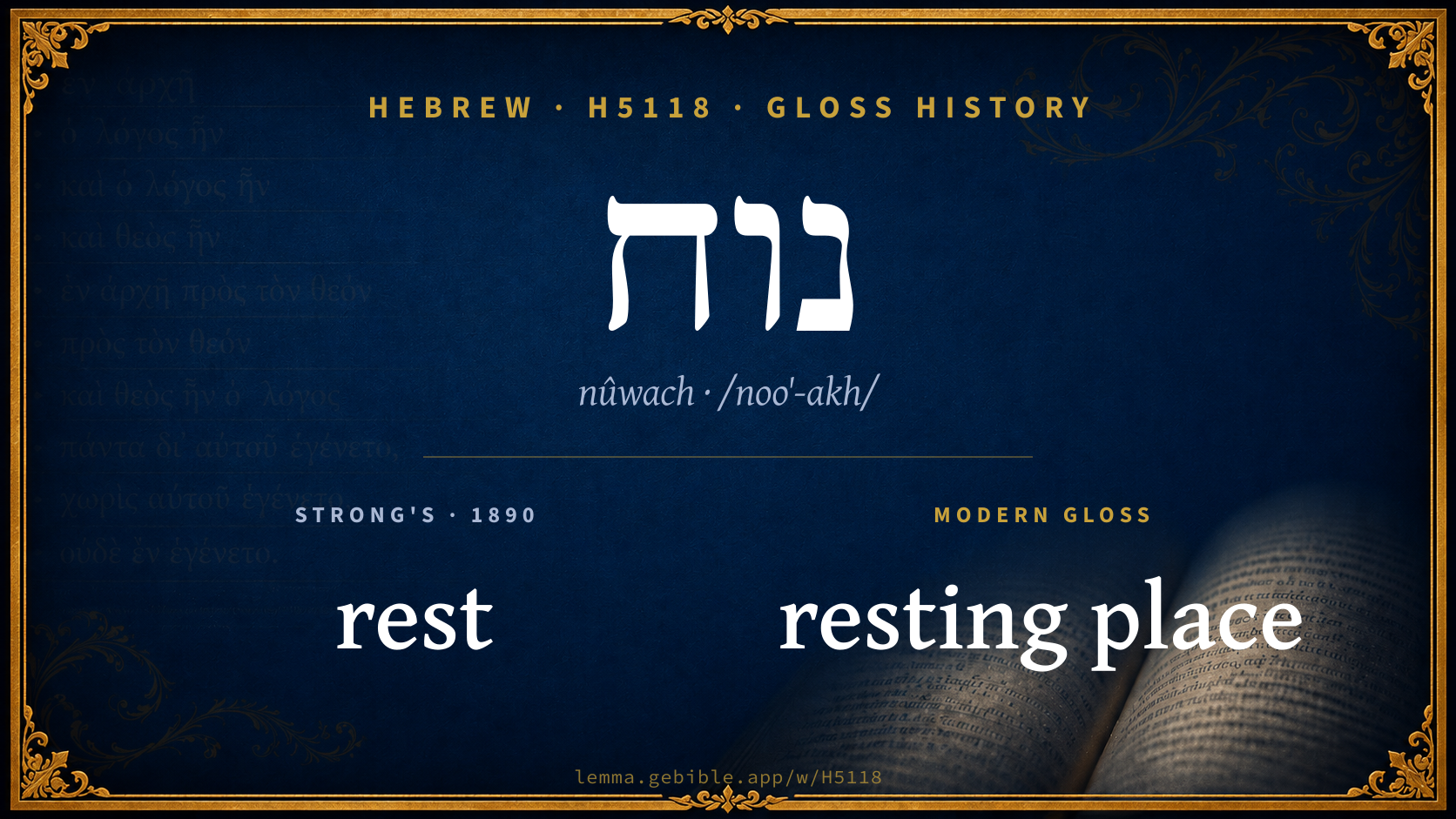
Gloss history
Strong's 1890 vs modern scholarship
About this word
Strong's H5118 catalogs a Hebrew word from the Hebrew Old Testament.
These counts are not copied from any lexicon or concordance. They are computed here, from the morphology-tagged Hebrew Old Testament. What Lemma adds →
- 2
- distinct verses
- The word appears in 2 distinct verses.
- 2 / 39
- OT books
- The word appears in 2 of 39 Old Testament books.
- #4,807
- by frequency
- Top 5000 most frequent Hebrew words (rank 4,807 of 8,640 Hebrew words by occurrence).
View all 2 occurrences in the concordance →
Most concentrated in
- 2 Chronicles 1 verse 50%
- Esther 1 verse 50%
By section of the Old Testament
By traditional corpus
Conventional, traditional groupings — biblical authorship is debated, so this is a traditional corpus grouping, not an authorship claim. Each share is this word’s portion of its verses in that division of the Hebrew canon. Each figure is a share of the word’s 2 distinct verses.
- Writings (Ketuvim) 2 verses · 100%
How translations render this word
Counts come from each version’s own published word-to-Strong’s tagging or interlinear alignment — an approximate guide to how each version renders this word, not a word-level alignment the data otherwise carries. Because each total is that version’s own tagged count, the per-version totals vary from one another and need not match the appearance or distinct-verse counts above. These counts may also differ from a printed concordance because Lemma counts each distinctly tagged rendering and does not collapse phrase taggings into a single head-word total. This is a fixed set of word-tagged versions (KJV, ASV, BSB, ULT) and does not change with the reading translation you choose elsewhere. Each version’s license is shown beside its name below (and on Sources).
- King James Version: Day of the same rested 1×, Day of the same they rested 1×, Had rest 1×
- American Standard Version: Day of the same they rested 1×, Fifteenth day of the same they rested 1×, Had rest 1×
- Berean Standard Bible: Enter your resting place 1×, Rid themselves 1×
- unfoldingWord Literal Text: Resting place 1×, They rested 1×
King James Version Public Domain
Renders H5118 across 4 tagged occurrences — most commonly:
American Standard Version Public Domain
Renders H5118 across 4 tagged occurrences — most commonly:
Berean Standard Bible Public Domain
Renders H5118 across 2 tagged occurrences — most commonly:
unfoldingWord Literal Text CC BY-SA 4.0
Renders H5118 across 2 tagged occurrences — most commonly:
Senses in BDB
The 1 sense BDB distinguishes for this word, in lexicon order (not ranked by frequency or importance). The full entry — with sub-senses — is in the Lexicon Entry tab.
- resting place
Word origin
v. נוח Inf. abs. נוּחַ 2 Ch 6:41 v. מְנוּחָה.
— Brown-Driver-Briggs (Oxford 1906, public domain), digitized via Sefaria, supplemented by the OpenScriptures HebrewLexicon (CC BY 4.0). See Sources.
Derived from נוח (nûwach) (H5117) — to rest.
Jastrow Dictionary
A second Hebrew/Aramaic lexicon for comparison, covering Aramaic and post-biblical (Talmudic, Targumic, Midrashic) usage that the biblical-Hebrew BDB does not. Matched by lemma rather than by Strong’s number, so a lemma may carry more than one Jastrow headword (shown separately below), and the entries cover usage well beyond the Bible.
נוּחַ
- (b. h.) to rest, lie; to be at ease, rest satisfied.—Sabb. 7ᵇ זרק … והלכה ונָחָה וכ׳ if one threw an object higher than ten handbreadths, and in its course it came to rest in a little hole. Ib. וזרק ונָח על גביו and he threw an object and it came to rest on it. Gen. R. s. 25 כיון שעמד נֹחַ נָחוּ when Noah rose, they rested (submitted to man’s rulership; Yalk. Chr. 1072 נִינּוֹחוּ; Yalk. Gen. 42 נִחֲמָן he appeased them); ib. וכיון שעמד נֹחַ נחו and when Noah rose, they remained undisturbed in their graves; Yalk. Chr. l. c. נינוחו.—Meg. 25ᵇ, a. fr. יָנוּחוּ לו ברכות וכ׳ blessings rest upon his head. Sabb. 152ᵇ, a. e. תָּנוּחַ … שהנחת וכ׳ let thy mind be at rest, for thou hast set my mind at rest; a. fr.—Part. נָח, נוֹחַ, f. נוֹחָה; pl. נוֹחִים, נוֹחִין; נוֹחוֹת a) resting. Gen. R. s. 11 אתם נוחין you rest. Y. Erub. III, end, 21ᶜ, a. fr. נוֹחֵי נפש whose souls are at rest; a. fr.—b) pleased. Ab. III, 10 כל שרוח הבריות נ׳ הימנו וכ׳ in whom the mind of man finds pleasure, the mind of God finds pleasure. Shebi. X, 9; a. fr.—V. נוֹחַ.
- (fr. יָנַח)
- 1. to set at rest; to set down, place. Gen. R. l. c. (ref. to Gen. V, 29) או נח זה יְנִיחֵנוּ וכ׳ either let him be called Noaḥ, then it ought to read, ‘he shall set us at rest’, or Naḥman &c. Sabb. l. c. שהֵנַחְתָּ, v. supra; (Snh. 30ᵇ שהתנחת, v. תָּנַח; v. Rabb. D. S. a. l. note 20). Ḥull. 91ᵇ עלי יַנִּיחַ צדיק וכ׳ let this righteous man rest his head on me.—B. Kam. III, 1. B. Mets. VI, 6 הַנַּח לפני put it down before me (I will take charge of it). Sabb. 21ᵇ להַנִּיחָהּ על פתח וכ׳ to place it over the entrance &c.; a. fr. e.g. Genesis 5:29
- 2. to leave; to leave alone; to allow. B. Bath. IX, 1 מי שמת וה׳ בנים וכ׳ if a person died and left sons and daughters. Ib. 3 ראו מה שה׳ לנו וכ׳ see what our father left us. Snh. 30ᵃ מעות שה׳ לו אביו money which his father had left him (without telling him where it was deposited). Pesik. R. s. 26; Yalk. Ps. 884 אבינו ירמיה הרי אתה מַנִּיחֵנוּ שם J., our father, wilt thou leave us there (in Babylonia, without a prophet)?—Bets. 30ᵃ, a. fr. הַנַּח להם לישראל leave Israel alone (let them do as they please). Yoma I, 4 לא היו מְנִיחִים אותו וכ׳ they did not let him eat much. Ab. Zar. 10ᵇ יַנִּיחֶנָּה, v. נוֹמִי. Ib. 17ᵃ לא ה׳ זונה וכ׳ he did not forego a single prostitute &c. Ex. R. s. 30 לא ה׳ שלא היה מצערו he allowed no opportunity to pass without tormenting him; a. v. fr.
- 3. to relieve, remit. Ab. Zar. 13ᵃ יום שע"א מֵנַחַת בו וכ׳ a day on which the idol grants a remission of duties. Ib. כל מי … ויָנִיחַ … יָנִיחַ וכ׳ to him who will take a wreath and place it on his head (in honor of the deity), he will allow a remission &c.; a. fr.
- 4. to wish rest (to a deceased); to bless the memory of. Yalk. Ex. 411 מזכירין ומניחין there are those who are mentioned and blessed (opp. משחקין); Ex. R. s. 48 מדכרין ומניחין; (Tanḥ. Vayakh. 4 מזכירין ומשבחים;) [Midr. Sam. ch. I מדכרין ומניחין we mention and let alone, neither praising nor blaming by mentioning the ancestry].
- 5. to give pleasure. Gen. R. s. 16 לַהֲנִיחוֹ וכ׳ to give him pleasure, to protect him &c.
- to be put down, rested. Sabb. 4ᵃ, a. fr. קלוטה כמי שהוּנְחָה דמיא an object intercepted in the air (crossing an area, v. רָשׁוּת) is considered as having rested there, v. הַנָּחָה. B. Mets. III, 4, a. e. יהא מוּנָח וכ׳, v. אֵלִיָּהוּ. Yoma 72ᵇ עדיין מונח הוא וכ׳ still lies (undisposed of), whosoever desires to obtain it &c. Kidd. 66ᵃ הרי כרוכה ומוּנַחַת וכ׳ it (the Law) is wrapped up and lies in the corner, whosoever wishes to study &c.; a. fr.
- to be released; to be rested. Cant. R. to VII, 5 והגליות באות ונִינּוֹחוֹת וכ׳ and the exiles will come and rest under it; (Yalk. Is. 334 ונוֹחוֹת; Yalk. Zech. 575 וחָנוֹת). Y. Ber. V, end, 9ᵈ בטוח אני שנ׳ בנו וכ׳ I am confident that the son of … will recover from his illness. Gen. R. s. 13 נִינּוֹחוּ they are relieved (out of danger). Yalk. Chr. 1072, v. supra; a. e.
נוּחַ ²
- Targ. Gen. II, 2 ונַח. Targ. II Sam. XXI, 10 לִמְנָח; a. fr.—Part. נְיָיח, נְיָח. Targ. Y. Num. XXIII, 24. Targ. Job III, 25 נְיָיחִית (Ms. נָחִית); a. fr.—B. Mets. 86ᵃ נַח זעפא the storm subsided. Ib. כי הוה נָיְחָא נפשיה when his soul was at rest (when he was dead). Ib. תִּינַח נפשיה וכ׳ let me rather die, than be delivered &c. Ib. ההוא יומא דנח נפשיה on the day when he died. Keth. 104ᵃ, a. fr. נח נפשיה ד־—is dead. Yoma 20ᵇ נִינַח מר leave it alone, sir (be no longer my interpreter). Sabb. 3ᵃ bot. גופו מֵינַח נָיֵיח Ms. M. (v. Rabb. D. S. a. l. note) his body had been resting (and he lifted it from the ground in moving). Ib. 5ᵇ מים מי עבידי דנָיְיחֵי is it possible that water (running down an incline) is at rest at any time?; a. v. fr.
- , אַנַּח
- 1. to give rest, to assuage. Targ. O. Deut. III, 20 דִּינִיחַ (ed. Vien. דִּי יְנִיחַ); Y. דְּיָנִיחַ. Targ. Ezek. XXIV, 13; a. fr.—Targ. II Chr. XV, 15; XX, 30 אַנְיָיח (ed. Lag. אניח; fr. נְיָיח, v. supra).—Ber. 28ᵇ לַאֲנוּחֵי דעתיה וכ׳ to quiet the mind of &c.—[Lev. R. s. 32, a. e. מדכרין ומניחין, v. preced.]
- 2. to rest, put down; to leave alone. Targ. Ex. XXXII, 10 אַנַּח (O. ed. Vien. הַנַּחַ; ed. Berl. אָ׳). Targ. Jud. VI, 18; a. fr.—Sabb. 6ᵃ כי מַנַּח ליה when he sets it down. Keth. 47ᵇ אֲנוּחֵי נַנְחִינְהוּ he must let them lie (store them); a. fr.—Part. pass. מַנַּח; f. מַנְּחָא; pl. מַנְּחֵי. Ḥull. 46ᵃ bot. דמ׳ ביה וכ׳, v. וַרְדָּא. Keth. 84ᵇ דמנחי היכא where were they placed (at the time of death)?; a. fr.
- to be relieved, recover. Targ. Y. Lev. XXVI, 35.
- 1. to be laid down, placed. B. Bath. 14ᵇ דמִתְנַח ליה וכ׳ (Rashi דמַנַּח, v. supra) it was placed by the side; a. e.
- 2. (v. נִיחָא) to be satisfactory. Kidd. 45ᵇ אִיתְנוּחֵי אִיתְנָחָא ליה it was agreeable to him. B. Bath. 129ᵃ אִיתְנָחַת לן חדא Ms. R. (v. Rabb. D. S. a. l. note 60; ed. אנחתת, v. נְחַת) one of thy arguments has been satisfactorily disposed of for us.—Contr. אִינַּח.—תִּינַּח, הָתִינַּח (a dialectical term) this might be right, acceptable, might do well. Sabb. 5ᵃ הת׳ ברשות היחיד וכ׳ this might be acceptable with regard to a covered private ground, but &c. Ib. 132ᵇ ת׳ גדול וכ׳ this may apply to an adult, but &c.; a. fr.
נוֹחַ
- preced.) rest; satisfaction. Tosef. Sot. XIV, 10 ואין נ׳ בעולם לישראל and there is no rest in the world for Israel; Sot. 47ᵇ אין נ׳ בעולם there is no satisfaction (to the Lord) in the world.
נוֹחַ II
- (preced. wds.)
- 1. pleasing, kind. Ab. III, 12 הוי קל לראש ונ׳ לתשחורת be quick (to serve) to thy superior, and kind to youth; Y. Taan. II, 65ᵇ bot. ונ׳ תשח׳ (corr. acc.).
- 2. easy. Gen. R. s. 17 מפני מה האיש נ׳ להתפתות וכ׳ why is man easily pacified, and woman not? Ab. V, 11 נ׳ לכעוס ונ׳ וכ׳ easily angered and easily reconciled, opp. קשה. Yalk. Deut. 845 נֹחַ לקנות שונא וכ׳ it is easy to acquire an enemy, but hard to acquire a friend; נח לעלות לבימה וכ׳ it is easy to be brought up to the platform of the court, but hard to come down (be acquitted); a. fr.—Pl. נוֹחִים, נוֹחוֹת, נֹח׳. Gen. R. s. 90 ונח׳; Yalk. ib. 148 ונוח׳, v. יָפַע.
- 3. נ׳ לו it is good (better) for. Erub. 13ᵇ נ׳ לו לאדם שלא נברא יותר וכ׳ it would have been better for man not to have been born at all than &c. Sabb. 56ᵇ נ׳ לו לאותו … ואל וכ׳ it would have been better for that pious man, had he been a slave in an idolatrous temple, only that it might not be written about him &c.; a. fr.
נוֹחַ III
- pr. n. m., v. נֹחַ
A Dictionary of the Targumim, the Talmud Babli and Yerushalmi, and the Midrashic Literature (Marcus Jastrow; London, Luzac, 1903) — Public Domain. Digitized via Sefaria. Digitized via Sefaria. Full attribution on Sources.
Forms in the corpus
The 2 distinct written forms H5118 takes in the Hebrew Bible, most frequent first — each parse links to that stem’s occurrences in the concordance. Hebrew forms include their vowel points and cantillation, so a single lemma takes many written forms.
| Form | Parsing | Example | Uses |
|---|---|---|---|
| וְ/נ֨וֹחַ֙ | Verb, Qal, Infinitive Absolute | Esther 9:16 | 1 |
| לְֽ/נוּחֶ֔/ךָ | Noun, Common, Masculine, Singular, Construct | 2 Chronicles 6:41 | 1 |
Same root — word family
Other BDB entries built from the same root as H5118, grouped by Strong’s listed origin. These share a root / origin per the lexicon — not necessarily a shared meaning. Each links to that word’s own entry.
Derives from
Shares the same root
Proper names from this root
People and places named from this root — a name, not an additional meaning of the word.
Compare all same-root words → Showing 4 of 8 — not the complete family. 3 of the same-root words are proper names (people or places). They share a root, not necessarily a meaning.
Septuagint verse parallels
This word appears in 2 verses that also exist in the Greek Old Testament (Septuagint), out of the 2 Hebrew verses it occurs in. You can read those verses in Greek by switching the Old Testament edition to the Septuagint.
Read these verses in the Septuagint
This is a verse-level parallel only — the same verses exist in both the Hebrew and Greek Old Testaments. No word-level Hebrew↔Greek correspondence is claimed: the data carries no such alignment, so no Greek word is shown as this Hebrew word’s translation. Coverage is not total — the Septuagint omits the deuterocanon and renumbers the Psalms, so some Hebrew verses have no direct Greek parallel.