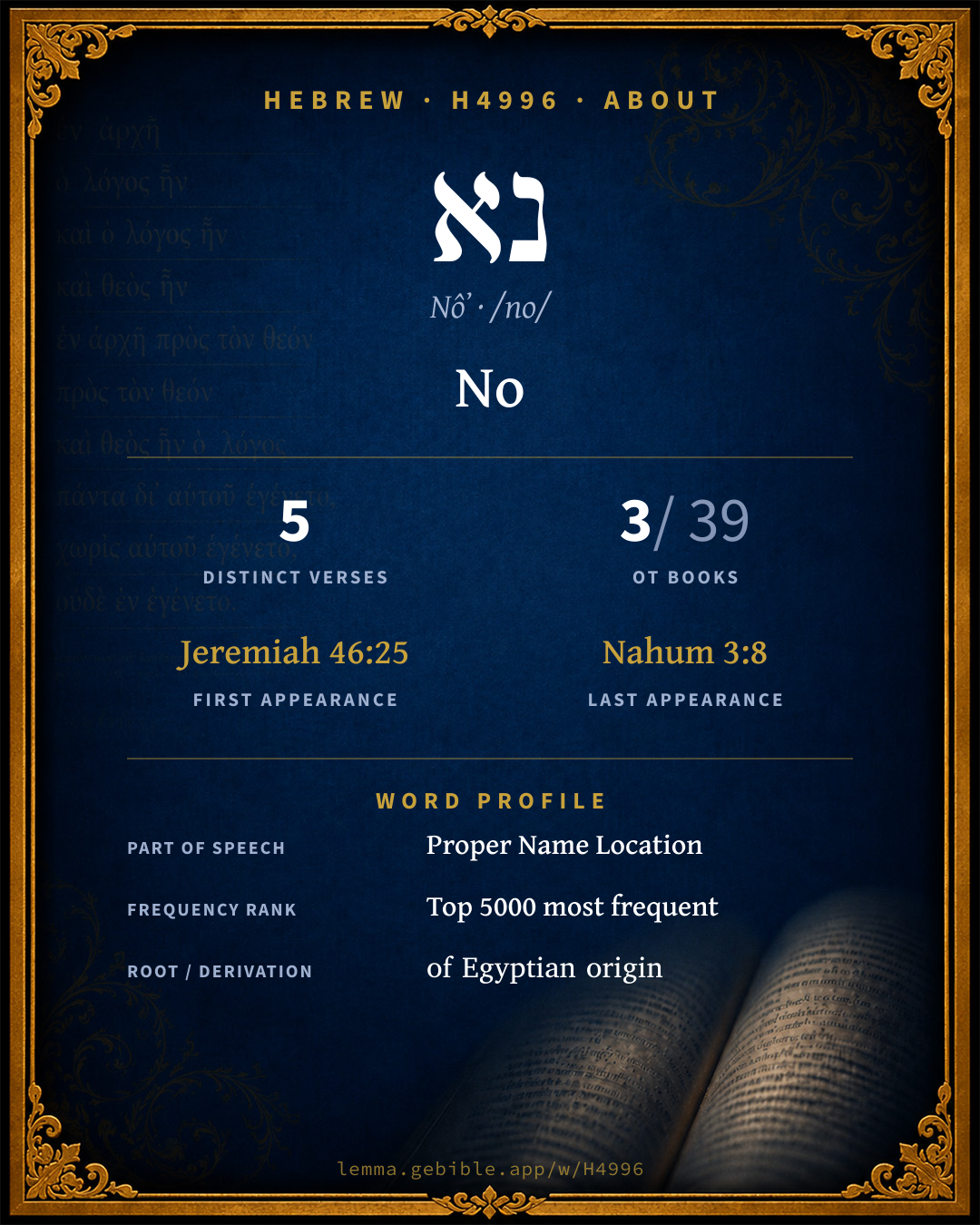
נֹא
No
BDB lists 2 entries for ‘No’ fuller range ↓
Full lexicon entry — Brown-Driver-Briggs (BDB)
From Brown-Driver-Briggs (BDB)
Where this word appears
Grammar key — what these labels mean
Part of speech
- Noun
- A naming word — a person, place, thing, or idea.
Noun type
- Proper
- A name of a specific person, place, or people (e.g. Abraham, Zion, Israel).
Every verse where H4996 appears in the Book of Nahum — 1 distinct verse. Click any verse to open its interlinear word-by-word view. Verse text shown in the World English Bible for context — . Each verse’s Hebrew form is shown with its reference; the English is not keyword-highlighted, since the data carries no word-level English alignment. Use “Compare translations” on any verse to read it across multiple English versions. This concordance covers the Hebrew Bible; Septuagint (Greek Old Testament) occurrences are not indexed here.
Nahum
About this entry
At a glance — auto-summarized from this page’s data, not written by a person. Every figure links to its source below. This summary describes the numbers; it doesn’t interpret them.
נא (Nôʼ) is a Hebrew name most often rendered “No.” A scarce word — 5 verses in all of the Hebrew Bible. It clusters heavily in Ezekiel, which alone accounts for 60% of its uses. Debuting at Jeremiah 46:25, it then recurs through the corpus. The sections below give every occurrence and version rendering.
Gloss history
Strong's 1890 vs modern scholarship
About this word
Strong's H4996 catalogs a Hebrew word from the Hebrew Old Testament.
These counts are not copied from any lexicon or concordance. They are computed here, from the morphology-tagged Hebrew Old Testament. What Lemma adds →
- 5
- distinct verses
- The word appears in 5 distinct verses.
- 3 / 39
- OT books
- The word appears in 3 of 39 Old Testament books.
- #3,337
- by frequency
- Top 5000 most frequent Hebrew words (rank 3,337 of 8,640 Hebrew words by occurrence).
View all 5 occurrences in the concordance →
By section of the Old Testament
By traditional corpus
Conventional, traditional groupings — biblical authorship is debated, so this is a traditional corpus grouping, not an authorship claim. Each share is this word’s portion of its verses in that division of the Hebrew canon. Each figure is a share of the word’s 5 distinct verses.
- Prophets (Nevi'im) 5 verses · 100%
How translations render this word
Counts come from each version’s own published word-to-Strong’s tagging or interlinear alignment — an approximate guide to how each version renders this word, not a word-level alignment the data otherwise carries. Because each total is that version’s own tagged count, the per-version totals vary from one another and need not match the appearance or distinct-verse counts above. These counts may also differ from a printed concordance because Lemma counts each distinctly tagged rendering and does not collapse phrase taggings into a single head-word total. This is a fixed set of word-tagged versions (KJV, ASV, BSB, ULT) and does not change with the reading translation you choose elsewhere. Each version’s license is shown beside its name below (and on Sources).
- King James Version: No 5×
- American Standard Version: No 4×
- Berean Standard Bible: Thebes 4×
- unfoldingWord Literal Text: Thebes 3×
King James Version Public Domain
Renders H4996 across 5 tagged occurrences — most commonly:
American Standard Version Public Domain
Renders H4996 across 5 tagged occurrences — most commonly:
Plus 1 rendering that appears only once — usually multi-word phrases or single function words the recovered tagging swept in, not distinct renderings.
Berean Standard Bible Public Domain
Renders H4996 across 5 tagged occurrences — most commonly:
Plus 1 rendering that appears only once — usually multi-word phrases or single function words the recovered tagging swept in, not distinct renderings.
unfoldingWord Literal Text CC BY-SA 4.0
Renders H4996 across 4 tagged occurrences — most commonly:
Plus 1 rendering that appears only once — usually multi-word phrases or single function words the recovered tagging swept in, not distinct renderings.
Senses in BDB
The 2 senses BDB distinguishes for this word, in lexicon order (not ranked by frequency or importance). The full entry — with sub-senses — is in the Lexicon Entry tab.
- No = "disrupting"
- the ancient capital of Egypt; also 'Thebes'
Word origin
n.pr.loc. No = Thebes (Egyptian nt, city, i.e. prob. nē(t), v. SteindBAS i. 596 f.; Assyrian Ni-ʾu, Ni-iʾ DlPar 318 Steind l.c. SchrCOT gloss.; Tel Am. Nî (Ni-i) WklTel Am. 39 BezTel Am. in BM 153);—הִנְנִי פוֹקֵד אֶל־אָמוֹן מִנֹּא Je 46:25 Amon from (of, 𝔊 ἐν = בְּ) No; נֹא אָמוֹן Na 3:8 No of Amon (= city of god Ammon, = 𝔊 Διόσπολις Ez 30:14, 16 Steind l.c.; v. also Jerem. and BillerbeckBAS iii. 104 f.); Ez 30:14 (‖ פַּתְרוֹס, צֹ֫עַן), וְהִכְרַתִּי אֶת־הֲמוֹן נֹא v 15 (‖ סִין; but 𝔊 Co Berthol נֹף q.v. for נֹא) v 16 (‖ סִין, Co סון). It lay on the right bank of the Nile, c. 400 miles (by the river) S. of Memphis.
— Brown-Driver-Briggs (Oxford 1906, public domain), digitized via Sefaria, supplemented by the OpenScriptures HebrewLexicon (CC BY 4.0). See Sources.
Origin: of Egyptian origin
Jastrow Dictionary
A second Hebrew/Aramaic lexicon for comparison, covering Aramaic and post-biblical (Talmudic, Targumic, Midrashic) usage that the biblical-Hebrew BDB does not. Matched by lemma rather than by Strong’s number, so a lemma may carry more than one Jastrow headword (shown separately below), and the entries cover usage well beyond the Bible.
נָא I
- = אֲנָא. Y. Ter. V, 43ᶜ bot. ואוף נא וכ׳ I, too, think so. Y. Ber. IV, beg. 7ᵃ וָנָא אמרית וכ׳ and I gave a reason for it; a. fr.—V. דְּנָה, לֵינָא.—Pl. נַן. Y. B. Kam. II, beg. 2ᵈ מה נן אמרין וכ׳ why do we say &c.; a. fr.
נָא II
- (also adverb)(b. h.;
- 1. hurried, half-done. Pes. 41ᵃ bot. אכלו נא if he ate it (the Passover lamb) half-done. Ib.ᵇ ישנו בבל תאכל נא is subject to the law (Ex. XII, 9) &c. Tosef. Macc. IV (III), 1, contrad. to חַי. Men. 78ᵇ מצה נא, v. הַיָנָא; a. fr. e.g. Exodus 12:9
- 2. slender, fine, brittle. — Pl. נָאִין; f. נָאוֹת. Tosef. Kel. B. Kam. II, 9 [read with R. S. to Kel. III, 2:] הוסקו והנאין (= והן נאין) if the vessels were heated but turned out brittle. B. Bath, 97ᵇ (expl. פיטסות, ib. VI, 2) נאות ומגופרות thin, but lined with pitch; Tosef. ib. VI, 3.
נָא III
- (b. h.) I pray, prithee. Yoma IV, 2; a. fr.—Ber. 9ᵃ, a. e. אין נא אלא וכ׳, v. בַּקָּשָׁה.
נַן
- , pl. of נָא I.
A Dictionary of the Targumim, the Talmud Babli and Yerushalmi, and the Midrashic Literature (Marcus Jastrow; London, Luzac, 1903) — Public Domain. Digitized via Sefaria. Digitized via Sefaria. Full attribution on Sources.
Forms in the corpus
The 5 distinct written forms H4996 takes in the Hebrew Bible, most frequent first — each parse links to that state’s occurrences in the concordance. Hebrew forms include their vowel points and cantillation, so a single lemma takes many written forms.
| Form | Parsing | Example | Uses |
|---|---|---|---|
| בְּ/נֹֽא | Noun, Proper | Ezekiel 30:14 | 1 |
| וְ/נֹ֖א | Noun, Proper | Ezekiel 30:16 | 1 |
| מִ/נֹּ֔א | Noun, Proper | Jeremiah 46:25 | 1 |
| מִ/נֹּ֣א | Noun, Proper | Nahum 3:8 | 1 |
| נֹֽא | Noun, Proper | Ezekiel 30:15 | 1 |
Bible dictionary
Public-domain dictionary articles matched to this entry by name (No). A biblical name can be shared by more than one person or place, so an article may treat several.
Easton's Bible Dictionary · M. G. Easton, 1897
Or No-A'mon, the home of Amon, the name of Thebes, the ancient capital of what is called the Middle Empire, in Upper or Southern Egypt. "The multitude of No" (Jer. 46:25) is more correctly rendered, as in the Revised Version, "Amon of No", i.e., No, where Jupiter Amon had his temple. In Ezek. 30:14, 16 it is simply called "No;" but in ver. 15 the name has the Hebrew Hamon prefixed to it, "Hamon No." This prefix is probably the name simply of the god usually styled Amon or Ammon. In Nah. 3:8 the "populous No" of the Authorized Version is in the Revised Version correctly rendered "No-Amon."
It was the Diospolis or Thebes of the Greeks, celebrated for its hundred gates and its vast population. It stood on both sides of the Nile, and is by some supposed to have included Karnak and Luxor. In grandeur and extent it can only be compared to Nineveh. It is mentioned only in the prophecies referred to, which point to its total destruction. It was first taken by the Assyrians in the time of Sargon (Isa. 20). It was afterwards "delivered into the hand" of Nebuchadnezzar and Assurbani-pal (Jer. 46:25, 26). Cambyses, king of the Persians (B.C. 525), further laid it waste by fire. Its ruin was completed (B.C. 81) by Ptolemy Lathyrus. The ruins of this city are still among the most notable in the valley of the Nile. They have formed a great storehouse of interesting historic remains for more than two thousand years. "As I wandered day after day with ever-growing amazement amongst these relics of ancient magnificence, I felt that if all the ruins in Europe, classical, Celtic, and medieval, were brought together into one centre, they would fall far short both in extent and grandeur of those of this single Egyptian city." Manning, The Land of the Pharaohs.
Smith's Bible Dictionary · William Smith, 1863
[No-Amon]
Hitchcock's Bible Names Dictionary · Roswell D. Hitchcock, 1869
stirring up; forbidding
Classic public-domain reference works; full attribution on Sources.
Septuagint verse parallels
This word appears in 4 verses that also exist in the Greek Old Testament (Septuagint), out of the 5 Hebrew verses it occurs in. You can read those verses in Greek by switching the Old Testament edition to the Septuagint.
Read these verses in the Septuagint
This is a verse-level parallel only — the same verses exist in both the Hebrew and Greek Old Testaments. No word-level Hebrew↔Greek correspondence is claimed: the data carries no such alignment, so no Greek word is shown as this Hebrew word’s translation. Coverage is not total — the Septuagint omits the deuterocanon and renumbers the Psalms, so some Hebrew verses have no direct Greek parallel.