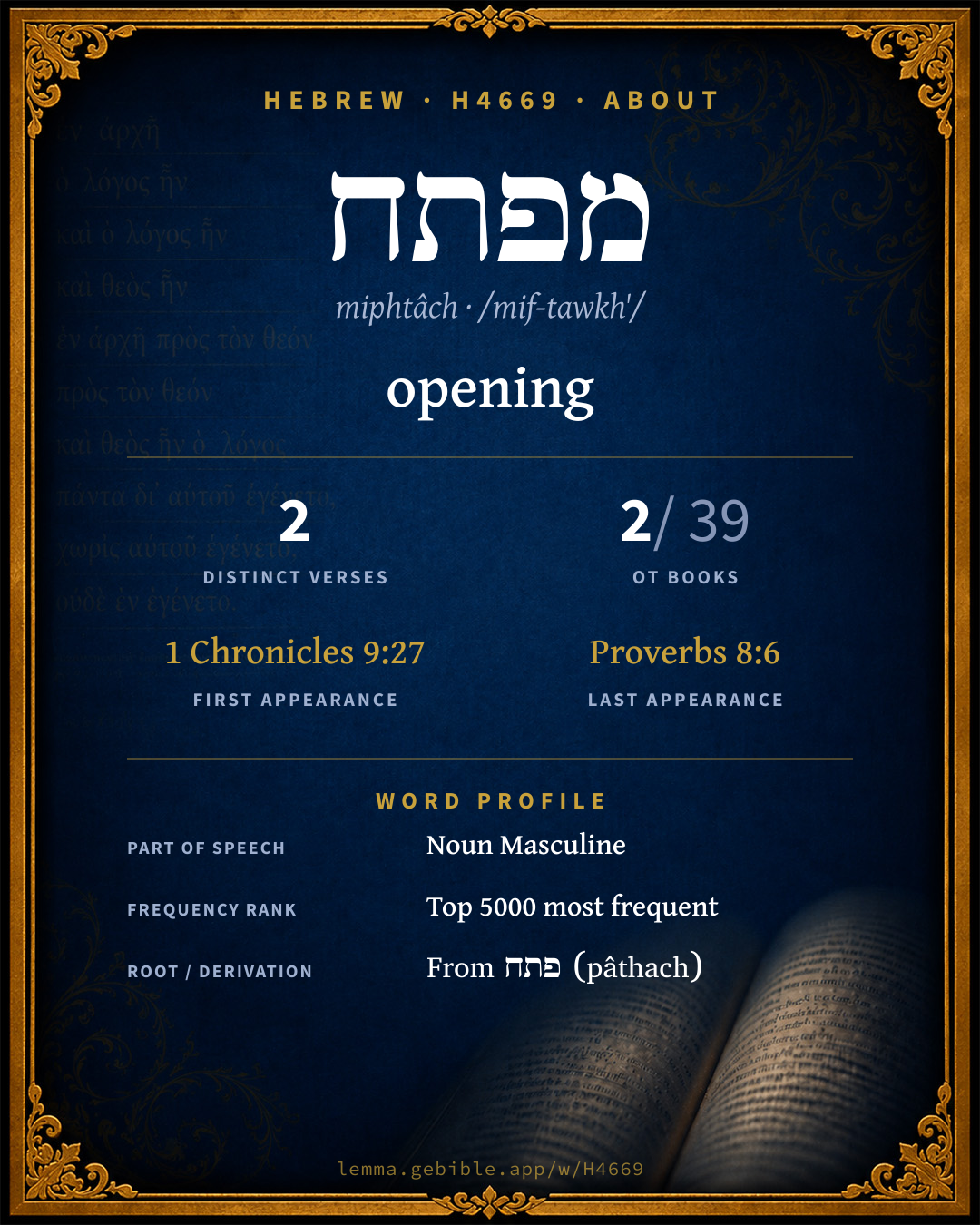
מִפְתָּח
opening
Full lexicon entry — Brown-Driver-Briggs (BDB)
From Brown-Driver-Briggs (BDB)
Where this word appears
See every Absolute-state word in the Hebrew Bible →
Grammar key — what these labels mean
Noun type
- Common
- A common noun — a general class of person, place, or thing (“king,” “city,” “water”), not a specific name.
State
- Construct
- A noun bound to a following noun in a possessive / “of” relationship (the construct chain).
- Absolute
- The independent form of a noun, not bound to a following word.
Gender
- Masculine
- Grammatically masculine.
Number
- Singular
- One.
1 distinct verse where H4669 appears in the Absolute state, across 1 book. Filtered view — show all forms. Click any verse to open its interlinear word-by-word view. Verse text shown in the World English Bible for context — . Each verse’s Hebrew form is shown with its reference; the English is not keyword-highlighted, since the data carries no word-level English alignment. Use “Compare translations” on any verse to read it across multiple English versions. This concordance covers the Hebrew Bible; Septuagint (Greek Old Testament) occurrences are not indexed here.
1 Chronicles 1 verse
About this entry
At a glance — auto-summarized from this page’s data, not written by a person. Every figure links to its source below. This summary describes the numbers; it doesn’t interpret them.
מפתח (miphtâch) is a Hebrew noun most often rendered “opening.” It occurs a mere 2 verses across Scripture. It clusters heavily in 1 Chronicles, which alone accounts for 50% of its uses. It first appears in 1 Chronicles 9:27. From the same root come פתח, מפתח and פתוח. The sections below give every sense, occurrence, and version rendering.
Gloss history
Strong's 1890 vs modern scholarship
About this word
Strong's H4669 catalogs a Hebrew word from the Hebrew Old Testament.
These counts are not copied from any lexicon or concordance. They are computed here, from the morphology-tagged Hebrew Old Testament. What Lemma adds →
- 2
- distinct verses
- The word appears in 2 distinct verses.
- 2 / 39
- OT books
- The word appears in 2 of 39 Old Testament books.
- #4,807
- by frequency
- Top 5000 most frequent Hebrew words (rank 4,807 of 8,640 Hebrew words by occurrence).
View all 2 occurrences in the concordance →
Most concentrated in
- 1 Chronicles 1 verse 50%
- Proverbs 1 verse 50%
By section of the Old Testament
By traditional corpus
Conventional, traditional groupings — biblical authorship is debated, so this is a traditional corpus grouping, not an authorship claim. Each share is this word’s portion of its verses in that division of the Hebrew canon. Each figure is a share of the word’s 2 distinct verses.
- Writings (Ketuvim) 2 verses · 100%
How translations render this word
Counts come from each version’s own published word-to-Strong’s tagging or interlinear alignment — an approximate guide to how each version renders this word, not a word-level alignment the data otherwise carries. Because each total is that version’s own tagged count, the per-version totals vary from one another and need not match the appearance or distinct-verse counts above. These counts may also differ from a printed concordance because Lemma counts each distinctly tagged rendering and does not collapse phrase taggings into a single head-word total. This is a fixed set of word-tagged versions (KJV, ASV, BSB, ULT) and does not change with the reading translation you choose elsewhere. Each version’s license is shown beside its name below (and on Sources).
- King James Version: Opening 1×
- American Standard Version: Opening 1×
- Berean Standard Bible: Opening 1×
- unfoldingWord Literal Text: Opening 1×, Opening of 1×
King James Version Public Domain
Renders H4669 across 1 tagged occurrence — most commonly:
American Standard Version Public Domain
Renders H4669 across 1 tagged occurrence — most commonly:
Berean Standard Bible Public Domain
Renders H4669 across 1 tagged occurrence — most commonly:
unfoldingWord Literal Text CC BY-SA 4.0
Renders H4669 across 2 tagged occurrences — most commonly:
Senses in BDB
The 1 sense BDB distinguishes for this word, in lexicon order (not ranked by frequency or importance). The full entry — with sub-senses — is in the Lexicon Entry tab.
- opening, utterance
Word origin
Derived from פתח (pâthach) (H6605) — to open.
Jastrow Dictionary
A second Hebrew/Aramaic lexicon for comparison, covering Aramaic and post-biblical (Talmudic, Targumic, Midrashic) usage that the biblical-Hebrew BDB does not. Matched by lemma rather than by Strong’s number, so a lemma may carry more than one Jastrow headword (shown separately below), and the entries cover usage well beyond the Bible.
מִפְתָּח
- opening, entrance. Mikv. VIII, 1 חוץ למ׳ (Var. לפתח) outside of the (town) gate; Tosef. ib. VI, 1 (R. S. to Mikv. l. c. פתח).—Pesik. R. s. 37 מִפְתַּח שפתיו וכ׳ the opening of his lips is blessing and peace. Sabb. XV, 2 (111ᵇ) מ׳ חלוקה (Y. ed. מפתחי) the neekhole of her shirt; Y. ib. 15ᵇ; a. e.—Pl. מִפְתָּחִים, constr. מִפְתְּחֵי. Ber. 61ᵃ bot. יה"ר דומה … בין שני מ׳ הלב man’s evil inclination resembles a fly and is seated between the two valves of the heart; Yalk. Koh. 979; Yalk. Gen. 38.—מ׳ חלוק, v. supra.
מִפְתַּח
- , opening. Targ. Ez. XXIX, 21.
מְפַתֵּחַ
- (פָּתַח, Pi. 2)
- 1. engraver, sculptor. — Pl. מְפַתְּחִים. Kel. XXIX, 5 מקבת של מְפַתְּחֵי אבנים the sculptors’ mallet (contrad. to סַתָּת stone-cutter).
- 2. seal-ring. Tosef. Sabb. IV (V), 11 מ׳ שבאצבעה; Sabb. 62ᵇ מ׳ שבידה (corresp. to טבעת שיש עליה חותם, ib. VI, 3).
מַפְתֵּחַ
- c. (b. h.; key. Kel. XIV, 8, v. אַרְכּוּבָה. Bech. 45ᵃ. Taan. 2ᵃ, sq.; a. fr.—Pl. מַפְתֵּחוֹת, מַפְתֵּיחוֹת. Tam. III, 6. Taan. l. c.; a. fr.
פָּתַח
- (b. h.)
- 1. to open, begin. Y. Ber. VI, end, 10ᵈ על כל … שהיה פוֹתֵהַ וכ׳ over each cask as he opened it he said the benediction &c. Sabb. 104ᵃ, a. e. פּוֹתְחִין לו (Var. פְּתָחִין), v. טָמֵא I. Ib. 48ᵃ מתירין … אבל לא פותחין you may untie the neck-hole of a shirt, but not cut it open (on the Sabbath). Y. Taan. I, 64ᵇ top (ref. to Is. XLV, 8) כנקבה … פוֹתַחַת וכ׳ like the female that opens for the male. Ned. III, 4 לא יִפְתַּח לו בנדר he must not begin (offer his willingness) to make a vow (in order to escape robbery &c., v. נָדַר); a. v. fr.—Part. pass. פָּתוּחַ; פְּתוּחָה; pl. פְּתוּחִים, פְּתוּחִין; פְּתוּחוֹת. Yeb. 71ᵇ, a. e. נסתם הפ׳, v. סָתַם. Snh. 94ᵃ, v. סָתַם (v. מנצפ"ך). Meg. 3ᵃ, פ׳ באמצע, v. סָתַם. Erub. IV, 6 שלש חצירות הפ׳ זו לזו ופ׳ וכ׳ three courts opening into (communicating with) one another and into the publicroad; a. v. fr.—פתח פתוח, v. פֶּתַח.—Esp. (פרשה) פְּתוּחָה a paragraph in the Torah beginning with a new, indented line, opp. סתומה. Treat. Sof’rim I, 14 איזהו פ׳ כל שלא וכ׳ what is an open paragraph? Such as does not begin at the beginning of a line, וכמה … ותהא נקראת פ׳ and how much space must one leave … for a paragraph to be called open?; a. fr.—Trnsf. [to open the door to,] to introduce (into learning). Y. M. Kat. III, 83ᵇ top איזהו רבו כל שפ׳ לו תחלה who is called one’s (special) teacher? He who was the first to initiate him; a. e.—Esp. to open an opportunity for retracting a vow, to suggest reasons which, if known at the time, would have prevented the person from making the vow, v. חֲרָטָה. Ned. IX, 1 פותחין לאדם בכבוך וכ׳ the judges offer suggestions taken from the respect due to parents (saying, if you had known that this vow cast a reflection on your father &c.). Ib. רִפְתְּחוּ לו בכבוד המקום why not suggest to him the reverence due to the Lord (‘if you had known that he who makes a vow is considered an evil-doer &c.’)? Ib. 4 פותחין לו מן הכתוב וכ׳ we offer suggestions to him from what is written in the Law, saying to him, if you had known that (in fulfilling that vow) you would transgress the law forbidding revenge &c.; a. fr.—B. Kam. 27ᵃ פ׳ בכד וסיים בחבית the Mishnah begins with kad and closes with ḥabith! Ber. 10ᵃ פ׳ בה באשרי וכ׳, v. סוּם I h. Gen. R. s. 84 אתה פָתַחְתָּ תחלה בהצלת וכ׳ thou wast the first man to speak of saving life; אתה פתחת בתשובה וכ׳ thou wast the first to do repentance, … one of thy descendants shall rise and be the first (prophet) to call for repentance; a. fr.—Esp. to open a lecture with a (Biblical) text. Pesik. Aḥăré, p. 170ᵃ ר׳ לוי פ׳ וכ׳ R. Levi took up the text (Ps. LXXV, 5) &c. Gen. R. s. 1; a. v. fr.—Pesik. R. s. 33 [an editorial gloss] פ׳ בכל אלו הפרשיות the author takes his texts from all those (quoted) passages. e.g. Isaiah 45:8
- 2. to explain, speak plainly. Shek. V, 1; Men. 65ᵃ (ref. to פתחיה as identical with מרדכי) he was named Pethahia, שהיה פותח דברים ודורשן וכ׳ (not בדברים) because he explained words and interpreted them (etymologically) and knew seventy languages.—Part. pass. as ab. Sifré Aḥăré, beg., v. סָתַם.
- 1. to be opened. Yeb. 71ᵇ, a. e., v. סָתַם. R. Hash. 16ᵇ שלשה … נִפְתָּחִין בר"ה three books are opened (for recording) on the New Year’s Day. B. Bath. 125ᵇ, v. סוּם I, Nithpa. Pesik. R. l. c. להִיפָּתֵחַ to have one’s bowels opened, v. פְּסִיעָה; a. fr.—Ib. [editorial gloss] ונ׳ עוד שם בפרשת וכ׳ and furthermore this section (Is. LXI, 1) was used as the opening text; a. fr.—Esp. to have one’s eyes opened, to become seeing. Pesik. R. s. 42 כשילדה שדה כל סומא … נ׳ when Sarah gave birth, every blind person in the world was restored to sight; a. e. e.g. Isaiah 61:1
- 1. to open. Ib. פי׳ הפילקיות he opened the prisons. Par. III, 8 ועושין … ומְפַתְּחִין בה חלונות they piled wood in the shape of a tower and opened windows in it. Zeb. 88ᵇ רימונים שלא פִיתְּחוּ פיהן (Ms. K. a. R. 2 נִפְתְּחוּ; Ms. R. 1 נִתְפַּתְּחוּ, v. Rabb. D. S. a. l. note 5) pomegranates which have not yet burst open; a. e.
- 2. to engrave. Y. Ab. Zar. III, 43ᵇ bot פי׳ בה פיתוחים if he cut designs into it.
- 3. to dig, break ground. Pirké d’R. El. ch. XXVIII; Gen. R. s. 76 כשיצמד … יְפַתְּחוּ וישדדו וכ׳ when an ox and a cow are harnessed together, they will break and harrow all valleys.
- 1. to be opened, v. supra. Pesik. R. s. 31 נִתְפַּתְּחוּ בדם they (their cavities) were opened with (discharged) blood; a. e.
- 2. to be cut into, graven. Tosef. Sot. XV, 1; Y. ib. IX, 24ᵇ וכיון … היו מִתְפַּתְּחוֹת לפניו וכ׳ and when they let it (the Shamir, v. שָׁמִיר) look at the stones, they were engraven before it like the (wax-covered) tablets &c.—[Y. Kil. VII, beg. 30ᵈ מתפתחת R. S. to Kil. VIII, 1, v. פִּתְפֵּת.]
פְּתַח
- Targ. Deut. XV, 11. Targ. Is. XIV, 17; a. fr.—Part. pass. פְּתִיחַ; f. פְּתִיחָא; pl. פְּתִיחִין, פְּתִיחַיָּא; פְּתִיחָן a) open. Targ. Num. XIX, 15. Targ. Josh. VIII, 17; a. fr.—b) seeing, v. פְּתִיהַ.—Taan. 24ᵃ אתיא למִיפְתַּח … ולא מִיפְּתַח וכ׳ she came to open the door …, but it could not be opened on account of the wheat pressing against it. Gitt. 69ᵇ לִיפְתַּה הביתא וכ׳ let him open a keg of wine &c. B. Kam. 112ᵇ כגון דפָתְחוּ ליה בדיניה וכ׳ when they (the court) have opened his case (written a warrant, v. פְּתִיחָא II) and sent for him. Ned. 28ᵃ מיפתח הוא דלא יפתח וכ׳ he dare not offer to make oath (in order to escape robbery &c.), but make a vow, he may. Num. R. s. 9 תרעא דלא פתיח וכ׳, v. אָסֵי; a. fr.—Ned. 22ᵃ אע"ג דפ׳ … אנן לא פַתְחִינָן וכ׳ although R. Y. offered such a suggestion for retracting a vow, we must not do so; ולא פתחינן בהדא וכ׳ nor do we offer that other suggestion &c.; a. e.
- same. Lam. R. to I, 1 רבתי, beg. א׳ ליה ביתיה וכ׳ he opened his house to him, and he entered.
- same. Targ. Is. XLV, 1. Ib. XLII, 7.—Part. pass. מְפַתַּח open-eyed, able to see. Lev. R. s. 22 חד סמי וחד מפ׳ (Koh. R. to V, 8 פתיח) one was blind, and the other could see.
- 1. to be opened; to be released. Targ. O. Gen. III, 5; 7. Targ. Job XII, 14; a. fr.—Gitt. 69ᵃ bot. לאִיפַּתּוּחֵי וכ׳ (Rashi לפתיחי, read: לפַתּוּחֵי Pa.) that the boil may open, let somebody blow &c. Ib.ᵇ, v. צְפִירְתָּא; Pes. 42ᵇ; a. e.—Esp. to be restored to sight. Lev. R. l. c. דין דהוה סמי א׳ וכ׳ he who was blind recovered sight &c., v. סְמֵי; Koh. R. l. c. Ib. אִיתְפַּתְּחַת the she-ass recovered &c.; a. e.
פַּתָּח
- (פָּתַח Pi.
- 2. engraver. Pl. פַּתָּחִים. Y. Shek. IV, 48ᵃ top פַּתָּחֵי אבנים (Ms. M. מְפַתְּחֵי) stone engravers.
פִּתֵּחַ
- , v. פִּיתֵּחַ
פֶּתַח
- opening, door, gate. Keth. IV, 3 (ref. to Deut. XXII, 21) אין לה לא פ׳ בית האב וכ׳ if she (the faithless betrothed) has no paternal house door. Y. Sabb. VII, 9ᶜ top ניכר הוא … על פִּיתְחָהּ של תירה it can be seen that this man has never passed the gate of the Law (never studied). Koh. R. to III, 11 זה הפ׳ פתוח עד התהום this gate (verse used as introductory text, v. פָּתַח) opens to the deep, i.e. leads to deep reflection. Gen. R. s. 85 (ref. to פתח עינים, Gen. XXXVIII, 14) תלה עיניה בפ׳ שכל העינים וכ׳ she lifted up her eyes to the gate to which all eyes are directed (she prayed to the Lord). Gen. R. s. 38 פתח … פ׳ של תשובה the Lord opened to them the gate of repentance; a. fr.—Euphem. פ׳ פָּתוּחַ absence of virginity Keth. 9ᵇ טענת פ׳ פ׳, contrad. to טענת דמים, v. דָּם. Ib. 9ᵃ ופ׳ פ׳ כשני עדים דמי and the husband’s statement that lie found ‘the gate open’ is like a statement of two witnesses (to make her forbidden to him as a faithless betrothed); a. fr.—Trnsf. a) an opening for retracting a vow, a suggestion, v. פָּתַח. Gen. R. s. 91 למאה … מצא להם פ׳ for one hundred and fifty Nazarites he found causes for absolution; a. fr.—b) the starting time of menstruation. Arakh. II, 1 אין פ׳ בטועה וכ׳ for a woman that has lost the account of a prolonged flux, there is no new starting point within either less than seven or more than seventeen days. Ib. 8ᵃ פִּתְחָהּ שבעה עשר her sure starting point is after seventeen days; a. fr.—Pl. פְּתָחִים, פְּתָחִין. B. Bath. IX, 1 ישאלו על הפ׳ let them go begging at the doors; Keth. XIII, 3 יחזרו על הפ׳. Cant. R. to V, 2 פתחו לי פתח … ואני פותח לכם פ׳ וכ׳ make for me one opening for return as wide as the point of a needle, and I shall open for you gates through which wagons and coaches can pass; a. fr.—Ab. III, 18 פִּתְחֵי נדה the calculations concerning starting points of menstruants (v. supra). e.g. Deuteronomy 22:21
A Dictionary of the Targumim, the Talmud Babli and Yerushalmi, and the Midrashic Literature (Marcus Jastrow; London, Luzac, 1903) — Public Domain. Digitized via Sefaria. Digitized via Sefaria. Full attribution on Sources.
Forms in the corpus
The 2 distinct written forms H4669 takes in the Hebrew Bible, most frequent first — each parse links to that state’s occurrences in the concordance. Hebrew forms include their vowel points and cantillation, so a single lemma takes many written forms.
| Form | Parsing | Example | Uses |
|---|---|---|---|
| הַ/מַּפְתֵּ֖חַ | Noun, Common, Masculine, Singular, Absolute | 1 Chronicles 9:27 | 1 |
| וּ/מִפְתַּ֥ח | Noun, Common, Masculine, Singular, Construct | Proverbs 8:6 | 1 |
Same root — word family
Other BDB entries built from the same root as H4669, grouped by Strong’s listed origin. These share a root / origin per the lexicon — not necessarily a shared meaning. Each links to that word’s own entry.
Derives from
Shares the same root
- מפתח maphtêach H4668 key
- פתוח pittûwach H6603 engraving
- פתח pᵉthach H6606 to open
- פתח pethach H6607 doorway
- פתח pêthach H6608 opening
- פתחה pᵉthichâh H6609 sword
- פתחון pithchôwn H6610 opening
Proper names from this root
People and places named from this root — a name, not an additional meaning of the word.
- יפתח Yiphtâch H3316 Jephthah
- יפתחאל Yiphtach-ʼêl H3317 Jiphthah-el
- נפתוח Nephtôwach H5318 Nephtoah
- פתחיה Pᵉthachyâh H6611 Pethahiah
Compare all same-root words → Showing 4 of 13 — not the complete family. 4 of the same-root words are proper names (people or places). They share a root, not necessarily a meaning.
Septuagint verse parallels
This word appears in 2 verses that also exist in the Greek Old Testament (Septuagint), out of the 2 Hebrew verses it occurs in. You can read those verses in Greek by switching the Old Testament edition to the Septuagint.
Read these verses in the Septuagint
This is a verse-level parallel only — the same verses exist in both the Hebrew and Greek Old Testaments. No word-level Hebrew↔Greek correspondence is claimed: the data carries no such alignment, so no Greek word is shown as this Hebrew word’s translation. Coverage is not total — the Septuagint omits the deuterocanon and renumbers the Psalms, so some Hebrew verses have no direct Greek parallel.