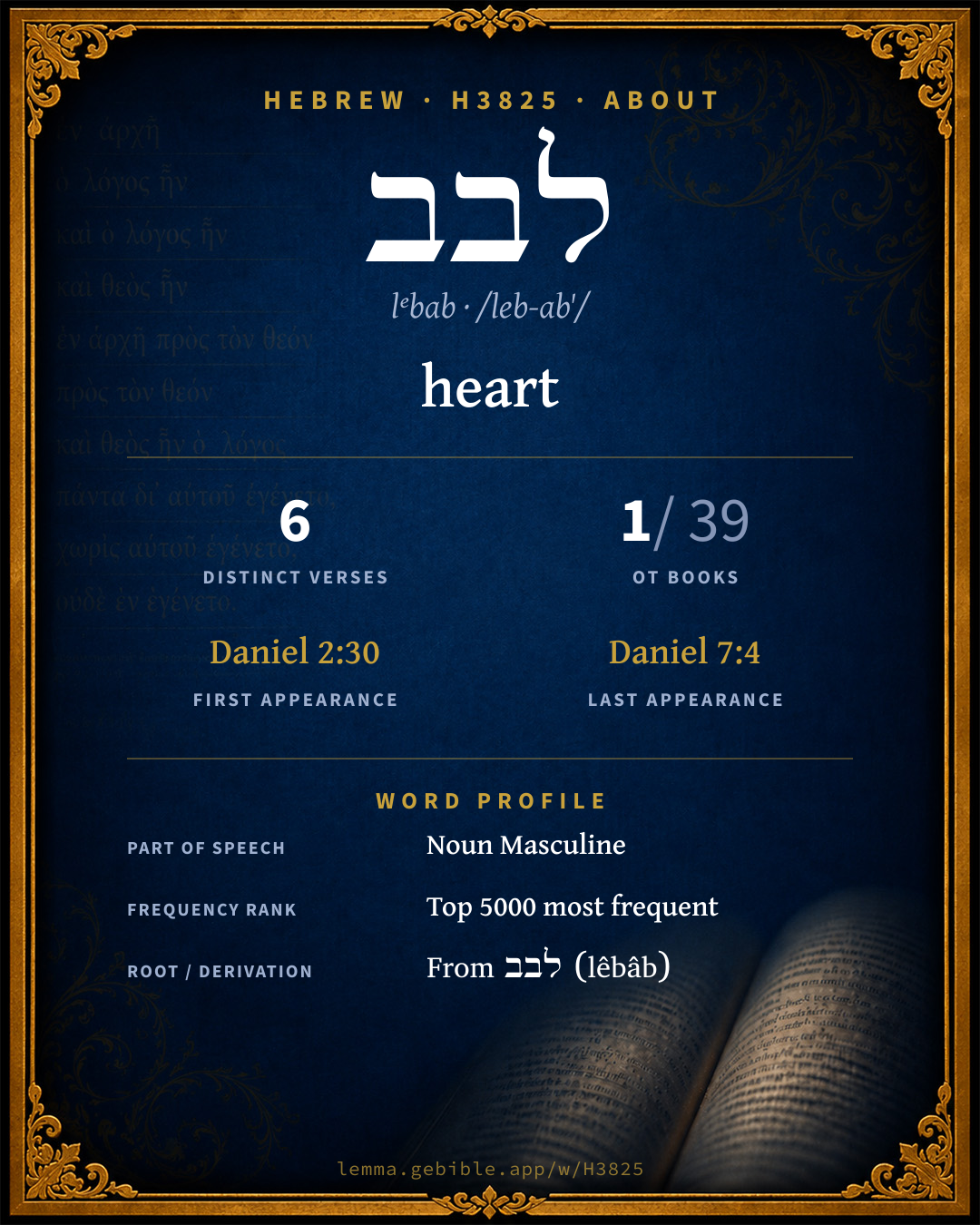
לְבַב
heart
Full lexicon entry — Brown-Driver-Briggs (BDB)
From Brown-Driver-Briggs (BDB)
Where this word appears
Grammar key — what these labels mean
Part of speech
- Noun
- A naming word — a person, place, thing, or idea.
Noun type
- Common
- A common noun — a general class of person, place, or thing (“king,” “city,” “water”), not a specific name.
State
- Construct
- A noun bound to a following noun in a possessive / “of” relationship (the construct chain).
Gender
- Masculine
- Grammatically masculine.
Number
- Singular
- One.
Every verse where H3825 appears — 6 distinct verses across 1 book. Click any verse to open its interlinear word-by-word view. Verse text shown in the World English Bible for context — . Each verse’s Hebrew form is shown with its reference; the English is not keyword-highlighted, since the data carries no word-level English alignment. Use “Compare translations” on any verse to read it across multiple English versions. This concordance covers the Hebrew Bible; Septuagint (Greek Old Testament) occurrences are not indexed here.
Daniel 6 verses
- Daniel 2:30 לִבְבָ֖/ךְ n c ms cs + sfx pers 2ms But as for me, this secret is not revealed to me for any wisdom that I have more than any living, but to the intent that the interpretation may be made known to the king, and that you may know the thoughts of your heart.
- Daniel 4:16 לִבְבֵ/הּ֙ וּ/לְבַ֥ב n c ms cs + sfx pers 3ms conj + n c ms cs let his heart be changed from man's, and let a animal's heart be given to him; and let seven times pass over him.
- Daniel 5:20 לִבְבֵ֔/הּ n c ms cs + sfx pers 3ms But when his heart was lifted up, and his spirit was hardened so that he dealt proudly, he was deposed from his kingly throne, and they took his glory from him:
- Daniel 5:21 וְ/לִבְבֵ֣/הּ conj + n c ms cs + sfx pers 3ms and he was driven from the sons of men, and his heart was made like the animals', and his dwelling was with the wild donkeys; he was fed with grass like oxen, and his body was wet with the dew of the sky; until he knew that the Most High God rules in the kingdom of men, and that he sets up over it whoever he will.
- Daniel 5:22 לִבְבָ֑/ךְ n c ms cs + sfx pers 2ms You his son, Belshazzar, have not humbled your heart, though you knew all this,
- Daniel 7:4 וּ/לְבַ֥ב conj + n c ms cs The first was like a lion, and had eagle's wings: I saw until the wings of it were plucked, and it was lifted up from the earth, and made to stand on two feet as a man; and a man's heart was given to it.
About this entry
At a glance — auto-summarized from this page’s data, not written by a person. Every figure links to its source below. This summary describes the numbers; it doesn’t interpret them.
“heart” is the headline sense of the Hebrew noun לבב (lᵉbab). It clusters heavily in Daniel, which alone accounts for 100% of its uses. With 6 verses in 1 book, it is an uncommon word in the Hebrew Bible. Scripture first uses it in Daniel 2:30. From the same root come לבב and לב. See the sense tree, 6-verse concordance, and the renderings breakdown below.
Gloss history
Strong's 1890 vs modern scholarship
About this word
Strong's H3825 catalogs a Hebrew word from the Hebrew Old Testament.
These counts are not copied from any lexicon or concordance. They are computed here, from the morphology-tagged Hebrew Old Testament. What Lemma adds →
- 6
- distinct verses
- The word appears in 6 distinct verses.
- 1 / 39
- OT books
- The word appears in 1 of 39 Old Testament books.
- #2,835
- by frequency
- Top 5000 most frequent Hebrew words (rank 2,835 of 8,640 Hebrew words by occurrence).
View all 6 occurrences in the concordance →
Most concentrated in
- Daniel 6 verses 100%
By section of the Old Testament
By traditional corpus
Conventional, traditional groupings — biblical authorship is debated, so this is a traditional corpus grouping, not an authorship claim. Each share is this word’s portion of its verses in that division of the Hebrew canon. Each figure is a share of the word’s 6 distinct verses.
- Writings (Ketuvim) 6 verses · 100%
How translations render this word
Counts come from each version’s own published word-to-Strong’s tagging or interlinear alignment — an approximate guide to how each version renders this word, not a word-level alignment the data otherwise carries. Because each total is that version’s own tagged count, the per-version totals vary from one another and need not match the appearance or distinct-verse counts above. These counts may also differ from a printed concordance because Lemma counts each distinctly tagged rendering and does not collapse phrase taggings into a single head-word total. This is a fixed set of word-tagged versions (KJV, ASV, BSB, ULT) and does not change with the reading translation you choose elsewhere. Each version’s license is shown beside its name below (and on Sources).
- King James Version: Heart 6×
- American Standard Version: Heart 4×, 's heart 2×
- Berean Standard Bible: Mind 4×, Heart 2×
- unfoldingWord Literal Text: Mind 3×, Heart 2×, Mind of 2×
King James Version Public Domain
Renders H3825 across 7 tagged occurrences — most commonly:
Plus 1 rendering that appears only once — usually multi-word phrases or single function words the recovered tagging swept in, not distinct renderings.
American Standard Version Public Domain
Renders H3825 across 7 tagged occurrences — most commonly:
Plus 1 rendering that appears only once — usually multi-word phrases or single function words the recovered tagging swept in, not distinct renderings.
Berean Standard Bible Public Domain
Renders H3825 across 7 tagged occurrences — most commonly:
Plus 1 rendering that appears only once — usually multi-word phrases or single function words the recovered tagging swept in, not distinct renderings.
unfoldingWord Literal Text CC BY-SA 4.0
Renders H3825 across 8 tagged occurrences — most commonly:
Plus 1 rendering that appears only once — usually multi-word phrases or single function words the recovered tagging swept in, not distinct renderings.
Senses in BDB
The 1 sense BDB distinguishes for this word, in lexicon order (not ranked by frequency or importance). The full entry — with sub-senses — is in the Lexicon Entry tab.
- heart, mind
Word origin
Derived from לבב (lêbâb) (H3824) — heart.
Jastrow Dictionary
A second Hebrew/Aramaic lexicon for comparison, covering Aramaic and post-biblical (Talmudic, Targumic, Midrashic) usage that the biblical-Hebrew BDB does not. Matched by lemma rather than by Strong’s number, so a lemma may carry more than one Jastrow headword (shown separately below), and the entries cover usage well beyond the Bible.
לֵבָב
- (b. h.) = לֵב, heart; (in rabbinical homiletics) double heart, seat of two opposite inclinations (v. יֵצֶר). Ber. IX, 5 (ref. to Deut. VI, 5) בכל לְבָבְךָ בשני יצריך וכ׳ ‘with all thy heart’ means with both thy inclinations &c. (i.e. break thy evil inclination for the love of God). Gen. R. s. 48 (ref. to Gen. XVIII, 5) וסעדו לְבַבְכֶם אין וכ׳ it does not say here, ‘comfort ye your l’bab, but your leb’, which intimates that the evil inclination has no power over angels; a. e.—[Pesik. S’liḥ., p. 166ᵃ, v. next w.]—Pl. f. לְבָבוֹת. Tanḥ. Ki Thabo 1 (ref. to Deut. XXVI, 16) בשעה שאתם מתפללים … שתי ל׳ וכ׳ when you pray before the Lord, you shall not have two hearts, one for the Lord, and one for another thing (idol); ib. 2. Sot. I, 8 גנב ג׳ ל׳ (Bab. ed. p. 9ᵇ גנבות) he deceived three hearts (v. גָּנַב). B. Bath. 12ᵇ before eating and drinking man has שתי ל׳ וכ׳ two hearts (his thoughts are not clearly defined) &c. (ref. to Job XI, 12 ‘a hollow man is divided at heart’). e.g. Deuteronomy 6:5
לָבַב
- (b. h.)
- 1. to join closely; to tie.—Part. Pass. לָבוּב, pl. לְבוּבִין. Sabb. V, 2 (52ᵇ) זכרים יוצאין ל׳ wethers may be taken out (on the Sabbath) coupled; expl. ib. 53ᵇ תותרי. Ib. מאי משמע דהאי ל׳ לישנא דקרובי הוא where is the proof that this root לבב has the meaning of bringing close together? Answ. ref. to לבבתני (Cant. IV, 9) ‘thou hast chained me’; עולא אמר עור שקושרין להם כנגד לבם וכ׳ Ulla says (l’bubin refers to) the skin which is tied against their chests to protect them from the attacks of wolves; Y. ib. V, 7ᵇ bot. שהוא נותן עור וכ׳ (v. בּוּרְסִיון). e.g. Song of Solomon 4:9
- 2. (denom. of לֵב) part. pass. (עור) לָבוּב a hide showing a hole in the place corresponding to the heart.—Pl. לְבוּבִים, לְבוּבִין. Ab. Zar. II, 3 (29ᵇ) עורות ל׳ hides with holes &c. (are forbidden, because the heart has been cut out for idolatrous purposes); expl. Tosef. ib. IV (V), 7; Y. ib. II, 41ᵇ; Bab. ib. 32ᵃ
- to be tied around. Y. Sabb. X, end, 12ᵈ העושה … לִילָּבֵב he who makes a strap to be tied around (an animal’s chest &c., v. supra); Tosef. Kel. B. Bath. IV, 13 ללַבֵּב Pi.
- 1. to join, tie, v. supra.
- 2. (denom. of לֵב) to encourage; to strengthen. Tanḥ. Sh’moth 14; Ex. R. s. 2 (play on לַבַּת, Ex. III, 2) (כדי) לְלַבְּבוֹ וכ׳ in order to make him courageous when he comes to Mount Sinai &c. Gen. R. s. 77 היה … ומְלַבְּבוֹ בארי the king took his son and made him courageous by making him attack the (tamed) lion; Cant. R. to III, 6 זיווג את הארי והיה מלבבו כנגד בנו he attacked the lion and incited him against his son. Pesik. S’liḥ., p. 166ᵃ [read:] יפה כחך לַבֵּב כחך גבור improve thy strength, strengthen thy powers, valiant man! (Ar. ed. Koh. ליבב כח בגבורה, oth. ed. לבב כח בגבורה join physical strength to valor). e.g. Exodus 3:2
A Dictionary of the Targumim, the Talmud Babli and Yerushalmi, and the Midrashic Literature (Marcus Jastrow; London, Luzac, 1903) — Public Domain. Digitized via Sefaria. Digitized via Sefaria. Full attribution on Sources.
Forms in the corpus
The 6 distinct written forms H3825 takes in the Hebrew Bible, most frequent first — each parse links to that state’s occurrences in the concordance. Hebrew forms include their vowel points and cantillation, so a single lemma takes many written forms.
| Form | Parsing | Example | Uses |
|---|---|---|---|
| וּ/לְבַ֥ב | Noun, Common, Masculine, Singular, Construct | Daniel 4:16 | 2 |
| וְ/לִבְבֵ֣/הּ | Noun, Common, Masculine, Singular, Construct | Daniel 5:21 | 1 |
| לִבְבֵ/הּ֙ | Noun, Common, Masculine, Singular, Construct | Daniel 4:16 | 1 |
| לִבְבֵ֔/הּ | Noun, Common, Masculine, Singular, Construct | Daniel 5:20 | 1 |
| לִבְבָ֑/ךְ | Noun, Common, Masculine, Singular, Construct | Daniel 5:22 | 1 |
| לִבְבָ֖/ךְ | Noun, Common, Masculine, Singular, Construct | Daniel 2:30 | 1 |
Same root — word family
Other BDB entries built from the same root as H3825, grouped by Strong’s listed origin. These share a root / origin per the lexicon — not necessarily a shared meaning. Each links to that word’s own entry.
Derives from
Shares the same root
Compare all same-root words → They share a root, not necessarily a meaning.
Septuagint verse parallels
This word appears in 3 verses that also exist in the Greek Old Testament (Septuagint), out of the 6 Hebrew verses it occurs in. You can read those verses in Greek by switching the Old Testament edition to the Septuagint.
Read these verses in the Septuagint
This is a verse-level parallel only — the same verses exist in both the Hebrew and Greek Old Testaments. No word-level Hebrew↔Greek correspondence is claimed: the data carries no such alignment, so no Greek word is shown as this Hebrew word’s translation. Coverage is not total — the Septuagint omits the deuterocanon and renumbers the Psalms, so some Hebrew verses have no direct Greek parallel.