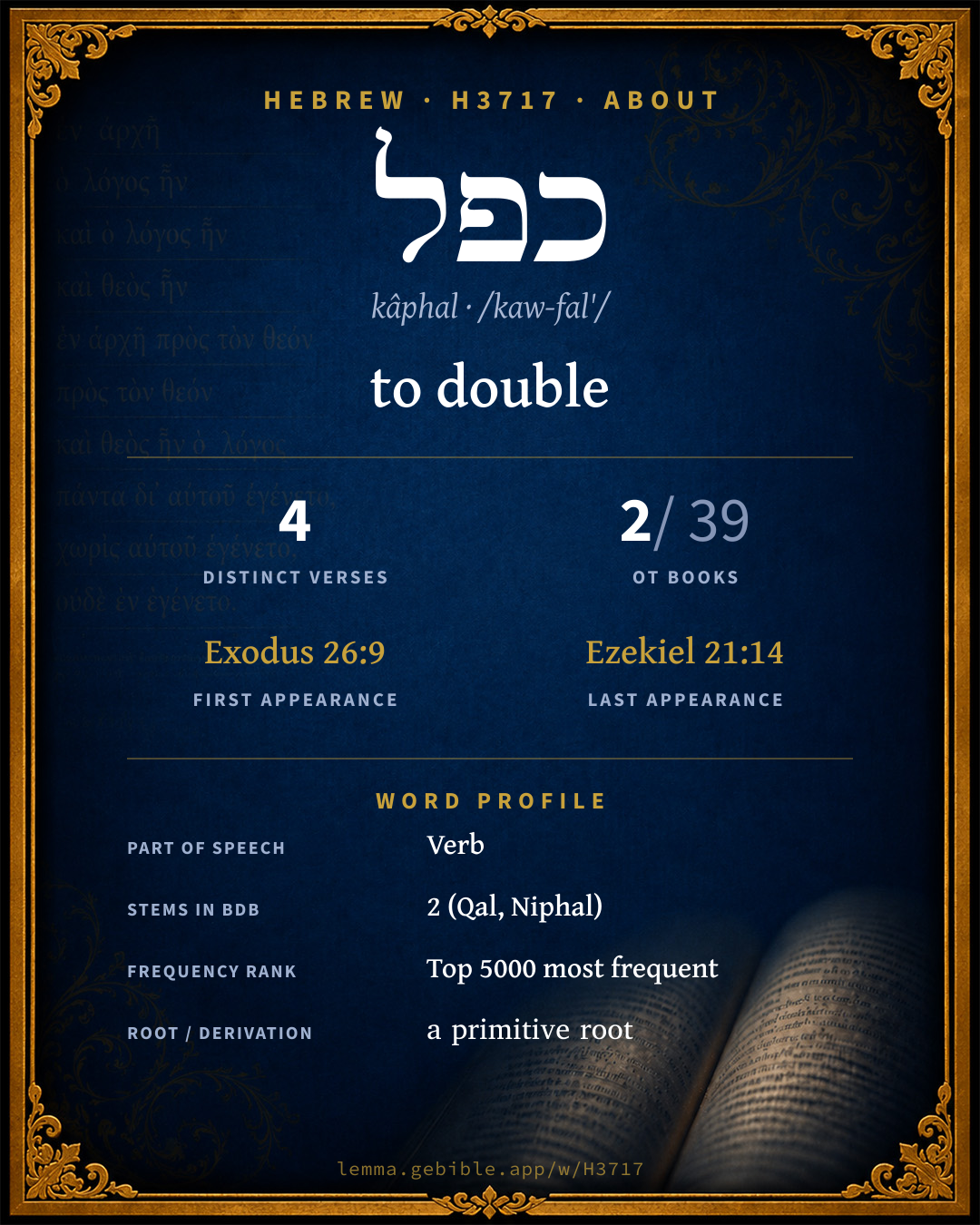
כָּפַל
to double
also: fold double, double over fuller range ↓
Full lexicon entry — Brown-Driver-Briggs (BDB)
From Brown-Driver-Briggs (BDB)
Where this word appears
See every Qal verb in the Hebrew Bible →
Grammar key — what these labels mean
Part of speech
- Verb
- An action or state-of-being word.
Stem
- Qal
- The basic, simple active stem — the plain form of the verb (“he wrote”). Here: ‘and thou shalt double over the sixth curtain’
- Niphal
- Usually the simple passive or reflexive of the Qal (“he was written”).
Form
- Participle Passive
- A verbal adjective expressing action received (“written”).
- Jussive
- A third- or second-person volitional form expressing wish or command (“let him write”).
- Sequential Perfect
- A perfect with prefixed waw continuing a preceding imperfect or command (waw-consecutive perfect).
State
- Absolute
- The independent form of a noun, not bound to a following word.
Person
- 3rd Person
- The one spoken about (“he / she / it / they”).
- 2nd Person
- The one addressed (“you”).
Gender
- Masculine
- Grammatically masculine.
- Feminine
- Grammatically feminine.
Number
- Singular
- One.
1 distinct verse where H3717 appears in the Niphal stem, across 1 book. Filtered view — show all forms. Click any verse to open its interlinear word-by-word view. Verse text shown in the World English Bible for context — . Each verse’s Hebrew form is shown with its reference; the English is not keyword-highlighted, since the data carries no word-level English alignment. Use “Compare translations” on any verse to read it across multiple English versions. This concordance covers the Hebrew Bible; Septuagint (Greek Old Testament) occurrences are not indexed here.
Ezekiel 1 verse
About this entry
At a glance — auto-summarized from this page’s data, not written by a person. Every figure links to its source below. This summary describes the numbers; it doesn’t interpret them.
The Hebrew verb כפל centers on the idea of “to double.” A scarce word — 4 verses in all of the Hebrew Bible. The word gravitates to Exodus (75%), then Ezekiel. First canonically at Exodus 26:9, it enters the text early. Read the stem: it spans 2 stems, including Qal and Niphal. Dig into 4-verse concordance and the renderings breakdown below.
Gloss history
Strong's 1890 vs modern scholarship
About this word
Strong's H3717 catalogs a Hebrew word from the Hebrew Old Testament.
These counts are not copied from any lexicon or concordance. They are computed here, from the morphology-tagged Hebrew Old Testament. What Lemma adds →
- 4
- distinct verses
- The word appears in 4 distinct verses.
- 2 / 39
- OT books
- The word appears in 2 of 39 Old Testament books.
- #3,337
- by frequency
- Top 5000 most frequent Hebrew words (rank 3,337 of 8,640 Hebrew words by occurrence).
View all 4 occurrences in the concordance →
By traditional corpus
Conventional, traditional groupings — biblical authorship is debated, so this is a traditional corpus grouping, not an authorship claim. Each share is this word’s portion of its verses in that division of the Hebrew canon. Each figure is a share of the word’s 4 distinct verses.
- Torah (Pentateuch) 3 verses · 75%
- Prophets (Nevi'im) 1 verse · 25%
How translations render this word
Counts come from each version’s own published word-to-Strong’s tagging or interlinear alignment — an approximate guide to how each version renders this word, not a word-level alignment the data otherwise carries. Because each total is that version’s own tagged count, the per-version totals vary from one another and need not match the appearance or distinct-verse counts above. These counts may also differ from a printed concordance because Lemma counts each distinctly tagged rendering and does not collapse phrase taggings into a single head-word total. This is a fixed set of word-tagged versions (KJV, ASV, BSB, ULT) and does not change with the reading translation you choose elsewhere. Each version’s license is shown beside its name below (and on Sources).
- King James Version: Be doubled 1×, Double 1×, Shall be being doubled 1×
- American Standard Version: Be doubled 1×, Double 1×, Shall be and double 1×
- Berean Standard Bible: Folded over double 2×
- unfoldingWord Literal Text: Folded double 3×
King James Version Public Domain
Renders H3717 across 5 tagged occurrences — most commonly:
American Standard Version Public Domain
Renders H3717 across 5 tagged occurrences — most commonly:
Berean Standard Bible Public Domain
Renders H3717 across 4 tagged occurrences — most commonly:
Plus 2 renderings that appear only once — usually multi-word phrases or single function words the recovered tagging swept in, not distinct renderings. Not rendered by a distinct English word in 1 further occurrence.
unfoldingWord Literal Text CC BY-SA 4.0
Renders H3717 across 5 tagged occurrences — most commonly:
Plus 2 renderings that appear only once — usually multi-word phrases or single function words the recovered tagging swept in, not distinct renderings.
Senses in the full BDB
Hebrew verbs can shift meaning by stem (binyan): Qal is the basic action, Niphal is often passive or reflexive, Piel often intensifies or makes it factitive, and Hiphil is typically causative. The senses below are grouped under the stem BDB assigns to each.
What do BDB’s symbols mean?
BDB uses these scholarly abbreviations:
| Symbol | Meaning |
|---|---|
| 𝔊 | the Septuagint (the ancient Greek translation, LXX) |
| 𝔙 | the Vulgate (the Latin translation) |
| 𝔖 | the Syriac version (the Peshitta) |
| 𝔗 | the Targum (the Aramaic translation) |
| ψ | the Psalms |
| √ | root (the underlying root or stem) |
| ‖ | parallel passage (a synonymous or contrasted parallel) |
| † | the dagger: every passage where the word occurs is cited |
The 2 senses and sub-senses the full Brown-Driver-Briggs lexicon distinguishes for this word, in lexicon order (not ranked by frequency), with BDB’s own verbatim wording and sub-sense lettering. Shown in Hebrew script with BDB’s own scholarly abbreviations. The condensed entry is in the Lexicon Entry tab. See also the Forms in the corpus table below.
Qal
- and thou shalt double over the sixth curtain, i.e. prob. use it double; folded double, of the breast-piece
Niphal
- . and let the sword be doubled, but very dub.
Senses from the full Brown-Driver-Briggs lexicon (Brown, Driver, Briggs; Oxford 1906 — public domain), digitized via Sefaria, supplemented by the OpenScriptures HebrewLexicon (CC BY 4.0). Full attribution on Sources.
Word origin
כָּפַל vb. double, double over (late)
— Brown-Driver-Briggs (Oxford 1906, public domain), digitized via Sefaria, supplemented by the OpenScriptures HebrewLexicon (CC BY 4.0). See Sources.
Origin: a primitive root
Jastrow Dictionary
A second Hebrew/Aramaic lexicon for comparison, covering Aramaic and post-biblical (Talmudic, Targumic, Midrashic) usage that the biblical-Hebrew BDB does not. Matched by lemma rather than by Strong’s number, so a lemma may carry more than one Jastrow headword (shown separately below), and the entries cover usage well beyond the Bible.
כָּפַל
- to bend over, fold, double. Ber. 63ᵃ כּוֹפְלִין לו וכ׳ his means of support will be doubled to him. Gen. R. s. 95, end כל מי שכ׳ שמו וכ׳ every one whose name the Scripture mentions twice in the blessings of Moses; (B. Kam. 92ᵃ אותן שהוּכְפְּלוּ בשמות). Succ. III, 11 … מקום לִכְפּוֹל יִכְפּוֹל where it is customary to recite twice (each verse of Ps. CXVIII, 21—29), let one do so. Tosef. Pes. X, 9 רבי היה כּוֹפֵל בה דברים Rabbi used to repeat certain words (in singing the Hallel); Pes. 119ᵇ; Succ. 39ᵃ מוסיף לכפול מאודך וכ׳ adds (to Rabbi’s repetitions) by doubling the verses from Od’kha (Ps. l. c.). Sifra Vayikra, N’dabah, Par. 10, ch. XII; Men. VI, 4 (75ᵇ) כופל אחד וכ׳ (Bab. ed. קופל) he folds it twice over and breaks it (into four parts). Ned. 61ᵇ יכפלו, v. קָפַל. Gitt. 62ᵃ כּוֹפְלִין שלום וכ׳ we must double the greeting (say twice shalom) &c. B. Mets. 104ᵇ לכפול וכ׳ where it is costumary to write out the K’thubah for double the amount of the dowry, half the amount is collected; a. fr.—Part. pass. כָּפוּל, f. כְּפוּלָה; pl. כְּפוּלִים, כְּפוּלִין; כְּפוּלוֹת. Kel. XXVII, 5 נמדד כ׳ is measured as it is doubled (folded). Ib. 6.—Ohol. XI, 3 כ׳ Var. in R. S. a. l. (ed. ק׳) folded up one above the other. Ned. 66ᵇ כ׳ הן her ears are bent over (deformed).—Treat. Sof’rim II, 11 אותיות הכ׳ letters which have two forms (מנצפך); a. fr.—תנאי כ׳, v. תְּנַאי. e.g. Psalms 118:21
- to be doubled. Y. Kil. IX, 32ᶜ top נִכְפְּלוּ לו שניו his years of life were doubled to him. Gen. R. s. 30, beg.; Tanḥ. Sh’moth 18, a. e. כל מי שנ׳ שמו every one whose name appears twice in immediate succession (as Noah Noah, Gen. VI, 9); a. fr. e.g. Genesis 6:9
- to double, fold up. Ned. 61ᵇ, sq., v. קָפַל.
- to be doubled, bent. Ib., v. קָפַל. M. Kat. 25ᵇ (in a poetic eulogy) קאת … הוּכְפְּלוּ לראות וכ׳ pelican and owl were bent upon looking (took pains to see, cmp. next w. Ithp.).—B. Kam. 92ᵃ, v. supra.—Part. pass. מוּכְפָּל (Pu. מְכוּפָּל) doubly guarded, surrounded. Yalk. Lev. 557 מוכ׳ כמה כְפֵלוֹת; Lev. R. s. 16 מכו׳ בכמה כפולות (the tongue) is guarded by several folding doors (teeth, lips).
- to fold. Sifra l. c.; Men. l. c. לא היה מְכַפְּלָהּ (Bab. ed. מק׳) he did not fold it (in four parts, v. supra).
כְּפַל
- Part. pass. כָּפִיל double. Targ. Cant. VIII, 7.—Gitt. 62ᵃ דכַפְלִינָן שלמא וכ׳, v. preced.
- 1. to be folded up, doubled. Targ. Is. XXXVIII, 12 (ed. Lag. אתק׳). Targ. Ez. XXI, 19.—B. Mets. 104ᵇ אי מקנא לא מִיכְּפֵל if formal obligation is to be entered into (v. קִנְיָן), the document must not be made out for double the amount, v. preced.; a. fr.
- 2. to be bent upon, take pains. Sabb. 5ᵃ איכ׳ תנא וכ׳ was it necessary for the Tannai to take pains to let us hear all this (to be so explicit)?—B. Mets. 46ᵃ וא׳ תנא וכ׳ should the Tannai have taken the trouble to speak of such an exceptional case as that of a naked man &c.?—B. Bath. 91ᵃ אִיכְּפֵל ואוליד וכ׳ apply thyself (Rashi: marry again), and beget &c. Shebu. 48ᵇ אִיכְפְּלִי ואתאי וכ׳ have I taken the trouble to come all this distance for the sake of upsetting &c.?; a. e.—[Y. Ter. VIII, 46ᵃ top אכפלן ed. Zyt., v. אֲפַךְ.]
כֶּפֶל
- preced. wds.) doubling, double amount, esp. (תשלומי) כ׳ the additional amount to be paid as fine on restoring stolen goods (Ex. XXII, 3; 6—8). Snh. I, 1. B. Kam. VII, 1; a. fr.—Ib. 65ᵃ עולה לו בכְפֵילוֹ (fr. כָּפֵל; Rashi: בתוך הכפל) is credited to him as the thief’s fine; Tosef. ib. VIII, 8 מתוך כפילו … is deducted from &c. Y. Sot. III, end, 19ᵇ; Kidd. 18ᵃ ולא בכפילו cannot be sold for the fine; a. fr.—Du. כִּפְלַיִם, כִּפְלַיִים. Succ. 51ᵇ; Tosef. ib. IV, 6 כ׳ כיוצאי מצרים twice as many as those who went out of Egypt; a. e.—Pl. כְּפָלִים even numbers. Pes. 110ᵃ השותה כ׳ Ms. M. he who drinks even numbers of cups, v. זוֹגָא.—כְּפֵלוֹת folding doors, v. כָּפַל. e.g. Exodus 22:3
A Dictionary of the Targumim, the Talmud Babli and Yerushalmi, and the Midrashic Literature (Marcus Jastrow; London, Luzac, 1903) — Public Domain. Digitized via Sefaria. Digitized via Sefaria. Full attribution on Sources.
Forms in the corpus
The 5 distinct written forms H3717 takes in the Hebrew Bible, most frequent first — each parse links to that stem’s occurrences in the concordance. Hebrew forms include their vowel points and cantillation, so a single lemma takes many written forms.
| Form | Parsing | Example | Uses |
|---|---|---|---|
| וְ/כָפַלְתָּ֙ | Verb, Qal, Sequential Perfect, 2nd Person, Masculine, Singular | Exodus 26:9 | 1 |
| וְ/תִכָּפֵ֞ל | Verb, Niphal, Jussive, 3rd Person, Feminine, Singular | Ezekiel 21:14 | 1 |
| כָּפ֑וּל | Verb, Qal, Participle Passive, Masculine, Singular, Absolute | Exodus 28:16 | 1 |
| כָּפ֖וּל | Verb, Qal, Participle Passive, Masculine, Singular, Absolute | Exodus 39:9 | 1 |
| כָּפֽוּל | Verb, Qal, Participle Passive, Masculine, Singular, Absolute | Exodus 39:9 | 1 |
Same root — word family
Other BDB entries built from the same root as H3717, grouped by Strong’s listed origin. These share a root / origin per the lexicon — not necessarily a shared meaning. Each links to that word’s own entry.
Derived from this word
Proper names from this root
People and places named from this root — a name, not an additional meaning of the word.
Compare all same-root words → 1 of the same-root words is a proper name (a person or place). They share a root, not necessarily a meaning.
Septuagint verse parallels
This word appears in 4 verses that also exist in the Greek Old Testament (Septuagint), out of the 4 Hebrew verses it occurs in. You can read those verses in Greek by switching the Old Testament edition to the Septuagint.
Read these verses in the Septuagint
This is a verse-level parallel only — the same verses exist in both the Hebrew and Greek Old Testaments. No word-level Hebrew↔Greek correspondence is claimed: the data carries no such alignment, so no Greek word is shown as this Hebrew word’s translation. Coverage is not total — the Septuagint omits the deuterocanon and renumbers the Psalms, so some Hebrew verses have no direct Greek parallel.