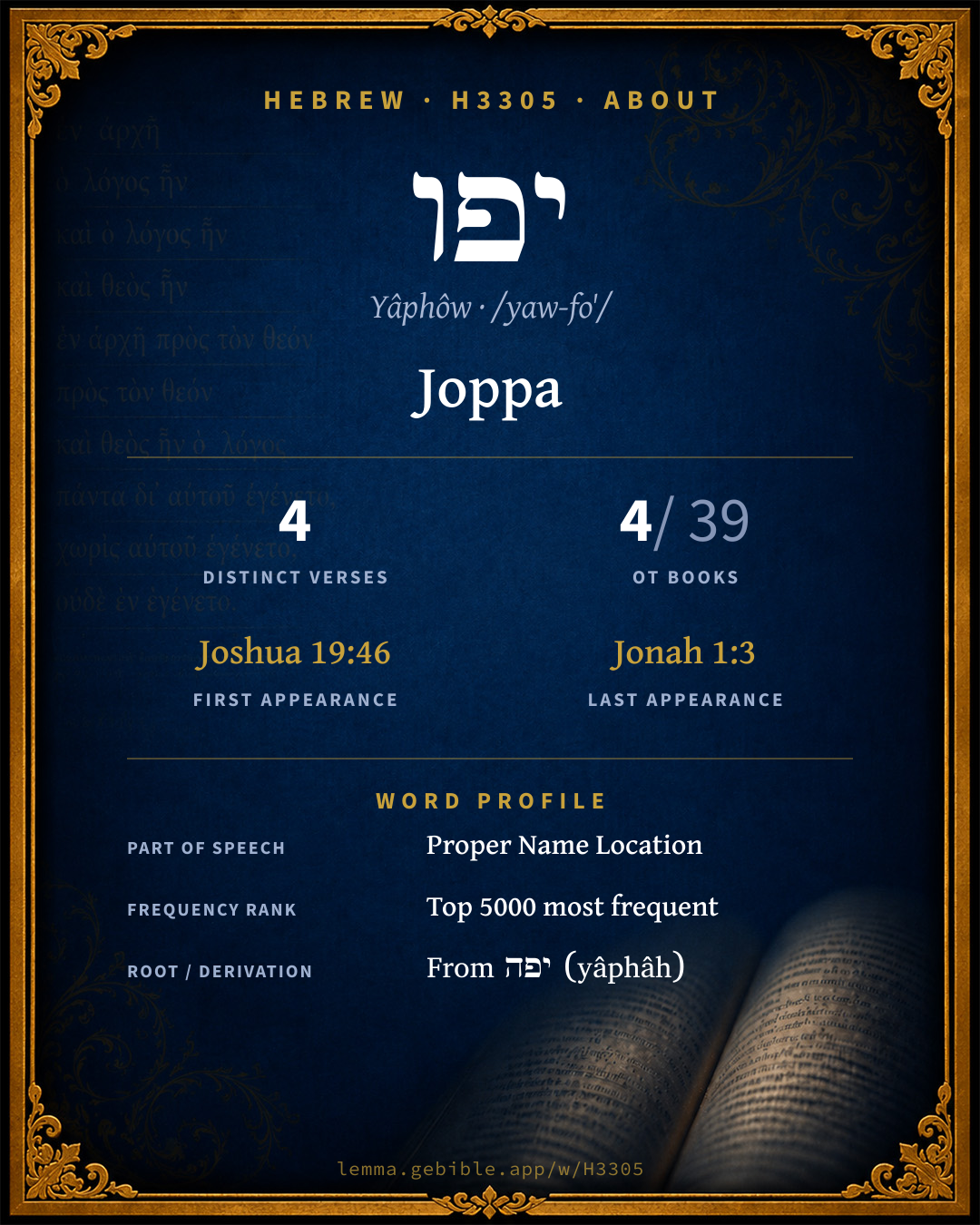
יָפוֹ
Joppa
BDB lists 2 entries for ‘Joppa’ fuller range ↓
Full lexicon entry — Brown-Driver-Briggs (BDB)
From Brown-Driver-Briggs (BDB)
Where this word appears
Grammar key — what these labels mean
Part of speech
- Noun
- A naming word — a person, place, thing, or idea.
Noun type
- Proper
- A name of a specific person, place, or people (e.g. Abraham, Zion, Israel).
Every verse where H3305 appears in the Book of Joshua — 1 distinct verse. Click any verse to open its interlinear word-by-word view. Verse text shown in the World English Bible for context — . Each verse’s Hebrew form is shown with its reference; the English is not keyword-highlighted, since the data carries no word-level English alignment. Use “Compare translations” on any verse to read it across multiple English versions. This concordance covers the Hebrew Bible; Septuagint (Greek Old Testament) occurrences are not indexed here.
Joshua
About this entry
At a glance — auto-summarized from this page’s data, not written by a person. Every figure links to its source below. This summary describes the numbers; it doesn’t interpret them.
“Joppa” is the headline sense of the Hebrew name יפו (Yâphôw). A scarce word — 4 verses in all of the Hebrew Bible. It concentrates in Joshua, which alone accounts for 25% of its uses. First canonically at Joshua 19:46, it enters the text early. Each statement above links to its evidence; the full detail follows below.
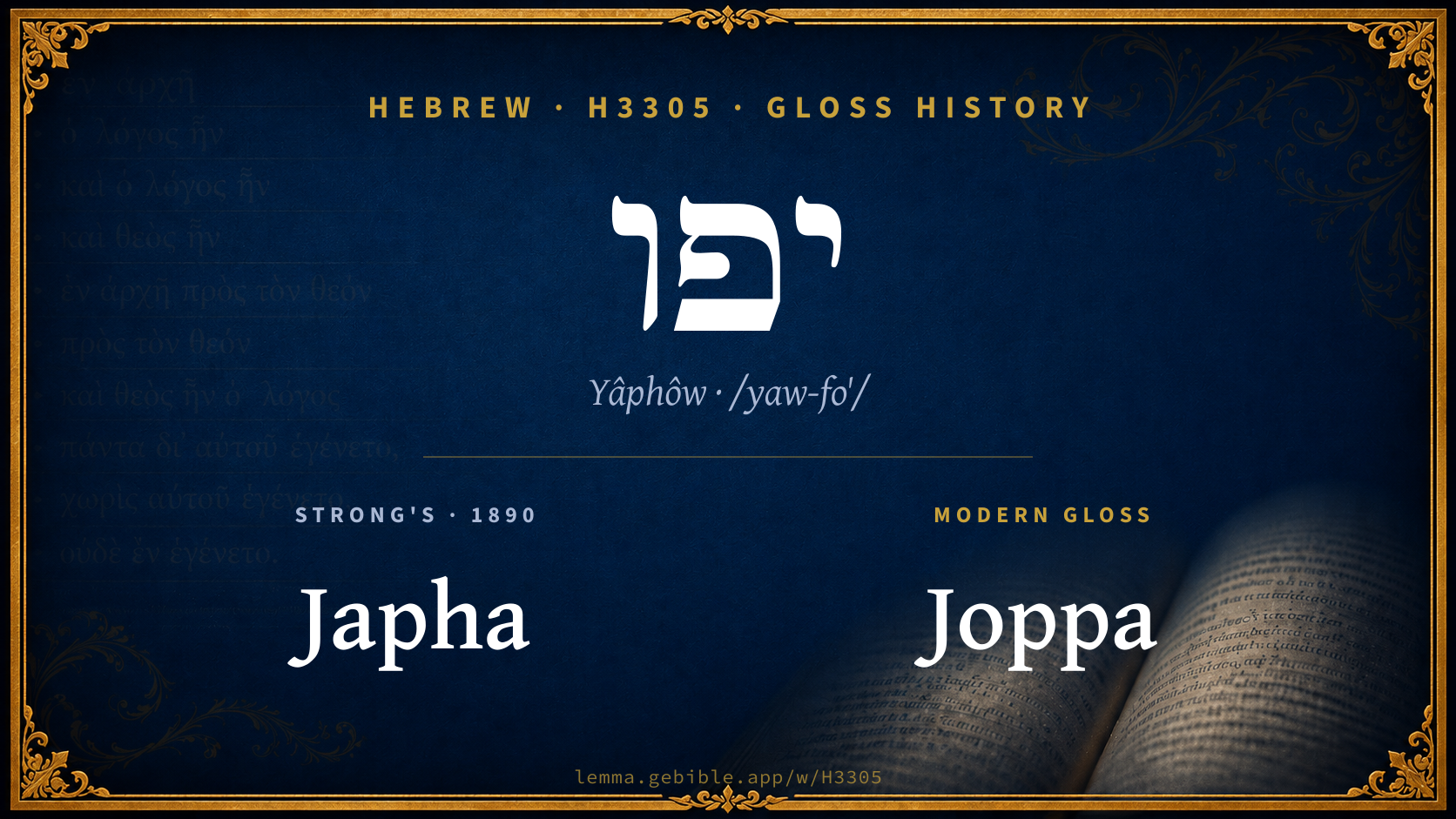
Gloss history
Strong's 1890 vs modern scholarship
About this word
Strong's H3305 catalogs a Hebrew word from the Hebrew Old Testament.
These counts are not copied from any lexicon or concordance. They are computed here, from the morphology-tagged Hebrew Old Testament. What Lemma adds →
- 4
- distinct verses
- The word appears in 4 distinct verses.
- 4 / 39
- OT books
- The word appears in 4 of 39 Old Testament books.
- #3,696
- by frequency
- Top 5000 most frequent Hebrew words (rank 3,696 of 8,640 Hebrew words by occurrence).
View all 4 occurrences in the concordance →
Most concentrated in
- Joshua 1 verse 25%
- 2 Chronicles 1 verse 25%
- Ezra 1 verse 25%
By section of the Old Testament
By traditional corpus
Conventional, traditional groupings — biblical authorship is debated, so this is a traditional corpus grouping, not an authorship claim. Each share is this word’s portion of its verses in that division of the Hebrew canon. Each figure is a share of the word’s 4 distinct verses.
- Prophets (Nevi'im) 2 verses · 50%
- Writings (Ketuvim) 2 verses · 50%
How translations render this word
Counts come from each version’s own published word-to-Strong’s tagging or interlinear alignment — an approximate guide to how each version renders this word, not a word-level alignment the data otherwise carries. Because each total is that version’s own tagged count, the per-version totals vary from one another and need not match the appearance or distinct-verse counts above. These counts may also differ from a printed concordance because Lemma counts each distinctly tagged rendering and does not collapse phrase taggings into a single head-word total. This is a fixed set of word-tagged versions (KJV, ASV, BSB, ULT) and does not change with the reading translation you choose elsewhere. Each version’s license is shown beside its name below (and on Sources).
- King James Version: Joppa 3×
- American Standard Version: Joppa 4×
- Berean Standard Bible: Joppa 3×
- unfoldingWord Literal Text: Joppa 4×
King James Version Public Domain
Renders H3305 across 4 tagged occurrences — most commonly:
Plus 1 rendering that appears only once — usually multi-word phrases or single function words the recovered tagging swept in, not distinct renderings.
American Standard Version Public Domain
Renders H3305 across 4 tagged occurrences — most commonly:
Berean Standard Bible Public Domain
Renders H3305 across 4 tagged occurrences — most commonly:
Plus 1 rendering that appears only once — usually multi-word phrases or single function words the recovered tagging swept in, not distinct renderings.
unfoldingWord Literal Text CC BY-SA 4.0
Renders H3305 across 4 tagged occurrences — most commonly:
Senses in BDB
The 2 senses BDB distinguishes for this word, in lexicon order (not ranked by frequency or importance). The full entry — with sub-senses — is in the Lexicon Entry tab.
- Joppa or Japho = "beautiful"
- a town on the southwest coast of Palestine in the territory of Dan…
Word origin
n.pr.loc. Joppa (Ph. יפי; Assyrian Ja(p)pu COT Gloss. Bez Tel-el-Amarna Tabl. in Brit. Mus. 146; Egyptian Ye-pu WMM 159)—seaport town of Palestine (Jerusalem), יָפוֹ Jos 19:46 Jon 1:3 2 Ch 2:15 = יָפוֹא Ezr 3:7; 𝔊 Ιοππα, mod. Jaffa.
— Brown-Driver-Briggs (Oxford 1906, public domain), digitized via Sefaria, supplemented by the OpenScriptures HebrewLexicon (CC BY 4.0). See Sources.
Derived from יפה (yâphâh) (H3302) — to be beautiful.
Jastrow Dictionary
A second Hebrew/Aramaic lexicon for comparison, covering Aramaic and post-biblical (Talmudic, Targumic, Midrashic) usage that the biblical-Hebrew BDB does not. Matched by lemma rather than by Strong’s number, so a lemma may carry more than one Jastrow headword (shown separately below), and the entries cover usage well beyond the Bible.
יָפוֹ
- (b. h.) pr. n. pl. Japho (Joppa), the harbor of Jerusalem. Pirké d’R. El. ch. X. Yalk. Is. 334 עד שיחיה די׳ to the excavations of the harbor of J.; Cant. R. to VII, 5 ריפע (corr. acc.); v. יָקַב. Ex. R. s. 43 ר׳חייא … די׳ (some ed. דיָפוֹא) R. Ḥ. … of J.
A Dictionary of the Targumim, the Talmud Babli and Yerushalmi, and the Midrashic Literature (Marcus Jastrow; London, Luzac, 1903) — Public Domain. Digitized via Sefaria. Digitized via Sefaria. Full attribution on Sources.
Forms in the corpus
The 4 distinct written forms H3305 takes in the Hebrew Bible, most frequent first — each parse links to that state’s occurrences in the concordance. Hebrew forms include their vowel points and cantillation, so a single lemma takes many written forms.
| Form | Parsing | Example | Uses |
|---|---|---|---|
| יָפ֑וֹ | Noun, Proper | 2 Chronicles 2:16 | 1 |
| יָפ֔וֹא | Noun, Proper | Ezra 3:7 | 1 |
| יָפ֜וֹ | Noun, Proper | Jonah 1:3 | 1 |
| יָפֽוֹ | Noun, Proper | Joshua 19:46 | 1 |
Same root — word family
Other BDB entries built from the same root as H3305, grouped by Strong’s listed origin. These share a root / origin per the lexicon — not necessarily a shared meaning. Each links to that word’s own entry.
Derives from
Shares the same root
- יפה yâpheh H3303 beautiful
- יפהפיה yᵉphêh-phîyâh H3304 very beautiful
- יפי yŏphîy H3308 beauty
- מופת môwphêth H4159 sign
Proper names from this root
People and places named from this root — a name, not an additional meaning of the word.
Compare all same-root words → Showing 4 of 7 — not the complete family. 1 of the same-root words is a proper name (a person or place). They share a root, not necessarily a meaning.
Bible dictionary
Public-domain dictionary articles matched to this entry by name (Joppa). A biblical name can be shared by more than one person or place, so an article may treat several.
Easton's Bible Dictionary · M. G. Easton, 1897
Beauty, a town in the portion of Dan (Josh. 19:46; A.V., "Japho"), on a sandy promontory between Caesarea and Gaza, and at a distance of 30 miles north-west from Jerusalem. It is one of the oldest towns in Asia. It was and still is the chief sea-port of Judea. It was never wrested from the Phoenicians. It became a Jewish town only in the second century B.C. It was from this port that Jonah "took ship to flee from the presence of the Lord" (Jonah 1:3). To this place also the wood cut in Lebanon by Hiram's men for Solomon was brought in floats (2 Chr. 2:16); and here the material for the building of the second temple was also landed (Ezra 3:7). At Joppa, in the house of Simon the tanner, "by the sea-side," Peter resided "many days," and here, "on the house-top," he had his "vision of tolerance" (Acts 9:36-43). It bears the modern name of Jaffa, and exibituds all the decrepitude and squalor of cities ruled over by the Turks. "Scarcely any other town has been so often overthrown, sacked, pillaged, burned, and rebuilt." Its present population is said to be about 16,000. It was taken by the French under Napoleon in 1799, who gave orders for the massacre here of 4,000 prisoners. It is connected with Jerusalem by the only carriage road that exists in the country, and also by a railway completed in 1892. It is noticed on monuments B.C. 1600-1300, and was attacked by Sannacharib B.C. 702.
Hitchcock's Bible Names Dictionary · Roswell D. Hitchcock, 1869
beauty; comeliness
Classic public-domain reference works; full attribution on Sources.
Septuagint verse parallels
This word appears in 4 verses that also exist in the Greek Old Testament (Septuagint), out of the 4 Hebrew verses it occurs in. You can read those verses in Greek by switching the Old Testament edition to the Septuagint.
Read these verses in the Septuagint
This is a verse-level parallel only — the same verses exist in both the Hebrew and Greek Old Testaments. No word-level Hebrew↔Greek correspondence is claimed: the data carries no such alignment, so no Greek word is shown as this Hebrew word’s translation. Coverage is not total — the Septuagint omits the deuterocanon and renumbers the Psalms, so some Hebrew verses have no direct Greek parallel.