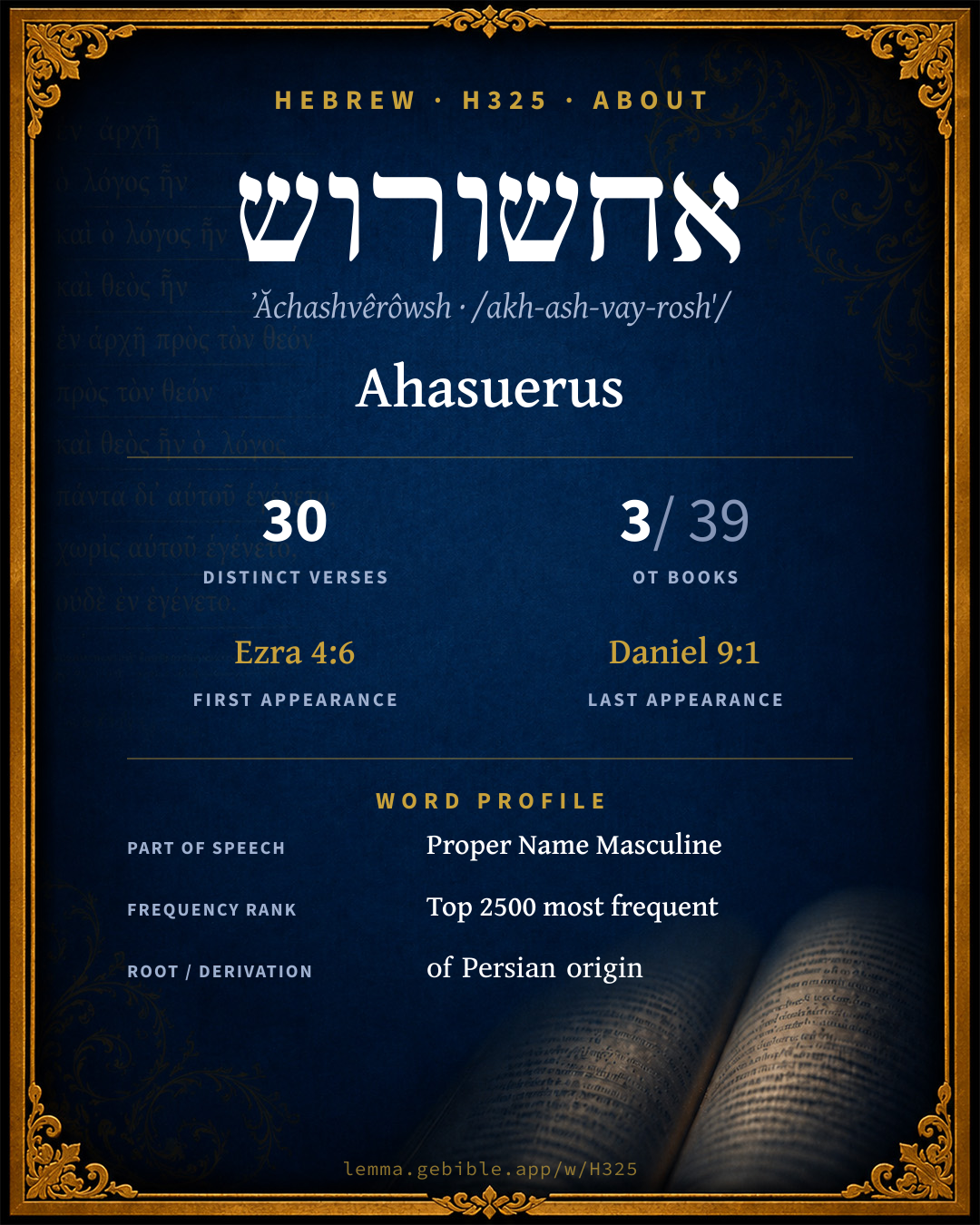
אֲחַשְׁוֵרוֹשׁ
Ahasuerus
BDB lists 2 entries for ‘Ahasuerus’ fuller range ↓
Full lexicon entry — Brown-Driver-Briggs (BDB)
From Brown-Driver-Briggs (BDB)
Where this word appears
Grammar key — what these labels mean
Part of speech
- Noun
- A naming word — a person, place, thing, or idea.
Noun type
- Proper
- A name of a specific person, place, or people (e.g. Abraham, Zion, Israel).
Every verse where H325 appears in the Book of Daniel — 1 distinct verse. Click any verse to open its interlinear word-by-word view. Verse text shown in the World English Bible for context — . Each verse’s Hebrew form is shown with its reference; the English is not keyword-highlighted, since the data carries no word-level English alignment. Use “Compare translations” on any verse to read it across multiple English versions. This concordance covers the Hebrew Bible; Septuagint (Greek Old Testament) occurrences are not indexed here.
Daniel
About this entry
At a glance — auto-summarized from this page’s data, not written by a person. Every figure links to its source below. This summary describes the numbers; it doesn’t interpret them.
At its core, אחשורוש (ʼĂchashvêrôwsh) means “Ahasuerus.” Its uses cluster heavily in Esther (93% of all occurrences). Spanning 30 verses in 3 books, it ranks among the moderately common words of the Hebrew Bible. It first appears in Ezra 4:6. Dig into 30-verse concordance and the renderings breakdown below.
Gloss history
Strong's 1890 vs modern scholarship
About this word
Strong's H325 catalogs a Hebrew word from the Hebrew Old Testament.
These counts are not copied from any lexicon or concordance. They are computed here, from the morphology-tagged Hebrew Old Testament. What Lemma adds →
- 30
- distinct verses
- The word appears in 30 distinct verses.
- 3 / 39
- OT books
- The word appears in 3 of 39 Old Testament books.
- #1,086
- by frequency
- Top 2500 most frequent Hebrew words (rank 1,086 of 8,640 Hebrew words by occurrence).
View all 30 occurrences in the concordance →
By section of the Old Testament
By traditional corpus
Conventional, traditional groupings — biblical authorship is debated, so this is a traditional corpus grouping, not an authorship claim. Each share is this word’s portion of its verses in that division of the Hebrew canon. Each figure is a share of the word’s 30 distinct verses.
- Writings (Ketuvim) 30 verses · 100%
How translations render this word
Counts come from each version’s own published word-to-Strong’s tagging or interlinear alignment — an approximate guide to how each version renders this word, not a word-level alignment the data otherwise carries. Because each total is that version’s own tagged count, the per-version totals vary from one another and need not match the appearance or distinct-verse counts above. These counts may also differ from a printed concordance because Lemma counts each distinctly tagged rendering and does not collapse phrase taggings into a single head-word total. This is a fixed set of word-tagged versions (KJV, ASV, BSB, ULT) and does not change with the reading translation you choose elsewhere. Each version’s license is shown beside its name below (and on Sources).
- King James Version: Ahasuerus 29×
- American Standard Version: Ahasuerus 30×
- Berean Standard Bible: Xerxes 29×
- unfoldingWord Literal Text: Ahasuerus 31×
King James Version Public Domain
Renders H325 across 31 tagged occurrences — most commonly:
Plus 2 renderings that appear only once — usually multi-word phrases or single function words the recovered tagging swept in, not distinct renderings.
American Standard Version Public Domain
Renders H325 across 31 tagged occurrences — most commonly:
Plus 1 rendering that appears only once — usually multi-word phrases or single function words the recovered tagging swept in, not distinct renderings.
Berean Standard Bible Public Domain
Renders H325 across 30 tagged occurrences — most commonly:
Plus 1 rendering that appears only once — usually multi-word phrases or single function words the recovered tagging swept in, not distinct renderings. Not rendered by a distinct English word in 1 further occurrence.
unfoldingWord Literal Text CC BY-SA 4.0
Renders H325 across 32 tagged occurrences — most commonly:
Plus 1 rendering that appears only once — usually multi-word phrases or single function words the recovered tagging swept in, not distinct renderings.
Senses in BDB
The 2 senses BDB distinguishes for this word, in lexicon order (not ranked by frequency or importance). The full entry — with sub-senses — is in the Lexicon Entry tab.
- Ahasuerus = "I will be silent and poor"
- title of the king of Persia, probably Xerxes
Word origin
n.pr.m. Ahasuerus = Xerxes (Pers. Khshayârshâ = mighty + eye or man, vid. Spiegel l.c. 216; in Aramaic חשיארש, CISII. i. 122 [b.c. 481]) king of Pers. Ezr 4:6 Est 1:1(×2), 2, 9, 10 + 18 textual Est + Est 10:1 Qr (Kt אחשׁרשׁ); אֲחַשְׁוֵרֹשׁ Est 1:16; 2:21; 3:12; 8:7, 10; also Dn 9:1 where made father of ‘Darius the Mede,’ cf. Meinh.
— Brown-Driver-Briggs (Oxford 1906, public domain), digitized via Sefaria, supplemented by the OpenScriptures HebrewLexicon (CC BY 4.0). See Sources.
Origin: of Persian origin
Forms in the corpus
The 14 distinct written forms H325 takes in the Hebrew Bible, most frequent first — each parse links to that state’s occurrences in the concordance. Hebrew forms include their vowel points and cantillation, so a single lemma takes many written forms.
| Form | Parsing | Example | Uses |
|---|---|---|---|
| אֲחַשְׁוֵר֔וֹשׁ | Noun, Proper | Esther 1:15 | 7 |
| אֲחַשְׁוֵר֑וֹשׁ | Noun, Proper | Esther 1:1 | 5 |
| אֲחַשְׁוֵרֽוֹשׁ | Noun, Proper | Esther 1:9 | 4 |
| אֲחַשְׁוֵר֗וֹשׁ | Noun, Proper | Esther 1:1 | 3 |
| אֲחַשְׁוֵר֖וֹשׁ | Noun, Proper | Daniel 9:1 | 2 |
| אֲחַשְׁוֵרֹשׁ֙ | Noun, Proper | Esther 3:12 | 2 |
| אֲחַשְׁוֵרוֹשׁ֙ | Noun, Proper | Esther 2:16 | 2 |
| אֲחַשְׁוֵֽרֹשׁ | Noun, Proper | Esther 2:21 | 1 |
| אֲחַשְׁוֵר֜וֹשׁ | Noun, Proper | Esther 3:1 | 1 |
| אֲחַשְׁוֵר֡וֹשׁ | Noun, Proper | Esther 1:17 | 1 |
| אֲחַשְׁוֵר֧וֹשׁ | Noun, Proper | Esther 10:1 | 1 |
| אֲחַשְׁוֵרֹ֔שׁ | Noun, Proper | Esther 8:10 | 1 |
| אֳחַשְׁוֵר֔וֹשׁ | Noun, Proper | Esther 9:2 | 1 |
| אחשרש | Noun, Proper | Esther 10:1 | 1 |
Bible dictionary
Public-domain dictionary articles matched to this entry by name (Ahasuerus). A biblical name can be shared by more than one person or place, so an article may treat several.
Easton's Bible Dictionary · M. G. Easton, 1897
There are three kings designated by this name in Scripture. (1.) The father of Darius the Mede, mentioned in Dan. 9:1. This was probably the Cyaxares I. known by this name in profane history, the king of Media and the conqueror of Nineveh.
(2.) The king mentioned in Ezra 4:6, probably the Cambyses of profane history, the son and successor of Cyrus (B.C. 529).
(3.) The son of Darius Hystaspes, the king named in the Book of Esther. He ruled over the kingdoms of Persia, Media, and Babylonia, "from India to Ethiopia." This was in all probability the Xerxes of profane history, who succeeded his father Darius (B.C. 485). In the LXX. version of the Book of Esther the name Artaxerxes occurs for Ahasuerus. He reigned for twenty-one years (B.C. 486-465). He invaded Greece with an army, it is said, of more than 2,000,000 soldiers, only 5,000 of whom returned with him. Leonidas, with his famous 300, arrested his progress at the Pass of Thermopylae, and then he was defeated disastrously by Themistocles at Salamis. It was after his return from this invasion that Esther was chosen as his queen.
Smith's Bible Dictionary · William Smith, 1863
(lion-king), the name of one Median and two Persian kings mentioned in the Old Testament.
+ In (Daniel 9:1) Ahasuerus is said to be the father of Darius the Mede. [Darius] This first Ahasuerus is Cyaxares, the conqueror of Nineveh. (Began to reign B.C. 634.) + The Ahasuerus king of Persia, referred to in (Ezra 4:6) must be Cambyses, thought to be Cyrus' successor, and perhaps his son. (B.C. 529.) + The third is the Ahasuerus of the book of Esther. This Ahasuerus is probably Xerxes of history, (Esther 1:1) (B.C. 485), and this conclusion is fortified by the resemblance of character and by certain chronological indications, the account of his life and character agreeing with the book of Esther In the third year of Ahaseuerus was held a great feast and assembly in Shushan the palace, (Esther 1:3) following a council held to consider the invasion of Greece. He divorced his queen Vashti for refusing to appear in public at this banquet, and married, four years afterwards, the Jewess Esther, cousin and ward of Mordecai. Five years after this, Haman, one of his counsellors, having been slighted by Mordecai, prevailed upon the king to order the destruction of all the Jews in the empire. But before the day appointed for the massacre, Esther and Mordecai influenced the king to put Haman to death and to give the Jews the right of self-Defence.
Hitchcock's Bible Names Dictionary · Roswell D. Hitchcock, 1869
prince; head; chief
Classic public-domain reference works; full attribution on Sources.
Septuagint verse parallels
This word appears in 29 verses that also exist in the Greek Old Testament (Septuagint), out of the 30 Hebrew verses it occurs in. You can read those verses in Greek by switching the Old Testament edition to the Septuagint.
Read these verses in the Septuagint
This is a verse-level parallel only — the same verses exist in both the Hebrew and Greek Old Testaments. No word-level Hebrew↔Greek correspondence is claimed: the data carries no such alignment, so no Greek word is shown as this Hebrew word’s translation. Coverage is not total — the Septuagint omits the deuterocanon and renumbers the Psalms, so some Hebrew verses have no direct Greek parallel.