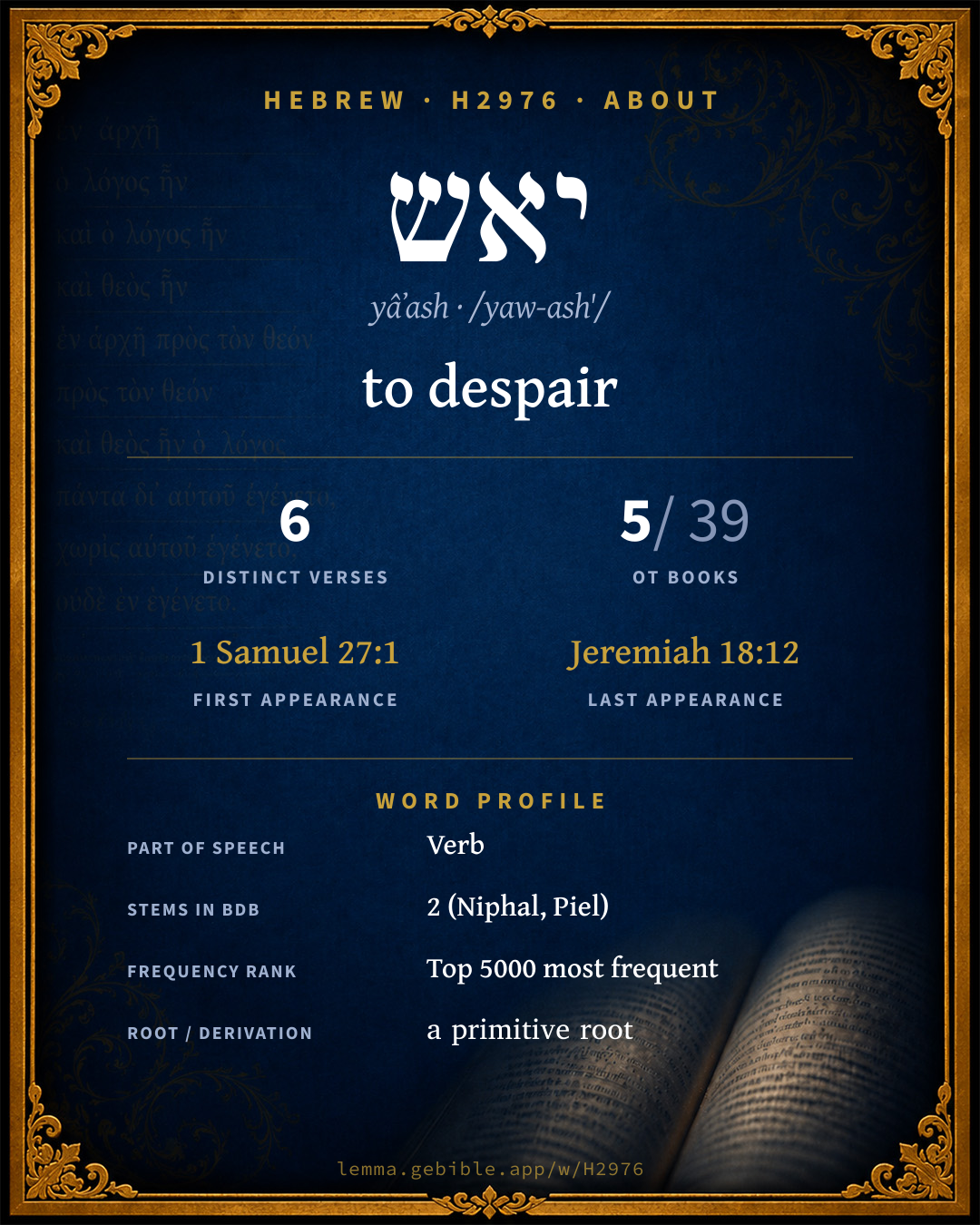
יָאַשׁ
to despair
‘to despair’ is one of 2 main senses fuller range ↓
Full lexicon entry — Brown-Driver-Briggs (BDB)
From Brown-Driver-Briggs (BDB)
Where this word appears
See every Niphal verb in the Hebrew Bible →
Grammar key — what these labels mean
Part of speech
- Verb
- An action or state-of-being word.
Stem
- Niphal
- Usually the simple passive or reflexive of the Qal (“he was written”).
- Piel
- An intensive or resultative active stem.
Form
- Participle Active
- A verbal adjective expressing ongoing or characteristic action (“writing / one who writes”).
- Perfect
- A completed action or state — Hebrew marks aspect (completeness) more than strict tense (“he wrote”).
- Infinitive Construct
- A bound verbal noun, frequently with prepositions (“to write / in writing”).
State
- Absolute
- The independent form of a noun, not bound to a following word.
Person
- 3rd Person
- The one spoken about (“he / she / it / they”).
Gender
- Masculine
- Grammatically masculine.
Number
- Singular
- One.
5 distinct verses where H2976 appears in the Niphal stem, across 4 books. Filtered view — show all forms. Click any verse to open its interlinear word-by-word view. Verse text shown in the World English Bible for context — . Each verse’s Hebrew form is shown with its reference; the English is not keyword-highlighted, since the data carries no word-level English alignment. Use “Compare translations” on any verse to read it across multiple English versions. This concordance covers the Hebrew Bible; Septuagint (Greek Old Testament) occurrences are not indexed here.
1 Samuel 1 verse
Job 1 verse
Isaiah 1 verse
Jeremiah 2 verses
- Jeremiah 2:25 נוֹאָ֔שׁ Niphal ptcp.act ms Withhold your foot from being unshod, and your throat from thirst: but you said, It is in vain; no, for I have loved strangers, and after them will I go.
- Jeremiah 18:12 נוֹאָ֑שׁ Niphal ptcp.act ms But they say, It is in vain; for we will walk after our own devices, and we will do everyone after the stubbornness of his evil heart.
About this entry
At a glance — auto-summarized from this page’s data, not written by a person. Every figure links to its source below. This summary describes the numbers; it doesn’t interpret them.
יאש — transliterated yâʼash — is a Hebrew verb carrying the sense “to despair.” Debuting at 1 Samuel 27:1, it then recurs through the corpus. Spanning 6 verses in 5 books, it ranks among the uncommon words of the Hebrew Bible. Its uses concentrate in Jeremiah (33% of all occurrences). As a verb its force shifts by stem, across 2 stems (Niphal, Piel, and more). Each statement above links to its evidence; the full detail follows below.
Gloss history
Strong's 1890 vs modern scholarship
About this word
Strong's H2976 catalogs a Hebrew word from the Hebrew Old Testament.
These counts are not copied from any lexicon or concordance. They are computed here, from the morphology-tagged Hebrew Old Testament. What Lemma adds →
- 6
- distinct verses
- The word appears in 6 distinct verses.
- 5 / 39
- OT books
- The word appears in 5 of 39 Old Testament books.
- #3,040
- by frequency
- Top 5000 most frequent Hebrew words (rank 3,040 of 8,640 Hebrew words by occurrence).
View all 6 occurrences in the concordance →
By section of the Old Testament
By traditional corpus
Conventional, traditional groupings — biblical authorship is debated, so this is a traditional corpus grouping, not an authorship claim. Each share is this word’s portion of its verses in that division of the Hebrew canon. Each figure is a share of the word’s 6 distinct verses.
- Prophets (Nevi'im) 4 verses · 67%
- Writings (Ketuvim) 2 verses · 33%
How translations render this word
Counts come from each version’s own published word-to-Strong’s tagging or interlinear alignment — an approximate guide to how each version renders this word, not a word-level alignment the data otherwise carries. Because each total is that version’s own tagged count, the per-version totals vary from one another and need not match the appearance or distinct-verse counts above. These counts may also differ from a printed concordance because Lemma counts each distinctly tagged rendering and does not collapse phrase taggings into a single head-word total. This is a fixed set of word-tagged versions (KJV, ASV, BSB, ULT) and does not change with the reading translation you choose elsewhere. Each version’s license is shown beside its name below (and on Sources).
- King James Version: Is no hope 2×
- American Standard Version: Is in vain 2×
- Berean Standard Bible: Despair 2×, Is hopeless 2×
- unfoldingWord Literal Text: Is hopeless 2×
King James Version Public Domain
Renders H2976 across 7 tagged occurrences — most commonly:
Plus 5 renderings that appear only once — usually multi-word phrases or single function words the recovered tagging swept in, not distinct renderings.
American Standard Version Public Domain
Renders H2976 across 7 tagged occurrences — most commonly:
Plus 5 renderings that appear only once — usually multi-word phrases or single function words the recovered tagging swept in, not distinct renderings.
Berean Standard Bible Public Domain
Renders H2976 across 6 tagged occurrences — most commonly:
Plus 2 renderings that appear only once — usually multi-word phrases or single function words the recovered tagging swept in, not distinct renderings.
unfoldingWord Literal Text CC BY-SA 4.0
Renders H2976 across 8 tagged occurrences — most commonly:
Plus 6 renderings that appear only once — usually multi-word phrases or single function words the recovered tagging swept in, not distinct renderings.
Senses in the full BDB
Hebrew verbs can shift meaning by stem (binyan): Qal is the basic action, Niphal is often passive or reflexive, Piel often intensifies or makes it factitive, and Hiphil is typically causative. The senses below are grouped under the stem BDB assigns to each.
What do BDB’s symbols mean?
BDB uses these scholarly abbreviations:
| Symbol | Meaning |
|---|---|
| 𝔊 | the Septuagint (the ancient Greek translation, LXX) |
| 𝔙 | the Vulgate (the Latin translation) |
| 𝔖 | the Syriac version (the Peshitta) |
| 𝔗 | the Targum (the Aramaic translation) |
| ψ | the Psalms |
| √ | root (the underlying root or stem) |
| ‖ | parallel passage (a synonymous or contrasted parallel) |
| † | the dagger: every passage where the word occurs is cited |
The 2 senses and sub-senses the full Brown-Driver-Briggs lexicon distinguishes for this word, in lexicon order (not ranked by frequency), with BDB’s own verbatim wording and sub-sense lettering. Shown in Hebrew script with BDB’s own scholarly abbreviations. The condensed entry is in the Lexicon Entry tab. See also the Forms in the corpus table below.
Niphal
- . despair
Piel
- . to make my heart despair, concerning all the toil.
Senses from the full Brown-Driver-Briggs lexicon (Brown, Driver, Briggs; Oxford 1906 — public domain), digitized via Sefaria, supplemented by the OpenScriptures HebrewLexicon (CC BY 4.0). Full attribution on Sources.
Word origin
Origin: a primitive root
Jastrow Dictionary
A second Hebrew/Aramaic lexicon for comparison, covering Aramaic and post-biblical (Talmudic, Targumic, Midrashic) usage that the biblical-Hebrew BDB does not. Matched by lemma rather than by Strong’s number, so a lemma may carry more than one Jastrow headword (shown separately below), and the entries cover usage well beyond the Bible.
יָאַשׁ
- [to exist, be strong.]
- (privat., cmp. דִּשֵּׁן) to consider undone, to give up; v. יֵאוּשׁ.
- ; Nithpa. נִתְיָאֵשׁ, נִתְיָי׳
- 1. to lose energy, relax. Y. Ber. IX, end, 14ᵈ שנִתְיָאֲשׁוּ ידיהם וכ׳ whose hands have grown lax concerning the Law (who do not care to uphold the Law; Midr. Till. to Ps. CXIX, 126 רפו ידיהם).
- 2. (with מן) to give up hope, to discard from the mind. Ab. I, 7 אל תִּתְיָאֵשׁ וכ׳ do not give up the idea of divine retribution (when you see sinners prosper).—Esp. (of lost things) to despair of recovery, to resign possession (by which the finder acquires the right of keeping what he has found, and the robber obtains possession of the stolen object and must make restoration in value). B. Kam. 68ᵇ, a. e. גזל ולא נִתְיָיאֲשׁוּ הבעלים if one has robbed, and the owner has not yet given the hope of recovery. B. Mets. 21ᵇ מפני שהבעלים מִתְיָאֲשִׁין מהן because the owners (who dropped the coins) have given them up; a. v. fr.
יְאַשׁ
- , Pa. יָאֵשׁ ch. same, to relax. Targ. Koh. II, 20 ליָאָשָׁא ית לבי על וכ׳ to relax my mind concerning (to give up thinking of) the trouble &c.
- 1. to become careless. Targ. Y. Deut. XXIX, 18.
- 2. contr. אִיָּיאֵשׁ, אִיָּאֵשׁ, Ithpe. (אִיאוֹשׁ) אִיאֵשׁ to resign possession, give up. B. Kam. 68ᵇ ודילמא לא איי׳ but may it not be that he has not resigned? Ib. שמעיניה דאיאוש they heard him say that he gave it up; B. Mets. 21ᵇ דמֵיאַשׁ (Ms. F. דאיאש). Ib. מִיָּאֲשֵׁי (Ms. F. a. R. מִיָּי׳) they give it up. Ib. אִיאוּשֵׁי מֵיאוּשׁ (better: יָאוּשֵׁי מִיָּיאֲשֵׁי, v. Rabb. D. S. a. l. note 8). Ib. 22ᵃ; a. fr.
A Dictionary of the Targumim, the Talmud Babli and Yerushalmi, and the Midrashic Literature (Marcus Jastrow; London, Luzac, 1903) — Public Domain. Digitized via Sefaria. Digitized via Sefaria. Full attribution on Sources.
Forms in the corpus
The 5 distinct written forms H2976 takes in the Hebrew Bible, most frequent first — each parse links to that stem’s occurrences in the concordance. Hebrew forms include their vowel points and cantillation, so a single lemma takes many written forms.
| Form | Parsing | Example | Uses |
|---|---|---|---|
| נוֹאָ֑שׁ | Verb, Niphal, Participle Active, Masculine, Singular, Absolute | Isaiah 57:10 | 2 |
| וְ/נוֹאַ֨שׁ | Verb, Niphal, Perfect, 3rd Person, Masculine, Singular | 1 Samuel 27:1 | 1 |
| לְ/יַאֵ֣שׁ | Verb, Piel, Infinitive Construct | Ecclesiastes 2:20 | 1 |
| נֹאָֽשׁ | Verb, Niphal, Participle Active, Masculine, Singular, Absolute | Job 6:26 | 1 |
| נוֹאָ֔שׁ | Verb, Niphal, Participle Active, Masculine, Singular, Absolute | Jeremiah 2:25 | 1 |
Septuagint verse parallels
This word appears in 6 verses that also exist in the Greek Old Testament (Septuagint), out of the 6 Hebrew verses it occurs in. You can read those verses in Greek by switching the Old Testament edition to the Septuagint.
Read these verses in the Septuagint
This is a verse-level parallel only — the same verses exist in both the Hebrew and Greek Old Testaments. No word-level Hebrew↔Greek correspondence is claimed: the data carries no such alignment, so no Greek word is shown as this Hebrew word’s translation. Coverage is not total — the Septuagint omits the deuterocanon and renumbers the Psalms, so some Hebrew verses have no direct Greek parallel.