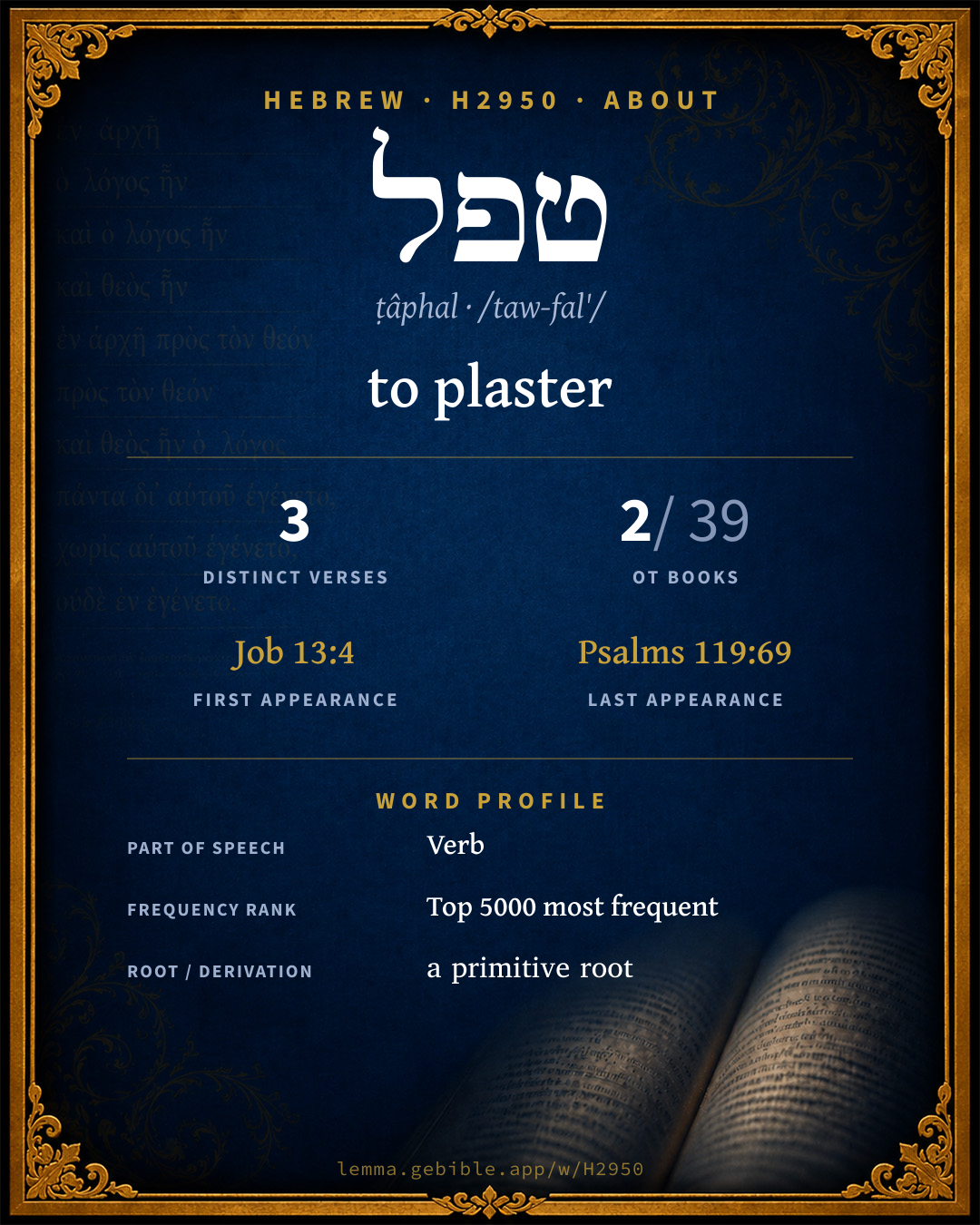
טָפַל
to plaster
Full lexicon entry — Brown-Driver-Briggs (BDB)
From Brown-Driver-Briggs (BDB)
Where this word appears
Grammar key — what these labels mean
Part of speech
- Verb
- An action or state-of-being word.
Stem
- Qal
- The basic, simple active stem — the plain form of the verb (“he wrote”).
Form
- Sequential Imperfect
- An imperfect with prefixed waw — the standard past-narrative form (waw-consecutive imperfect).
- Perfect
- A completed action or state — Hebrew marks aspect (completeness) more than strict tense (“he wrote”).
- Participle Active
- A verbal adjective expressing ongoing or characteristic action (“writing / one who writes”).
State
- Construct
- A noun bound to a following noun in a possessive / “of” relationship (the construct chain).
Person
- 2nd Person
- The one addressed (“you”).
- 3rd Person
- The one spoken about (“he / she / it / they”).
Gender
- Masculine
- Grammatically masculine.
- Common
- Either gender — not distinguished for this form.
Number
- Singular
- One.
- Plural
- More than one (in Hebrew, generally three or more).
Every verse where H2950 appears in the Book of Job — 2 distinct verses. Click any verse to open its interlinear word-by-word view. Verse text shown in the World English Bible for context — . Each verse’s Hebrew form is shown with its reference; the English is not keyword-highlighted, since the data carries no word-level English alignment. Use “Compare translations” on any verse to read it across multiple English versions. This concordance covers the Hebrew Bible; Septuagint (Greek Old Testament) occurrences are not indexed here.
Job
About this entry
At a glance — auto-summarized from this page’s data, not written by a person. Every figure links to its source below. This summary describes the numbers; it doesn’t interpret them.
The Hebrew verb טפל centers on the idea of “to plaster.” With only 3 verses it sits in the long tail of Hebrew Bible vocabulary. Job dominates its distribution — 2 of 3 verses. First canonically at Job 13:4, it enters the text early. Dig into 3-verse concordance and the renderings breakdown below.
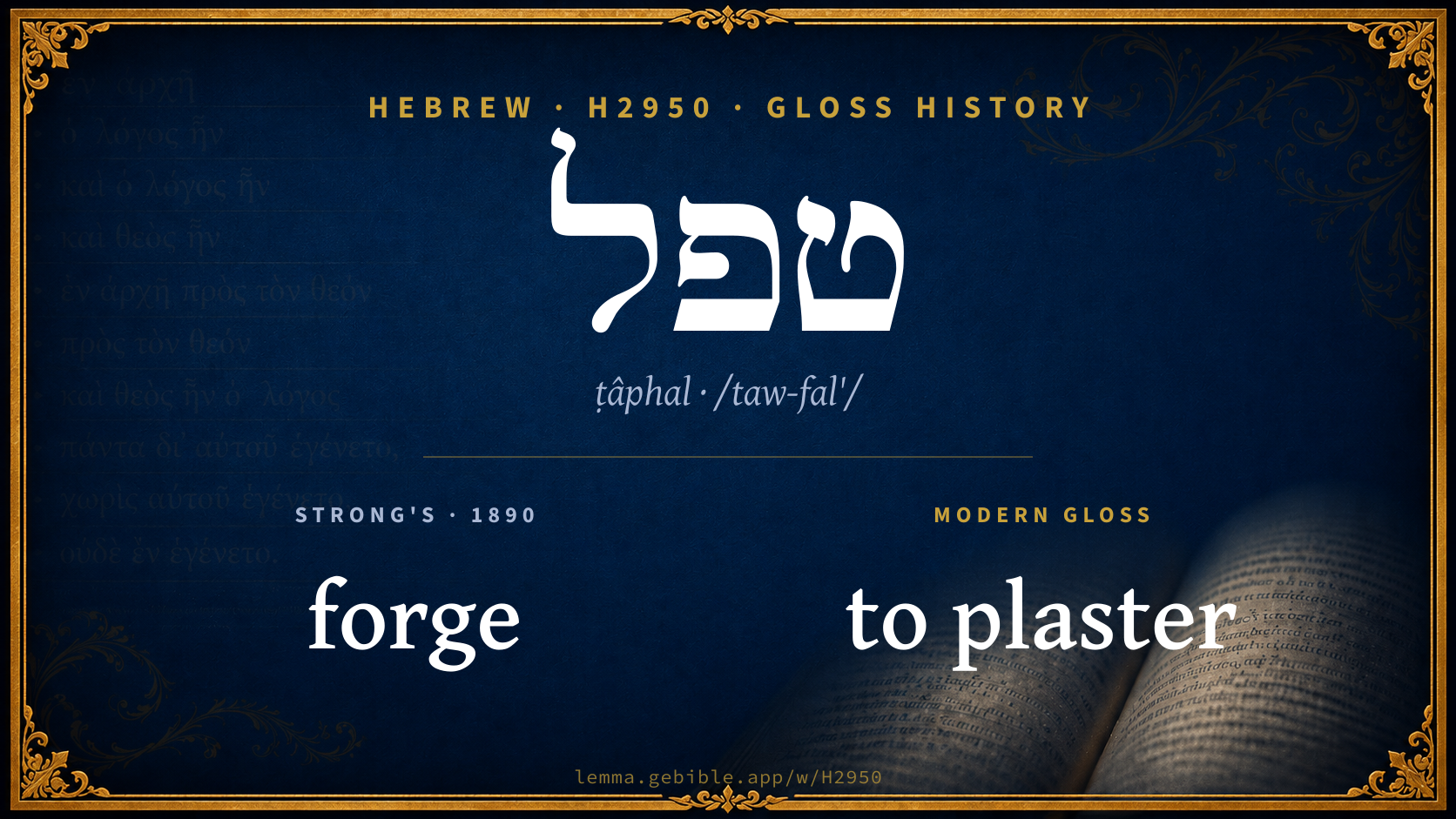
Gloss history
Strong's 1890 vs modern scholarship
About this word
Strong's H2950 catalogs a Hebrew word from the Hebrew Old Testament.
These counts are not copied from any lexicon or concordance. They are computed here, from the morphology-tagged Hebrew Old Testament. What Lemma adds →
- 3
- distinct verses
- The word appears in 3 distinct verses.
- 2 / 39
- OT books
- The word appears in 2 of 39 Old Testament books.
- #4,179
- by frequency
- Top 5000 most frequent Hebrew words (rank 4,179 of 8,640 Hebrew words by occurrence).
View all 3 occurrences in the concordance →
By traditional corpus
Conventional, traditional groupings — biblical authorship is debated, so this is a traditional corpus grouping, not an authorship claim. Each share is this word’s portion of its verses in that division of the Hebrew canon. Each figure is a share of the word’s 3 distinct verses.
- Writings (Ketuvim) 3 verses · 100%
How translations render this word
Counts come from each version’s own published word-to-Strong’s tagging or interlinear alignment — an approximate guide to how each version renders this word, not a word-level alignment the data otherwise carries. Because each total is that version’s own tagged count, the per-version totals vary from one another and need not match the appearance or distinct-verse counts above. These counts may also differ from a printed concordance because Lemma counts each distinctly tagged rendering and does not collapse phrase taggings into a single head-word total. This is a fixed set of word-tagged versions (KJV, ASV, BSB, ULT) and does not change with the reading translation you choose elsewhere. Each version’s license is shown beside its name below (and on Sources).
- King James Version: Have forged 1×, Thou sewest up 1×, Ye are forgers 1×
- American Standard Version: Have forged 1×, Thou fastenest up 1×, Ye are forgers 1×
- Berean Standard Bible: Have smeared me 1×, Smear 1×, You would cover 1×
- unfoldingWord Literal Text: Are plasterers of 1×, Smear 1×, You would plaster 1×
King James Version Public Domain
Renders H2950 across 3 tagged occurrences — most commonly:
American Standard Version Public Domain
Renders H2950 across 3 tagged occurrences — most commonly:
Berean Standard Bible Public Domain
Renders H2950 across 3 tagged occurrences — most commonly:
unfoldingWord Literal Text CC BY-SA 4.0
Renders H2950 across 3 tagged occurrences — most commonly:
Senses in BDB
The 1 sense BDB distinguishes for this word, in lexicon order (not ranked by frequency or importance). The full entry — with sub-senses — is in the Lexicon Entry tab.
- (Qal) to smear, plaster over, stick, glue
Word origin
[ טָפַל ] vb. smear or plaster (over), stick, glue
— Brown-Driver-Briggs (Oxford 1906, public domain), digitized via Sefaria, supplemented by the OpenScriptures HebrewLexicon (CC BY 4.0). See Sources.
Origin: a primitive root
Jastrow Dictionary
A second Hebrew/Aramaic lexicon for comparison, covering Aramaic and post-biblical (Talmudic, Targumic, Midrashic) usage that the biblical-Hebrew BDB does not. Matched by lemma rather than by Strong’s number, so a lemma may carry more than one Jastrow headword (shown separately below), and the entries cover usage well beyond the Bible.
טָפַל
- [to join, add,]
- 1. to paste, line. Kel. III, 4 וטְפָלָן בגללין and lined them (the cracked vessels) with a paste of ordure. Ib. 5 הטוֹפֵל וכ׳ if one covers with paste a sound vessel. Bets. 34ᵃ אין טוֹפְלִין וכ׳ you must not cover (the fowls) with potter’s clay (to get the feathers off); Tosef. ib. III, 19 וטובלין ed. Zuck. (corr. acc.). Sabb. 80ᵇ; Pes. 43ᵃ; M. Kat. 9ᵇ טוֹפְלוֹת אותן בסיד dress their skins with lime (to keep them hairless). Y. Ab. Zar. II, 40ᵈ (in Chald. diction) שחוק וטְפוֹל grind it to powder and apply it (as a remedy); a. fr.
- 2. to add, join. Ḥag. 8ᵃ בטוֹפֵל when he combines two different funds. Ib. טוֹפְלִין בהמה לבהמה וכ׳ you may use the second tithe money for buying an additional animal to that designated for the pilgrim’s offering (חֲגִיגָה), but you must not join the two funds (in order to buy a larger animal). Ab. Zar. 25ᵇ טוֹפְלוֹ לימינו lets the gentile walk to his right side, v. זָמַן; (Tosef. ib. III, 4 נותנו); Ḥull. 91ᵃ.—Part. pass. טָפוּל a) affixed, attached. Y. Sabb. XVI, 15ᶜ bot. (ref. to Mish. Sabb. XVI, 2) בשאינו ט׳ לו וכ׳ when the casing is not attached to the book, but if it is &c.—b) dependent on, supported by. Y. Dem. II, 23ᵃ top; Y. Peah IV, 18ᵇ bot. טְפוּלִין לאביהן dependent on (living with) their parents (cmp. B. Mets. 12ᵇ, s. v. סָמַךְ).
- 1. to be attached, affixed. Lev. R. s. 6; s. 15; Yalk. Is. 281 ונִטְפְּלוּ בישעיה and they were embodied in the Book of Isaiah. Tanḥ. Vayḥi 17 נִטְפַּלְתֶּם בעצמי you will be attached to myself (be called sons of Jacob); Yalk. Gen. 161; (Gen. R. s. 100 זכיתם בעצמי you will have a share in me).
- 2. (cmp. זָוַג) to meet, join. Ḥull. 91ᵃ ישראל שנ׳ וכ׳, v. זָמַן. Men. 65ᵃ ניט׳ להם וכ׳ R. J. joined their discussions. Snh. 9ᵃ הני׳ לעוברי עבירה he who is an accessory to sin. Y. B. Kam. X, 7ᶜ top, שלא … נִטְפָּלִין לגנבים that citizens may not be in conspiracy with thieves (and sell the stolen goods to their owner under the pretence of having bought them).
- 3. to attend to, to nurse, tend. Y. Keth. XII, 35ᵃ top מי שני׳ … יִטָּפֵל בי וכ׳ those who attended to me (nursed me) in life, shall attend to me in death; Y. Kil. IX, 32ᵇ top; Gen. R. s. 100; Tanḥ. Vayḥi 3. Ib. a. e. להִטָּפֵל בקבורתו to attend to his funeral; a. fr.
- 1. same. B. Kam. 10ᵇ, a. e. הבעלים מִטַּפְּלִין וכ׳ the owner has to attend to the disposal of the carcass. B. Mets. 28ᵇ מִטַּפֵּל בהן must take care of them. Ex. R. s. 20; Deut. R. s. 11 אני בעצמי מט׳ וכ׳ I myself shall attend to thy burial; a. fr.
- 2. (of lower animals) to breed, increase (v. טָפֵל). Kidd. 80ᵃ ושרצים … מִיטַּפְּלִין שם vermin and frogs breed in the house.
- (denom. of טָפֵל) burdened with a large family. Taan. 16ᵃ, sq. מט׳ ואין לו one having a large family with no means of support.
טְפַל
- , to paste, plaster &c. Pes. 74ᵇ טַפְלֵיה ההוא וכ׳ put a dough paste over a pigeon. M. Kat. 9ᵇ טַפְלָהּ אבר אבר put a paste on her (for improving her complexion) limb-wise; Sabb. 80ᵇ.—Trnsf. (with שקרא) to charge falsely, calumniate (cmp. טוּחַ I, v. Ps. CXIX, 69).—Targ. Y. I Deut. I, 1. e.g. Psalms 119:69
- to be put on. Part. מִיטַּפַּל, מִיטַּפְלָא, מִטַּ׳ (not מְ׳) forming a scab (h. מִסְפַּחַת). Targ. Y. Lev. XIII, 6; 7; 8; 19.—2) to attend, care. Y. Taan. IV, 68ᵈ top עד דהוון מִיטַּפְּלִין ביה while they were engaged in burying him.—3) to join, attach one’s self. Keth. 23ᵃ אִיטְּפֵל בקריבותיך marry one of thy relations. Snh. 26ᵃ א׳ בהדיהו joined them. Y. Kil. IX, 32ᶜ bot.; Y. Keth. XII, 35ᵇ אזל וא׳ בהון מן תמן (not זמן) he went and remained in their company from thence.
טָפֵל
- preced.)
- 1. attachment, of secondary import, opp. עיקר. Gen. R. s. 39 ולוט ט׳ לו (Var. נטפל) and Lot was merely an attachment to Abraham. Ber. 12ᵇ ויציאת … ט׳ לו and the exodus from Egypt will be considered of secondary import to it (the redemption from the powers). Ib. 13ᵃ ויעקב ט׳ the name Jacob will be secondary to Israel; a. fr.
- 2. pl. טְפֵלִים, טְפֵלִין dependants, children, minors. Kidd. 34ᵇ (ref. to Deut. XXXI, 12) ט׳ חייבין minors are obliged to appear; v. טַף. B. Bath. 117ᵃ; a. fr.—Y. Shebi. VII, beg. 37ᵇ תְּפֵילִין, v. אֲלוּנְטִית II.—V. טְפֵלָה. e.g. Deuteronomy 31:12
A Dictionary of the Targumim, the Talmud Babli and Yerushalmi, and the Midrashic Literature (Marcus Jastrow; London, Luzac, 1903) — Public Domain. Digitized via Sefaria. Digitized via Sefaria. Full attribution on Sources.
Forms in the corpus
The 3 distinct written forms H2950 takes in the Hebrew Bible, most frequent first — each parse links to that stem’s occurrences in the concordance. Hebrew forms include their vowel points and cantillation, so a single lemma takes many written forms.
| Form | Parsing | Example | Uses |
|---|---|---|---|
| וַ֝/תִּטְפֹּ֗ל | Verb, Qal, Sequential Imperfect, 2nd Person, Masculine, Singular | Job 14:17 | 1 |
| טָפְל֬וּ | Verb, Qal, Perfect, 3rd Person, Common, Plural | Psalms 119:69 | 1 |
| טֹֽפְלֵי | Verb, Qal, Participle Active, Masculine, Plural, Construct | Job 13:4 | 1 |
Septuagint verse parallels
This word appears in 2 verses that also exist in the Greek Old Testament (Septuagint), out of the 3 Hebrew verses it occurs in. You can read those verses in Greek by switching the Old Testament edition to the Septuagint.
Read these verses in the Septuagint
This is a verse-level parallel only — the same verses exist in both the Hebrew and Greek Old Testaments. No word-level Hebrew↔Greek correspondence is claimed: the data carries no such alignment, so no Greek word is shown as this Hebrew word’s translation. Coverage is not total — the Septuagint omits the deuterocanon and renumbers the Psalms, so some Hebrew verses have no direct Greek parallel.