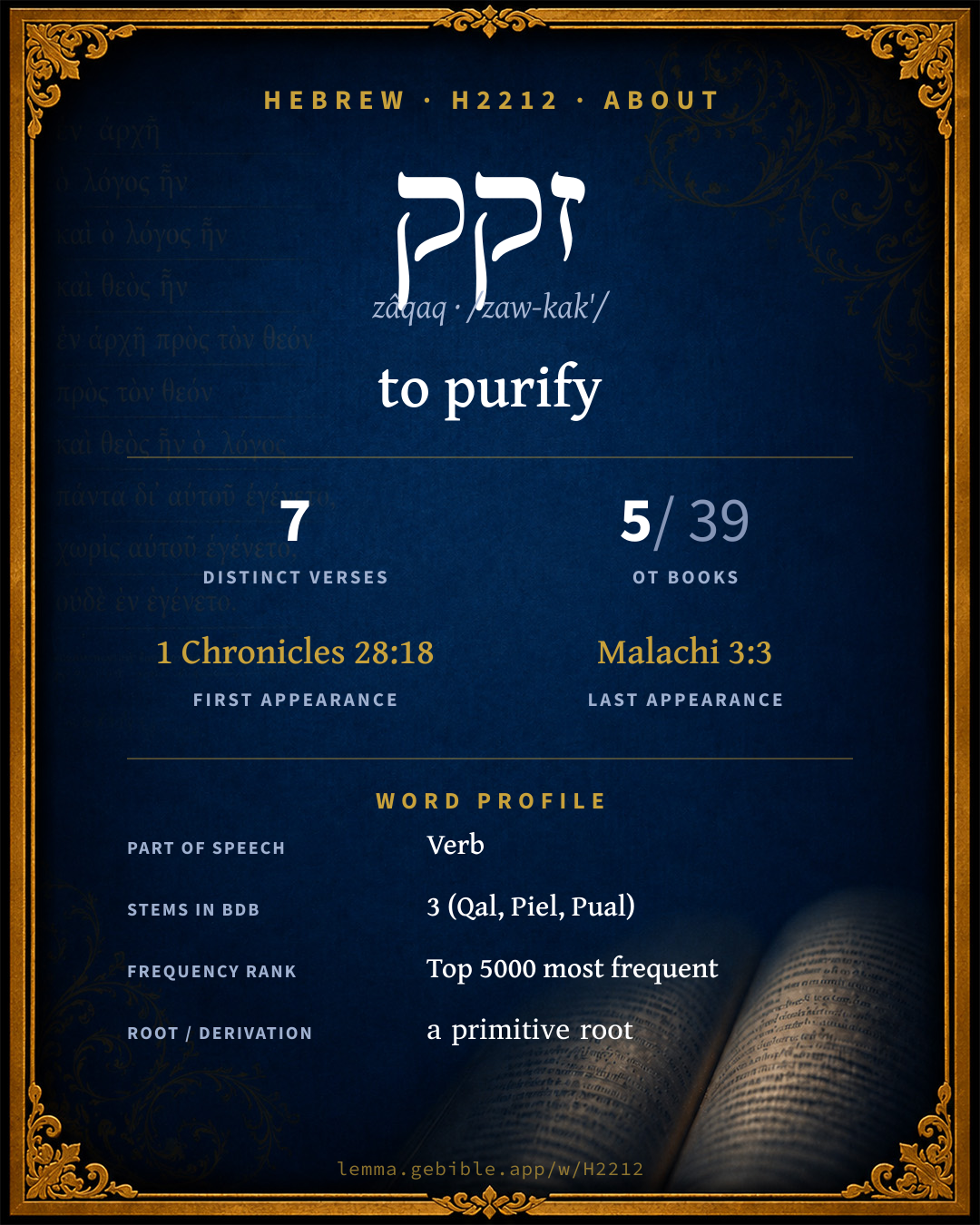
זָקַק
to purify
also: distil, strain, refine fuller range ↓
Full lexicon entry — Brown-Driver-Briggs (BDB)
From Brown-Driver-Briggs (BDB)
Where this word appears
Grammar key — what these labels mean
Part of speech
- Verb
- An action or state-of-being word.
Stem
- Pual
- The passive counterpart of the Piel.
- Qal
- The basic, simple active stem — the plain form of the verb (“he wrote”).
- Piel
- An intensive or resultative active stem.
Form
- Participle Passive
- A verbal adjective expressing action received (“written”).
- Imperfect
- An incomplete, ongoing, or future action (“he will / would write”).
- Sequential Perfect
- A perfect with prefixed waw continuing a preceding imperfect or command (waw-consecutive perfect).
State
- Absolute
- The independent form of a noun, not bound to a following word.
Person
- 3rd Person
- The one spoken about (“he / she / it / they”).
Gender
- Masculine
- Grammatically masculine.
Number
- Singular
- One.
- Plural
- More than one (in Hebrew, generally three or more).
Every verse where H2212 appears in the Book of 1 Chronicles — 2 distinct verses. Click any verse to open its interlinear word-by-word view. Verse text shown in the World English Bible for context — . Each verse’s Hebrew form is shown with its reference; the English is not keyword-highlighted, since the data carries no word-level English alignment. Use “Compare translations” on any verse to read it across multiple English versions. This concordance covers the Hebrew Bible; Septuagint (Greek Old Testament) occurrences are not indexed here.
1 Chronicles
- 1 Chronicles 28:18 מְזֻקָּ֖ק Pual ptcp.pass ms and for the altar of incense refined gold by weight; and gold for the pattern of the chariot, [even] the cherubim, that spread out [their wings], and covered the ark of the covenant of Yahweh.
- 1 Chronicles 29:4 מְזֻקָּ֔ק Pual ptcp.pass ms even three thousand talents of gold, of the gold of Ophir, and seven thousand talents of refined silver, with which to overlay the walls of the houses;
About this entry
At a glance — auto-summarized from this page’s data, not written by a person. Every figure links to its source below. This summary describes the numbers; it doesn’t interpret them.
“to purify” is the headline sense of the Hebrew verb זקק (zâqaq). First canonically at 1 Chronicles 28:18, it enters the text early. The Hebrew Bible uses it across 7 verses — uncommon. More than a quarter of its appearances fall in 1 Chronicles. Across 3 stems, its meaning turns on the binyan (Qal, Piel). The sections below give every sense, occurrence, and version rendering.
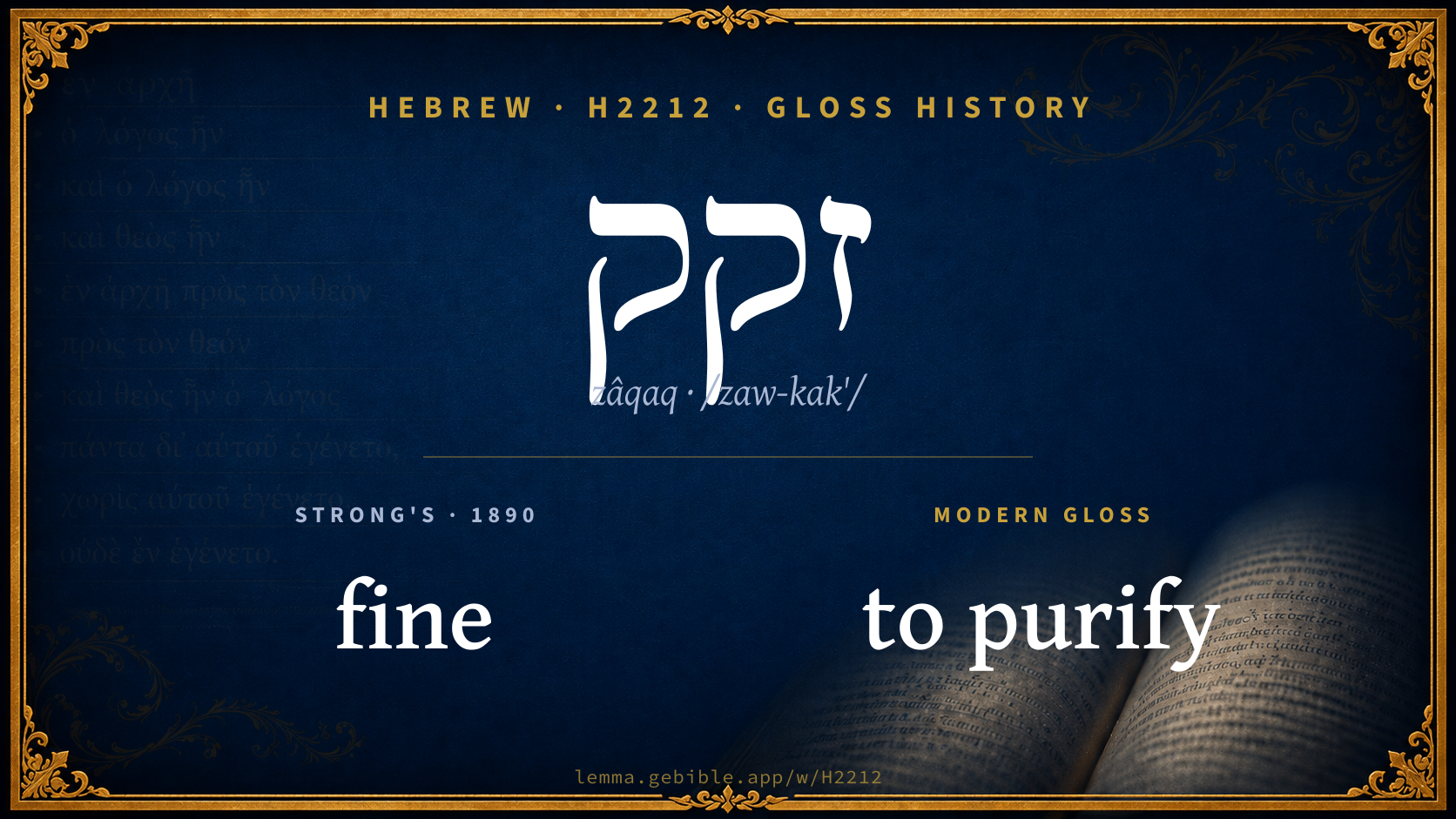
Gloss history
Strong's 1890 vs modern scholarship
About this word
Strong's H2212 catalogs a Hebrew word from the Hebrew Old Testament.
These counts are not copied from any lexicon or concordance. They are computed here, from the morphology-tagged Hebrew Old Testament. What Lemma adds →
- 7
- distinct verses
- The word appears in 7 distinct verses.
- 5 / 39
- OT books
- The word appears in 5 of 39 Old Testament books.
- #2,835
- by frequency
- Top 5000 most frequent Hebrew words (rank 2,835 of 8,640 Hebrew words by occurrence).
View all 7 occurrences in the concordance →
Most concentrated in
- 1 Chronicles 2 verses 29%
- Job 2 verses 29%
- Psalms 1 verse 14%
By section of the Old Testament
By traditional corpus
Conventional, traditional groupings — biblical authorship is debated, so this is a traditional corpus grouping, not an authorship claim. Each share is this word’s portion of its verses in that division of the Hebrew canon. Each figure is a share of the word’s 7 distinct verses.
- Writings (Ketuvim) 5 verses · 71%
- Prophets (Nevi'im) 2 verses · 29%
How translations render this word
Counts come from each version’s own published word-to-Strong’s tagging or interlinear alignment — an approximate guide to how each version renders this word, not a word-level alignment the data otherwise carries. Because each total is that version’s own tagged count, the per-version totals vary from one another and need not match the appearance or distinct-verse counts above. These counts may also differ from a printed concordance because Lemma counts each distinctly tagged rendering and does not collapse phrase taggings into a single head-word total. This is a fixed set of word-tagged versions (KJV, ASV, BSB, ULT) and does not change with the reading translation you choose elsewhere. Each version’s license is shown beside its name below (and on Sources).
- King James Version: Refined 2×
- American Standard Version: Refined 2×
- Berean Standard Bible: Refined 2×
- unfoldingWord Literal Text: Refined 2×
King James Version Public Domain
Renders H2212 across 7 tagged occurrences — most commonly:
Plus 5 renderings that appear only once — usually multi-word phrases or single function words the recovered tagging swept in, not distinct renderings.
American Standard Version Public Domain
Renders H2212 across 7 tagged occurrences — most commonly:
Plus 5 renderings that appear only once — usually multi-word phrases or single function words the recovered tagging swept in, not distinct renderings.
Berean Standard Bible Public Domain
Renders H2212 across 7 tagged occurrences — most commonly:
Plus 5 renderings that appear only once — usually multi-word phrases or single function words the recovered tagging swept in, not distinct renderings.
unfoldingWord Literal Text CC BY-SA 4.0
Renders H2212 across 7 tagged occurrences — most commonly:
Plus 5 renderings that appear only once — usually multi-word phrases or single function words the recovered tagging swept in, not distinct renderings.
Senses in the full BDB
Hebrew verbs can shift meaning by stem (binyan): Qal is the basic action, Niphal is often passive or reflexive, Piel often intensifies or makes it factitive, and Hiphil is typically causative. The senses below are grouped under the stem BDB assigns to each. This entry also uses Pual (the passive of Piel).
What do BDB’s symbols mean?
BDB uses these scholarly abbreviations:
| Symbol | Meaning |
|---|---|
| 𝔊 | the Septuagint (the ancient Greek translation, LXX) |
| 𝔙 | the Vulgate (the Latin translation) |
| 𝔖 | the Syriac version (the Peshitta) |
| 𝔗 | the Targum (the Aramaic translation) |
| ψ | the Psalms |
| √ | root (the underlying root or stem) |
| ‖ | parallel passage (a synonymous or contrasted parallel) |
| † | the dagger: every passage where the word occurs is cited |
The 3 senses and sub-senses the full Brown-Driver-Briggs lexicon distinguishes for this word, in lexicon order (not ranked by frequency), with BDB’s own verbatim wording and sub-sense lettering. Shown in Hebrew script with BDB’s own scholarly abbreviations. The condensed entry is in the Lexicon Entry tab. See also the Forms in the corpus table below.
Qal
- Impf. 3 mpl.
Piel
- . fig., of purifying sons of Levi
Pual
- . refined
Senses from the full Brown-Driver-Briggs lexicon (Brown, Driver, Briggs; Oxford 1906 — public domain), digitized via Sefaria, supplemented by the OpenScriptures HebrewLexicon (CC BY 4.0). Full attribution on Sources.
Word origin
[ זָקַק ] vb. refine, purify
— Brown-Driver-Briggs (Oxford 1906, public domain), digitized via Sefaria, supplemented by the OpenScriptures HebrewLexicon (CC BY 4.0). See Sources.
Origin: a primitive root
Jastrow Dictionary
A second Hebrew/Aramaic lexicon for comparison, covering Aramaic and post-biblical (Talmudic, Targumic, Midrashic) usage that the biblical-Hebrew BDB does not. Matched by lemma rather than by Strong’s number, so a lemma may carry more than one Jastrow headword (shown separately below), and the entries cover usage well beyond the Bible.
זָקַק
- [to make thin, fine, clear,]
- 1. to distil, smelt, v. Pi.
- צָרַף) to rivet, forge; to chain, to join; to bind, obligate.—Part. pass. זָקוּק, f. זְקוּקָה; pl. זְקוּקִים, זְקוּקִין, f. זְקוּקוֹת, with ל chained to, connected with, dependent on. Men. 27ᵃ העושין פירות יהיו ז׳ וכ׳ the fruit-bearing species of the festive wreath shall be combined with those which bear no fruits. Y. Ber. VI, 10ᵃ bot. כשהיו כולן ז׳ וכ׳ when they were, all of them, dependent on one loaf (for saying grace). Pesik. R. s. 43 כנגד שלש … זקוקות להן (not זקוקין) corresponding to the three laws for which, our Rabbis taught, women are made responsible (Sabb. II, 6). Y. Ab. Zar. II, 41ᵃ top ז׳ למלכות in constant intercourse with the government.—Num. R. s. 9 לשנים היא זקוקה she is responsible to two (her husband and the Lord).—Shebu. VI, 3. נכסים … זוֹקְקִין וכ׳ movable chattel binds the immovable with reference to the obligation of making oath, i.e. the two claims preferred in one suit are considered as one lawsuit, and the oath must refer to both; Y. Keth. XII, 36ᵃ bot. [read:] לזוֹקְקָן לשבועה to combine the two (as one lawsuit) with regard to the oath. Yeb. II, 5 זוֹקֵק את וכ׳ he holds his brother’s wife tied to the leviratical marriage, i.e. she cannot marry otherwise until released from him; a. fr. V. זִיקָה.
- (cmp. זָוַג Nithpa.)
- 1. to join, meet; to be engaged in. Gen. R. s. 20 מעולם לא נ׳ וכ׳ the Lord never engaged in communication with woman. Gen. R. s. 42; Pesik. R. s. 5; a. e. נ׳ המלך וכ׳ the king was attached to, took an interest in the affairs of the country. Sabb. 12ᵇ אין מ"ה נִזְקָקִין לו the angels do not attend to his prayers.—[
- 2. (in a hostile sense) to attack. Gen. R. l. c. באו ברברים לִיוָּקֵק לו (Pesik. R. l. c.; Ruth R. introd., a. e. להִזְדַּוֵּוג) Barbarians came to attack him.]
- 3. to live with; to be coupled. Ruth R. to IV, 3 ע"מ שלא אֶזָּקֵק לה with the condition that I will not live with her. Gen. R. s. 20 איני נִזְקֶקֶת וכ׳ I shall never again live with &c.—Pesik. R. s. 15; Pesik. Haḥod., p. 43ᵇ שיהא אדם נִזְקָק לביתו in order that man be attached to his house (love his wife); Yalk. Ps. 738; a. e.
- to oblige. Succ. 28ᵃ הִזְקַקְתּוּנִי וכ׳ will you force me to say &c.?
- to be made dependent on, to obligate one’s self, to be obliged to regard. B. Bath. 170ᵃ אם הוּזְקָקוּ וכ׳ Ms. M. (ed. אם כתוב בו הוּזְקַקְנוּ) if they (the parties to the deed) bound themselves to depend on the signatures of witnesses, &c. (ed. if it was written in the document, we obligate ourselves &c.).
- 1. to be engaged in, to care. Tanḥ. Korah 6 לא נִזְדַּקְּקוּ להשיבו (Yalk. Num. 750 נִזְקָקוּ) they did not care to answer him.
- 2. to attach one’s self to, to make love to. Num. R. s. 9.
- 3. (in an evil sense) to get at, to harm. Num. R. s. 5 בקש להִזְדּקֵּק להם wanted to harm them.
- (b. h.) to smelt, refine, distil. Lev. R. s. 31 עד שמְזַקְּקוֹ until he has refined the gold.—Part. pass. מְזוּקָּק, f. מְזוּקֶּקֶת. Pesik. R. s. 14 התורה … ומז׳ וכ׳ the Torah is clarified and distilled in forty nine ways.—2) to chain, tie, connect.—Part. pass. as ab. Y. Ḥag. III, beg. 78ᵈ במז׳ לקדש it treats of an object which is tied (has been made subject) to the law regulating sacred matter, i.e. treated as if it were sacred matter, v. טָהֳרָה.
זְקַק
- 1. to refine.—Part. pass. זָקִיק. Targ. Ps. XII, 7. Targ. Cant. I, 11; a. e.
- 2. to chain. Part. pass. as above. Targ. Is. LX, 11 זְקִיקִין led in chains (h. text נהוגים).
- 3. to obligate. Part. pass. as ab. Y. Ber. I, 3ᶜ bot. זְקִיקִינָן למברכה we are bound to say the blessing. Y. B. Mets. X, beg. 12ᶜ ז׳ את וכ׳ thou art bound to carry me (the lower story must be kept in repair at the expense of its owner). Ib. דאינון זקוקין (read: זקי׳).
- 1. to refine.—Part. pass. מְזוּקַּק (Hebraism). Targ. Cant. I, 11.
- 2. to obligate, tie. Yeb. 22ᵇ top מיזקק נמי זַקִּיקָהּ Rashi (ed. זקיק) he (the bastard brother) also ties her (prevents her from remarrying).
- , contr. אִידַּקֵּק to be cleared. Targ. Y. II, Num. V, 19 הִדַּקִּי (h. text הִנָּקִי).
- as preced. Nif. Ned. 77ᵃ איזְדְּקִיקוּ ליה רבנן וכ׳ the Rabbis attended to (the absolution from vows of) the son &c. Ib., sq. א׳ ליה רב וכ׳ Rab attended to Rabbah’s vows in a private room of the school-house &c.—Y. Keth. II, 26ᶜ bot. אִיזְדְּקזּקֵי וכ׳ to sleep with &c.
זַקָּק
- (denom. of זִיקָא II; cmp. זִיקוּקָא II) maker of and dealer in leather bags.—Pl. זַקָּקִין. Mikv. IX, 5 של ז׳ saddles used by the dealers in hose (Ar.: של זִיקִין saddles on which hose is carried).
A Dictionary of the Targumim, the Talmud Babli and Yerushalmi, and the Midrashic Literature (Marcus Jastrow; London, Luzac, 1903) — Public Domain. Digitized via Sefaria. Digitized via Sefaria. Full attribution on Sources.
Forms in the corpus
The 7 distinct written forms H2212 takes in the Hebrew Bible, most frequent first — each parse links to that stem’s occurrences in the concordance. Hebrew forms include their vowel points and cantillation, so a single lemma takes many written forms.
| Form | Parsing | Example | Uses |
|---|---|---|---|
| וְ/זִקַּ֣ק | Verb, Piel, Sequential Perfect, 3rd Person, Masculine, Singular | Malachi 3:3 | 1 |
| יָזֹ֖קּוּ | Verb, Qal, Imperfect, 3rd Person, Masculine, Plural | Job 36:27 | 1 |
| יָזֹֽקּוּ | Verb, Qal, Imperfect, 3rd Person, Masculine, Plural | Job 28:1 | 1 |
| מְ֝זֻקָּ֗ק | Verb, Pual, Participle Passive, Masculine, Singular, Absolute | Psalms 12:6 | 1 |
| מְזֻקָּ֔ק | Verb, Pual, Participle Passive, Masculine, Singular, Absolute | 1 Chronicles 29:4 | 1 |
| מְזֻקָּ֖ק | Verb, Pual, Participle Passive, Masculine, Singular, Absolute | 1 Chronicles 28:18 | 1 |
| מְזֻקָּקִֽים | Verb, Pual, Participle Passive, Masculine, Plural, Absolute | Isaiah 25:6 | 1 |
Septuagint verse parallels
This word appears in 7 verses that also exist in the Greek Old Testament (Septuagint), out of the 7 Hebrew verses it occurs in. You can read those verses in Greek by switching the Old Testament edition to the Septuagint.
Read these verses in the Septuagint
This is a verse-level parallel only — the same verses exist in both the Hebrew and Greek Old Testaments. No word-level Hebrew↔Greek correspondence is claimed: the data carries no such alignment, so no Greek word is shown as this Hebrew word’s translation. Coverage is not total — the Septuagint omits the deuterocanon and renumbers the Psalms, so some Hebrew verses have no direct Greek parallel.