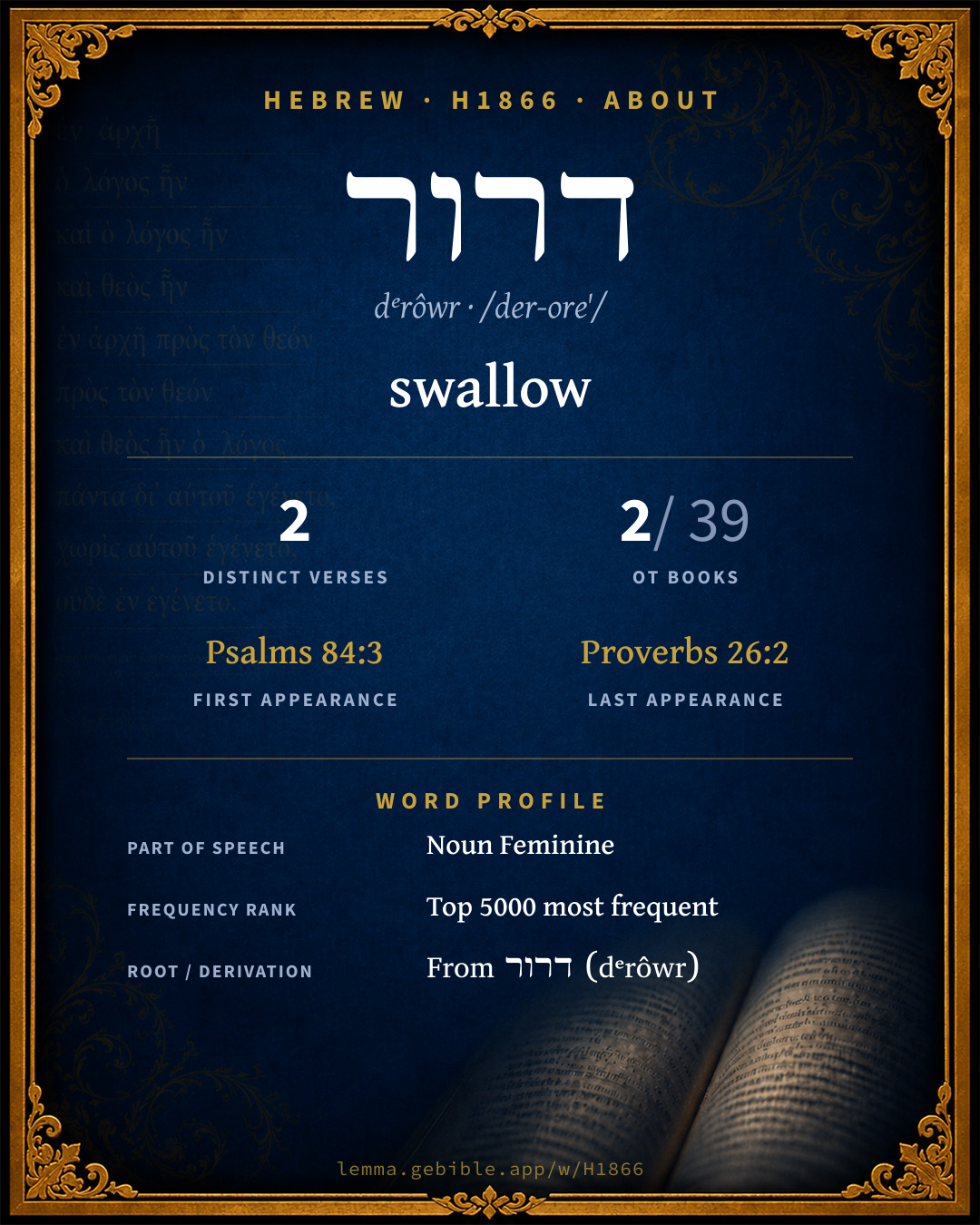
דְּרוֹר
swallow
Full lexicon entry — Brown-Driver-Briggs (BDB)
From Brown-Driver-Briggs (BDB)
Where this word appears
Grammar key — what these labels mean
Noun type
- Common
- A common noun — a general class of person, place, or thing (“king,” “city,” “water”), not a specific name.
State
- Absolute
- The independent form of a noun, not bound to a following word.
Gender
- Feminine
- Grammatically feminine.
Number
- Singular
- One.
Every verse where H1866 appears — 2 distinct verses across 2 books. Click any verse to open its interlinear word-by-word view. Verse text shown in the World English Bible for context — . Each verse’s Hebrew form is shown with its reference; the English is not keyword-highlighted, since the data carries no word-level English alignment. Use “Compare translations” on any verse to read it across multiple English versions. This concordance covers the Hebrew Bible; Septuagint (Greek Old Testament) occurrences are not indexed here.
Psalms 1 verse
Proverbs 1 verse
About this entry
At a glance — auto-summarized from this page’s data, not written by a person. Every figure links to its source below. This summary describes the numbers; it doesn’t interpret them.
At its core, דרור (dᵉrôwr) means “swallow.” It occurs a mere 2 verses across Scripture. Its uses cluster heavily in Psalms (50% of all occurrences). First canonically at Psalms 84:3, it enters the text early. From the same root come דרור and דר. Dig into 2-verse concordance and the renderings breakdown below.
Gloss history
Strong's 1890 vs modern scholarship
About this word
Strong's H1866 catalogs a Hebrew word from the Hebrew Old Testament.
These counts are not copied from any lexicon or concordance. They are computed here, from the morphology-tagged Hebrew Old Testament. What Lemma adds →
- 2
- distinct verses
- The word appears in 2 distinct verses.
- 2 / 39
- OT books
- The word appears in 2 of 39 Old Testament books.
- #4,807
- by frequency
- Top 5000 most frequent Hebrew words (rank 4,807 of 8,640 Hebrew words by occurrence).
View all 2 occurrences in the concordance →
By traditional corpus
Conventional, traditional groupings — biblical authorship is debated, so this is a traditional corpus grouping, not an authorship claim. Each share is this word’s portion of its verses in that division of the Hebrew canon. Each figure is a share of the word’s 2 distinct verses.
- Writings (Ketuvim) 2 verses · 100%
How translations render this word
Counts come from each version’s own published word-to-Strong’s tagging or interlinear alignment — an approximate guide to how each version renders this word, not a word-level alignment the data otherwise carries. Because each total is that version’s own tagged count, the per-version totals vary from one another and need not match the appearance or distinct-verse counts above. These counts may also differ from a printed concordance because Lemma counts each distinctly tagged rendering and does not collapse phrase taggings into a single head-word total. This is a fixed set of word-tagged versions (KJV, ASV, BSB, ULT) and does not change with the reading translation you choose elsewhere. Each version’s license is shown beside its name below (and on Sources).
BDB lists this Strong’s number as 2 distinct words (homographs). Each count above pools all of them and is not split by sense — see the Senses section below. A low-frequency rendering may belong to a different one of those words, not the primary meaning.
- King James Version†: Swallow 2×
- American Standard Version†: Swallow 2×
- Berean Standard Bible†: Swallow 2×
- unfoldingWord Literal Text†: Like the swallow 1×, Swallow 1×
King James Version Public Domain
Renders H1866 across 2† tagged occurrences — most commonly:
American Standard Version Public Domain
Renders H1866 across 2† tagged occurrences — most commonly:
Berean Standard Bible Public Domain
Renders H1866 across 2† tagged occurrences — most commonly:
unfoldingWord Literal Text CC BY-SA 4.0
Renders H1866 across 2† tagged occurrences — most commonly:
Senses in the full BDB
What do BDB’s symbols mean?
BDB uses these scholarly abbreviations:
| Symbol | Meaning |
|---|---|
| 𝔊 | the Septuagint (the ancient Greek translation, LXX) |
| 𝔙 | the Vulgate (the Latin translation) |
| 𝔖 | the Syriac version (the Peshitta) |
| 𝔗 | the Targum (the Aramaic translation) |
| ψ | the Psalms |
| √ | root (the underlying root or stem) |
| ‖ | parallel passage (a synonymous or contrasted parallel) |
| † | the dagger: every passage where the word occurs is cited |
The 2 senses and sub-senses the full Brown-Driver-Briggs lexicon distinguishes for this word, in lexicon order (not ranked by frequency), with BDB’s own verbatim wording and sub-sense lettering. Shown in Hebrew script with BDB’s own scholarly abbreviations. The condensed entry is in the Lexicon Entry tab. See also the Forms in the corpus table below.
- 1. מָר־דְּרוֹר Ex 30:23 (P) i.e. myrrh of flowing, fine-flowing m. cf. מֹר & Di. e.g. Exodus 30:23
- 2. c. קרא proclaim liberty, וּקְרָאתֶם דְּרוֹר בָּאָרֶץ לְכָל־יֹשְׁכֶ֑יהָ Lv 25:10 (H) in Jubilee year, cf. Is 61:1 (‖ פְּקַח־קוֹחַ); Je 34:8, 15, 17 all ref. to liberty of Sabbatical year; v 17 (iron.) lo! I proclaim to you liberty unto the sword, unto pestilence & unto famine, i.e. liberty to be destroyed by sword, pestilence and famine, (a judgment of Yahweh); שְׁנַת־הַדּ׳ Ez 46:17 i.e. year of Jubilee (cf. Lv 25:10). e.g. Leviticus 25:10
Senses from the full Brown-Driver-Briggs lexicon (Brown, Driver, Briggs; Oxford 1906 — public domain), digitized via Sefaria, supplemented by the OpenScriptures HebrewLexicon (CC BY 4.0). Full attribution on Sources.
Word origin
I. n.[m.] a flowing; free run, liberty;—
II. n.f. ψ 84:4 swallow ψ 84:4 (‖ צִפּוֹר), Che (q.v.) makes simile of quiet, peace, security, and supplies ellipsis; in simile, Pr 26:2 כַּצִּפּוֹר לָנוּד כַּדְּרוֹר לָעוּף (of groundless curse, which does not alight, i.e. is not fulfilled).
— Brown-Driver-Briggs (Oxford 1906, public domain), digitized via Sefaria, supplemented by the OpenScriptures HebrewLexicon (CC BY 4.0). See Sources.
Derived from דרור (dᵉrôwr) (H1865) — flowing.
Jastrow Dictionary
A second Hebrew/Aramaic lexicon for comparison, covering Aramaic and post-biblical (Talmudic, Targumic, Midrashic) usage that the biblical-Hebrew BDB does not. Matched by lemma rather than by Strong’s number, so a lemma may carry more than one Jastrow headword (shown separately below), and the entries cover usage well beyond the Bible.
דְּרוֹר
- , v. דור) [moving about,]
- 1. freedom, privilege, amnesty. Midr. Till. to Ps. XC ליטול ד׳ to ask a privilege. Ib. שתתן לי ד׳, v. מֶרֶד I.—Esp. merchant’s license. Meg. 12ᵃ (cmp. דּוּר ch. Pa.).
- 2. צפור ד׳ a free bird, living in the house as well as in the field. Sabb. 106ᵇ. Neg. XIV, 1 שתי ציפרי ד׳ (corresp. to חיות, Lev. XIV, 4); Tosef. Naz. VI, 1 שני ציפרים ד׳; Y. ib. VIII, 57ᵃ bot. Tosef. Neg. VIII, 3 שתי ציפרין ד׳ ואלו וכ׳ two free birds which means such as are around in the city. Neg. XIV, 5 נמצאת שלא ד׳ it is discovered that it is not a free bird; Tosef. ib. VIII, 7 [read:] ונמצאת שנייה שלא ד׳ (v. R. S. to Neg. l. c.).—[Y. Snh. X, 28ᵃ top כד׳ נאות, read: כדּוּר בנות like the jewel of girls, v. דּוּרָא II.] e.g. Leviticus 14:4
A Dictionary of the Targumim, the Talmud Babli and Yerushalmi, and the Midrashic Literature (Marcus Jastrow; London, Luzac, 1903) — Public Domain. Digitized via Sefaria. Digitized via Sefaria. Full attribution on Sources.
Forms in the corpus
The 2 distinct written forms H1866 takes in the Hebrew Bible, most frequent first — each parse links to that state’s occurrences in the concordance. Hebrew forms include their vowel points and cantillation, so a single lemma takes many written forms.
| Form | Parsing | Example | Uses |
|---|---|---|---|
| וּ/דְר֤וֹר | Noun, Common, Feminine, Singular, Absolute | Psalms 84:3 | 1 |
| כַּ/דְּר֣וֹר | Noun, Common, Feminine, Singular, Absolute | Proverbs 26:2 | 1 |
Same root — word family
Other BDB entries built from the same root as H1866, grouped by Strong’s listed origin. These share a root / origin per the lexicon — not necessarily a shared meaning. Each links to that word’s own entry.
Derives from
Shares the same root
Compare all same-root words → They share a root, not necessarily a meaning.
Septuagint verse parallels
This word appears in 2 verses that also exist in the Greek Old Testament (Septuagint), out of the 2 Hebrew verses it occurs in. You can read those verses in Greek by switching the Old Testament edition to the Septuagint.
Read these verses in the Septuagint
This is a verse-level parallel only — the same verses exist in both the Hebrew and Greek Old Testaments. No word-level Hebrew↔Greek correspondence is claimed: the data carries no such alignment, so no Greek word is shown as this Hebrew word’s translation. Coverage is not total — the Septuagint omits the deuterocanon and renumbers the Psalms, so some Hebrew verses have no direct Greek parallel.