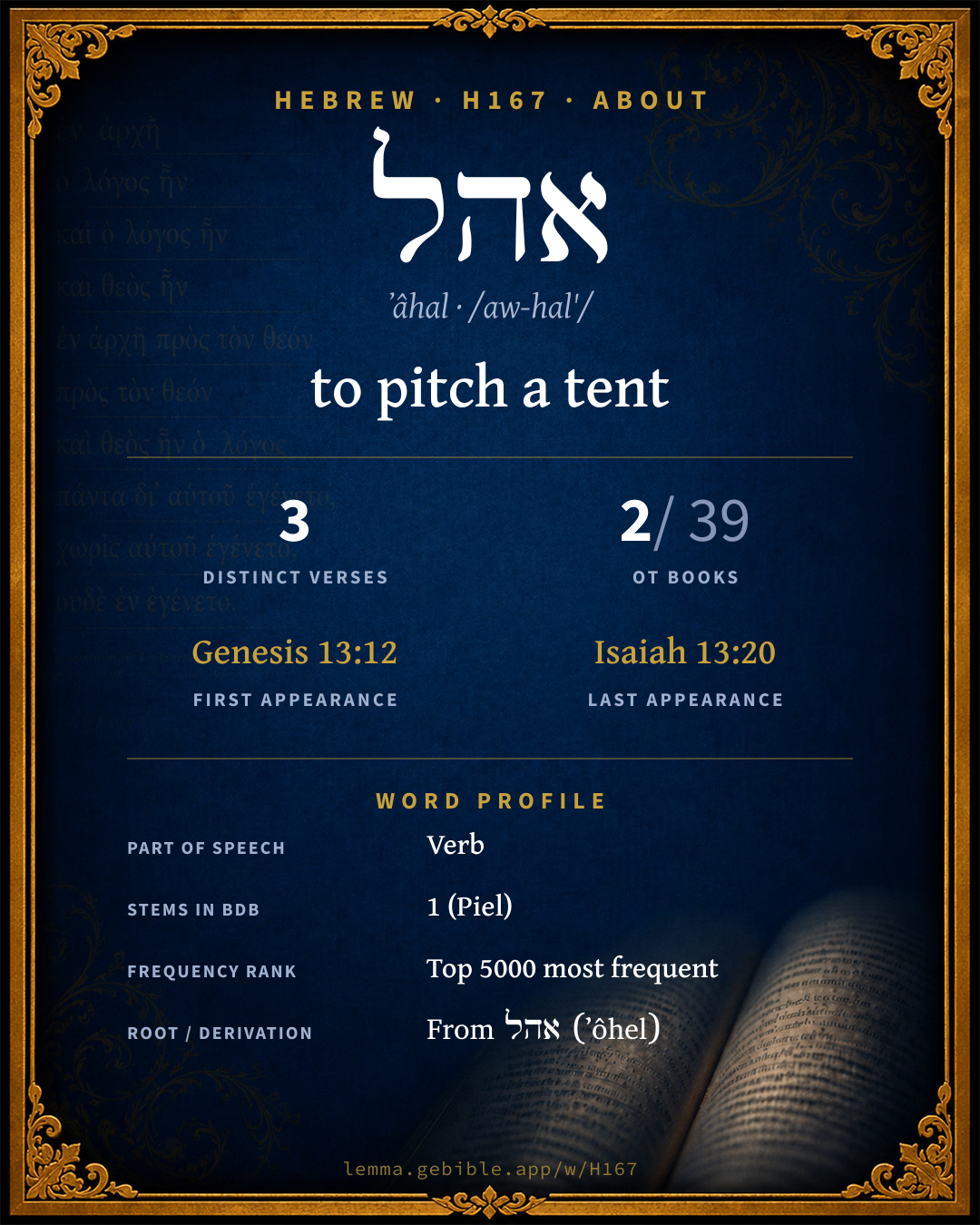
אָהַל
to pitch a tent
‘to pitch a tent’ is one of 3 main senses fuller range ↓
Full lexicon entry — Brown-Driver-Briggs (BDB)
From Brown-Driver-Briggs (BDB)
Where this word appears
See every Qal verb in the Hebrew Bible →
Grammar key — what these labels mean
Part of speech
- Verb
- An action or state-of-being word.
Stem
- Qal
- The basic, simple active stem — the plain form of the verb (“he wrote”).
- Piel
- An intensive or resultative active stem.
Form
- Sequential Imperfect
- An imperfect with prefixed waw — the standard past-narrative form (waw-consecutive imperfect).
- Imperfect
- An incomplete, ongoing, or future action (“he will / would write”).
Person
- 3rd Person
- The one spoken about (“he / she / it / they”).
Gender
- Masculine
- Grammatically masculine.
Number
- Singular
- One.
1 distinct verse where H167 appears in the Piel stem, across 1 book. Filtered view — show all forms. Click any verse to open its interlinear word-by-word view. Verse text shown in the World English Bible for context — . Each verse’s Hebrew form is shown with its reference; the English is not keyword-highlighted, since the data carries no word-level English alignment. Use “Compare translations” on any verse to read it across multiple English versions. This concordance covers the Hebrew Bible; Septuagint (Greek Old Testament) occurrences are not indexed here.
Isaiah 1 verse
About this entry
At a glance — auto-summarized from this page’s data, not written by a person. Every figure links to its source below. This summary describes the numbers; it doesn’t interpret them.
אהל — transliterated ʼâhal — is a Hebrew verb carrying the sense “to pitch a tent.” A scarce word — 3 verses in all of the Hebrew Bible. More than two-thirds of its appearances fall in Genesis. Debuting at Genesis 13:12, it then recurs through the corpus. It is not a single-sense word — see its full sense range. Each statement above links to its evidence; the full detail follows below.
Gloss history
Strong's 1890 vs modern scholarship
About this word
Strong's H167 catalogs a Hebrew word from the Hebrew Old Testament.
These counts are not copied from any lexicon or concordance. They are computed here, from the morphology-tagged Hebrew Old Testament. What Lemma adds →
- 3
- distinct verses
- The word appears in 3 distinct verses.
- 2 / 39
- OT books
- The word appears in 2 of 39 Old Testament books.
- #4,179
- by frequency
- Top 5000 most frequent Hebrew words (rank 4,179 of 8,640 Hebrew words by occurrence).
View all 3 occurrences in the concordance →
By traditional corpus
Conventional, traditional groupings — biblical authorship is debated, so this is a traditional corpus grouping, not an authorship claim. Each share is this word’s portion of its verses in that division of the Hebrew canon. Each figure is a share of the word’s 3 distinct verses.
- Torah (Pentateuch) 2 verses · 67%
- Prophets (Nevi'im) 1 verse · 33%
How translations render this word
Counts come from each version’s own published word-to-Strong’s tagging or interlinear alignment — an approximate guide to how each version renders this word, not a word-level alignment the data otherwise carries. Because each total is that version’s own tagged count, the per-version totals vary from one another and need not match the appearance or distinct-verse counts above. These counts may also differ from a printed concordance because Lemma counts each distinctly tagged rendering and does not collapse phrase taggings into a single head-word total. This is a fixed set of word-tagged versions (KJV, ASV, BSB, ULT) and does not change with the reading translation you choose elsewhere. Each version’s license is shown beside its name below (and on Sources).
- King James Version: Pitch tent 1×, Pitched his tent 1×, Removed his tent 1×
- American Standard Version: Moved his tent 2×
- Berean Standard Bible: Moved his tent 1×, Pitched tent 1×, Will pitch his tent 1×
- unfoldingWord Literal Text: Moved his tents 2×
King James Version Public Domain
Renders H167 across 3 tagged occurrences — most commonly:
American Standard Version Public Domain
Renders H167 across 3 tagged occurrences — most commonly:
Plus 1 rendering that appears only once — usually multi-word phrases or single function words the recovered tagging swept in, not distinct renderings.
Berean Standard Bible Public Domain
Renders H167 across 3 tagged occurrences — most commonly:
unfoldingWord Literal Text CC BY-SA 4.0
Renders H167 across 5 tagged occurrences — most commonly:
Plus 3 renderings that appear only once — usually multi-word phrases or single function words the recovered tagging swept in, not distinct renderings.
Senses in the full BDB
What do BDB’s symbols mean?
BDB uses these scholarly abbreviations:
| Symbol | Meaning |
|---|---|
| 𝔊 | the Septuagint (the ancient Greek translation, LXX) |
| 𝔙 | the Vulgate (the Latin translation) |
| 𝔖 | the Syriac version (the Peshitta) |
| 𝔗 | the Targum (the Aramaic translation) |
| ψ | the Psalms |
| √ | root (the underlying root or stem) |
| ‖ | parallel passage (a synonymous or contrasted parallel) |
| † | the dagger: every passage where the word occurs is cited |
The 1 sense the full Brown-Driver-Briggs lexicon distinguishes for this word, in lexicon order (not ranked by frequency), with BDB’s own verbatim wording and sub-sense lettering. Shown in Hebrew script with BDB’s own scholarly abbreviations. The condensed entry is in the Lexicon Entry tab. See also the Forms in the corpus table below.
Piel
- . Impf. pitch one’s tent like nomad
Senses from the full Brown-Driver-Briggs lexicon (Brown, Driver, Briggs; Oxford 1906 — public domain), digitized via Sefaria, supplemented by the OpenScriptures HebrewLexicon (CC BY 4.0). Full attribution on Sources.
Word origin
[ אָהַל ] vb. denom. tent, move tent fr. place to place
— Brown-Driver-Briggs (Oxford 1906, public domain), digitized via Sefaria, supplemented by the OpenScriptures HebrewLexicon (CC BY 4.0). See Sources.
Derived from אהל (ʼôhel) (H168) — tent.
Jastrow Dictionary
A second Hebrew/Aramaic lexicon for comparison, covering Aramaic and post-biblical (Talmudic, Targumic, Midrashic) usage that the biblical-Hebrew BDB does not. Matched by lemma rather than by Strong’s number, so a lemma may carry more than one Jastrow headword (shown separately below), and the entries cover usage well beyond the Bible.
אָהַל
- (b. h.), Pi. אִיהֵל (deriv. of אֹהֶל) to spread tent-like, to cover, shade, bend over &c., usu. with refer. to levitical uncleanness arising from being under the same shelter with, or forming a shelter over, a corpse &c. Meïlah 17ᵃ אי׳ על מקצתו if he bent over a portion (of the blood). Sabb. 17ᵃ אי׳ צדו אחת וכ׳ he caused one side of his body to overshadow the grave.—[More freq.]
- same. Ohol. III, 1; 3 sq. הא׳ על המת he formed a tent, i.e. spread himself, or bent, over a corpse. Ib. הבית מַאֲחִיל עליו the house forms a cover over part of it. Y. Sot. IX, 23ᶜ top; a. fr.
אֹהֶל
- tent, shelter. Succ. 21ᵇ א׳ עראי a temporary dwelling. א׳ קבע a permanent dwelling.—Naz. 55ᵃ א׳ זרוק a movable cover, e.g. a person carried in a vehicle over a grave, v. foreg.—B. Bath. 27ᵇ, a. fr. א׳ הטומאה something spread over an unclean object, e.g. a tree shading a corpse; v. foreg. Naz. VII, 2, v. אָהִיל.—Pl. אוֹהֳלִים, (אָהֳולִין) אוֹהֳלִין. Y. Sabb. XX, beg. 17ᶜ נטע א׳ to spread sheets over poles &c. (Tosef. ib. XII (XIII), 14, a. e. עשה א׳). Y. Erub. I, 19ᵈ א׳ בשיירה tents in a caravan, א׳ שבמחנה in a camp. Tosef. Kil. V, 25 אהולין ed. Zuck.
אֳהָל
- (Syr. אחלא P. Sm. 125; הל, חל, v. הלל, חלל, cmp. מוהל, מוחל)
- 1. an alcalic plant, used as soap. Sabb. 90ᵃ; Nidd. 62ᵃ (counted among plants subject to the laws of the Sabbath year).
- 2. a mineral substance of the same use (in connection with נתר; v. however Maim. to Nidd. IX, 6). Nidd. l. c. והתניא הבורית והאהל; (Sabb. l. c. first time חול ed., Ms. M. אָהֵיל; sec. time אהלא ed., Ms. M. אהיל). M. Kat. 17ᵇ; a, e. [The biblical אהלים a. אהלות have no connection of meaning with our w.]
A Dictionary of the Targumim, the Talmud Babli and Yerushalmi, and the Midrashic Literature (Marcus Jastrow; London, Luzac, 1903) — Public Domain. Digitized via Sefaria. Digitized via Sefaria. Full attribution on Sources.
Forms in the corpus
The 3 distinct written forms H167 takes in the Hebrew Bible, most frequent first — each parse links to that stem’s occurrences in the concordance. Hebrew forms include their vowel points and cantillation, so a single lemma takes many written forms.
| Form | Parsing | Example | Uses |
|---|---|---|---|
| וַ/יֶּאֱהַ֖ל | Verb, Qal, Sequential Imperfect, 3rd Person, Masculine, Singular | Genesis 13:12 | 1 |
| וַ/יֶּאֱהַ֣ל | Verb, Qal, Sequential Imperfect, 3rd Person, Masculine, Singular | Genesis 13:18 | 1 |
| יַהֵ֥ל | Verb, Piel, Imperfect, 3rd Person, Masculine, Singular | Isaiah 13:20 | 1 |
Same root — word family
Other BDB entries built from the same root as H167, grouped by Strong’s listed origin. These share a root / origin per the lexicon — not necessarily a shared meaning. Each links to that word’s own entry.
Derives from
Proper names from this root
People and places named from this root — a name, not an additional meaning of the word.
Compare all same-root words → Showing 4 of 5 — not the complete family. 3 of the same-root words are proper names (people or places). They share a root, not necessarily a meaning.
Septuagint verse parallels
This word appears in 3 verses that also exist in the Greek Old Testament (Septuagint), out of the 3 Hebrew verses it occurs in. You can read those verses in Greek by switching the Old Testament edition to the Septuagint.
Read these verses in the Septuagint
This is a verse-level parallel only — the same verses exist in both the Hebrew and Greek Old Testaments. No word-level Hebrew↔Greek correspondence is claimed: the data carries no such alignment, so no Greek word is shown as this Hebrew word’s translation. Coverage is not total — the Septuagint omits the deuterocanon and renumbers the Psalms, so some Hebrew verses have no direct Greek parallel.