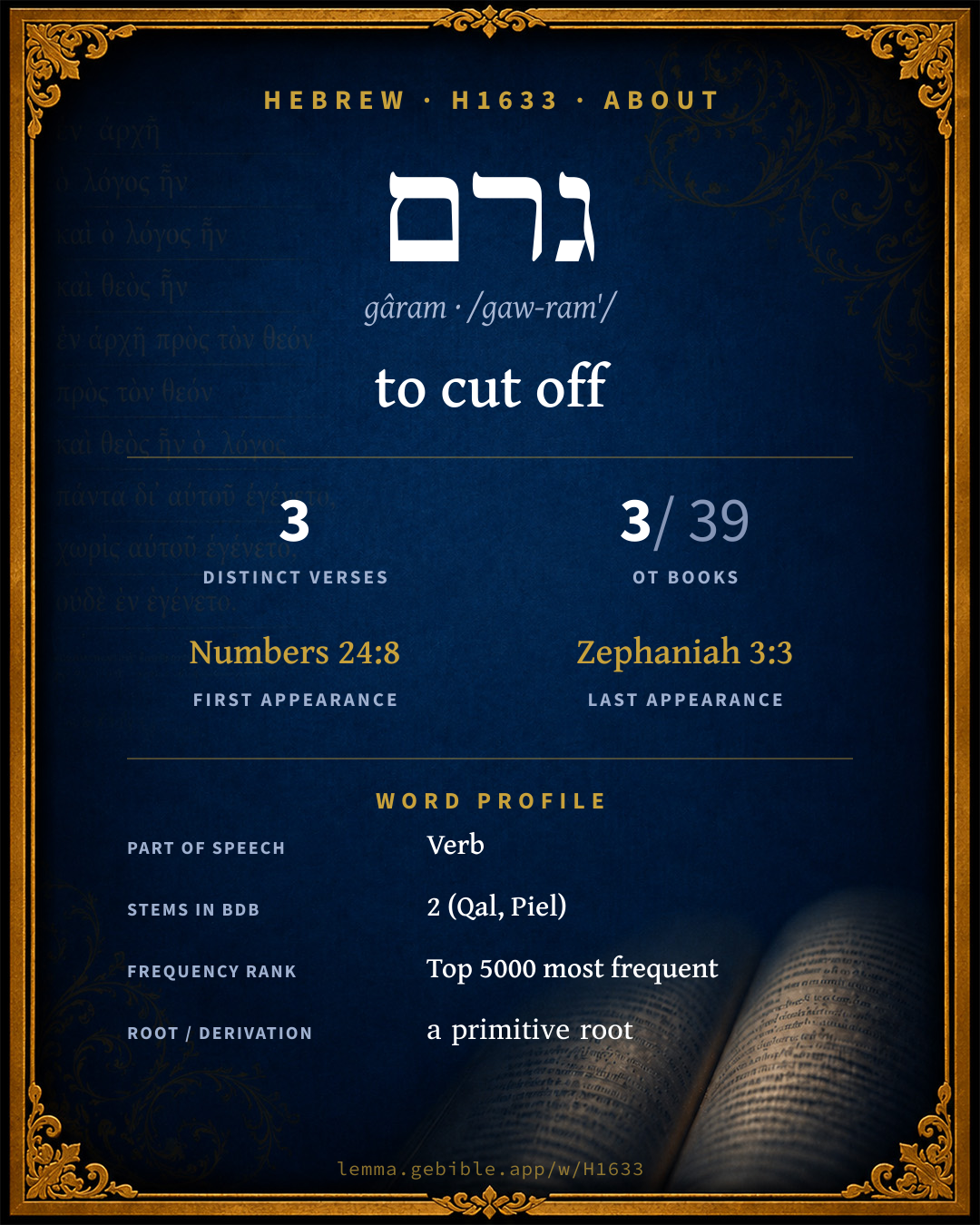
גָּרַם
to cut off
also: reserve, lay aside, leave, save fuller range ↓
Full lexicon entry — Brown-Driver-Briggs (BDB)
From Brown-Driver-Briggs (BDB)
Where this word appears
Grammar key — what these labels mean
Part of speech
- Verb
- An action or state-of-being word.
Stem
- Piel
- An intensive or resultative active stem.
- Qal
- The basic, simple active stem — the plain form of the verb (“he wrote”).
Form
- Imperfect
- An incomplete, ongoing, or future action (“he will / would write”).
- Perfect
- A completed action or state — Hebrew marks aspect (completeness) more than strict tense (“he wrote”).
Person
- 2nd Person
- The one addressed (“you”).
- 3rd Person
- The one spoken about (“he / she / it / they”).
Gender
- Feminine
- Grammatically feminine.
- Masculine
- Grammatically masculine.
- Common
- Either gender — not distinguished for this form.
Number
- Singular
- One.
- Plural
- More than one (in Hebrew, generally three or more).
Every verse where H1633 appears in the Book of Ezekiel — 1 distinct verse. Click any verse to open its interlinear word-by-word view. Verse text shown in the World English Bible for context — . Each verse’s Hebrew form is shown with its reference; the English is not keyword-highlighted, since the data carries no word-level English alignment. Use “Compare translations” on any verse to read it across multiple English versions. This concordance covers the Hebrew Bible; Septuagint (Greek Old Testament) occurrences are not indexed here.
Ezekiel
About this entry
At a glance — auto-summarized from this page’s data, not written by a person. Every figure links to its source below. This summary describes the numbers; it doesn’t interpret them.
גרם (gâram) is a Hebrew verb most often rendered “to cut off.” A scarce word — 3 verses in all of the Hebrew Bible. Numbers dominates its distribution — 1 of 3 verses. Scripture first uses it in Numbers 24:8. As a verb its force shifts by stem, across 2 stems (Qal, Piel, and more). The sections below give every sense, occurrence, and version rendering.
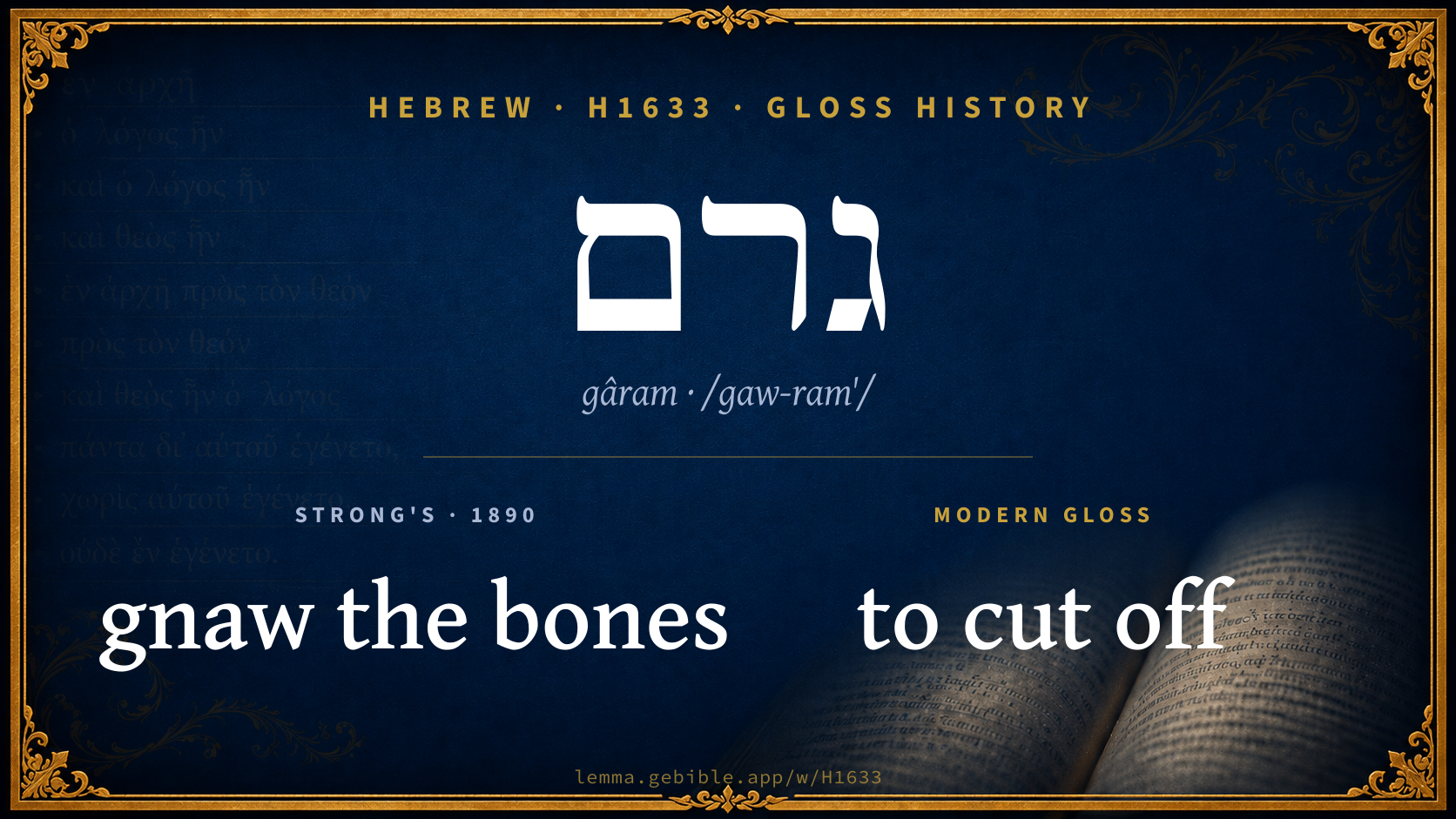
Gloss history
Strong's 1890 vs modern scholarship
About this word
Strong's H1633 catalogs a Hebrew word from the Hebrew Old Testament.
These counts are not copied from any lexicon or concordance. They are computed here, from the morphology-tagged Hebrew Old Testament. What Lemma adds →
- 3
- distinct verses
- The word appears in 3 distinct verses.
- 3 / 39
- OT books
- The word appears in 3 of 39 Old Testament books.
- #4,179
- by frequency
- Top 5000 most frequent Hebrew words (rank 4,179 of 8,640 Hebrew words by occurrence).
View all 3 occurrences in the concordance →
By section of the Old Testament
By traditional corpus
Conventional, traditional groupings — biblical authorship is debated, so this is a traditional corpus grouping, not an authorship claim. Each share is this word’s portion of its verses in that division of the Hebrew canon. Each figure is a share of the word’s 3 distinct verses.
- Prophets (Nevi'im) 2 verses · 67%
- Torah (Pentateuch) 1 verse · 33%
How translations render this word
Counts come from each version’s own published word-to-Strong’s tagging or interlinear alignment — an approximate guide to how each version renders this word, not a word-level alignment the data otherwise carries. Because each total is that version’s own tagged count, the per-version totals vary from one another and need not match the appearance or distinct-verse counts above. These counts may also differ from a printed concordance because Lemma counts each distinctly tagged rendering and does not collapse phrase taggings into a single head-word total. This is a fixed set of word-tagged versions (KJV, ASV, BSB, ULT) and does not change with the reading translation you choose elsewhere. Each version’s license is shown beside its name below (and on Sources).
BDB lists this Strong’s number as 2 distinct words (homographs). Each count above pools all of them and is not split by sense — see the Senses section below. A low-frequency rendering may belong to a different one of those words, not the primary meaning.
- King James Version†: Shall break 1×, They gnaw not the bones 1×, Thou shalt break 1×
- American Standard Version†: Shall break 1×, They leave nothing 1×, Thou shalt gnaw 1×
- Berean Standard Bible†: Crush 1×, Leaving 1×, You will dash it 1×
- unfoldingWord Literal Text†: Gnaw 1×, He will break 1×, They do 1×
King James Version Public Domain
Renders H1633 across 3† tagged occurrences — most commonly:
American Standard Version Public Domain
Renders H1633 across 3† tagged occurrences — most commonly:
Berean Standard Bible Public Domain
Renders H1633 across 3† tagged occurrences — most commonly:
unfoldingWord Literal Text CC BY-SA 4.0
Renders H1633 across 4† tagged occurrences — most commonly:
Senses in the full BDB
Hebrew verbs can shift meaning by stem (binyan): Qal is the basic action, Niphal is often passive or reflexive, Piel often intensifies or makes it factitive, and Hiphil is typically causative. The senses below are grouped under the stem BDB assigns to each.
What do BDB’s symbols mean?
BDB uses these scholarly abbreviations:
| Symbol | Meaning |
|---|---|
| 𝔊 | the Septuagint (the ancient Greek translation, LXX) |
| 𝔙 | the Vulgate (the Latin translation) |
| 𝔖 | the Syriac version (the Peshitta) |
| 𝔗 | the Targum (the Aramaic translation) |
| ψ | the Psalms |
| √ | root (the underlying root or stem) |
| ‖ | parallel passage (a synonymous or contrasted parallel) |
| † | the dagger: every passage where the word occurs is cited |
The 2 senses and sub-senses the full Brown-Driver-Briggs lexicon distinguishes for this word, in lexicon order (not ranked by frequency), with BDB’s own verbatim wording and sub-sense lettering. Shown in Hebrew script with BDB’s own scholarly abbreviations. The condensed entry is in the Lexicon Entry tab. See also the Forms in the corpus table below.
גרם I
Qal
- Pf. 3 pl. לֹא גָֽרְמוּ לַבֹּקֶר Zp 3:3 they have reserved nothing for the morrow, in fig. of cruel judges (dub.: al. from ii. [גָּרַם], v. KauAT Dr). e.g. Zephaniah 3:3
גרם II denom. break bones, break
Piel
- Impf. וְעַצְמֹתֵיהֶם יְגָרֵם Nu 24:8 (JE); but also וְאֶת־חֲרָשֶׂיהָ תְּגָרֵ֖מִי Ez 23:34 (yet on text v. Co.) e.g. Numbers 24:8
Senses from the full Brown-Driver-Briggs lexicon (Brown, Driver, Briggs; Oxford 1906 — public domain), digitized via Sefaria, supplemented by the OpenScriptures HebrewLexicon (CC BY 4.0). Full attribution on Sources.
Word origin
I. vb. cut off, hence reserve (?) (NH גָּרַם is shorten, occasion, bring about, to pass, Aramaic גְּרַם Pa. occasion, bring about, ܓܪܰܡ abscidit, decrevit, cf. Arabic جَرَمَ cut off (fruit), shear (sheep);—on connexion of ideas v. Fl NHWB i.437)
II. vb.denom. break bones, break—
— Brown-Driver-Briggs (Oxford 1906, public domain), digitized via Sefaria, supplemented by the OpenScriptures HebrewLexicon (CC BY 4.0). See Sources.
Origin: a primitive root
Jastrow Dictionary
A second Hebrew/Aramaic lexicon for comparison, covering Aramaic and post-biblical (Talmudic, Targumic, Midrashic) usage that the biblical-Hebrew BDB does not. Matched by lemma rather than by Strong’s number, so a lemma may carry more than one Jastrow headword (shown separately below), and the entries cover usage well beyond the Bible.
גָּרַם
- (v. גרר) to drag along, carry with it.—Part. pass. גָּרוּם added in boot, additional measure, v. גֵּירוּמִין.—אַמָּה גְּרוּמָה a large cubit. Gen. R. s. 12 [read:] כאמה ג׳ the size of a liberal cubit (equal to a cubit and a half of strict measure; some ed. גד׳; vers. in ‘Rashi’ a. l. גרמידא ומחצה).—Y. Shek. VI, end, 50ᵇ אמה גרו׳, read גְּדוּמָה, v. גָּדַם. [Tosef. Bekh. V, 4 אצבעותיו גרומות Var., ed. Zuck. גְּדוּמוֹת.]—Trnsf. to carry with it, to be the cause of, to engender. דבר הגֹּורֵם לממון something which may be the cause of pecuniary profit or loss. B. Kam. 71ᵇ if one steals objects dedicated to the sanctuary for which the original owner is responsible in case of loss &c., he is bound to pay the thief’s fine (כֵּפֶל) to the owner; אלמא דבר הג׳ למ׳ כממון דמי which proves that that which may cause a pecuniary loss, is to be considered as the property of him to whom it may cause it. Ib. 98ᵇ according to the opinion of R. Shimeon who says דבר הגורם … מיחייב that what is the cause of monetary gain is considered as money, he who burns a note of indebtedness is bound to pay the full amount of the note; a. fr.—Snh. 104ᵃ גורם גלות לבניו causes his children to be exiled. Ber. 5ᵇ bot. ג׳ לשכינה וכ׳ is the cause of the Divine Presence departing from Israel. M. Kat. 25ᵃ בבל גָּרְמָה לו Babylonia was the cause (that the Shekhinah did not rest upon him). Ab. Zar. 8ᵇ bot. המקום גורם the place makes the act legal, i.e. only in the Temple hall can the Sanhedrin judge capital cases; Snh. 14ᵇ המקום ג׳ only in the Temple hall can a rebellious elder be judged; ib. 87ᵃ.—Y. Yeb. I, 2ᶜ top דבר שהוא בא מחמת הגורם וכ׳ if a prohibition arises from a cause (a person that causes it, e.g. the prohibition against C.’s marrying B. because B.’s sister A. is his wife)—when the cause is removed (through A.’s death), the prohibition ceases; but a prohibition which has not its cause in the action of a person (but in natural kinship, e.g. C.’s daughter married to C.’s brother whereby she becomes forbidden to him also as his brother’s wife), is not removed with the removal of the cause of the (additional) prohibition, i.e. C. cannot perform the levir’s marriage with his brother’s wife since she has not ceased to be his daughter; ib. III, beg., 4ᶜ; IV, 6ᵃ top.—זה וזה גורם a product of combined causes. Tem. 30ᵇ זה וזה ג׳ אסור a product of combined causes is forbidden, e.g. the offspring of a dam unfitted for the altar, and of a sire fit; Pes. 27ᵃ; a. fr.—Ib. 26ᵇ זה וזה ג׳ מי שמעת ליה can you prove that Rabbi adopts the rule forbidding the product of combined causes?—Nidd. 31ᵃ (homiletical play on Gen. XLIX, 14) חמור ג׳ ליששכר the braying of an ass was the cause of Isachar being begotten; Gen. R. s. 99; v. next w. e.g. Genesis 49:14
- same. Gen. R. s. 39 הדרך מְגָרֶמֶת וכ׳ traveling is the cause of three evils.
- to be indirectly engendered. Ab. Zar. 55ᵇ אסור לִיגָּרֵם וכ׳ no assistance must be given to making unclean &c.
- to leave a comb (גֵּרוּם) in striking a measure off, whence (in ritual slaughtering) to cut in a slanting direction, to let the knife slide beyond the space prescribed for cutting. Ḥull. 19ᵃ; 20ᵃ; a. fr.—Part. pass. f. מוּגְרֶמֶת an animal slaughtered by a slanting cut. Ib. 18ᵇ; a. fr.—Denom. הַגְרָמָה.
גְּרַם I
- Targ. Is. III, 9; a. fr.—Meg. 12ᵇ אנא גַּרְמִי וכ׳ Ms. M. (ed. גרים) I am the cause that M. was born. Ber. 7ᵇ שמא גָרֵים a person’s name has an influence on his fate or character. Ab. Zar. 19ᵇ ע"א מאן קא גרים לה what action caused the work to be called an idol?—Gen. R. s. 98 [read:] יששכר חמור גַּרְמֵיה (play on גרם, v. preced. w.) the braying of an ass caused him to be begotten (by announcing Jacob’s arrival upon which Leah went forth to meet him; v. ib. s. 99, Nidd. 31ᵃ).
גְּרַם II
- (denom. of גַּרְמָא, cmp. עצם) to be substantial, strong. *Targ. Prov. XVIII, 10 וניגריס ביה Ms. a. Var. in ed. Lag. (read ונִיגְרִים; ed. ונתרים). Ib. V, 19 תִּגְרַם (some ed. תְּגָרֵם, Ms. תגרס) thou shalt grow strong.
- 1. to strengthen, comfort. Targ. Y. II, Gen. XXXV, 9 וגָרִימַת וכ׳ (some ed. וגְרִי׳ Pe.) and Thou didst strengthen him (in his trouble).
- 2. to eat up to the bone, to pick off. Targ. Ps. XXVII, 2 לְגָּרָמָא (Ms. a. Regia לגַמָּרָא, v. גְּמַר).—B. Bath. 22ᵃ אדמְגַרְמִיתוּ גרמי וכ׳ (Ms. M. מגרדיתו fr. גְּרַד; Ar. דמגריסתו fr. גְּרַס; v. Rabb. D. S. a. l. note) in place of picking off bones (receiving scanty instruction) in the school of A., go ye and eat flesh &c.
- to make substantial, harden. Targ. Prov. VIII, 28 (Var. אוגריס, h. text אמץ).
גָּרָם
- (גָּרַם) cause, indirect production of an effect. Sabb. 120ᵇ גְּרַם כיבוי indirect extinction of a fire (by placing vessels filled with water in its way), v. גְּרָמָא.
גֶּרֶם
- גרם to strip; cmp. גרד, [stripped, bare, cmp. II Kings IX, 13,] skeleton, bone; (cmp. עֶצֶם) self, strength.—Pl. גְּרָמִים. Gen. R. s. 98 מה חמור זה גְּרָמָיו ברורים as the bony frame of the ass is clearly discernible. e.g. 2 Kings 9:13
A Dictionary of the Targumim, the Talmud Babli and Yerushalmi, and the Midrashic Literature (Marcus Jastrow; London, Luzac, 1903) — Public Domain. Digitized via Sefaria. Digitized via Sefaria. Full attribution on Sources.
Forms in the corpus
The 3 distinct written forms H1633 takes in the Hebrew Bible, most frequent first — each parse links to that stem’s occurrences in the concordance. Hebrew forms include their vowel points and cantillation, so a single lemma takes many written forms.
| Form | Parsing | Example | Uses |
|---|---|---|---|
| גָרְמ֖וּ | Verb, Qal, Perfect, 3rd Person, Common, Plural | Zephaniah 3:3 | 1 |
| יְגָרֵ֖ם | Verb, Piel, Imperfect, 3rd Person, Masculine, Singular | Numbers 24:8 | 1 |
| תְּגָרֵ֖מִי | Verb, Piel, Imperfect, 2nd Person, Feminine, Singular | Ezekiel 23:34 | 1 |
Same root — word family
Other BDB entries built from the same root as H1633, grouped by Strong’s listed origin. These share a root / origin per the lexicon — not necessarily a shared meaning. Each links to that word’s own entry.
Derived from this word
Compare all same-root words → They share a root, not necessarily a meaning.
Septuagint verse parallels
This word appears in 3 verses that also exist in the Greek Old Testament (Septuagint), out of the 3 Hebrew verses it occurs in. You can read those verses in Greek by switching the Old Testament edition to the Septuagint.
Read these verses in the Septuagint
This is a verse-level parallel only — the same verses exist in both the Hebrew and Greek Old Testaments. No word-level Hebrew↔Greek correspondence is claimed: the data carries no such alignment, so no Greek word is shown as this Hebrew word’s translation. Coverage is not total — the Septuagint omits the deuterocanon and renumbers the Psalms, so some Hebrew verses have no direct Greek parallel.