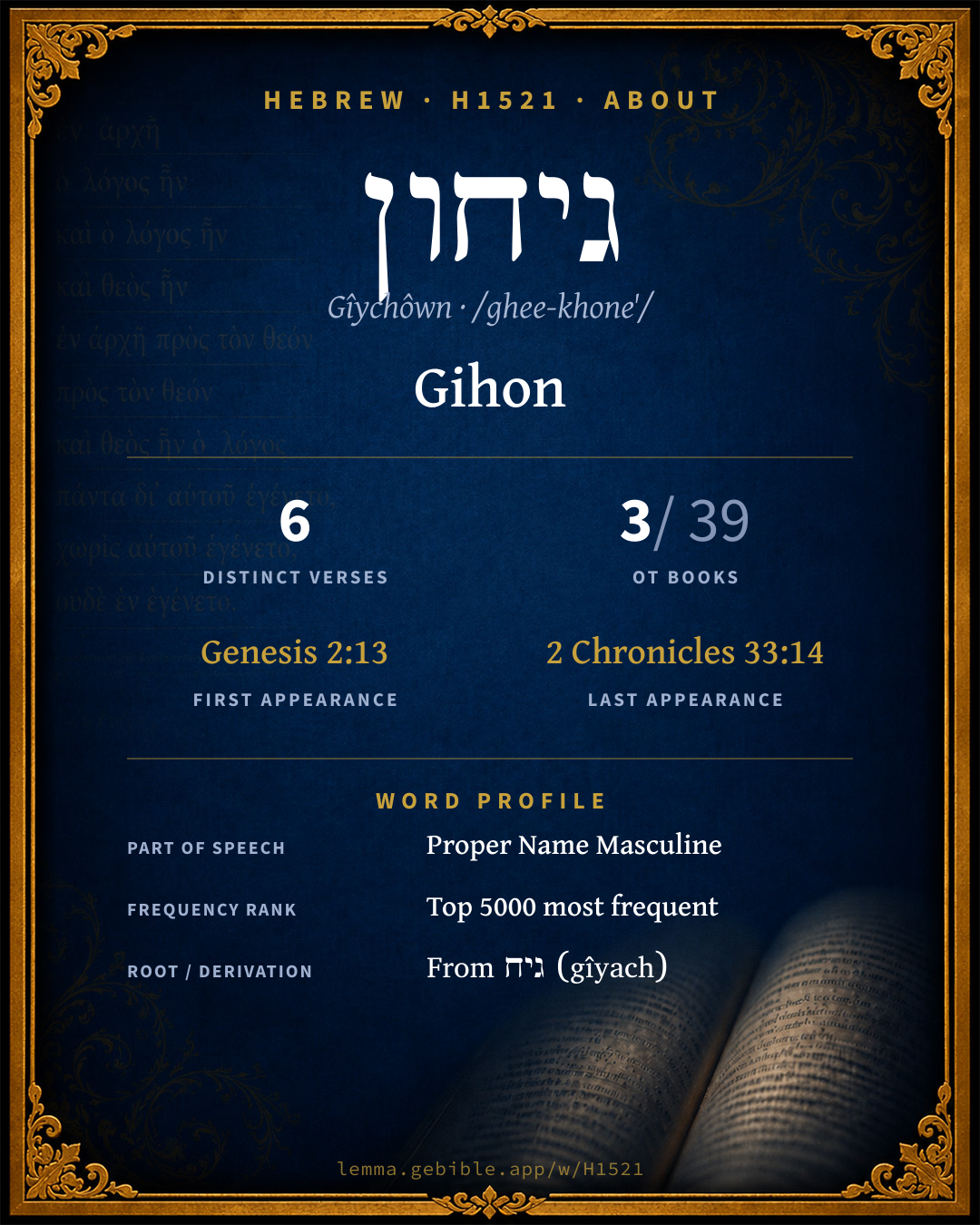
גִּיחוֹן
Gihon
BDB lists 3 entries for ‘Gihon’ fuller range ↓
Full lexicon entry — Brown-Driver-Briggs (BDB)
From Brown-Driver-Briggs (BDB)
Where this word appears
Grammar key — what these labels mean
Part of speech
- Noun
- A naming word — a person, place, thing, or idea.
Noun type
- Proper
- A name of a specific person, place, or people (e.g. Abraham, Zion, Israel).
Every verse where H1521 appears in the Book of 2 Chronicles — 2 distinct verses. Click any verse to open its interlinear word-by-word view. Verse text shown in the World English Bible for context — . Each verse’s Hebrew form is shown with its reference; the English is not keyword-highlighted, since the data carries no word-level English alignment. Use “Compare translations” on any verse to read it across multiple English versions. This concordance covers the Hebrew Bible; Septuagint (Greek Old Testament) occurrences are not indexed here.
2 Chronicles
- 2 Chronicles 32:30 גִיחוֹן֙ n Proper This same Hezekiah also stopped the upper spring of the waters of Gihon, and brought them straight down on the west side of the city of David. Hezekiah prospered in all his works.
- 2 Chronicles 33:14 לְ/גִיח֨וֹן prep + n Proper Now after this he built an outer wall to the city of David, on the west side of Gihon, in the valley, even to the entrance at the fish gate; and he compassed Ophel about [with it], and raised it up to a very great height: and he put valiant captains in all the fortified cities of Judah.
About this entry
At a glance — auto-summarized from this page’s data, not written by a person. Every figure links to its source below. This summary describes the numbers; it doesn’t interpret them.
The Hebrew name גיחון centers on the idea of “Gihon.” 1 Kings dominates its distribution — 3 of 6 verses. Spanning 6 verses in 3 books, it ranks among the uncommon words of the Hebrew Bible. Scripture first uses it in Genesis 2:13. The sections below give every occurrence and version rendering.
Gloss history
Strong's 1890 vs modern scholarship
About this word
Strong's H1521 catalogs a Hebrew word from the Hebrew Old Testament.
These counts are not copied from any lexicon or concordance. They are computed here, from the morphology-tagged Hebrew Old Testament. What Lemma adds →
- 6
- distinct verses
- The word appears in 6 distinct verses.
- 3 / 39
- OT books
- The word appears in 3 of 39 Old Testament books.
- #3,040
- by frequency
- Top 5000 most frequent Hebrew words (rank 3,040 of 8,640 Hebrew words by occurrence).
View all 6 occurrences in the concordance →
Most concentrated in
- 1 Kings 3 verses 50%
- 2 Chronicles 2 verses 33%
- Genesis 1 verse 17%
By section of the Old Testament
By traditional corpus
Conventional, traditional groupings — biblical authorship is debated, so this is a traditional corpus grouping, not an authorship claim. Each share is this word’s portion of its verses in that division of the Hebrew canon. Each figure is a share of the word’s 6 distinct verses.
- Prophets (Nevi'im) 3 verses · 50%
- Writings (Ketuvim) 2 verses · 33%
- Torah (Pentateuch) 1 verse · 17%
How translations render this word
Counts come from each version’s own published word-to-Strong’s tagging or interlinear alignment — an approximate guide to how each version renders this word, not a word-level alignment the data otherwise carries. Because each total is that version’s own tagged count, the per-version totals vary from one another and need not match the appearance or distinct-verse counts above. These counts may also differ from a printed concordance because Lemma counts each distinctly tagged rendering and does not collapse phrase taggings into a single head-word total. This is a fixed set of word-tagged versions (KJV, ASV, BSB, ULT) and does not change with the reading translation you choose elsewhere. Each version’s license is shown beside its name below (and on Sources).
- King James Version: Gihon 5×
- American Standard Version: Gihon 4×
- Berean Standard Bible: Gihon 6×
- unfoldingWord Literal Text: Gihon 6×
King James Version Public Domain
Renders H1521 across 6 tagged occurrences — most commonly:
Plus 1 rendering that appears only once — usually multi-word phrases or single function words the recovered tagging swept in, not distinct renderings.
American Standard Version Public Domain
Renders H1521 across 6 tagged occurrences — most commonly:
Plus 2 renderings that appear only once — usually multi-word phrases or single function words the recovered tagging swept in, not distinct renderings.
Berean Standard Bible Public Domain
Renders H1521 across 6 tagged occurrences — most commonly:
unfoldingWord Literal Text CC BY-SA 4.0
Renders H1521 across 6 tagged occurrences — most commonly:
Senses in the full BDB
What do BDB’s symbols mean?
BDB uses these scholarly abbreviations:
| Symbol | Meaning |
|---|---|
| 𝔊 | the Septuagint (the ancient Greek translation, LXX) |
| 𝔙 | the Vulgate (the Latin translation) |
| 𝔖 | the Syriac version (the Peshitta) |
| 𝔗 | the Targum (the Aramaic translation) |
| ψ | the Psalms |
| √ | root (the underlying root or stem) |
| ‖ | parallel passage (a synonymous or contrasted parallel) |
| † | the dagger: every passage where the word occurs is cited |
The 4 senses and sub-senses the full Brown-Driver-Briggs lexicon distinguishes for this word, in lexicon order (not ranked by frequency), with BDB’s own verbatim wording and sub-sense lettering. Shown in Hebrew script with BDB’s own scholarly abbreviations. The condensed entry is in the Lexicon Entry tab. See also the Forms in the corpus table below.
- 1. one of the rivers of Eden Gn 2:13 (on theories of identity v. Comm.; also SmithDict. Bible Schaff-HerzogArt. Eden SpurrellText of Gen. ad loc. RiHWB). e.g. Genesis 2:13
- 2. spring of water near Jerusalem: גִּחוֹן 1 K 1:33, 38, 45, מֵימֵי גִוחוֹן הָעֶלְיוֹן 2 Ch 32:30, לְגִיחוֹן בַּנַּחַל 2 Ch 33:14;—there are two main theories as to locality: e.g. 1 Kings 1:33
- a. W. of Jerusalem, connected with Birket Mamilla, and aqueduct into city RobBR i. 239, 345 ff. SurveyJerusalem al.;
- b. E. of Jerusalem = Fountain of the Virgin, FurrerSchenkelBL ii. 463 BdPal. 101, or Siloah water-system GutheZPV, v., 1882, 359 ff.
Senses from the full Brown-Driver-Briggs lexicon (Brown, Driver, Briggs; Oxford 1906 — public domain), digitized via Sefaria, supplemented by the OpenScriptures HebrewLexicon (CC BY 4.0). Full attribution on Sources.
Word origin
n.pr.fl. (a bursting forth)—
— Brown-Driver-Briggs (Oxford 1906, public domain), digitized via Sefaria, supplemented by the OpenScriptures HebrewLexicon (CC BY 4.0). See Sources.
Derived from גיח (gîyach) (H1518) — to burst forth.
Jastrow Dictionary
A second Hebrew/Aramaic lexicon for comparison, covering Aramaic and post-biblical (Talmudic, Targumic, Midrashic) usage that the biblical-Hebrew BDB does not. Matched by lemma rather than by Strong’s number, so a lemma may carry more than one Jastrow headword (shown separately below), and the entries cover usage well beyond the Bible.
גִּיחוֹן
- (b. h.) the river Giḥon. Gen. R. s. 16 (play on גָּחוֹן).
A Dictionary of the Targumim, the Talmud Babli and Yerushalmi, and the Midrashic Literature (Marcus Jastrow; London, Luzac, 1903) — Public Domain. Digitized via Sefaria. Digitized via Sefaria. Full attribution on Sources.
Forms in the corpus
The 5 distinct written forms H1521 takes in the Hebrew Bible, most frequent first — each parse links to that state’s occurrences in the concordance. Hebrew forms include their vowel points and cantillation, so a single lemma takes many written forms.
| Form | Parsing | Example | Uses |
|---|---|---|---|
| גִּחֽוֹן | Noun, Proper | 1 Kings 1:33 | 2 |
| בְּ/גִח֗וֹן | Noun, Proper | 1 Kings 1:45 | 1 |
| גִיחוֹן֙ | Noun, Proper | 2 Chronicles 32:30 | 1 |
| גִּיח֑וֹן | Noun, Proper | Genesis 2:13 | 1 |
| לְ/גִיח֨וֹן | Noun, Proper | 2 Chronicles 33:14 | 1 |
Same root — word family
Other BDB entries built from the same root as H1521, grouped by Strong’s listed origin. These share a root / origin per the lexicon — not necessarily a shared meaning. Each links to that word’s own entry.
Derives from
Shares the same root
Proper names from this root
People and places named from this root — a name, not an additional meaning of the word.
Compare all same-root words → Showing 4 of 5 — not the complete family. 1 of the same-root words is a proper name (a person or place). They share a root, not necessarily a meaning.
Bible dictionary
Public-domain dictionary articles matched to this entry by name (Gihon). A biblical name can be shared by more than one person or place, so an article may treat several.
Easton's Bible Dictionary · M. G. Easton, 1897
A stream. (1.) One of the four rivers of Eden (Gen. 2:13). It has been identified with the Nile. Others regard it as the Oxus, or the Araxes, or the Ganges. But as, according to the sacred narrative, all these rivers of Eden took their origin from the head-waters of the Euphrates and the Trigris, it is probable that the Gihon is the ancient Araxes, which, under the modern name of the Arras, discharges itself into the Caspian Sea. It was the Asiatic and not the African "Cush" which the Gihon compassed (Gen. 10:7-10). (See EDEN.)
(2.) The only natural spring of water in or near Jerusalem is the "Fountain of the Virgin" (q.v.), which rises outside the city walls on the west bank of the Kidron valley. On the occasion of the approach of the Assyrian army under Sennacherib, Hezekiah, in order to prevent the besiegers from finding water, "stopped the upper water course of Gihon, and brought it straight down to the west side of the city of David" (2 Chr. 32:30; 33:14). This "fountain" or spring is therefore to be regarded as the "upper water course of Gihon." From this "fountain" a tunnel cut through the ridge which forms the south part of the temple hill conveys the water to the Pool of Siloam, which lies on the opposite side of this ridge at the head of the Tyropoeon ("cheesemakers'") valley, or valley of the son of Hinnom, now filled up by rubbish. The length of this tunnel is about 1,750 feet. In 1880 an inscription was accidentally discovered on the wall of the tunnel about nineteen feet from where it opens into the Pool of Siloam. This inscription was executed in all probability by Hezekiah's workmen. It briefly narrates the history of the excavation. It may, however, be possible that this tunnel was executed in the time of Solomon. If the "waters of Shiloah that go softly" (Isa. 8:6) refers to the gentle stream that still flows through the tunnel into the Pool of Siloam, then this excavation must have existed before the time of Hezekiah.
In the upper part of the Tyropoeoan valley there are two pools still existing, the first, called Birket el-Mamilla, to the west of the Jaffa gate; the second, to the south of the first, called Birket es-Sultan. It is the opinion of some that the former was the "upper" and the latter the "lower" Pool of Gihon (2 Kings 18:17; Isa. 7:3; 36:2; 22:9). (See CONDUIT; SILOAM.)
Smith's Bible Dictionary · William Smith, 1863
(a stream).
+ The second river of Paradise. (Genesis 2:13) [Eden] + A place near Jerusalem, memorable as the scene of the anointing and proclamation of Solomon as king. (1 Kings 1:33,38,45)
Hitchcock's Bible Names Dictionary · Roswell D. Hitchcock, 1869
valley of grace
Classic public-domain reference works; full attribution on Sources.
Septuagint verse parallels
This word appears in 6 verses that also exist in the Greek Old Testament (Septuagint), out of the 6 Hebrew verses it occurs in. You can read those verses in Greek by switching the Old Testament edition to the Septuagint.
Read these verses in the Septuagint
This is a verse-level parallel only — the same verses exist in both the Hebrew and Greek Old Testaments. No word-level Hebrew↔Greek correspondence is claimed: the data carries no such alignment, so no Greek word is shown as this Hebrew word’s translation. Coverage is not total — the Septuagint omits the deuterocanon and renumbers the Psalms, so some Hebrew verses have no direct Greek parallel.