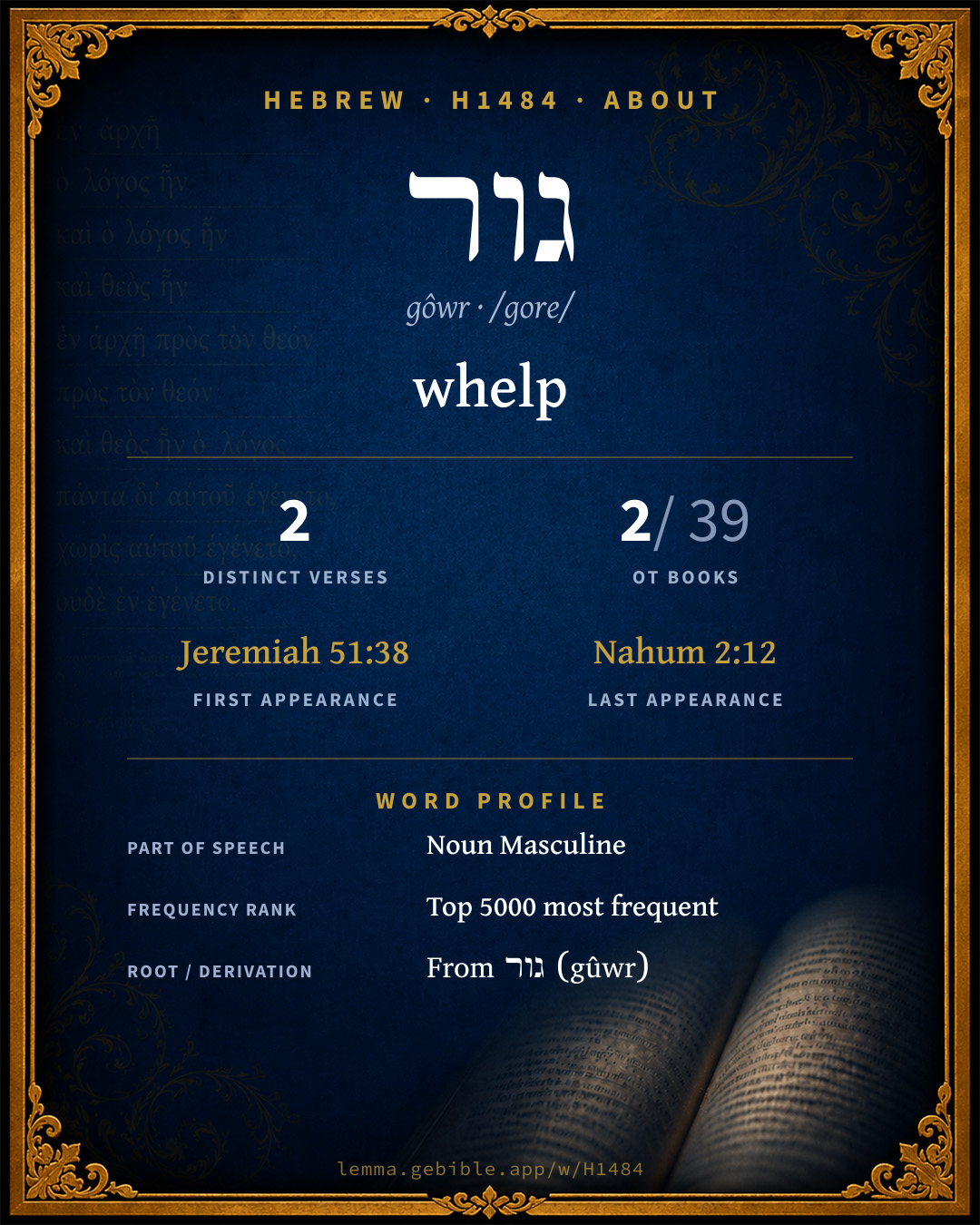
גּוֹר
whelp
Full lexicon entry — Brown-Driver-Briggs (BDB)
From Brown-Driver-Briggs (BDB)
Where this word appears
Grammar key — what these labels mean
Part of speech
- Noun
- A naming word — a person, place, thing, or idea.
Noun type
- Common
- A common noun — a general class of person, place, or thing (“king,” “city,” “water”), not a specific name.
State
- Construct
- A noun bound to a following noun in a possessive / “of” relationship (the construct chain).
Gender
- Masculine
- Grammatically masculine.
Number
- Plural
- More than one (in Hebrew, generally three or more).
Every verse where H1484 appears in the Book of Nahum — 1 distinct verse. Click any verse to open its interlinear word-by-word view. Verse text shown in the World English Bible for context — . Each verse’s Hebrew form is shown with its reference; the English is not keyword-highlighted, since the data carries no word-level English alignment. Use “Compare translations” on any verse to read it across multiple English versions. This concordance covers the Hebrew Bible; Septuagint (Greek Old Testament) occurrences are not indexed here.
Nahum
About this entry
At a glance — auto-summarized from this page’s data, not written by a person. Every figure links to its source below. This summary describes the numbers; it doesn’t interpret them.
“whelp” is the headline sense of the Hebrew noun גור (gôwr). The Hebrew Bible uses it only 2 verses. It clusters heavily in Jeremiah, which alone accounts for 50% of its uses. First canonically at Jeremiah 51:38, it enters the text early. From the same root come גור and גור. The sections below give every sense, occurrence, and version rendering.
Gloss history
Strong's 1890 vs modern scholarship
About this word
Strong's H1484 catalogs a Hebrew word from the Hebrew Old Testament.
These counts are not copied from any lexicon or concordance. They are computed here, from the morphology-tagged Hebrew Old Testament. What Lemma adds →
- 2
- distinct verses
- The word appears in 2 distinct verses.
- 2 / 39
- OT books
- The word appears in 2 of 39 Old Testament books.
- #4,807
- by frequency
- Top 5000 most frequent Hebrew words (rank 4,807 of 8,640 Hebrew words by occurrence).
View all 2 occurrences in the concordance →
By traditional corpus
Conventional, traditional groupings — biblical authorship is debated, so this is a traditional corpus grouping, not an authorship claim. Each share is this word’s portion of its verses in that division of the Hebrew canon. Each figure is a share of the word’s 2 distinct verses.
- Prophets (Nevi'im) 2 verses · 100%
How translations render this word
Counts come from each version’s own published word-to-Strong’s tagging or interlinear alignment — an approximate guide to how each version renders this word, not a word-level alignment the data otherwise carries. Because each total is that version’s own tagged count, the per-version totals vary from one another and need not match the appearance or distinct-verse counts above. These counts may also differ from a printed concordance because Lemma counts each distinctly tagged rendering and does not collapse phrase taggings into a single head-word total. This is a fixed set of word-tagged versions (KJV, ASV, BSB, ULT) and does not change with the reading translation you choose elsewhere. Each version’s license is shown beside its name below (and on Sources).
- King James Version: Whelps 2×
- American Standard Version: ' whelps 1×, Whelps 1×
- Berean Standard Bible: Cubs 2×
- unfoldingWord Literal Text: Cubs 1×
King James Version Public Domain
Renders H1484 across 2 tagged occurrences — most commonly:
American Standard Version Public Domain
Renders H1484 across 2 tagged occurrences — most commonly:
Berean Standard Bible Public Domain
Renders H1484 across 2 tagged occurrences — most commonly:
unfoldingWord Literal Text CC BY-SA 4.0
Renders H1484 across 1 tagged occurrence — most commonly:
Senses in BDB
The 1 sense BDB distinguishes for this word, in lexicon order (not ranked by frequency or importance). The full entry — with sub-senses — is in the Lexicon Entry tab.
- whelp
Word origin
[ גּוֹר ] n.[m.] whelp (as quarrelsome ? or onomatop.?) of lion
— Brown-Driver-Briggs (Oxford 1906, public domain), digitized via Sefaria, supplemented by the OpenScriptures HebrewLexicon (CC BY 4.0). See Sources.
Derived from גור (gûwr) (H1482) — cub.
Jastrow Dictionary
A second Hebrew/Aramaic lexicon for comparison, covering Aramaic and post-biblical (Talmudic, Targumic, Midrashic) usage that the biblical-Hebrew BDB does not. Matched by lemma rather than by Strong’s number, so a lemma may carry more than one Jastrow headword (shown separately below), and the entries cover usage well beyond the Bible.
גּוּר I
- (b. h.) [to move around (cmp. סחר),] to be a stranger, sojourn, dwell. Sot. 36ᵇ גֹרֹא שגָֹּרֹ וכ׳ he is named Gera (Gen. XLVI, 21), because he (Joseph) dwells in exile; Gen. R. s. 94. Yeb. 96ᵇ is it possible לָגּוּר וכ׳ בשני to dwell (simultaneously) in two worlds? Sabb. 104ᵃ, v. ג"ר. Sifré Deut. 301 (ref. to Deut. XXVI, 5) מלמד … להשתקע אלא לָגוּר שם it proves that he (Jacob) did not go down to be permanently settled, but only to sojourn there; a. fr.—Denom. גֵּר. e.g. Genesis 46:21
- (denom. of גֵּר) to make a proselyte, to initiate into the Jewish faith. Gen. R. s. 39 (ref. to Gen. XII, 5 ‘the souls which they had made’) אלו הגרים שגִּיְּירוּ that means the proselytes they had made. Ib. כל מי שמקרב … ומְגַיְּירוֹ וכ׳ whoever befriends a gentile and effects his conversion, is considered as though he had created him. Sabb. 31ᵃ גַּיְּירֵנִי וכ׳ make me a Jew with the condition &c.; a. fr. [For גִּיֵּיר to dress with lime, v. גִּיר.] e.g. Genesis 12:5
- , Nithpa. נִתְגַּיֵּיר to become a proselyte. Ber. 57ᵇ עתידים להִתְגַּיֵּיר they will adopt the Jewish faith. Yeb. 47ᵇ גר שבא להתג׳ if a stranger comes (appears before Jewish authorities) desirous to become a Jew. Ab. Zar. 3ᵇ מִתְגַּיְּירִין shall ask to be admitted &c.; a. fr.
גּוּר
- Taan. 25ᵃ גָרֵי (גָּרוּ) בך גירי Ar., ed. Ven. a. oth. (v. Rabb. D. S. a. l. note 1, ed. גָּיְרֵי) proselytes shall dwell with thee (in heaven); (for oth. vers. v. גִּיר III).
- to convert. Targ. Y. Gen. XII, 5, v. preced. Targ. Y. Ex. XVIII, 7; 27; a. e.—Sabb. 31ᵃ גַּיְּירֵיה he accepted him for initiation. Yeb. 76ᵃ גּיּיוּרֵי גַּיְּירָהּ he made her an Israelite. Gen. R. s. 76, end לאו גַּיַּירְתֵּיה would she not have converted him?; a. e.
- 1. to reside as a stranger. Targ. Lev. XVI, 29; a. fr.
- 2. to become a Jew, to embrace the Israelitish faith, to be converted. Targ. Y. Ex. XVIII, 6. Targ. Ps. LXVIII, 19; 32; a. e.
גּוּר II
- (euphem., cmp. גּוּף ch.) to have illegitimate intercourse;(also as act. v.) to seduce. Targ. Job XXXVI, 20 תגור Ms. (ed. תְגַיֵּר). Targ. Y. Lev. XX, 10 (O. גוף); a. e.—Part. גָּיֵר, גָּיְרָא. Lev. R. s. 3; Koh. R. to IV, 6 ג׳ בחזורין Ar. (ed. גָּיְפָא), v. גּוּף ch.—Ab. Zar. 10ᵇ הוה ליה ההיא ברתא דשמה גירא וכ׳ he (the emperor) had a daughter whose name was Gira (Ar. גילא), and who did wrong (was seduced); he sent to him (Rabbi) גרגירא (Ar. גרגילא) a gargira (rocket, play on גירא).
- to seduce. Targ. Job XXVI, 20, v. supra. Targ. Prov. VI, 32 דגַיֵּיר איתתא Ar. (ed. דגָיֵיר בא׳).
גּוּר III
- כרוך אחריו Ḥull. 78ᵇ) young animal, whelp, cub. Yalk. Job 926 עלה ג׳ אחד וכ׳ a young (R’êm) appeared in Palestine; Gen. R. s. 31 גורא א׳ (corr. acc.).—Pl. גּוּרִים. Ib. גּוּרָיו וכ׳ his (the R’êm’s) whelps went into the ark. Gen. R. s. 98 גבורה של … של גוריו the strength of the lion and the daring of his whelps.—גּוּר אַרְיֵה pr. n. m., v. גּוּרְיָא II.
גּוּר ²
- Lev. R. s. 19 (prov.) ג׳ טב מכלב ביש וכ׳ raise not a gentle cub of a vicious dog, much less a vicious cub &c.—[Pl. גּוּרֵי. Y. B. Bath. II, 13ᵇ bot. מן קל ג׳, prob. גִּירֵי, v. גִּיר III.]
A Dictionary of the Targumim, the Talmud Babli and Yerushalmi, and the Midrashic Literature (Marcus Jastrow; London, Luzac, 1903) — Public Domain. Digitized via Sefaria. Digitized via Sefaria. Full attribution on Sources.
Forms in the corpus
The 2 distinct written forms H1484 takes in the Hebrew Bible, most frequent first — each parse links to that state’s occurrences in the concordance. Hebrew forms include their vowel points and cantillation, so a single lemma takes many written forms.
| Form | Parsing | Example | Uses |
|---|---|---|---|
| גֹֽרוֹתָ֔י/ו | Noun, Common, Masculine, Plural, Construct | Nahum 2:12 | 1 |
| כְּ/גוֹרֵ֥י | Noun, Common, Masculine, Plural, Construct | Jeremiah 51:38 | 1 |
Same root — word family
Other BDB entries built from the same root as H1484, grouped by Strong’s listed origin. These share a root / origin per the lexicon — not necessarily a shared meaning. Each links to that word’s own entry.
Derives from
Proper names from this root
People and places named from this root — a name, not an additional meaning of the word.
Compare all same-root words → 1 of the same-root words is a proper name (a person or place). They share a root, not necessarily a meaning.
Septuagint verse parallels
This word appears in 1 verse that also exists in the Greek Old Testament (Septuagint), out of the 2 Hebrew verses it occurs in. You can read those verses in Greek by switching the Old Testament edition to the Septuagint.
Read these verses in the Septuagint
This is a verse-level parallel only — the same verses exist in both the Hebrew and Greek Old Testaments. No word-level Hebrew↔Greek correspondence is claimed: the data carries no such alignment, so no Greek word is shown as this Hebrew word’s translation. Coverage is not total — the Septuagint omits the deuterocanon and renumbers the Psalms, so some Hebrew verses have no direct Greek parallel.