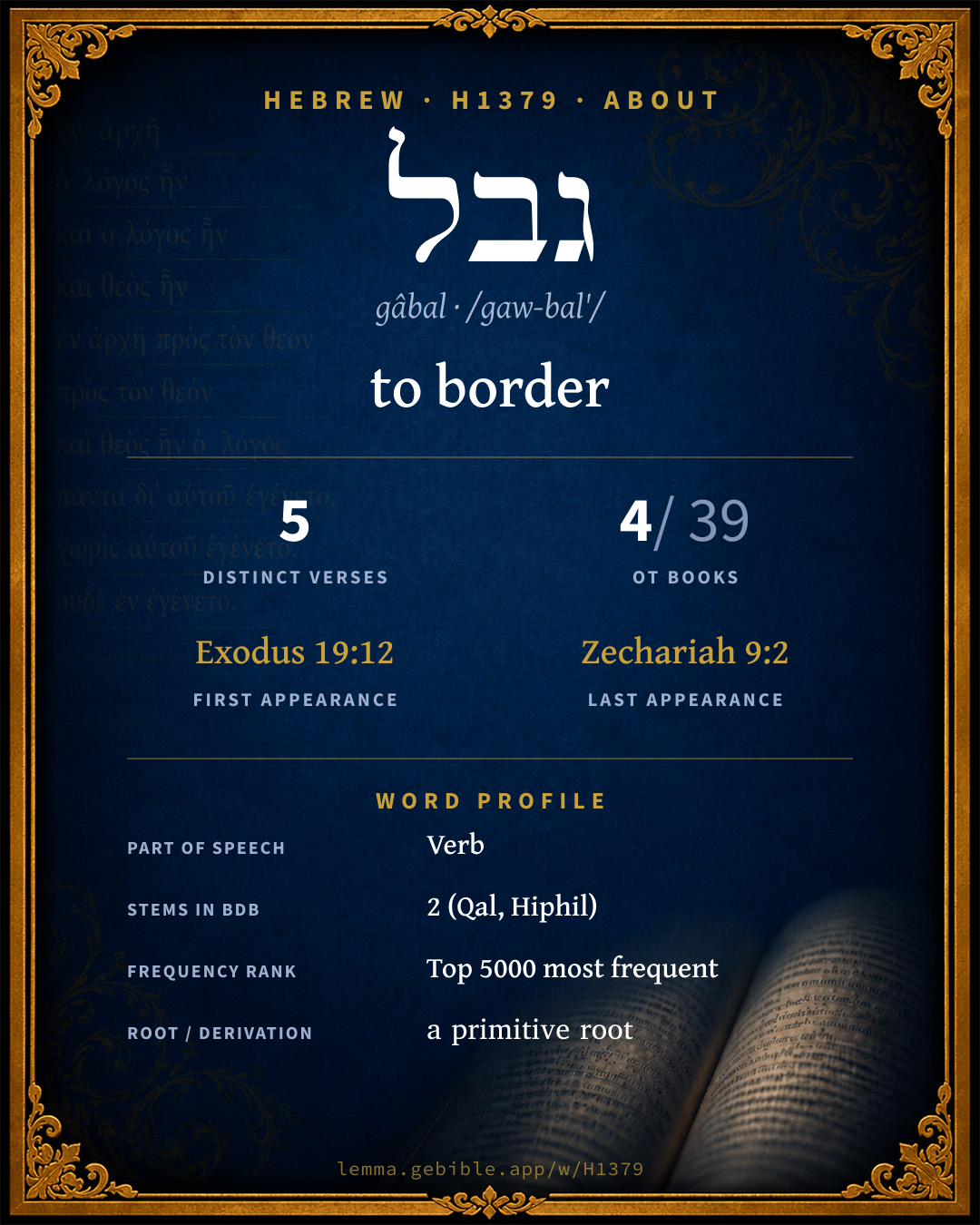
גָּבַל
to border
‘to border’ is one of 3 main senses fuller range ↓
Full lexicon entry — Brown-Driver-Briggs (BDB)
From Brown-Driver-Briggs (BDB)
Where this word appears
Grammar key — what these labels mean
Part of speech
- Verb
- An action or state-of-being word.
Stem
- Hiphil
- The causative active stem (“he caused / brought about”). Here: ‘set bounds for’
- Qal
- The basic, simple active stem — the plain form of the verb (“he wrote”). Here: ‘bound’
Form
- Sequential Perfect
- A perfect with prefixed waw continuing a preceding imperfect or command (waw-consecutive perfect).
- Imperative
- A direct command (“write!”).
- Imperfect
- An incomplete, ongoing, or future action (“he will / would write”).
- Perfect
- A completed action or state — Hebrew marks aspect (completeness) more than strict tense (“he wrote”).
Person
- 2nd Person
- The one addressed (“you”).
- 3rd Person
- The one spoken about (“he / she / it / they”).
Gender
- Masculine
- Grammatically masculine.
- Feminine
- Grammatically feminine.
- Common
- Either gender — not distinguished for this form.
Number
- Singular
- One.
- Plural
- More than one (in Hebrew, generally three or more).
Every verse where H1379 appears in the Book of Exodus — 2 distinct verses. Click any verse to open its interlinear word-by-word view. Verse text shown in the World English Bible for context — . Each verse’s Hebrew form is shown with its reference; the English is not keyword-highlighted, since the data carries no word-level English alignment. Use “Compare translations” on any verse to read it across multiple English versions. This concordance covers the Hebrew Bible; Septuagint (Greek Old Testament) occurrences are not indexed here.
Exodus
- Exodus 19:12 וְ/הִגְבַּלְתָּ֤ conj + Hiphil wpf 2ms You shall set bounds to the people round about, saying, 'Be careful that you don't go up onto the mountain, or touch its border. Whoever touches the mountain shall be surely put to death.
- Exodus 19:23 הַגְבֵּ֥ל Hiphil impv 2ms Moses said to Yahweh, "The people can't come up to Mount Sinai, for you charged us, saying, 'Set bounds around the mountain, and sanctify it.'"
About this entry
At a glance — auto-summarized from this page’s data, not written by a person. Every figure links to its source below. This summary describes the numbers; it doesn’t interpret them.
גבל (gâbal) is a Hebrew verb most often rendered “to border.” With only 5 verses it sits in the long tail of Hebrew Bible vocabulary. It concentrates in Exodus, which alone accounts for 40% of its uses. Debuting at Exodus 19:12, it then recurs through the corpus. The verb spans 2 stems, from Qal to Hiphil. For the data behind this summary, explore the sense tree and the renderings breakdown below.
Gloss history
Strong's 1890 vs modern scholarship
About this word
Strong's H1379 catalogs a Hebrew word from the Hebrew Old Testament.
These counts are not copied from any lexicon or concordance. They are computed here, from the morphology-tagged Hebrew Old Testament. What Lemma adds →
- 5
- distinct verses
- The word appears in 5 distinct verses.
- 4 / 39
- OT books
- The word appears in 4 of 39 Old Testament books.
- #3,337
- by frequency
- Top 5000 most frequent Hebrew words (rank 3,337 of 8,640 Hebrew words by occurrence).
View all 5 occurrences in the concordance →
Most concentrated in
- Exodus 2 verses 40%
- Deuteronomy 1 verse 20%
- Joshua 1 verse 20%
By section of the Old Testament
By traditional corpus
Conventional, traditional groupings — biblical authorship is debated, so this is a traditional corpus grouping, not an authorship claim. Each share is this word’s portion of its verses in that division of the Hebrew canon. Each figure is a share of the word’s 5 distinct verses.
- Torah (Pentateuch) 3 verses · 60%
- Prophets (Nevi'im) 2 verses · 40%
How translations render this word
Counts come from each version’s own published word-to-Strong’s tagging or interlinear alignment — an approximate guide to how each version renders this word, not a word-level alignment the data otherwise carries. Because each total is that version’s own tagged count, the per-version totals vary from one another and need not match the appearance or distinct-verse counts above. These counts may also differ from a printed concordance because Lemma counts each distinctly tagged rendering and does not collapse phrase taggings into a single head-word total. This is a fixed set of word-tagged versions (KJV, ASV, BSB, ULT) and does not change with the reading translation you choose elsewhere. Each version’s license is shown beside its name below (and on Sources).
- King James Version: Have set 1×, Set bounds 1×, Shall border 1×
- American Standard Version: Also 1×, Have set 1×, Saying set bounds 1×
- Berean Standard Bible: Border 1×, Borders 1×, Put a boundary around 1×
- unfoldingWord Literal Text: Borders 2×
King James Version Public Domain
Renders H1379 across 5 tagged occurrences — most commonly:
American Standard Version Public Domain
Renders H1379 across 5 tagged occurrences — most commonly:
Berean Standard Bible Public Domain
Renders H1379 across 5 tagged occurrences — most commonly:
unfoldingWord Literal Text CC BY-SA 4.0
Renders H1379 across 6 tagged occurrences — most commonly:
Plus 4 renderings that appear only once — usually multi-word phrases or single function words the recovered tagging swept in, not distinct renderings.
Senses in the full BDB
Hebrew verbs can shift meaning by stem (binyan): Qal is the basic action, Niphal is often passive or reflexive, Piel often intensifies or makes it factitive, and Hiphil is typically causative. The senses below are grouped under the stem BDB assigns to each.
What do BDB’s symbols mean?
BDB uses these scholarly abbreviations:
| Symbol | Meaning |
|---|---|
| 𝔊 | the Septuagint (the ancient Greek translation, LXX) |
| 𝔙 | the Vulgate (the Latin translation) |
| 𝔖 | the Syriac version (the Peshitta) |
| 𝔗 | the Targum (the Aramaic translation) |
| ψ | the Psalms |
| √ | root (the underlying root or stem) |
| ‖ | parallel passage (a synonymous or contrasted parallel) |
| † | the dagger: every passage where the word occurs is cited |
The 2 senses and sub-senses the full Brown-Driver-Briggs lexicon distinguishes for this word, in lexicon order (not ranked by frequency), with BDB’s own verbatim wording and sub-sense lettering. Shown in Hebrew script with BDB’s own scholarly abbreviations. The condensed entry is in the Lexicon Entry tab. See also the Forms in the corpus table below.
Qal
- bound, border
Hiphil
- set bounds for
Senses from the full Brown-Driver-Briggs lexicon (Brown, Driver, Briggs; Oxford 1906 — public domain), digitized via Sefaria, supplemented by the OpenScriptures HebrewLexicon (CC BY 4.0). Full attribution on Sources.
Word origin
גָּבַל vb. denom. bound, border
— Brown-Driver-Briggs (Oxford 1906, public domain), digitized via Sefaria, supplemented by the OpenScriptures HebrewLexicon (CC BY 4.0). See Sources.
Origin: a primitive root
Jastrow Dictionary
A second Hebrew/Aramaic lexicon for comparison, covering Aramaic and post-biblical (Talmudic, Targumic, Midrashic) usage that the biblical-Hebrew BDB does not. Matched by lemma rather than by Strong’s number, so a lemma may carry more than one Jastrow headword (shown separately below), and the entries cover usage well beyond the Bible.
גָּבַל
- r.; v. גבב) [to give a rounded shape,] to to knead, stamp. Sabb. XXIV, 3 you may put water into the bran (on the Sabbath) אבל לא גוֹבְלִין but must not mix it to a mass. Tosef. Maasr. III, 13 גובל עיסתו he kneads his dough. Lev. R. s. 29 בד׳ גְּבָלוֹ (Pesik. Baḥod. p. 150ᵇ גִּיבְּלוֹ) on the fourth day He formed the dust into a mass.
- same. Y. Ter. V, 43ᶜ bot. הפריש ואח׳'כ גי׳ he set apart (the T’rumah) and then made the dough. Ib. מיגבול חמש (read מְגַבֵּל). Taan. 10ᵃ שמְגַ׳ את הגבינה that forms a cheese. Ib. 19ᵇ שמג׳ את הטיט that stamps clay; a. fr.—Part. pass. מְגוּבָּל. Ib. מ׳ יפה a thoroughly kneaded mass.
- to be kneaded. Ib. אינו מִתְגַּבֵּל יפה is not thoroughly kneaded.
גְּבַל
- 1. same. Y. Sabb. VII, 10ᵇ bot. ההן דִּגְבַל כ׳ (or דְּגַבַּל) he who kneads lime dust. Gitt. 69ᵃ ונִיגְבּוֹל בדובשא let him knead it with honey. Ib. וניגדול … וניגבול בהדין קיטמא Ar. (Var. v. גַּרְבֵּל; ed. וניגדבל) let him twist … and mix (the wick) thoroughly with ashes. Gen. R. s. 34, end גַּבְלִין ליה וכ׳, v. אֲדַמְדְּמָנֵי.
- 2. (of parasite worms) to grow. Ḥull. 67ᵇ מיניה קא גַבְלֵי they grow out of it (originate in the body). Ib. bot. כי קא גַבְלָן וכ׳ when they grew, they grew as permitted food.
- as Pe. 1).—Y. Maas. Sh. V, 56ᵈ top ומְגַבְּלָא אדמיה וכ׳ and to mix its blood with flax-seed. B. Mets. 69ᵃ (prov.) גַּבֵּיל לתורא גביל לתורי mix (fodder) for an ox, mix for oxen, i.e. it is the same trouble. Ber. 40ᵃ גביל לתורי (if he interrupted himself by saying,) ‘Mix fodder for the oxen’. Sabb. 156ᵃ
- to be kneaded. Lev. R. s. 6 אִיגַּבְּלוּן בלישה the coins were kneaded with the dough.
גְּבָל
- pr. n., v. גַּבְלָא
גַּבָּל
- (גבל) kneader, baker. Pes. 34ᵃ ג׳ של בית וכ׳ was the baker for the house of Rabbi. Ib. 46ᵃ לג׳ ולתפלה וכ׳ in order to get a kneader (that observes levitical purity), for prayer (in a synagogue) and for washing hands (for a meal) one is bound to walk four mils (no more). Keth. 72ᵃ פלוני ג׳ תקן וכ׳ a certain kneader prepared for me the dough according to the law of Ḥallah.
גַּבְלָא
- (cmp. b. h. גְּבָל) [Highland,] Gabla, Gabalena, a district (and town) South or South West of Jerusalem, occupied by Edomites (v. Graetz Monatsschrift 1875, p. 61 sq.; 1880, p. 481 sq.). Targ. Y. Gen. XXXVI, 20; I Chr. I, 38 (h. text שֵׂעִיר). Targ. Y. I Deut. XXXIII, 2.—Ab. Zar. 59ᵃ; Keth. 112ᵃ איקלע לג׳ came to Gabla. Cmp. גַּבְלָן. e.g. 1 Chronicles 1:38
A Dictionary of the Targumim, the Talmud Babli and Yerushalmi, and the Midrashic Literature (Marcus Jastrow; London, Luzac, 1903) — Public Domain. Digitized via Sefaria. Digitized via Sefaria. Full attribution on Sources.
Forms in the corpus
The 5 distinct written forms H1379 takes in the Hebrew Bible, most frequent first — each parse links to that stem’s occurrences in the concordance. Hebrew forms include their vowel points and cantillation, so a single lemma takes many written forms.
| Form | Parsing | Example | Uses |
|---|---|---|---|
| גָּבְל֖וּ | Verb, Qal, Perfect, 3rd Person, Common, Plural | Deuteronomy 19:14 | 1 |
| הַגְבֵּ֥ל | Verb, Hiphil, Imperative, 2nd Person, Masculine, Singular | Exodus 19:23 | 1 |
| וְ/הִגְבַּלְתָּ֤ | Verb, Hiphil, Sequential Perfect, 2nd Person, Masculine, Singular | Exodus 19:12 | 1 |
| יִגְבֹּל | Verb, Qal, Imperfect, 3rd Person, Masculine, Singular | Joshua 18:20 | 1 |
| תִּגְבָּל | Verb, Qal, Imperfect, 3rd Person, Feminine, Singular | Zechariah 9:2 | 1 |
Same root — word family
Other BDB entries built from the same root as H1379, grouped by Strong’s listed origin. These share a root / origin per the lexicon — not necessarily a shared meaning. Each links to that word’s own entry.
Derived from this word
Proper names from this root
People and places named from this root — a name, not an additional meaning of the word.
Compare all same-root words → Showing 4 of 5 — not the complete family. 1 of the same-root words is a proper name (a person or place). They share a root, not necessarily a meaning.
Septuagint verse parallels
This word appears in 5 verses that also exist in the Greek Old Testament (Septuagint), out of the 5 Hebrew verses it occurs in. You can read those verses in Greek by switching the Old Testament edition to the Septuagint.
Read these verses in the Septuagint
This is a verse-level parallel only — the same verses exist in both the Hebrew and Greek Old Testaments. No word-level Hebrew↔Greek correspondence is claimed: the data carries no such alignment, so no Greek word is shown as this Hebrew word’s translation. Coverage is not total — the Septuagint omits the deuterocanon and renumbers the Psalms, so some Hebrew verses have no direct Greek parallel.