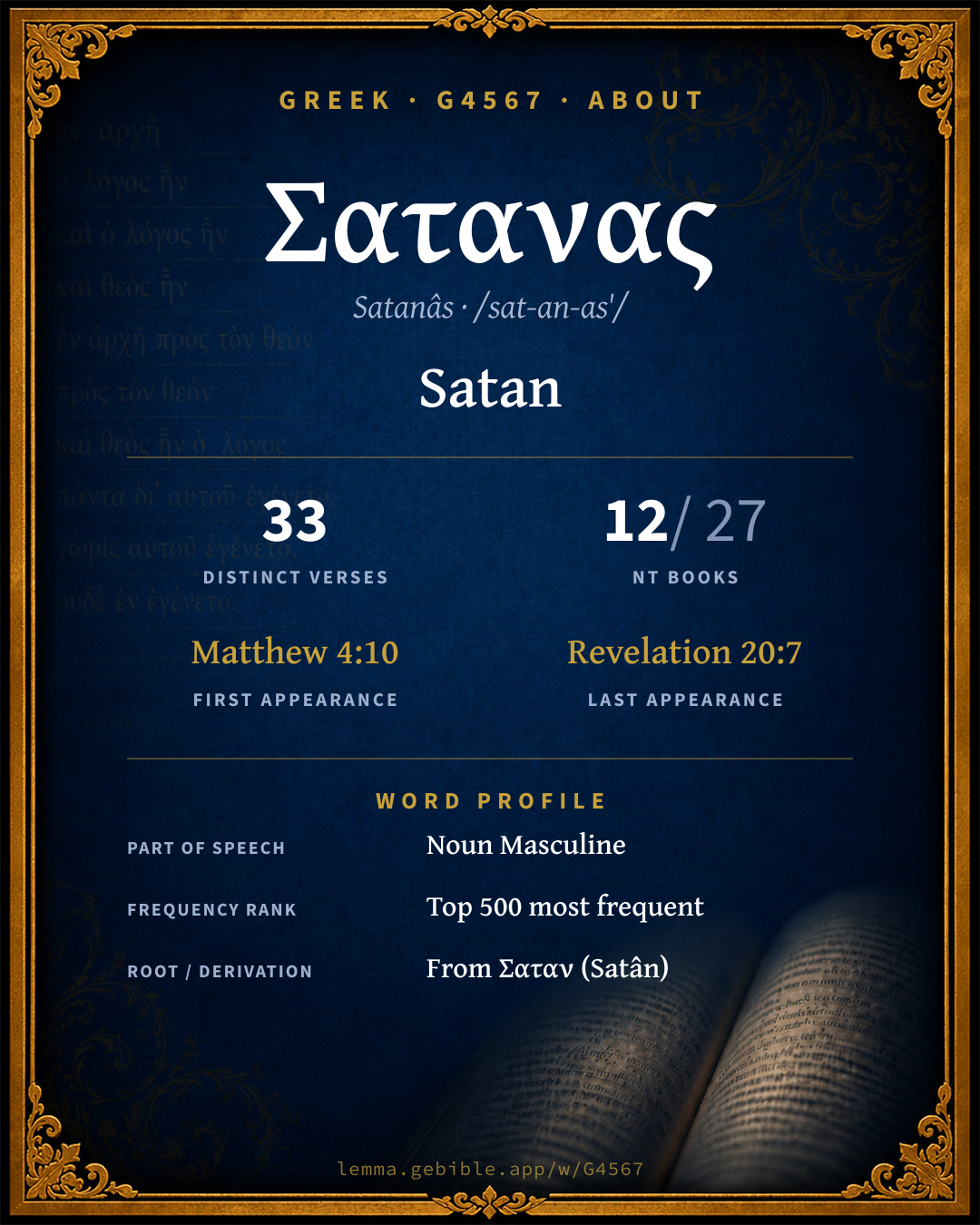
Σατανᾶς
Satan
Full lexicon entry — Thayer's Greek Lexicon
From Thayer's Greek Lexicon
Where this word appears
See every Nominative-case word in the Greek New Testament →
Grammar key — what these labels mean
Part of speech
- Noun
- A naming word — a person, place, thing, or idea.
Case
- Nominative
- The case of the subject (and the predicate nominative).
- Genitive
- The case of source, possession, or “of” — answers “whose / from what.”
- Accusative
- The case of the direct object and of extent.
- Vocative
- The case of direct address (“O Lord”).
- Dative
- The case of the indirect object, means, or location — “to / for / with / in.”
Gender
- Masculine
- Grammatically masculine.
Number
- Singular
- One.
3 verses where G4567 appears in the Nominative case in the Book of Mark. Filtered view — show all forms. Click any verse to open its interlinear word-by-word view. Verse text shown in the World English Bible for context — . Each verse’s Greek form is shown with its reference; the English is not keyword-highlighted, since the data carries no word-level English alignment. Use “Compare translations” on any verse to read it across multiple English versions. This concordance covers the Greek New Testament; Septuagint (Greek Old Testament) occurrences of this word are not indexed here.
Mark
- Mark 3:23 σατανᾶς σατανᾶν n nom sg masc n acc sg masc He summoned them, and said to them in parables, "How can Satan cast out Satan?
- Mark 3:26 σατανᾶς n nom sg masc If Satan has risen up against himself, and is divided, he can't stand, but has an end.
- Mark 4:15 σατανᾶς n nom sg masc These are the ones by the road, where the word is sown; and when they have heard, immediately Satan comes, and takes away the word which has been sown in them.
About this entry
At a glance — auto-summarized from this page’s data, not written by a person. Every figure links to its source below. This summary describes the numbers; it doesn’t interpret them.
Σατανας — transliterated Satanâs — is a Greek name carrying the sense “Satan.” Debuting at Matthew 4:10, it then recurs through the corpus. The Greek New Testament uses it across 33 verses — moderately common. See 33-verse concordance and the renderings breakdown below.
Gloss history
Strong's 1890 vs modern scholarship
About this word
Strong's G4567 catalogs a Greek word from the Greek New Testament.
These counts are not copied from any lexicon or concordance. They are computed here, from the morphology-tagged Greek New Testament. What Lemma adds →
- 33
- distinct verses
- The word appears in 33 distinct verses.
- 12 / 27
- NT books
- The word appears in 12 of 27 New Testament books.
- #406
- by frequency
- Top 500 most frequent Greek words (rank 406 of 5,347 Greek words by occurrence).
View all 33 occurrences in the concordance →
Most concentrated in
- Revelation 7 verses 21%
- Mark 5 verses 15%
- Luke 5 verses 15%
By section of the New Testament
By traditional corpus
Conventional, traditional groupings — biblical authorship is debated, so this is a traditional corpus grouping, not an authorship claim. Some books belong to more than one corpus (Luke is in both the Gospels and the Lukan corpus, and so on), so these shares overlap and need not total 100%. Each figure is a share of the word’s 33 distinct verses.
- Gospels 14 verses · 42%
- Pauline corpus 10 verses · 30%
- Johannine 8 verses · 24%
- Lukan (Luke–Acts) 7 verses · 21%
- Revelation 7 verses · 21%
How translations render this word
Counts come from each version’s own published word-to-Strong’s tagging or interlinear alignment — an approximate guide to how each version renders this word, not a word-level alignment the data otherwise carries. Because each total is that version’s own tagged count, the per-version totals vary from one another and need not match the appearance or distinct-verse counts above. These counts may also differ from a printed concordance because Lemma counts each distinctly tagged rendering and does not collapse phrase taggings into a single head-word total. This is a fixed set of word-tagged versions (KJV, ASV, BSB, ULT) and does not change with the reading translation you choose elsewhere. Each version’s license is shown beside its name below (and on Sources).
- King James Version: Satan 33×
- American Standard Version: Satan 34×
- Berean Standard Bible: Satan 36×
King James Version Public Domain
Renders G4567 across 35 tagged occurrences — most commonly:
Plus 2 renderings that appear only once — usually multi-word phrases or single function words the recovered tagging swept in, not distinct renderings. Not rendered by a distinct English word in 1 further occurrence.
American Standard Version Public Domain
Renders G4567 across 35 tagged occurrences — most commonly:
Plus 1 rendering that appears only once — usually multi-word phrases or single function words the recovered tagging swept in, not distinct renderings.
Berean Standard Bible Public Domain
Renders G4567 across 36 tagged occurrences — most commonly:
Senses in Thayer's
The 1 sense Thayer's distinguishes for this word, in lexicon order (not ranked by frequency or importance). The full entry — with sub-senses — is in the Lexicon Entry tab.
- adversary (one who opposes another in purpose or act), the name given to
Word origin
Derived from Σαταν (Satân) (G4566) — Satan.
Of Chaldee origin corresponding to G4566 (with the definite article affixed); the accuser that is the devil : - Satan.
— Strong’s Exhaustive Concordance (1890), public domain.
Forms in the corpus
The 6 distinct written forms G4567 takes in the Greek New Testament, most frequent first — each parse links to that case’s occurrences in the concordance.
| Form | Parsing | Example | Uses |
|---|---|---|---|
| σατανᾶς satanâs | Noun, Nominative, Singular, Masculine | Matthew 12:26 | 13 |
| σατανᾶ satanâ | Noun, Genitive, Singular, Masculine | Mark 1:13 | 12 |
| Σατανᾶς Satanâs | Noun, Nominative, Singular, Masculine | Revelation 2:13 | 4 |
| σατανᾶν satanân | Noun, Accusative, Singular, Masculine | Matthew 12:26 | 4 |
| σατανᾷ satanâ | Noun, Dative, Singular, Masculine | 1 Corinthians 5:5 | 2 |
| Σατανᾶ Satanâ | Noun, Genitive, Singular, Masculine | Revelation 2:13 | 1 |
Bible dictionary
Public-domain dictionary articles matched to this entry by name (Satan). A biblical name can be shared by more than one person or place, so an article may treat several.
Easton's Bible Dictionary · M. G. Easton, 1897
Adversary; accuser. When used as a proper name, the Hebrew word so rendered has the article "the adversary" (Job 1:6-12; 2:1-7). In the New Testament it is used as interchangeable with Diabolos, or the devil, and is so used more than thirty times.
He is also called "the dragon," "the old serpent" (Rev. 12:9; 20:2); "the prince of this world" (John 12:31; 14:30); "the prince of the power of the air" (Eph. 2:2); "the god of this world" (2 Cor. 4:4); "the spirit that now worketh in the children of disobedience" (Eph. 2:2). The distinct personality of Satan and his activity among men are thus obviously recognized. He tempted our Lord in the wilderness (Matt. 4:1-11). He is "Beelzebub, the prince of the devils" (12:24). He is "the constant enemy of God, of Christ, of the divine kingdom, of the followers of Christ, and of all truth; full of falsehood and all malice, and exciting and seducing to evil in every possible way." His power is very great in the world. He is a "roaring lion, seeking whom he may devour" (1 Pet. 5:8). Men are said to be "taken captive by him" (2 Tim. 2:26). Christians are warned against his "devices" (2 Cor. 2:11), and called on to "resist" him (James 4:7). Christ redeems his people from "him that had the power of death, that is, the devil" (Heb. 2:14). Satan has the "power of death," not as lord, but simply as executioner.
Smith's Bible Dictionary · William Smith, 1863
The word itself, the Hebrew satan, is simply an "adversary," and is so used in (1 Samuel 29:4; 2 Samuel 19:22; 1 Kings 6:4; 11:14,23,25; Numbers 22:22,33; Psalms 109:6) This original sense is still found in our Lord's application of the name to St. Peter in (Matthew 16:23) It is used as a proper name or title only four times in the Old Testament, vis. (with the article) in (Job 1:6; 12; 2:1; Zechariah 2:1) and without the article in (1 Chronicles 21:1) It is with the scriptural revelation on the subject that we are here concerned; and it is clear, from this simple enumeration of passages, that it is to be sought in the New rather than in the Old Testament. I. The personal existence of a spirit of evil is clearly revealed in Scripture; but the revelation is made gradually, in accordance with the progressiveness of God's method. In the first entrance of evil into the world, the temptation is referred only to the serpent. In the book of Job we find for the first time a distinct mention of "Satan" the "adversary" of Job. But it is important to remark the emphatic stress laid on his subordinate position, on the absence of all but delegated power, of all terror and all grandeur in his character. It is especially remarkable that no power of spiritual influence, but only a power over outward circumstances, is attributed to him. The captivity brought the Israelites face to face with the great dualism of the Persian mythology, the conflict of Ormuzd with Ahriman, the co-ordinate spirit of evil; but it is confessed by all that the Satan of Scripture bears no resemblance to the Persian Ahriman. His subordination and inferiority are as strongly marked as ever. The New Testament brings plainly forward the power and the influence of Satan, From the beginning of the Gospel, when he appears as the personal tempter of our Lord through all the Gospels, Epistles, and Apocalypse, it is asserted or implied, again and again, as a familiar and important truth. II. Of the nature and original state of Satan, little is revealed in Scripture. He is spoken of as a "spirit" in (Ephesians 2:2) as the prince or ruler of the "demons" in (Matthew 12:24-26) and as having "angels" subject to him in (Matthew 25:41; Revelation 12:7,9) The whole description of his power implies spiritual nature and spiritual influence. We conclude therefore that he was of angelic nature, a rational and spiritual creature, superhuman in power, wisdom and energy; and not only so, but an archangel, one of the "princes" of heaven. We cannot, of course, conceive that anything essentially and originally evil was created by God. We can only conjecture, therefore, that Satan is a fallen angel, who once had a time of probation, but whose condemnation is now irrevocably fixed. As to the time cause and manner of his fall Scripture tells us scarcely anything; but it describes to us distinctly the moral nature of the evil one. The ideal of goodness is made up of the three great moral attributes of God--love, truth, and purity or holiness; combined with that spirit which is the natural temper of the finite and dependent we find creature, the spirit of faith. We find, accordingly, opposites of qualities are dwelt upon as the characteristics of the devil. III. The power of Satan over the soul is represented as exercised either directly or by his instruments. His direct influence over the soul is simply that of a powerful and evil nature on those in whom lurks the germ of the same evil. Besides this direct influence, we learn from Scripture that Satan is the leader of a host of evil spirits or angels who share his evil work, and for whom the "everlasting fire is prepared." (Matthew 25:41) Of their origin and fall we know no more than of his. But one passage (Matthew 12:24-26)--identifies them distinctly with the "demons" (Authorized Version "devils") who had power to possess the souls of men. They are mostly spoken of in Scripture in reference to possession; but in (Ephesians 6:12) find them sharing the enmity to God and are ascribed in various lights. We find them sharing the enmity to God and man implied in the name and nature of Satan; but their power and action are little dwelt upon in comparison with his. But the evil one is not merely the "prince of the demons;" he is called also the "prince of this world" in (John 12:31; 14:30; 16:11) and even the. "god of this world" in (2 Corinthians 4:4) the two expressions being united in (Ephesians 6:12) This power he claimed for himself, as the delegated authority, in the temptation of our Lord, (Luke 4:6) and the temptation would have been unreal had he spoken altogether falsely. The indirect action of Satan is best discerned by an examination of the title by which he is designated in Scripture. He is called emphatically ho diabolos, "the devil." The derivation of the word in itself implies only the endeavor to break the bonds between others and "set them at variance;" but common usage adds to this general sense the special idea of "setting at variance by slander." In the application of the title to Satan, both the general and special senses should be kept in view. His general object is to break the bonds of communion between God and man, and the bonds of truth and love which bind men to each other. The slander of God to man is best seen in the words of (Genesis 3:4,5) They attribute selfishness and jealousy to the Giver of all good. The slander of man to God is illustrated by the book of Job. (Job 1:9-11; 2:4,5) IV. The method of satanic action upon the heart itself. It may be summed up in two words--temptation and possession. The subject of temptation is illustrated, not only by abstract statements, but also by the record of the temptations of Adam and of our Lord. It is expressly laid down, as in (James 1:2-4) that "temptation," properly so called, i.e. "trial," is essential to man, and is accordingly ordained for him and sent to him by God, as in (Genesis 22:1) It is this tentability of man, even in his original nature, which is represented in Scripture as giving scope to the evil action of Satan. But in the temptation of a fallen nature Satan has a greater power. Every sin committed makes a man the "servant of sin" for the future, (John 8:34; Romans 6:16) it therefore creates in the spirit of man a positive tendency to evil which sympathizes with, and aids, the temptation of the evil one. On the subject of possession, see Demoniacs.
Hitchcock's Bible Names Dictionary · Roswell D. Hitchcock, 1869
contrary; adversary; enemy; accuser
Classic public-domain reference works; full attribution on Sources.