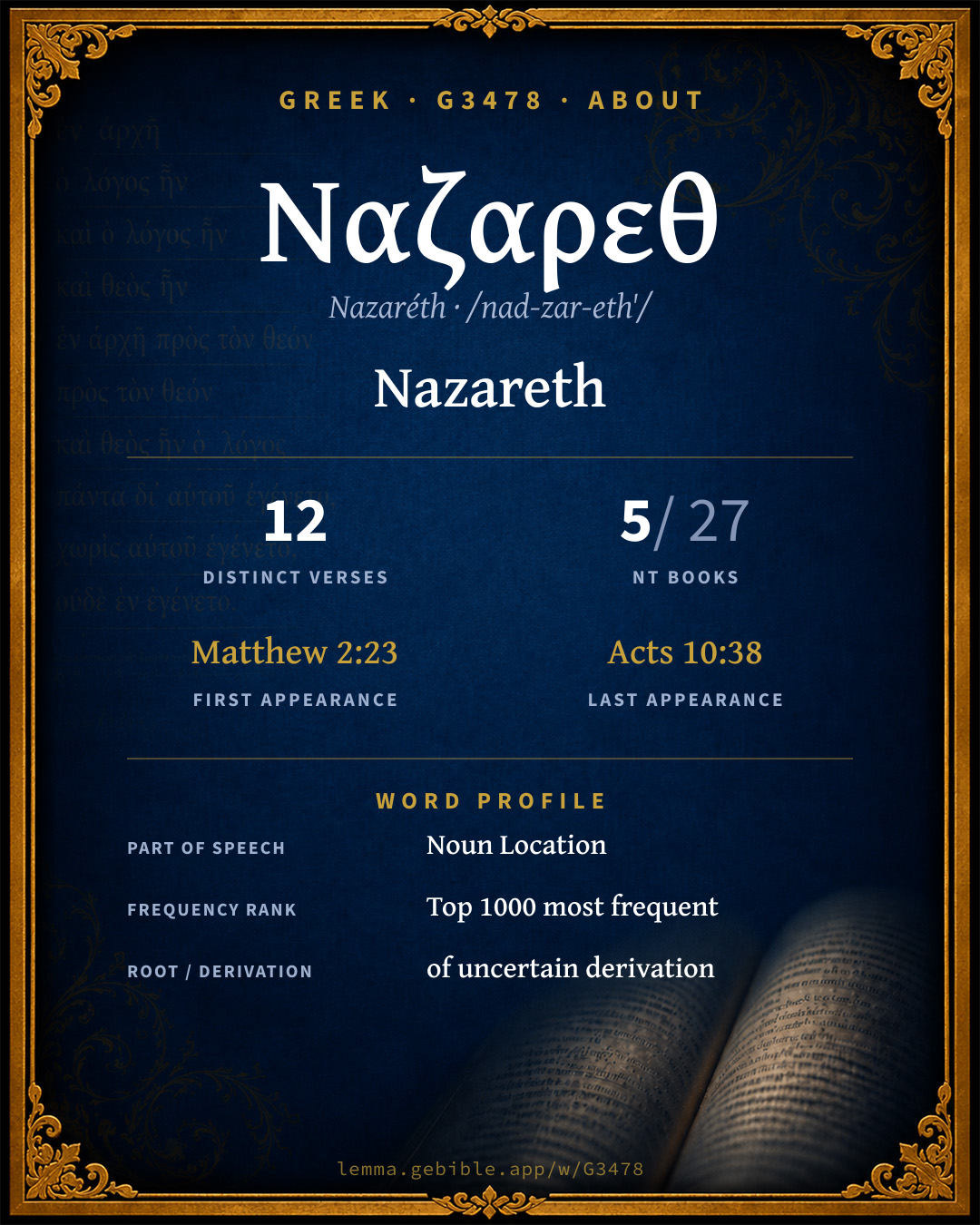
Ναζαρεθ
Nazareth
Thayer's lists 2 entries for ‘Nazareth’ fuller range ↓
Full lexicon entry — Thayer's Greek Lexicon
From Thayer's Greek Lexicon
Where this word appears
Every verse where G3478 appears in the Book of John — 2 distinct verses. Click any verse to open its interlinear word-by-word view. Verse text shown in the World English Bible for context — . Each verse’s Greek form is shown with its reference; the English is not keyword-highlighted, since the data carries no word-level English alignment. Use “Compare translations” on any verse to read it across multiple English versions. This concordance covers the Greek New Testament; Septuagint (Greek Old Testament) occurrences of this word are not indexed here.
John
About this entry
At a glance — auto-summarized from this page’s data, not written by a person. Every figure links to its source below. This summary describes the numbers; it doesn’t interpret them.
Ναζαρεθ — transliterated Nazaréth — is a Greek name carrying the sense “Nazareth.” Debuting at Matthew 2:23, it then recurs through the corpus. The Greek New Testament uses it across 12 verses — uncommon. More than a third of its appearances fall in Luke. See 12-verse concordance and the renderings breakdown below.
Gloss history
Strong's 1890 vs modern scholarship
About this word
Strong's G3478 catalogs a Greek word from the Greek New Testament.
These counts are not copied from any lexicon or concordance. They are computed here, from the morphology-tagged Greek New Testament. What Lemma adds →
- 12
- distinct verses
- The word appears in 12 distinct verses.
- 5 / 27
- NT books
- The word appears in 5 of 27 New Testament books.
- #904
- by frequency
- Top 1000 most frequent Greek words (rank 904 of 5,347 Greek words by occurrence).
View all 12 occurrences in the concordance →
By section of the New Testament
By traditional corpus
Conventional, traditional groupings — biblical authorship is debated, so this is a traditional corpus grouping, not an authorship claim. Some books belong to more than one corpus (Luke is in both the Gospels and the Lukan corpus, and so on), so these shares overlap and need not total 100%. Each figure is a share of the word’s 12 distinct verses.
- Gospels 11 verses · 92%
- Lukan (Luke–Acts) 6 verses · 50%
- Johannine 2 verses · 17%
How translations render this word
Counts come from each version’s own published word-to-Strong’s tagging or interlinear alignment — an approximate guide to how each version renders this word, not a word-level alignment the data otherwise carries. Because each total is that version’s own tagged count, the per-version totals vary from one another and need not match the appearance or distinct-verse counts above. These counts may also differ from a printed concordance because Lemma counts each distinctly tagged rendering and does not collapse phrase taggings into a single head-word total. This is a fixed set of word-tagged versions (KJV, ASV, BSB, ULT) and does not change with the reading translation you choose elsewhere. Each version’s license is shown beside its name below (and on Sources).
- King James Version: Nazareth 12×
- American Standard Version: Nazareth 12×
- Berean Standard Bible: Nazareth 12×
- unfoldingWord Literal Text: Nazareth 11×
King James Version Public Domain
Renders G3478 across 12 tagged occurrences — most commonly:
American Standard Version Public Domain
Renders G3478 across 12 tagged occurrences — most commonly:
Berean Standard Bible Public Domain
Renders G3478 across 12 tagged occurrences — most commonly:
unfoldingWord Literal Text CC BY-SA 4.0
Renders G3478 across 12 tagged occurrences — most commonly:
Plus 1 rendering that appears only once — usually multi-word phrases or single function words the recovered tagging swept in, not distinct renderings.
Senses in Thayer's
The 2 senses Thayer's distinguishes for this word, in lexicon order (not ranked by frequency or importance). The full entry — with sub-senses — is in the Lexicon Entry tab.
- Nazareth = "the guarded one"
- the ordinary residence and home town of Christ
Word origin
Origin: of uncertain derivation
Of uncertain derivation; Nazareth or Nazaret a place in Palestine : - Nazareth.
— Strong’s Exhaustive Concordance (1890), public domain.
Forms in the corpus
The 6 distinct written forms G3478 takes in the Greek New Testament, most frequent first — each parse links to that case’s occurrences in the concordance.
| Form | Parsing | Example | Uses |
|---|---|---|---|
| Ναζαρέθ Nazaréth | Noun, Proper, indeclinable | Matthew 2:23 | 4 |
| Ναζαρὲθ Nazarèth | Noun, Proper, indeclinable | Matthew 21:11 | 3 |
| Ναζαρὲτ Nazarèt | Noun, Proper, indeclinable | Mark 1:9 | 2 |
| Ναζαρά Nazará | Noun, Proper, indeclinable | Luke 4:16 | 1 |
| Ναζαρέτ Nazarét | Noun, Proper, indeclinable | John 1:46 | 1 |
| Ναζαρὰ Nazarà | Noun, Proper, indeclinable | Matthew 4:13 | 1 |
Same root — word family
Other Thayer's entries built from the same root as G3478, grouped by Strong’s listed origin. These share a root / origin per the lexicon — not necessarily a shared meaning. Each links to that word’s own entry.
Proper names from this root
People and places named from this root — a name, not an additional meaning of the word.
Compare all same-root words → 2 of the same-root words are proper names (people or places). They share a root, not necessarily a meaning.
Bible dictionary
Public-domain dictionary articles matched to this entry by name (Nazareth). A biblical name can be shared by more than one person or place, so an article may treat several.
Easton's Bible Dictionary · M. G. Easton, 1897
Separated, generally supposed to be the Greek form of the Hebrew netser, a "shoot" or "sprout." Some, however, think that the name of the city must be connected with the name of the hill behind it, from which one of the finest prospects in Palestine is obtained, and accordingly they derive it from the Hebrew notserah, i.e., one guarding or watching, thus designating the hill which overlooks and thus guards an extensive region.
This city is not mentioned in the Old Testament. It was the home of Joseph and Mary (Luke 2:39), and here the angel announced to the Virgin the birth of the Messiah (1:26-28). Here Jesus grew up from his infancy to manhood (4:16); and here he began his public ministry in the synagogue (Matt. 13:54), at which the people were so offended that they sought to cast him down from the precipice whereon their city was built (Luke 4:29). Twice they expelled him from their borders (4:16-29; Matt. 13:54-58); and he finally retired from the city, where he did not many mighty works because of their unbelief (Matt. 13:58), and took up his residence in Capernaum.
Nazareth is situated among the southern ridges of Lebanon, on the steep slope of a hill, about 14 miles from the Sea of Galilee and about 6 west from Mount Tabor. It is identified with the modern village en-Nazirah, of six or ten thousand inhabitants. It lies "as in a hollow cup" lower down upon the hill than the ancient city. The main road for traffic between Egypt and the interior of Asia passed by Nazareth near the foot of Tabor, and thence northward to Damascus.
It is supposed from the words of Nathanael in John 1:46 that the city of Nazareth was held in great disrepute, either because, it is said, the people of Galilee were a rude and less cultivated class, and were largely influenced by the Gentiles who mingled with them, or because of their lower type of moral and religious character. But there seems to be no sufficient reason for these suppositions. The Jews believed that, according to Micah 5:2, the birth of the Messiah would take place at Bethlehem, and nowhere else. Nathanael held the same opinion as his countrymen, and believed that the great "good" which they were all expecting could not come from Nazareth. This is probably what Nathanael meant. Moreover, there does not seem to be any evidence that the inhabitants of Galilee were in any respect inferior, or that a Galilean was held in contempt, in the time of our Lord. (See Dr. Merrill's Galilee in the Time of Christ.)
The population of this city (now about 10,000) in the time of Christ probably amounted to 15,000 or 20,000 souls.
"The so-called Holy House' is a cave under the Latin church, which appears to have been originally a tank. The brow of the hill', site of the attempted precipitation, is probably the northern cliff: the traditional site has been shown since the middle ages at some distance to the south. None of the traditional sites are traceable very early, and they have no authority. The name Nazareth perhaps means a watch tower' (now en-Nasrah), but is connected in the New Testament with Netzer, 'a branch' (Isa. 4:2; Jer. 23:5; Zech. 3:8; 6:12; Matt. 2:23), Nazarene being quite a different word from Nazarite."
Smith's Bible Dictionary · William Smith, 1863
(the guarded one) the ordinary residence of our Saviour, is not mentioned in the Old Testament, but occurs first in (Matthew 2:23) It derives its celebrity from its connection with the history of Christ, and in that respect has a hold on the imagination and feelings of men which it shares only with Jerusalem and Bethlehem. It is situated among the hills which constitute the south ridges of Lebanon, just before they sink down into the plain of Esdraelon, (Mr. Merrill, in "Galilee in the Time of Christ" (1881), represents Nazareth in Christ's time as a city (so always called in the New Testament) of 15,000 to 20,000 inhabitants, of some importance and considerable antiquity, and not so insignificant and mean as has been represented.--ED.) Of the identification of the ancient site there can be no doubt. The name of the present village is en-Nazirah the same, therefore, as of old it is formed on a hill or mountain, (Luke 4:29) it is within the limits of the province of Galilee, (Mark 1:9) it is near Cana, according to the implication in (John 2:1,2,11) a precipice exists in the neighborhood. (Luke 4:29) The modern Nazareth belongs to the better class of eastern villages. It has a population of 3000 or 4000; a few are Mohammadans, the rest Latin and Greek Christians. (Near this town Napoleon once encamped (1799), after the battle of Mount Tabor.) The origin of the disrepute in which Nazareth stood, (John 1:47) is not certainly known. All the inhabitants of Galilee were looked upon with contempt by the people of Judea because they spoke a ruder dialect, were less cultivated and were more exposed by their position to contact with the heathen. But Nazareth labored under a special opprobrium, for it was a Galilean and not a southern Jew who asked the reproachful question whether "any good thing" could come from that source. Above the town are several rocky ledges, over which a person could not be thrown without almost certain destruction. There is one very remarkable precipice, almost perpendicular and forty or fifty near the Maronite church, which may well be supposed to be the identical one over which his infuriated fellow townsmen attempted to hurl Jesus.
Hitchcock's Bible Names Dictionary · Roswell D. Hitchcock, 1869
separated; crowned; sanctified
Classic public-domain reference works; full attribution on Sources.