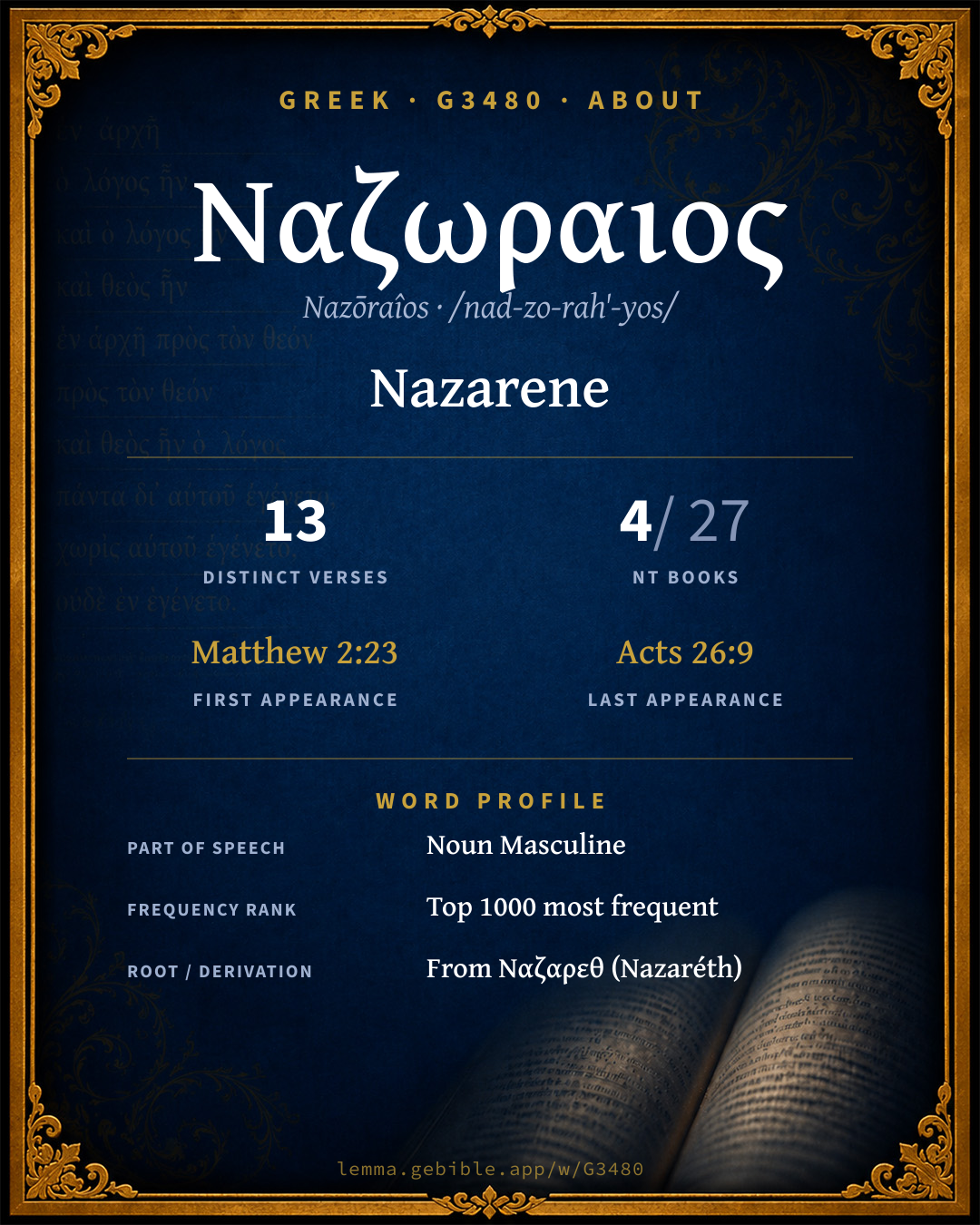
Ναζωραῖος
Nazarene
Thayer's lists 4 entries for ‘Nazarene’ fuller range ↓
Full lexicon entry — Thayer's Greek Lexicon
From Thayer's Greek Lexicon
Where this word appears
See every Genitive-case word in the Greek New Testament →
Grammar key — what these labels mean
Part of speech
- Noun
- A naming word — a person, place, thing, or idea.
Case
- Nominative
- The case of the subject (and the predicate nominative).
- Genitive
- The case of source, possession, or “of” — answers “whose / from what.”
- Accusative
- The case of the direct object and of extent.
Gender
- Masculine
- Grammatically masculine.
Number
- Singular
- One.
- Plural
- More than one.
Grammatical forms
- Noun, Nominative, Singular, Masculine 5 times (38%)
- Noun, Genitive, Singular, Masculine 4 times (31%)
- Noun, Accusative, Singular, Masculine 3 times (23%)
- Noun, Genitive, Plural, Masculine 1 time (8%)
Parsed forms decoded from the imported morphology (Robinson–Tischendorf, public domain), counted across 13 parsed occurrences — not distinct verses.
Every verse where G3480 appears — 13 distinct verses across 4 books. Click any verse to open its interlinear word-by-word view. Verse text shown in the World English Bible for context — . Each verse’s Greek form is shown with its reference; the English is not keyword-highlighted, since the data carries no word-level English alignment. Use “Compare translations” on any verse to read it across multiple English versions. This concordance covers the Greek New Testament; Septuagint (Greek Old Testament) occurrences of this word are not indexed here.
Matthew 2 verses
- Matthew 2:23 Ναζωραῖος n nom sg masc and came and lived in a city called Nazareth; that it might be fulfilled which was spoken through the prophets: "He will be called a Nazarene."
- Matthew 26:71 Ναζωραίου n gen sg masc When he had gone out onto the porch, someone else saw him, and said to those who were there, "This man also was with Jesus of Nazareth."
Luke 1 verse
John 3 verses
- John 18:5 Ναζωραῖον n acc sg masc They answered him, "Jesus of Nazareth." Jesus said to them, "I AM." Judas also, who betrayed him, was standing with them.
- John 18:7 Ναζωραῖον n acc sg masc Again therefore he asked them, "Who are you looking for?" They said, "Jesus of Nazareth."
- John 19:19 Ναζωραῖος n nom sg masc Pilate wrote a title also, and put it on the cross. There was written, "JESUS OF NAZARETH, THE KING OF THE JEWS."
Acts 7 verses
- Acts 2:22 Ναζωραῖον n acc sg masc "Men of Israel, hear these words! Jesus of Nazareth, a man approved by God to you by mighty works and wonders and signs which God did by him in the midst of you, even as you yourselves know,
- Acts 3:6 Ναζωραίου n gen sg masc But Peter said, "Silver and gold have I none, but what I have, that I give you. In the name of Jesus Christ of Nazareth, get up and walk!"
- Acts 4:10 Ναζωραίου n gen sg masc be it known to you all, and to all the people of Israel, that in the name of Jesus Christ of Nazareth, whom you crucified, whom God raised from the dead, in him does this man stand here before you whole.
- Acts 6:14 Ναζωραῖος n nom sg masc For we have heard him say that this Jesus of Nazareth will destroy this place, and will change the customs which Moses delivered to us."
- Acts 22:8 Ναζωραῖος n nom sg masc I answered, 'Who are you, Lord?' He said to me, 'I am Jesus of Nazareth, whom you persecute.'
- Acts 24:5 Ναζωραίων n gen pl masc For we have found this man to be a plague, an instigator of insurrections among all the Jews throughout the world, and a ringleader of the sect of the Nazarenes.
- Acts 26:9 Ναζωραίου n gen sg masc "I myself most assuredly thought that I ought to do many things contrary to the name of Jesus of Nazareth.
About this entry
At a glance — auto-summarized from this page’s data, not written by a person. Every figure links to its source below. This summary describes the numbers; it doesn’t interpret them.
At its core, Ναζωραιος (Nazōraîos) means “Nazarene.” Its uses cluster heavily in Acts (54% of all occurrences). Spanning 13 verses in 4 books, it ranks among the uncommon words of the Greek New Testament. Scripture first uses it in Matthew 2:23. Dig into 13-verse concordance and the renderings breakdown below.
Gloss history
Strong's 1890 vs modern scholarship

About this word
Strong's G3480 catalogs a Greek word from the Greek New Testament.
These counts are not copied from any lexicon or concordance. They are computed here, from the morphology-tagged Greek New Testament. What Lemma adds →
- 13
- distinct verses
- The word appears in 13 distinct verses.
- 4 / 27
- NT books
- The word appears in 4 of 27 New Testament books.
- #863
- by frequency
- Top 1000 most frequent Greek words (rank 863 of 5,347 Greek words by occurrence).
View all 13 occurrences in the concordance →
By section of the New Testament
By traditional corpus
Conventional, traditional groupings — biblical authorship is debated, so this is a traditional corpus grouping, not an authorship claim. Some books belong to more than one corpus (Luke is in both the Gospels and the Lukan corpus, and so on), so these shares overlap and need not total 100%. Each figure is a share of the word’s 13 distinct verses.
- Lukan (Luke–Acts) 8 verses · 62%
- Gospels 6 verses · 46%
- Johannine 3 verses · 23%
How translations render this word
Counts come from each version’s own published word-to-Strong’s tagging or interlinear alignment — an approximate guide to how each version renders this word, not a word-level alignment the data otherwise carries. Because each total is that version’s own tagged count, the per-version totals vary from one another and need not match the appearance or distinct-verse counts above. These counts may also differ from a printed concordance because Lemma counts each distinctly tagged rendering and does not collapse phrase taggings into a single head-word total. This is a fixed set of word-tagged versions (KJV, ASV, BSB, ULT) and does not change with the reading translation you choose elsewhere. Each version’s license is shown beside its name below (and on Sources).
- King James Version: Nazareth 13×
- American Standard Version: Nazareth 11×, Nazarene 3×
- Berean Standard Bible: Nazareth 11×
- unfoldingWord Literal Text: Nazarene 12×
King James Version Public Domain
Renders G3480 across 15 tagged occurrences — most commonly:
Plus 2 renderings that appear only once — usually multi-word phrases or single function words the recovered tagging swept in, not distinct renderings.
American Standard Version Public Domain
Renders G3480 across 15 tagged occurrences — most commonly:
Plus 1 rendering that appears only once — usually multi-word phrases or single function words the recovered tagging swept in, not distinct renderings.
Berean Standard Bible Public Domain
Renders G3480 across 13 tagged occurrences — most commonly:
Plus 2 renderings that appear only once — usually multi-word phrases or single function words the recovered tagging swept in, not distinct renderings.
unfoldingWord Literal Text CC BY-SA 4.0
Renders G3480 across 13 tagged occurrences — most commonly:
Plus 1 rendering that appears only once — usually multi-word phrases or single function words the recovered tagging swept in, not distinct renderings.
Senses in Thayer's
The 4 senses Thayer's distinguishes for this word, in lexicon order (not ranked by frequency or importance). The full entry — with sub-senses — is in the Lexicon Entry tab.
- Nazarite = "one separated"
- an inhabitant of Nazareth
- a title given to Jesus in the NT
- a name given to Christians by the Jews, Ac. 24:5
Word origin
Derived from Ναζαρεθ (Nazaréth) (G3478) — Nazareth.
From G3478 ; a Nazoraean that is inhabitant of Nazareth; by extension a Christian : - Nazarene of Nazareth.
— Strong’s Exhaustive Concordance (1890), public domain.
Forms in the corpus
The 4 distinct written forms G3480 takes in the Greek New Testament, most frequent first — each parse links to that case’s occurrences in the concordance.
| Form | Parsing | Example | Uses |
|---|---|---|---|
| Ναζωραῖος Nazōraîos | Noun, Nominative, Singular, Masculine | Matthew 2:23 | 5 |
| Ναζωραίου Nazōraíou | Noun, Genitive, Singular, Masculine | Matthew 26:71 | 4 |
| Ναζωραῖον Nazōraîon | Noun, Accusative, Singular, Masculine | John 18:5 | 3 |
| Ναζωραίων Nazōraíōn | Noun, Genitive, Plural, Masculine | Acts 24:5 | 1 |
Same root — word family
Other Thayer's entries built from the same root as G3480, grouped by Strong’s listed origin. These share a root / origin per the lexicon — not necessarily a shared meaning. Each links to that word’s own entry.
Derives from
Proper names from this root
People and places named from this root — a name, not an additional meaning of the word.
Compare all same-root words → 2 of the same-root words are proper names (people or places). They share a root, not necessarily a meaning.
Bible dictionary
Public-domain dictionary articles matched to this entry by name (Nazarene). A biblical name can be shared by more than one person or place, so an article may treat several.
Easton's Bible Dictionary · M. G. Easton, 1897
This epithet (Gr. Nazaraios) is applied to Christ only once (Matt. 2:23). In all other cases the word is rendered "of Nazareth" (Mark 1:24; 10:47; 14:67, etc.). When this Greek designation was at first applied to our Lord, it was meant simply to denote the place of his residence. In course of time the word became a term of reproach. Thus the word "Nazarene" carries with it an allusion to those prophecies which speak of Christ as "despised of men" (Isa. 53:3). Some, however, think that in this name there is an allusion to the Hebrew netser, which signifies a branch or sprout. It is so applied to the Messiah (Isa. 11:1), i.e., he whom the prophets called the Netse, the "Branch."
The followers of Christ were called "the sect of Nazarenes" (Acts 24:5). All over Palestine and Syria this name is still given to Christians. (See NAZARETH.)
Smith's Bible Dictionary · William Smith, 1863
an inhabitant of Nazareth. This appellative is applied to,Jesus in many passages in the New Testament. This name, made striking in so many ways, and which, if first given in scorn, was adopted and gloried in by the disciples, we are told in (Matthew 2:23) possesses a prophetic significance. Its application to Jesus, in consequence of the providential arrangements by which his Parents were led to take up their abode in Nazareth, was the filling out of the predictions in which the promised Messiah is described as a netser i.e. a shoot, sprout, of Jesse, a humble and despised descendant of the decayed royal family. Once, (Acts 24:5) the term Nazarenes is applied to the followers of Jesus by way of contempt. The name still exists in Arabic as the ordinary designation of Christians.
Classic public-domain reference works; full attribution on Sources.