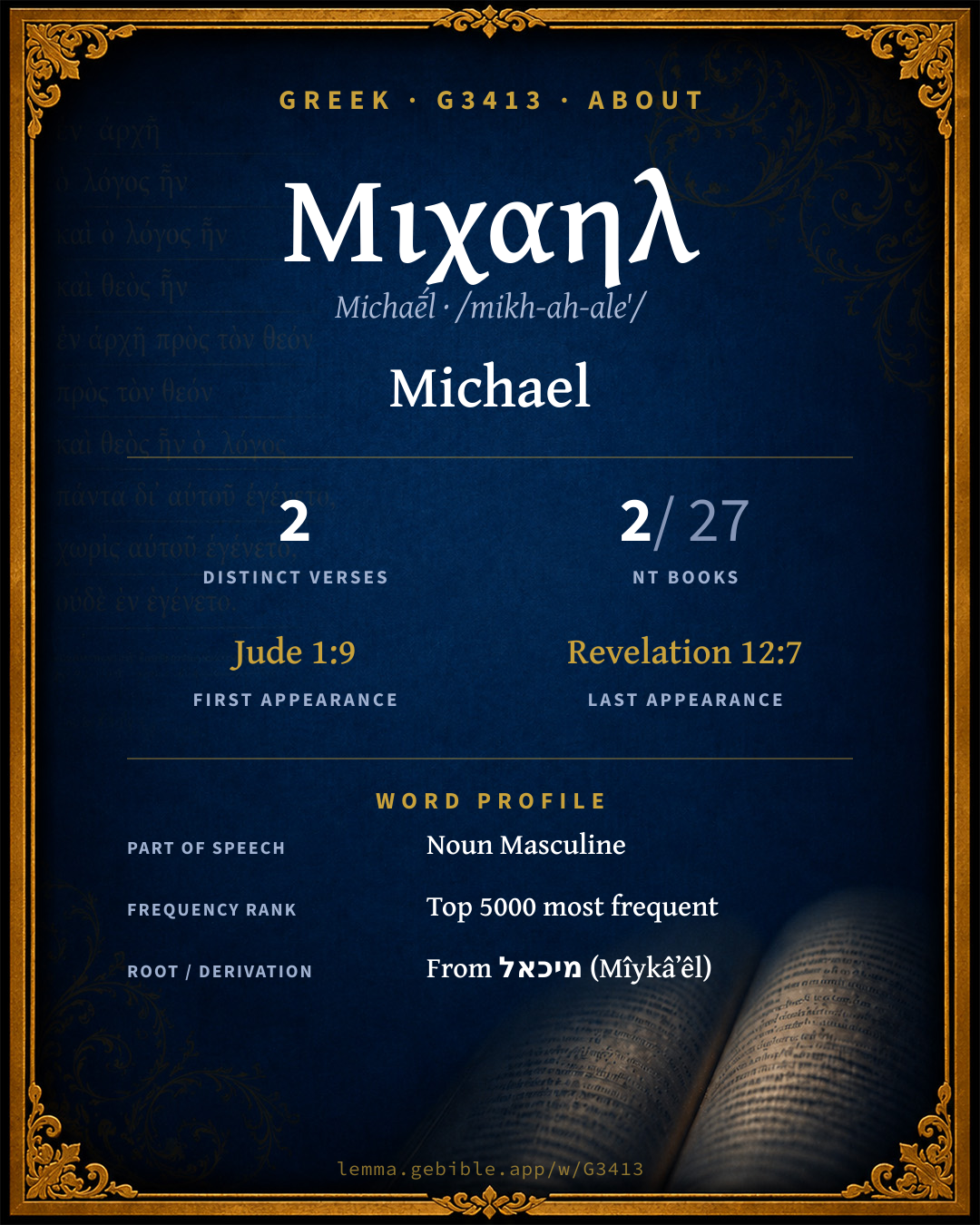
Μιχαήλ
Michael
Thayer's lists 2 entries for ‘Michael’ fuller range ↓
Full lexicon entry — Thayer's Greek Lexicon
From Thayer's Greek Lexicon
Where this word appears
Every verse where G3413 appears — 2 distinct verses across 2 books. Click any verse to open its interlinear word-by-word view. Verse text shown in the World English Bible for context — . Each verse’s Greek form is shown with its reference; the English is not keyword-highlighted, since the data carries no word-level English alignment. Use “Compare translations” on any verse to read it across multiple English versions. This concordance covers the Greek New Testament; Septuagint (Greek Old Testament) occurrences of this word are not indexed here.
Jude 1 verse
Revelation 1 verse
About this entry
At a glance — auto-summarized from this page’s data, not written by a person. Every figure links to its source below. This summary describes the numbers; it doesn’t interpret them.
Μιχαηλ — transliterated Michaḗl — is a Greek name carrying the sense “Michael.” A scarce word — 2 verses in all of the Greek New Testament. More than half of its appearances fall in Jude. Debuting at Jude 1:9, it then recurs through the corpus. See 2-verse concordance and the renderings breakdown below.
Gloss history
Strong's 1890 vs modern scholarship
About this word
Strong's G3413 catalogs a Greek word from the Greek New Testament.
These counts are not copied from any lexicon or concordance. They are computed here, from the morphology-tagged Greek New Testament. What Lemma adds →
- 2
- distinct verses
- The word appears in 2 distinct verses.
- 2 / 27
- NT books
- The word appears in 2 of 27 New Testament books.
- #2,678
- by frequency
- Top 5000 most frequent Greek words (rank 2,678 of 5,347 Greek words by occurrence).
View all 2 occurrences in the concordance →
Most concentrated in
- Jude 1 verse 50%
- Revelation 1 verse 50%
By section of the New Testament
By traditional corpus
Conventional, traditional groupings — biblical authorship is debated, so this is a traditional corpus grouping, not an authorship claim. Some books belong to more than one corpus (Luke is in both the Gospels and the Lukan corpus, and so on), so these shares overlap and need not total 100%. Each figure is a share of the word’s 2 distinct verses.
- Johannine 1 verse · 50%
- General (Catholic) Epistles 1 verse · 50%
- Revelation 1 verse · 50%
How translations render this word
Counts come from each version’s own published word-to-Strong’s tagging or interlinear alignment — an approximate guide to how each version renders this word, not a word-level alignment the data otherwise carries. Because each total is that version’s own tagged count, the per-version totals vary from one another and need not match the appearance or distinct-verse counts above. These counts may also differ from a printed concordance because Lemma counts each distinctly tagged rendering and does not collapse phrase taggings into a single head-word total. This is a fixed set of word-tagged versions (KJV, ASV, BSB, ULT) and does not change with the reading translation you choose elsewhere. Each version’s license is shown beside its name below (and on Sources).
- King James Version: Michael 2×
- American Standard Version: Michael 2×
- Berean Standard Bible: Michael 2×
- unfoldingWord Literal Text: Michael 2×
King James Version Public Domain
Renders G3413 across 2 tagged occurrences — most commonly:
American Standard Version Public Domain
Renders G3413 across 2 tagged occurrences — most commonly:
Berean Standard Bible Public Domain
Renders G3413 across 2 tagged occurrences — most commonly:
unfoldingWord Literal Text CC BY-SA 4.0
Renders G3413 across 2 tagged occurrences — most commonly:
Senses in Thayer's
The 2 senses Thayer's distinguishes for this word, in lexicon order (not ranked by frequency or importance). The full entry — with sub-senses — is in the Lexicon Entry tab.
- Michael = "who is like God"
- the first of the chief princes or archangels who is supposed to be the guardian angel of the Israelites
Word origin
Derived from מיכאל (Mîykâʼêl) (H4317) — Michael.
Of hebrew origin [ H4317 ]; Michael an archangel : - Michael.
— Strong’s Exhaustive Concordance (1890), public domain.
Bible dictionary
Public-domain dictionary articles matched to this entry by name (Michael). A biblical name can be shared by more than one person or place, so an article may treat several.
Easton's Bible Dictionary · M. G. Easton, 1897
Who is like God? (1.) The title given to one of the chief angels (Dan. 10:13, 21; 12:1). He had special charge of Israel as a nation. He disputed with Satan (Jude 1:9) about the body of Moses. He is also represented as warning against "that old serpent, called the Devil, and Satan, which deceiveth the whole world" (Rev. 12:7-9).
(2.) The father of Sethur, the spy selected to represent Asher (Num. 13:13).
(3.) 1 Chr. 7:3, a chief of the tribe of Issachar.
(4.) 1 Chr. 8:16, a Benjamite.
(5.) A chief Gadite in Bashan (1 Chr. 5:13).
(6.) A Manassite, "a captain of thousands" who joined David at Ziklag (1 Chr. 12:20).
(7.) A Gershonite Levite (1 Chr. 6:40).
(8.) The father of Omri (1 Chr. 27:18).
(9.) One of the sons of king Jehoshaphat (2 Chr. 21:2, 4). He was murdered by his brother Jehoram.
Smith's Bible Dictionary · William Smith, 1863
(who is like God?).
+ An Asherite, father of Sethur, one of the twelve spies. (Numbers 13:13) + One of the Gadites who settled in the land of Bashan. (1 Chronicles 5:13) + Another Gadite, ancestor of Abihail. (1 Chronicles 5:14) + A Gershionite Levite, ancestor of Asaph. (1 Chronicles 6:40) + One of the five sons of Izrahiah, of the tribe of Issachar. (1 Chronicles 7:3) + A Benjamite of the sons of Beriah. (1 Chronicles 8:16) + One of the captains of the "thousands" of Manasseh who joined David at Ziklag. (1 Chronicles 12:20) + The father or ancestor of Omri, chief of the tribe of Issachar in the reign of David. (1 Chronicles 27:18) + One of the sons of Jehoshaphat who were murdered by their elder brother, Jehoram. (2 Chronicles 21:2,4) + The father or ancestor of Zebadiah, of the sons of Shephatiah. (Ezra 8:8) + "One," or "the first, of the chief princes" or archangels, (Daniel 10:21) as the "prince" of Israel, and in ch. (Daniel 12:1) as "the great prince which standeth" in time conflict "for the children of thy people."
Classic public-domain reference works; full attribution on Sources.
Septuagint usage
The same Greek word Μιχαηλ appears 13 times in the Greek Old Testament (Septuagint), across 13 verses in 5 books.
- 13
- LXX occurrences
- Tagged occurrences of this Greek word in the Septuagint.
- 13
- verses
- Distinct Septuagint verses containing this word.
- 5 / 39
- OT books
- The word appears in 5 of the 39 Old Testament books.
Sample Septuagint occurrences
- Numbers 13:13 μιχαηλ
- 1 Chronicles 5:13 μιχαηλ
- 2 Chronicles 21:2 μιχαηλ
- Ezra 8:8 μιχαηλ
- Daniel 10:13 μιχαηλ
Septuagint occurrences (same lexeme)
Every verse where the same Strong’s number (G3413) appears in the Greek Septuagint. Verse text shown in the World English Bible for context; the Greek form is the matched word — the English is not keyword-highlighted.
- Numbers 13:13 μιχαηλ Of the tribe of Asher, Sethur the son of Michael.
- 1 Chronicles 5:13 μιχαηλ Their brothers of their fathers' houses: Michael, and Meshullam, and Sheba, and Jorai, and Jacan, and Zia, and Eber, seven.
- 1 Chronicles 5:14 μιχαηλ These were the sons of Abihail, the son of Huri, the son of Jaroah, the son of Gilead, the son of Michael, the son of Jeshishai, the son of Jahdo, the son of Buz;
- 1 Chronicles 6:25 μιχαηλ The sons of Elkanah: Amasai, and Ahimoth.
- 1 Chronicles 7:3 μιχαηλ The sons of Uzzi: Izrahiah. The sons of Izrahiah: Michael, and Obadiah, and Joel, Isshiah, five; all of them chief men.
- 1 Chronicles 8:16 μιχαηλ and Michael, and Ishpah, and Joha, the sons of Beriah,
- 1 Chronicles 12:21 μιχαηλ They helped David against the band of rovers: for they were all mighty men of valor, and were captains in the host.
- 1 Chronicles 27:18 μιχαηλ of Judah, Elihu, one of the brothers of David: of Issachar, Omri the son of Michael:
- 2 Chronicles 21:2 μιχαηλ He had brothers, the sons of Jehoshaphat: Azariah, and Jehiel, and Zechariah, and Azariah, and Michael, and Shephatiah; all these were the sons of Jehoshaphat king of Israel.
- Ezra 8:8 μιχαηλ Of the sons of Shephatiah, Zebadiah the son of Michael; and with him eighty males.
- Daniel 10:13 μιχαηλ But the prince of the kingdom of Persia withstood me twenty-one days; but, behold, Michael, one of the chief princes, came to help me: and I remained there with the kings of Persia.
- Daniel 10:21 μιχαηλ But I will tell you that which is inscribed in the writing of truth: and there is none who holds with me against these, but Michael your prince."
- Daniel 12:1 μιχαηλ "At that time shall Michael stand up, the great prince who stands for the children of your people; and there shall be a time of trouble, such as never was since there was a nation even to that same time: and at that time your people shall be delivered, everyone who shall be found written in the book.
These are occurrences of the same Greek lexeme (G3413) in the Septuagint — not a translation of any one Hebrew word. The store carries no word-level Hebrew↔Greek alignment, so no Hebrew original is asserted here. Counts come from the recovered LXX Strong's tagging — high-frequency vocabulary is well covered, while rare or late forms may be untagged — so they reflect tagged occurrences and may slightly undercount.