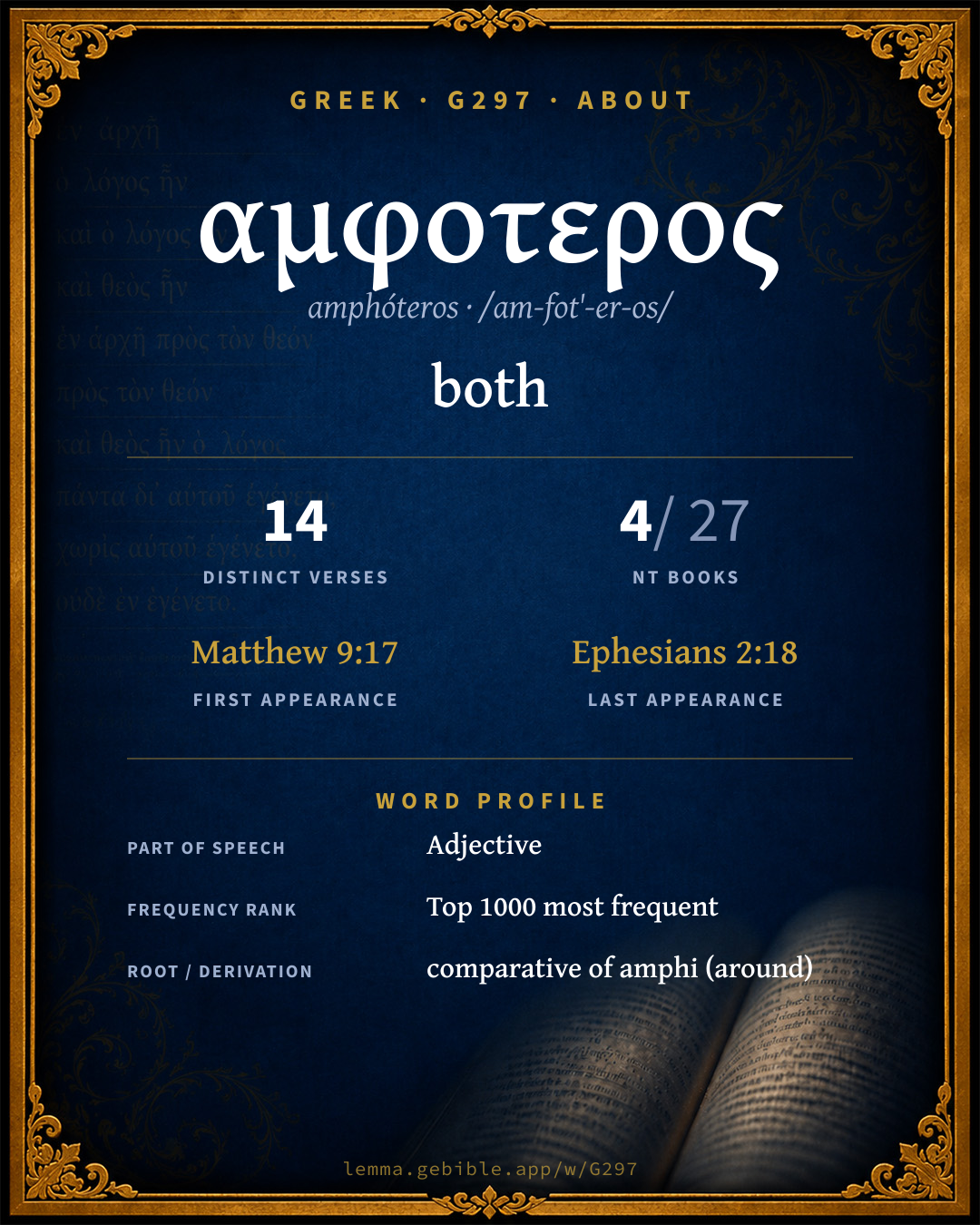
ἀμφότερος
both
Full lexicon entry — Thayer's Greek Lexicon
From Thayer's Greek Lexicon
Where this word appears
See every Nominative-case word in the Greek New Testament →
Grammar key — what these labels mean
Part of speech
- Adjective
- A word that describes or qualifies a noun.
Case
- Nominative
- The case of the subject (and the predicate nominative).
- Accusative
- The case of the direct object and of extent.
- Dative
- The case of the indirect object, means, or location — “to / for / with / in.”
- Genitive
- The case of source, possession, or “of” — answers “whose / from what.”
Gender
- Masculine
- Grammatically masculine.
- Neuter
- Grammatically neuter.
Number
- Plural
- More than one.
Grammatical forms
- Adjective, Nominative, Plural, Masculine 7 times (50%)
- Adjective, Accusative, Plural, Neuter 4 times (29%)
- Adjective, Accusative, Plural, Masculine 1 time (7%)
- Adjective, Dative, Plural, Masculine 1 time (7%)
- Adjective, Genitive, Plural, Masculine 1 time (7%)
Parsed forms decoded from the imported morphology (Robinson–Tischendorf, public domain), counted across 14 parsed occurrences — not distinct verses.
Every verse where G297 appears — 14 distinct verses across 4 books. Click any verse to open its interlinear word-by-word view. Verse text shown in the World English Bible for context — . Each verse’s Greek form is shown with its reference; the English is not keyword-highlighted, since the data carries no word-level English alignment. Use “Compare translations” on any verse to read it across multiple English versions. This concordance covers the Greek New Testament; Septuagint (Greek Old Testament) occurrences of this word are not indexed here.
Matthew 3 verses
- Matthew 9:17 ἀμφότεροι adj nom pl masc Neither do people put new wine into old wineskins, or else the skins would burst, and the wine be spilled, and the skins ruined. No, they put new wine into fresh wineskins, and both are preserved."
- Matthew 13:30 ἀμφότερα adj acc pl neut Let both grow together until the harvest, and in the harvest time I will tell the reapers, "First, gather up the darnel, and bind them in bundles to burn them; but gather the wheat into my barn."'"
- Matthew 15:14 ἀμφότεροι adj nom pl masc Leave them alone. They are blind guides of the blind. If the blind guide the blind, both will fall into a pit."
Luke 5 verses
- Luke 1:6 ἀμφότεροι adj nom pl masc They were both righteous before God, walking blamelessly in all the commandments and ordinances of the Lord.
- Luke 1:7 ἀμφότεροι adj nom pl masc But they had no child, because Elizabeth was barren, and they both were well advanced in years.
- Luke 5:7 ἀμφότερα adj acc pl neut They beckoned to their partners in the other boat, that they should come and help them. They came, and filled both boats, so that they began to sink.
- Luke 6:39 ἀμφότεροι adj nom pl masc He spoke a parable to them. "Can the blind guide the blind? Won't they both fall into a pit?
- Luke 7:42 ἀμφοτέροις adj dat pl masc When they couldn't pay, he forgave them both. Which of them therefore will love him most?"
Acts 3 verses
- Acts 8:38 ἀμφότεροι adj nom pl masc He commanded the chariot to stand still, and they both went down into the water, both Philip and the eunuch, and he baptized him.
- Acts 19:16 ἀμφοτέρων adj gen pl masc The man in whom the evil spirit was leaped on them, and overpowered them, and prevailed against them, so that they fled out of that house naked and wounded.
- Acts 23:8 ἀμφότερα adj acc pl neut For the Sadducees say that there is no resurrection, nor angel, nor spirit; but the Pharisees confess all of these.
Ephesians 3 verses
- Ephesians 2:14 ἀμφότερα adj acc pl neut For he is our peace, who made both one, and broke down the middle wall of partition,
- Ephesians 2:16 ἀμφοτέρους adj acc pl masc and might reconcile them both in one body to God through the cross, having killed the hostility thereby.
- Ephesians 2:18 ἀμφότεροι adj nom pl masc For through him we both have our access in one Spirit to the Father.
About this entry
At a glance — auto-summarized from this page’s data, not written by a person. Every figure links to its source below. This summary describes the numbers; it doesn’t interpret them.
The Greek adjective αμφοτερος centers on the idea of “both.” Its earliest occurrence is Matthew 9:17. Spanning 14 verses in 4 books, it ranks among the uncommon words of the Greek New Testament. Luke dominates its distribution — 5 of 14 verses. Related forms include αμπελος, αμφιβληστρον and αμφιεννυμι. For the data behind this summary, explore the sense tree and the renderings breakdown below.
Gloss history
Strong's 1890 vs modern scholarship
About this word
Strong's G297 catalogs a Greek word from the Greek New Testament.
These counts are not copied from any lexicon or concordance. They are computed here, from the morphology-tagged Greek New Testament. What Lemma adds →
- 14
- distinct verses
- The word appears in 14 distinct verses.
- 4 / 27
- NT books
- The word appears in 4 of 27 New Testament books.
- #814
- by frequency
- Top 1000 most frequent Greek words (rank 814 of 5,347 Greek words by occurrence).
View all 14 occurrences in the concordance →
By section of the New Testament
By traditional corpus
Conventional, traditional groupings — biblical authorship is debated, so this is a traditional corpus grouping, not an authorship claim. Some books belong to more than one corpus (Luke is in both the Gospels and the Lukan corpus, and so on), so these shares overlap and need not total 100%. Each figure is a share of the word’s 14 distinct verses.
- Gospels 8 verses · 57%
- Lukan (Luke–Acts) 8 verses · 57%
- Pauline corpus 3 verses · 21%
How translations render this word
Counts come from each version’s own published word-to-Strong’s tagging or interlinear alignment — an approximate guide to how each version renders this word, not a word-level alignment the data otherwise carries. Because each total is that version’s own tagged count, the per-version totals vary from one another and need not match the appearance or distinct-verse counts above. These counts may also differ from a printed concordance because Lemma counts each distinctly tagged rendering and does not collapse phrase taggings into a single head-word total. This is a fixed set of word-tagged versions (KJV, ASV, BSB, ULT) and does not change with the reading translation you choose elsewhere. Each version’s license is shown beside its name below (and on Sources).
- King James Version: Both 14×
- American Standard Version: Both 12×
- Berean Standard Bible: Both 10×, All 2×
- unfoldingWord Literal Text: Both 13×
King James Version Public Domain
Renders G297 across 15 tagged occurrences — most commonly:
Plus 1 rendering that appears only once — usually multi-word phrases or single function words the recovered tagging swept in, not distinct renderings.
American Standard Version Public Domain
Renders G297 across 13 tagged occurrences — most commonly:
Plus 1 rendering that appears only once — usually multi-word phrases or single function words the recovered tagging swept in, not distinct renderings.
Berean Standard Bible Public Domain
Renders G297 across 13 tagged occurrences — most commonly:
Plus 1 rendering that appears only once — usually multi-word phrases or single function words the recovered tagging swept in, not distinct renderings.
unfoldingWord Literal Text CC BY-SA 4.0
Renders G297 across 14 tagged occurrences — most commonly:
Plus 1 rendering that appears only once — usually multi-word phrases or single function words the recovered tagging swept in, not distinct renderings.
Senses in Thayer's
The 1 sense Thayer's distinguishes for this word, in lexicon order (not ranked by frequency or importance). The full entry — with sub-senses — is in the Lexicon Entry tab.
- both of two, both the one and the other
Word origin
Origin: comparative of amphi (around)
Comparative of ἀμφί amphi ( around ); (in plural) both : - both.
— Strong’s Exhaustive Concordance (1890), public domain.
Forms in the corpus
The 5 distinct written forms G297 takes in the Greek New Testament, most frequent first — each parse links to that case’s occurrences in the concordance.
| Form | Parsing | Example | Uses |
|---|---|---|---|
| ἀμφότεροι amphóteroi | Adjective, Nominative, Plural, Masculine | Matthew 9:17 | 7 |
| ἀμφότερα amphótera | Adjective, Accusative, Plural, Neuter | Matthew 13:30 | 4 |
| ἀμφοτέροις amphotérois | Adjective, Dative, Plural, Masculine | Luke 7:42 | 1 |
| ἀμφοτέρους amphotérous | Adjective, Accusative, Plural, Masculine | Ephesians 2:16 | 1 |
| ἀμφοτέρων amphotérōn | Adjective, Genitive, Plural, Masculine | Acts 19:16 | 1 |
Same root — word family
Other Thayer's entries built from the same root as G297, grouped by Strong’s listed origin. These share a root / origin per the lexicon — not necessarily a shared meaning. Each links to that word’s own entry.
Derived from this word
- αμπελος ámpelos G288 vine
- αμφιβληστρον amphíblēstron G293 impediment
- αμφιεννυμι amphiénnymi G294 to put on
- αμφοδον ámphodon G296 street
Proper names from this root
People and places named from this root — a name, not an additional meaning of the word.
Compare all same-root words → Showing 4 of 6 — not the complete family. 1 of the same-root words is a proper name (a person or place). They share a root, not necessarily a meaning.