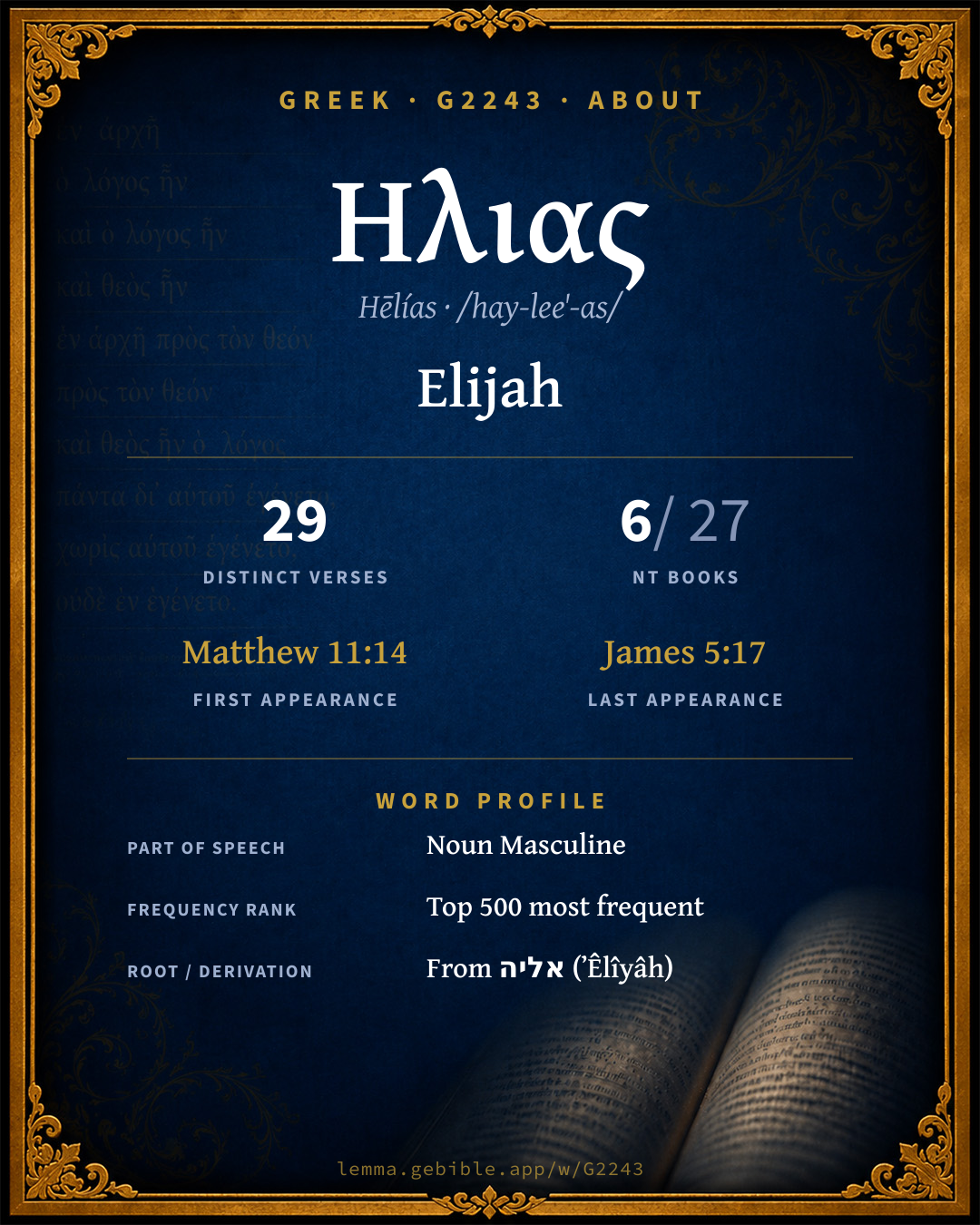
Ἡλίας
Elijah
Thayer's lists 2 entries for ‘Elijah’ fuller range ↓
Full lexicon entry — Thayer's Greek Lexicon
From Thayer's Greek Lexicon
Where this word appears
See every Nominative-case word in the Greek New Testament →
Grammar key — what these labels mean
Part of speech
- Noun
- A naming word — a person, place, thing, or idea.
Case
- Nominative
- The case of the subject (and the predicate nominative).
- Accusative
- The case of the direct object and of extent.
- Dative
- The case of the indirect object, means, or location — “to / for / with / in.”
- Genitive
- The case of source, possession, or “of” — answers “whose / from what.”
Gender
- Masculine
- Grammatically masculine.
Number
- Singular
- One.
2 verses where G2243 appears in the Genitive case in the Book of Luke. Filtered view — show all forms. Click any verse to open its interlinear word-by-word view. Verse text shown in the World English Bible for context — . Each verse’s Greek form is shown with its reference; the English is not keyword-highlighted, since the data carries no word-level English alignment. Use “Compare translations” on any verse to read it across multiple English versions. This concordance covers the Greek New Testament; Septuagint (Greek Old Testament) occurrences of this word are not indexed here.
Luke
- Luke 1:17 Ἡλεία n gen sg masc He will go before him in the spirit and power of Elijah, 'to turn the hearts of the fathers to the children,' and the disobedient to the wisdom of the just; to make ready a people prepared for the Lord."
- Luke 4:25 Ἡλείου n gen sg masc But truly I tell you, there were many widows in Israel in the days of Elijah, when the sky was shut up three years and six months, when a great famine came over all the land.
About this entry
At a glance — auto-summarized from this page’s data, not written by a person. Every figure links to its source below. This summary describes the numbers; it doesn’t interpret them.
The Greek name Ηλιας centers on the idea of “Elijah.” Its earliest occurrence is Matthew 11:14. The Greek New Testament uses it across 29 verses — moderately common. Matthew dominates its distribution — 9 of 29 verses. For the data behind this summary, explore 29-verse concordance and the renderings breakdown below.
Gloss history
Strong's 1890 vs modern scholarship

About this word
Strong's G2243 catalogs a Greek word from the Greek New Testament.
These counts are not copied from any lexicon or concordance. They are computed here, from the morphology-tagged Greek New Testament. What Lemma adds →
- 29
- distinct verses
- The word appears in 29 distinct verses.
- 6 / 27
- NT books
- The word appears in 6 of 27 New Testament books.
- #471
- by frequency
- Top 500 most frequent Greek words (rank 471 of 5,347 Greek words by occurrence).
View all 29 occurrences in the concordance →
By section of the New Testament
By traditional corpus
Conventional, traditional groupings — biblical authorship is debated, so this is a traditional corpus grouping, not an authorship claim. Some books belong to more than one corpus (Luke is in both the Gospels and the Lukan corpus, and so on), so these shares overlap and need not total 100%. Each figure is a share of the word’s 29 distinct verses.
- Gospels 27 verses · 93%
- Lukan (Luke–Acts) 7 verses · 24%
- Johannine 2 verses · 7%
- Pauline corpus 1 verse · 3%
- General (Catholic) Epistles 1 verse · 3%
How translations render this word
Counts come from each version’s own published word-to-Strong’s tagging or interlinear alignment — an approximate guide to how each version renders this word, not a word-level alignment the data otherwise carries. Because each total is that version’s own tagged count, the per-version totals vary from one another and need not match the appearance or distinct-verse counts above. These counts may also differ from a printed concordance because Lemma counts each distinctly tagged rendering and does not collapse phrase taggings into a single head-word total. This is a fixed set of word-tagged versions (KJV, ASV, BSB, ULT) and does not change with the reading translation you choose elsewhere. Each version’s license is shown beside its name below (and on Sources).
- King James Version: Elias 28×, Say elias 2×
- American Standard Version: Elijah 28×
- Berean Standard Bible: Elijah 29×
- unfoldingWord Literal Text: Elijah 29×
King James Version Public Domain
Renders G2243 across 30 tagged occurrences — most commonly:
American Standard Version Public Domain
Renders G2243 across 29 tagged occurrences — most commonly:
Plus 1 rendering that appears only once — usually multi-word phrases or single function words the recovered tagging swept in, not distinct renderings.
Berean Standard Bible Public Domain
Renders G2243 across 29 tagged occurrences — most commonly:
unfoldingWord Literal Text CC BY-SA 4.0
Renders G2243 across 29 tagged occurrences — most commonly:
Senses in Thayer's
The 2 senses Thayer's distinguishes for this word, in lexicon order (not ranked by frequency or importance). The full entry — with sub-senses — is in the Lexicon Entry tab.
- Elijah = "my God is Jehovah"
- a prophet born at Thisbe…
Word origin
Derived from אליה (ʼÊlîyâh) (H452) — Elijah.
Of hebrew origin [ H452 ]; helias (that is Elijah ) an Israelite : - Elias.
— Strong’s Exhaustive Concordance (1890), public domain.
Forms in the corpus
The 7 distinct written forms G2243 takes in the Greek New Testament, most frequent first — each parse links to that case’s occurrences in the concordance.
| Form | Parsing | Example | Uses |
|---|---|---|---|
| Ἡλείας Hēleías | Noun, Nominative, Singular, Masculine | Matthew 11:14 | 15 |
| Ἡλείαν Hēleían | Noun, Accusative, Singular, Masculine | Matthew 16:14 | 7 |
| Ἡλείᾳ Hēleía | Noun, Dative, Singular, Masculine | Matthew 17:4 | 3 |
| Ἠλείας Ēleías | Noun, Nominative, Singular, Masculine | James 5:17 | 1 |
| Ἠλείᾳ Ēleía | Noun, Dative, Singular, Masculine | Romans 11:2 | 1 |
| Ἡλεία Hēleía | Noun, Genitive, Singular, Masculine | Luke 1:17 | 1 |
| Ἡλείου Hēleíou | Noun, Genitive, Singular, Masculine | Luke 4:25 | 1 |
Bible dictionary
Public-domain dictionary articles matched to this entry by name (Elijah). A biblical name can be shared by more than one person or place, so an article may treat several.
Easton's Bible Dictionary · M. G. Easton, 1897
Whose God is Jehovah. (1.) "The Tishbite," the "Elias" of the New Testament, is suddenly introduced to our notice in 1 Kings 17:1 as delivering a message from the Lord to Ahab. There is mention made of a town called Thisbe, south of Kadesh, but it is impossible to say whether this was the place referred to in the name given to the prophet.
Having delivered his message to Ahab, he retired at the command of God to a hiding-place by the brook Cherith, beyond Jordan, where he was fed by ravens. When the brook dried up God sent him to the widow of Zarephath, a city of Zidon, from whose scanty store he was supported for the space of two years. During this period the widow's son died, and was restored to life by Elijah (1 Kings 17: 2-24).
During all these two years a famine prevailed in the land. At the close of this period of retirement and of preparation for his work (comp. Gal. 1:17, 18) Elijah met Obadiah, one of Ahab's officers, whom he had sent out to seek for pasturage for the cattle, and bade him go and tell his master that Elijah was there. The king came and met Elijah, and reproached him as the troubler of Israel. It was then proposed that sacrifices should be publicly offered, for the purpose of determining whether Baal or Jehovah were the true God. This was done on Carmel, with the result that the people fell on their faces, crying, "The Lord, he is the God." Thus was accomplished the great work of Elijah's ministry. The prophets of Baal were then put to death by the order of Elijah. Not one of them escaped. Then immediately followed rain, according to the word of Elijah, and in answer to his prayer (James 5:18).
Jezebel, enraged at the fate that had befallen her priests of Baal, threatened to put Elijah to death (1 Kings 19:1-13). He therefore fled in alarm to Beersheba, and thence went alone a day's journey into the wilderness, and sat down in despondency under a juniper tree. As he slept an angel touched him, and said unto him, "Arise and eat; because the journey is too great for thee." He arose and found a cake and a cruse of water. Having partaken of the provision thus miraculously supplied, he went forward on his solitary way for forty days and forty nights to Horeb, the mount of God, where he took up his abode in a cave. Here the Lord appeared unto him and said, "What dost thou here, Elijah?" In answer to his despondent words God manifests to him his glory, and then directs him to return to Damascus and anoint Hazael king over Syria, and Jehu king over Israel, and Elisha to be prophet in his room (1 Kings 19:13-21; comp. 2 Kings 8:7-15; 9:1-10).
Some six years after this he warned Ahab and Jezebel of the violent deaths they would die (1 Kings 21:19-24; 22:38). He also, four years afterwards, warned Ahaziah (q.v.), who had succeeded his father Ahab, of his approaching death (2 Kings 1:1-16). (See NABOTH.) During these intervals he probably withdrew to some quiet retirement, no one knew where. His interview with Ahaziah's messengers on the way to Ekron, and the account of the destruction of his captains with their fifties, suggest the idea that he may have been in retirement at this time on Mount Carmel.
The time now drew near when he was to be taken up into heaven (2 Kings 2:1-12). He had a presentiment of what was awaiting him. He went down to Gilgal, where was a school of the prophets, and where his successor Elisha, whom he had anointed some years before, resided. Elisha was solemnized by the thought of his master's leaving him, and refused to be parted from him. "They two went on," and came to Bethel and Jericho, and crossed the Jordan, the waters of which were "divided hither and thither" when smitten with Elijah's mantle. Arrived at the borders of Gilead, which Elijah had left many years before, it "came to pass as they still went on and talked" they were suddenly separated by a chariot and horses of fire; and "Elijah went up by a whirlwind into heaven, "Elisha receiving his mantle, which fell from him as he ascended.
No one of the old prophets is so frequently referred to in the New Testament. The priests and Levites said to the Baptist (John 1:25), "Why baptizest thou, if thou be not that Christ, nor Elias?" Paul (Rom. 11:2) refers to an incident in his history to illustrate his argument that God had not cast away his people. James (5:17) finds in him an illustration of the power of prayer. (See also Luke 4:25; 9:54.) He was a type of John the Baptist in the sternness and power of his reproofs (Luke 9:8). He was the Elijah that "must first come" (Matt. 11:11, 14), the forerunner of our Lord announced by Malachi. Even outwardly the Baptist corresponded so closely to the earlier prophet that he might be styled a second Elijah. In him we see "the same connection with a wild and wilderness country; the same long retirement in the desert; the same sudden, startling entrance on his work (1 Kings 17:1; Luke 3:2); even the same dress, a hairy garment, and a leathern girdle about the loins (2 Kings 1:8; Matt. 3:4)."
How deep the impression was which Elijah made "on the mind of the nation may be judged from the fixed belief, which rested on the words of Malachi (4:5, 6), which many centuries after prevailed that he would again appear for the relief and restoration of the country. Each remarkable person as he arrives on the scene, be his habits and characteristics what they may, the stern John equally with his gentle Successor, is proclaimed to be Elijah (Matt. 11:13, 14; 16:14; 17:10; Mark 9:11; 15:35; Luke 9:7, 8; John 1:21). His appearance in glory on the mount of transfiguration does not seem to have startled the disciples. They were sore afraid,' but not apparently surprised."
(2.) The Elijah spoken of in 2 Chr. 21:12-15 is by some supposed to be a different person from the foregoing. He lived in the time of Jehoram, to whom he sent a letter of warning (comp. 1 Chr. 28:19; Jer. 36), and acted as a prophet in Judah; while the Tishbite was a prophet of the northern kingdom. But there does not seem any necessity for concluding that the writer of this letter was some other Elijah than the Tishbite. It may be supposed either that Elijah anticipated the character of Jehoram, and so wrote the warning message, which was preserved in the schools of the prophets till Jehoram ascended the throne after the Tishbite's translation, or that the translation did not actually take place till after the accession of Jehoram to the throne (2 Chr. 21:12; 2 Kings 8:16). The events of 2 Kings 2 may not be recorded in chronological order, and thus there may be room for the opinion that Elijah was still alive in the beginning of Jehoram's reign.
Smith's Bible Dictionary · William Smith, 1863
(my God is Jehovah) has been well entitled "the grandest and the most romantic character that Israel ever produced." "Elijah the Tishbite,... of the inhabitants of Gilead" is literally all that is given us to know of his parentage and locality. Of his appearance as he "stood before" Ahab (B.C. 910) with the suddenness of motion to this day characteristic of the Bedouins from his native hills, we can perhaps realize something from the touches, few but strong, of the narrative. His chief characteristic was his hair, long and thick, and hanging down his back. His ordinary clothing consisted of a girdle of skin round his loins, which he tightened when about to move quickly. (1 Kings 18:46) But in addition to this he occasionally wore the "mantle" or cape of sheepskin which has supplied us with one of our most familiar figures of speech. His introduction, in what we may call the first act of his life, is the most startling description. He suddenly appears before Ahab, prophesies a three-years drought in Israel, and proclaims the vengeance of Jehovah for the apostasy of the king. Obliged to flee from the vengeance of king, or more probably of the queen (comp. (1 Kings 19:2) he was directed to the brook Cherith. There in the hollow of the torrent bed he remained, supported in the miraculous manner with which we are all familiar, till the failing of the brook obliged him to forsake it. His next refuge was at Zarephath. Here in the house of the widow woman Elijah performed the miracles of prolonging the oil and the meal, and restored the son of the widow to life after his apparent death. 1Kin 17. In this or some other retreat an interval of more than two years must have elapsed. The drought continued, and at last the full horrors of famine, caused by the failure of the crops, descended on Samaria. Again Elijah suddenly appears before Ahab. There are few more sublime stories in history than the account of the succeeding events--with the servant of Jehovah and his single attendant on the one hand, and the 850 prophets of Baal on the other; the altars, the descending fire of Jehovah consuming both sacrifice and altar; the rising storm, and the ride across the plain to Jezreel. 1Kin 18. Jezebel vows vengeance, and again Elijah takes refuge in flight into the wilderness, where he is again miraculously fed, and goes forward, in the strength of that food, a journey of forty days to the mount of God, even to Horeb, where he takes refuge in a cave, and witnesses a remarkable vision of Jehovah. (1 Kings 19:9-18) He receives the divine communication, and sets forth in search of Elisha, whom he finds ploughing in the field, and anoints him prophet in his place. ch. 19. For a time little is heard of Elijah, and Ahab and Jezebel probably believed they had seen the last of him. But after the murder of Naboth, Elijah, who had received an intimation from Jehovah of what was taking place, again suddenly appears before the king, and then follow Elijah's fearful denunciation of Ahab and Jezebel, which may possibly be recovered by putting together the words recalled by Jehu, (2 Kings 9:26,36,37) and those given in (1 Kings 21:19-25) A space of three or four years now elapses (comp. (1 Kings 22:1,51; 2 Kings 1:17) before we again catch a glimpse of Elijah. Ahaziah is on his death-bed, (1 Kings 22:51; 2 Kings 1:1,2) and sends to an oracle or shrine of Baal to ascertain the issue of his illness; but Elijah suddenly appears on the path of the messengers, without preface or inquiry utters his message of death, and as rapidly disappears. The wrathful king sends two bands of soldiers to seize Elijah, and they are consumed with fire; but finally the prophet goes down and delivers to Ahaziah's face the message of death. No long after Elijah sent a message to Jehoram denouncing his evil doings, and predicting his death. (2 Chronicles 21:12-15) It was at Gilgal--probably on the western edge of the hills of Ephraim-- that the prophet received the divine intimation that his departure was at hand. He was at the time with Elisha, who seems now to have become his constant companion, and who would not consent to leave him. "And it came to pass as they still went on and talked, that, behold, a chariot of fire and horses of fire, and parted them both asunder; and Elijah went up by a whirlwind into heaven." (B.C. 896.) Fifty men of the sons of the prophets ascended the abrupt heights behind the town, and witnessed the scene. How deep was the impression which he made on the mind of the nation may be judged of from the fixed belief which many centuries after prevailed that Elijah would again appear for the relief and restoration of his country, as Malachi prophesied. (Malachi 4:5) He spoke, but left no written words, save the letter to Jehoram king of Judah. (2 Chronicles 21:12-15)
Hitchcock's Bible Names Dictionary · Roswell D. Hitchcock, 1869
God the Lord, the strong Lord
Classic public-domain reference works; full attribution on Sources.
Septuagint usage
The same Greek word Ηλιας appears 4 times in the Greek Old Testament (Septuagint), across 4 verses in 2 books.
- 4
- LXX occurrences
- Tagged occurrences of this Greek word in the Septuagint.
- 4
- verses
- Distinct Septuagint verses containing this word.
- 2 / 39
- OT books
- The word appears in 2 of the 39 Old Testament books.
Sample Septuagint occurrences
- 2 Kings 9:36 ηλιας
- Malachi 3:22 ηλιας
Septuagint occurrences (same lexeme)
Every verse where the same Strong’s number (G2243) appears in the Greek Septuagint. Verse text shown in the World English Bible for context; the Greek form is the matched word — the English is not keyword-highlighted.
- 2 Kings 9:36 ηλιας Therefore they came back, and told him. He said, This is the word of Yahweh, which he spoke by his servant Elijah the Tishbite, saying, In the portion of Jezreel shall the dogs eat the flesh of Jezebel;
- 2 Kings 10:10 ηλιας Know now that there shall fall to the earth nothing of the word of Yahweh, which Yahweh spoke concerning the house of Ahab: for Yahweh has done that which he spoke by his servant Elijah.
- 2 Kings 10:17 ηλιας When he came to Samaria, he struck all who remained to Ahab in Samaria, until he had destroyed him, according to the word of Yahweh, which he spoke to Elijah.
- Malachi 3:22 ηλιας
These are occurrences of the same Greek lexeme (G2243) in the Septuagint — not a translation of any one Hebrew word. The store carries no word-level Hebrew↔Greek alignment, so no Hebrew original is asserted here. Counts come from the recovered LXX Strong's tagging — high-frequency vocabulary is well covered, while rare or late forms may be untagged — so they reflect tagged occurrences and may slightly undercount.