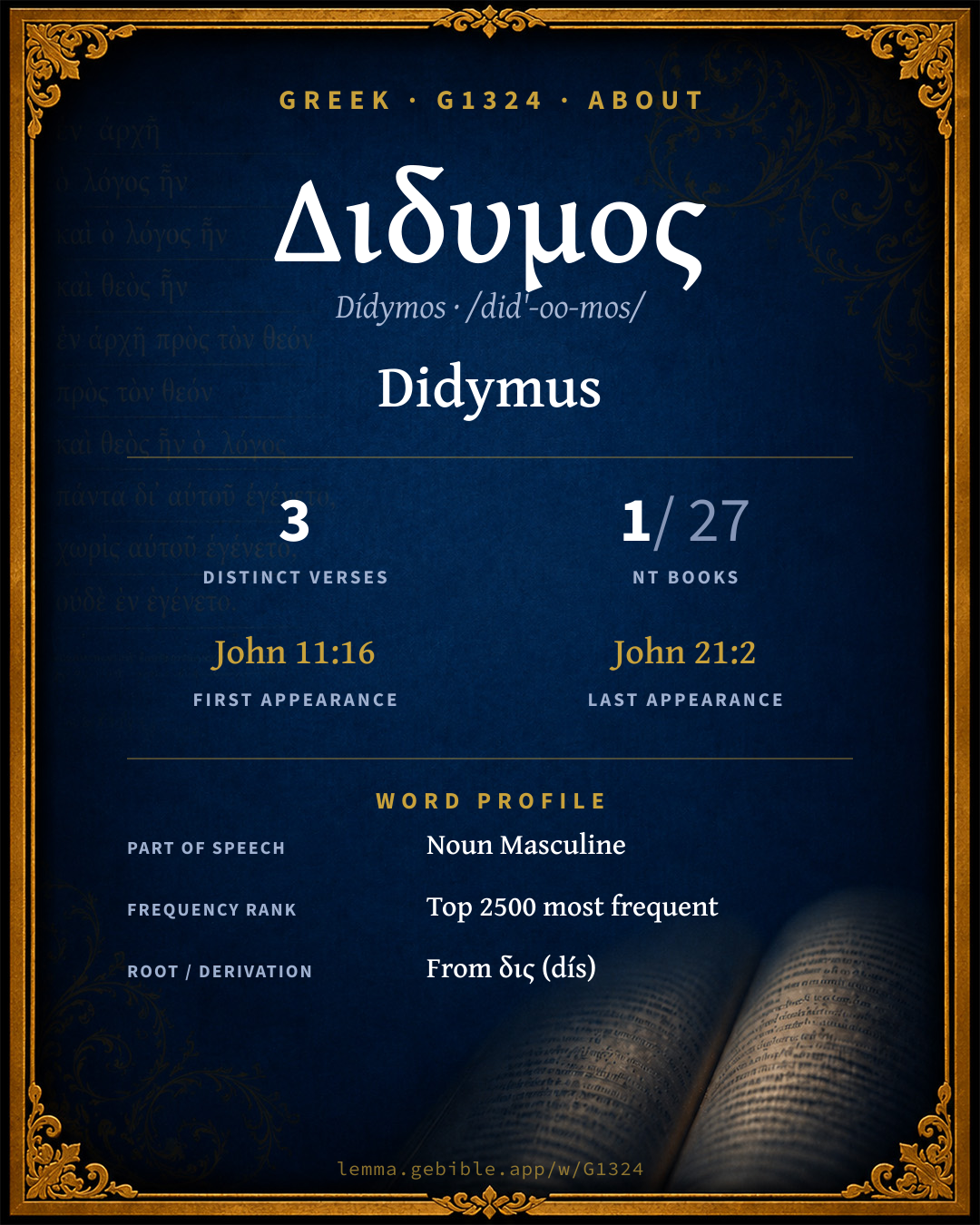
Δίδυμος
Didymus
Thayer's lists 2 entries for ‘Didymus’ fuller range ↓
Full lexicon entry — Thayer's Greek Lexicon
From Thayer's Greek Lexicon
Where this word appears
Grammar key — what these labels mean
Part of speech
- Noun
- A naming word — a person, place, thing, or idea.
Case
- Nominative
- The case of the subject (and the predicate nominative).
Gender
- Masculine
- Grammatically masculine.
Number
- Singular
- One.
Every verse where G1324 appears — 3 distinct verses across 1 book. Click any verse to open its interlinear word-by-word view. Verse text shown in the World English Bible for context — . Each verse’s Greek form is shown with its reference; the English is not keyword-highlighted, since the data carries no word-level English alignment. Use “Compare translations” on any verse to read it across multiple English versions. This concordance covers the Greek New Testament; Septuagint (Greek Old Testament) occurrences of this word are not indexed here.
John 3 verses
- John 11:16 Δίδυμος n nom sg masc Thomas therefore, who is called Didymus, said to his fellow disciples, "Let's go also, that we may die with him."
- John 20:24 Δίδυμος n nom sg masc But Thomas, one of the twelve, called Didymus, wasn't with them when Jesus came.
- John 21:2 Δίδυμος n nom sg masc Simon Peter, Thomas called Didymus, Nathanael of Cana in Galilee, and the sons of Zebedee, and two others of his disciples were together.
About this entry
At a glance — auto-summarized from this page’s data, not written by a person. Every figure links to its source below. This summary describes the numbers; it doesn’t interpret them.
At its core, Διδυμος (Dídymos) means “Didymus.” A scarce word — 3 verses in all of the Greek New Testament. The word gravitates to John (100%). First canonically at John 11:16, it enters the text early. Dig into 3-verse concordance and the renderings breakdown below.
Gloss history
Strong's 1890 vs modern scholarship
About this word
Strong's G1324 catalogs a Greek word from the Greek New Testament.
These counts are not copied from any lexicon or concordance. They are computed here, from the morphology-tagged Greek New Testament. What Lemma adds →
- 3
- distinct verses
- The word appears in 3 distinct verses.
- 1 / 27
- NT books
- The word appears in 1 of 27 New Testament books.
- #2,203
- by frequency
- Top 2500 most frequent Greek words (rank 2,203 of 5,347 Greek words by occurrence).
View all 3 occurrences in the concordance →
Most concentrated in
- John 3 verses 100%
By section of the New Testament
By traditional corpus
Conventional, traditional groupings — biblical authorship is debated, so this is a traditional corpus grouping, not an authorship claim. Some books belong to more than one corpus (Luke is in both the Gospels and the Lukan corpus, and so on), so these shares overlap and need not total 100%. Each figure is a share of the word’s 3 distinct verses.
- Gospels 3 verses · 100%
- Johannine 3 verses · 100%
How translations render this word
Counts come from each version’s own published word-to-Strong’s tagging or interlinear alignment — an approximate guide to how each version renders this word, not a word-level alignment the data otherwise carries. Because each total is that version’s own tagged count, the per-version totals vary from one another and need not match the appearance or distinct-verse counts above. These counts may also differ from a printed concordance because Lemma counts each distinctly tagged rendering and does not collapse phrase taggings into a single head-word total. This is a fixed set of word-tagged versions (KJV, ASV, BSB, ULT) and does not change with the reading translation you choose elsewhere. Each version’s license is shown beside its name below (and on Sources).
- King James Version: Didymus 3×
- American Standard Version: Didymus 3×
- Berean Standard Bible: Didymus 3×
- unfoldingWord Literal Text: Didymus 3×
King James Version Public Domain
Renders G1324 across 3 tagged occurrences — most commonly:
American Standard Version Public Domain
Renders G1324 across 3 tagged occurrences — most commonly:
Berean Standard Bible Public Domain
Renders G1324 across 3 tagged occurrences — most commonly:
unfoldingWord Literal Text CC BY-SA 4.0
Renders G1324 across 3 tagged occurrences — most commonly:
Senses in Thayer's
The 2 senses Thayer's distinguishes for this word, in lexicon order (not ranked by frequency or importance). The full entry — with sub-senses — is in the Lexicon Entry tab.
- Didymus = "two fold or twain"
- a surname for the apostle Thomas
Word origin
Derived from δις (dís) (G1364) — twice.
Prolonged from G1364 ; double that is twin ; Didymus a Christian : - Didymus.
— Strong’s Exhaustive Concordance (1890), public domain.
Same root — word family
Other Thayer's entries built from the same root as G1324, grouped by Strong’s listed origin. These share a root / origin per the lexicon — not necessarily a shared meaning. Each links to that word’s own entry.
Derives from
Shares the same root
- διακοσιοι diakósioi G1250 two hundred
- διδραχμον dídrachmon G1323 didrachma
- διετης dietḗs G1332 two-year-old
- διθαλασσος dithálassos G1337 between two seas
- διλογος dílogos G1351 double-tongued
- διπλους diploûs G1362 double
- δισταζω distázō G1365 to doubt
- διστομος dístomos G1366 double-mouthed
- δισχιλιοι dischílioi G1367 two thousand
- διχαζω dicházō G1369 to cut asunder
- διχοστασια dichostasía G1370 dissension
- διχοτομεω dichotoméō G1371 to scourge severely
- διψυχος dípsychos G1374 double-minded
Compare all same-root words → Showing 4 of 15 — not the complete family. They share a root, not necessarily a meaning.
Bible dictionary
Public-domain dictionary articles matched to this entry by name (Didymus). A biblical name can be shared by more than one person or place, so an article may treat several.
Easton's Bible Dictionary · M. G. Easton, 1897
(Gr. twin = Heb. Thomas, q.v.), John 11:16; 20:24; 21:2.
Smith's Bible Dictionary · William Smith, 1863
(the twin), a surname of the apostle Thomas. (John 11:16; 20:24; 21:2) [Thomas]
Hitchcock's Bible Names Dictionary · Roswell D. Hitchcock, 1869
a twin; double
Classic public-domain reference works; full attribution on Sources.
Septuagint usage
The same Greek word Διδυμος appears 6 times in the Greek Old Testament (Septuagint), across 6 verses in 4 books.
- 6
- LXX occurrences
- Tagged occurrences of this Greek word in the Septuagint.
- 6
- verses
- Distinct Septuagint verses containing this word.
- 4 / 39
- OT books
- The word appears in 4 of the 39 Old Testament books.
Sample Septuagint occurrences
- Genesis 25:24 δίδυμος
- Deuteronomy 25:11 δίδυμος
- Joshua 8:29 δίδυμος
- Song of Solomon 4:5 δίδυμος
Septuagint occurrences (same lexeme)
Every verse where the same Strong’s number (G1324) appears in the Greek Septuagint. Verse text shown in the World English Bible for context; the Greek form is the matched word — the English is not keyword-highlighted.
- Genesis 25:24 δίδυμος When her days to be delivered were fulfilled, behold, there were twins in her womb.
- Genesis 38:27 δίδυμος It happened in the time of her travail, that behold, twins were in her womb.
- Deuteronomy 25:11 δίδυμος When men strive together one with another, and the wife of the one draws near to deliver her husband out of the hand of him who strikes him, and puts forth her hand, and takes him by the secrets;
- Joshua 8:29 δίδυμος The king of Ai he hanged on a tree until the evening: and at the going down of the sun Joshua commanded, and they took his body down from the tree, and cast it at the entrance of the gate of the city, and raised thereon a great heap of stones, to this day.
- Song of Solomon 4:5 δίδυμος Your two breasts are like two fawns That are twins of a roe, Which feed among the lilies.
- Song of Solomon 7:4 δίδυμος Your neck is like an ivory tower. Your eyes are like the pools in Heshbon by the gate of Bath-rabbim; Your nose is like the tower of Lebanon which looks toward Damascus.
These are occurrences of the same Greek lexeme (G1324) in the Septuagint — not a translation of any one Hebrew word. The store carries no word-level Hebrew↔Greek alignment, so no Hebrew original is asserted here. Counts come from the recovered LXX Strong's tagging — high-frequency vocabulary is well covered, while rare or late forms may be untagged — so they reflect tagged occurrences and may slightly undercount.