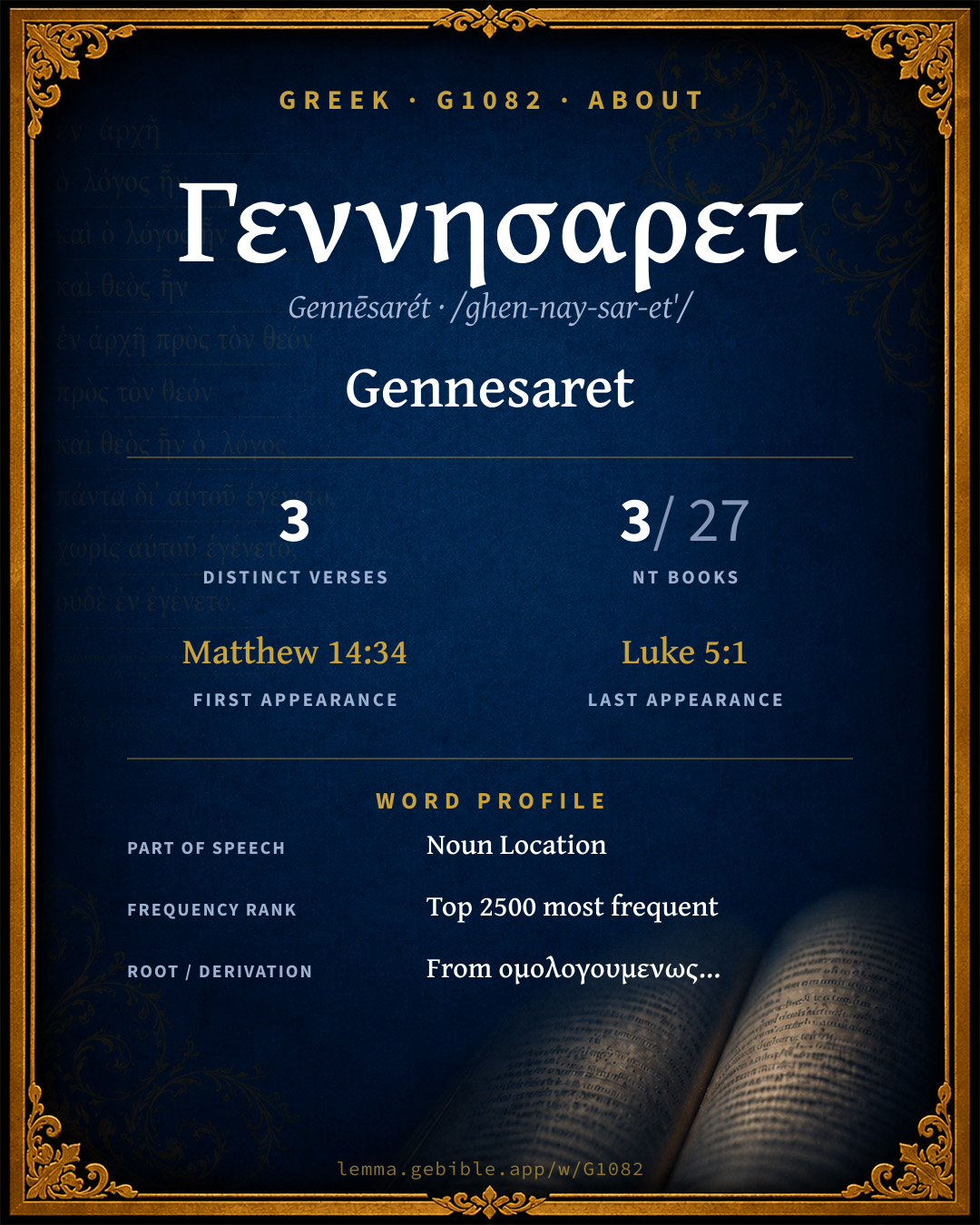
Γεννησαρέτ
Gennesaret
Full lexicon entry — Thayer's Greek Lexicon
From Thayer's Greek Lexicon
Where this word appears
Every verse where G1082 appears — 3 distinct verses across 3 books. Click any verse to open its interlinear word-by-word view. Verse text shown in the World English Bible for context — . Each verse’s Greek form is shown with its reference; the English is not keyword-highlighted, since the data carries no word-level English alignment. Use “Compare translations” on any verse to read it across multiple English versions. This concordance covers the Greek New Testament; Septuagint (Greek Old Testament) occurrences of this word are not indexed here.
Matthew 1 verse
Mark 1 verse
Luke 1 verse
About this entry
At a glance — auto-summarized from this page’s data, not written by a person. Every figure links to its source below. This summary describes the numbers; it doesn’t interpret them.
Γεννησαρετ — transliterated Gennēsarét — is a Greek name carrying the sense “Gennesaret.” It is rare — just 3 verses in the entire Greek New Testament. More than a third of its appearances fall in Matthew. Its earliest occurrence is Matthew 14:34. See 3-verse concordance and the renderings breakdown below.
Gloss history
Strong's 1890 vs modern scholarship
About this word
Strong's G1082 catalogs a Greek word from the Greek New Testament.
These counts are not copied from any lexicon or concordance. They are computed here, from the morphology-tagged Greek New Testament. What Lemma adds →
- 3
- distinct verses
- The word appears in 3 distinct verses.
- 3 / 27
- NT books
- The word appears in 3 of 27 New Testament books.
- #2,203
- by frequency
- Top 2500 most frequent Greek words (rank 2,203 of 5,347 Greek words by occurrence).
View all 3 occurrences in the concordance →
By section of the New Testament
By traditional corpus
Conventional, traditional groupings — biblical authorship is debated, so this is a traditional corpus grouping, not an authorship claim. Some books belong to more than one corpus (Luke is in both the Gospels and the Lukan corpus, and so on), so these shares overlap and need not total 100%. Each figure is a share of the word’s 3 distinct verses.
- Gospels 3 verses · 100%
- Lukan (Luke–Acts) 1 verse · 33%
How translations render this word
Counts come from each version’s own published word-to-Strong’s tagging or interlinear alignment — an approximate guide to how each version renders this word, not a word-level alignment the data otherwise carries. Because each total is that version’s own tagged count, the per-version totals vary from one another and need not match the appearance or distinct-verse counts above. These counts may also differ from a printed concordance because Lemma counts each distinctly tagged rendering and does not collapse phrase taggings into a single head-word total. This is a fixed set of word-tagged versions (KJV, ASV, BSB, ULT) and does not change with the reading translation you choose elsewhere. Each version’s license is shown beside its name below (and on Sources).
- King James Version: Gennesaret 3×
- American Standard Version: Gennesaret 3×
- Berean Standard Bible: Gennesaret 3×
- unfoldingWord Literal Text: Gennesaret 3×
King James Version Public Domain
Renders G1082 across 3 tagged occurrences — most commonly:
American Standard Version Public Domain
Renders G1082 across 3 tagged occurrences — most commonly:
Berean Standard Bible Public Domain
Renders G1082 across 3 tagged occurrences — most commonly:
unfoldingWord Literal Text CC BY-SA 4.0
Renders G1082 across 3 tagged occurrences — most commonly:
Senses in Thayer's
The 1 sense Thayer's distinguishes for this word, in lexicon order (not ranked by frequency or importance). The full entry — with sub-senses — is in the Lexicon Entry tab.
- Gennesaret = "a harp"
Word origin
Derived from ομολογουμενως (homologouménōs) (G3672) — confessedly.
Of hebrew origin (compare [ H3672 ]); Gennesaret (that is Kinnereth ) a lake and plain in Palestine : - Gennesaret.
— Strong’s Exhaustive Concordance (1890), public domain.
Forms in the corpus
The 2 distinct written forms G1082 takes in the Greek New Testament, most frequent first — each parse links to that case’s occurrences in the concordance.
| Form | Parsing | Example | Uses |
|---|---|---|---|
| Γεννησαρέτ Gennēsarét | Noun, Proper, indeclinable | Matthew 14:34 | 2 |
| Γεννησαρὲτ Gennēsarèt | Noun, Proper, indeclinable | Mark 6:53 | 1 |
Bible dictionary
Public-domain dictionary articles matched to this entry by name (Gennesaret). A biblical name can be shared by more than one person or place, so an article may treat several.
Easton's Bible Dictionary · M. G. Easton, 1897
A garden of riches. (1.) A town of Naphtali, called Chinnereth (Josh. 19:35), sometimes in the plural form Chinneroth (11:2). In later times the name was gradually changed to Genezar and Gennesaret (Luke 5:1). This city stood on the western shore of the lake to which it gave its name. No trace of it remains. The plain of Gennesaret has been called, from its fertility and beauty, "the Paradise of Galilee." It is now called el-Ghuweir.
(2.) The Lake of Gennesaret, the Grecized form of CHINNERETH (q.v.). (See GALILEE, SEA OF.)
Smith's Bible Dictionary · William Smith, 1863
(garden of the prince), Land of. It is generally believed that this term was applied to the fertile crescent-shaped plain on the western shore of the lake, extending from Khan Minyeh (two or three miles south of Capernaum (Tel-Hum) on the north to the steep hill behind Mejdel (Magdala) on the south, and called by the Arabs el-Ghuweir, "the little Ghor." Mr. Porter gives the length as three miles, and the greatest breadth as about one mile. Additional interest is given to the land of Gennesaret, or el-Ghuweir, by the probability that its scenery suggested the parable of the sower. It is mentioned only twice in Scripture - (Matthew 14:34; Mark 6:53) Compare Luke 5:1
Hitchcock's Bible Names Dictionary · Roswell D. Hitchcock, 1869
garden of the prince
Classic public-domain reference works; full attribution on Sources.