
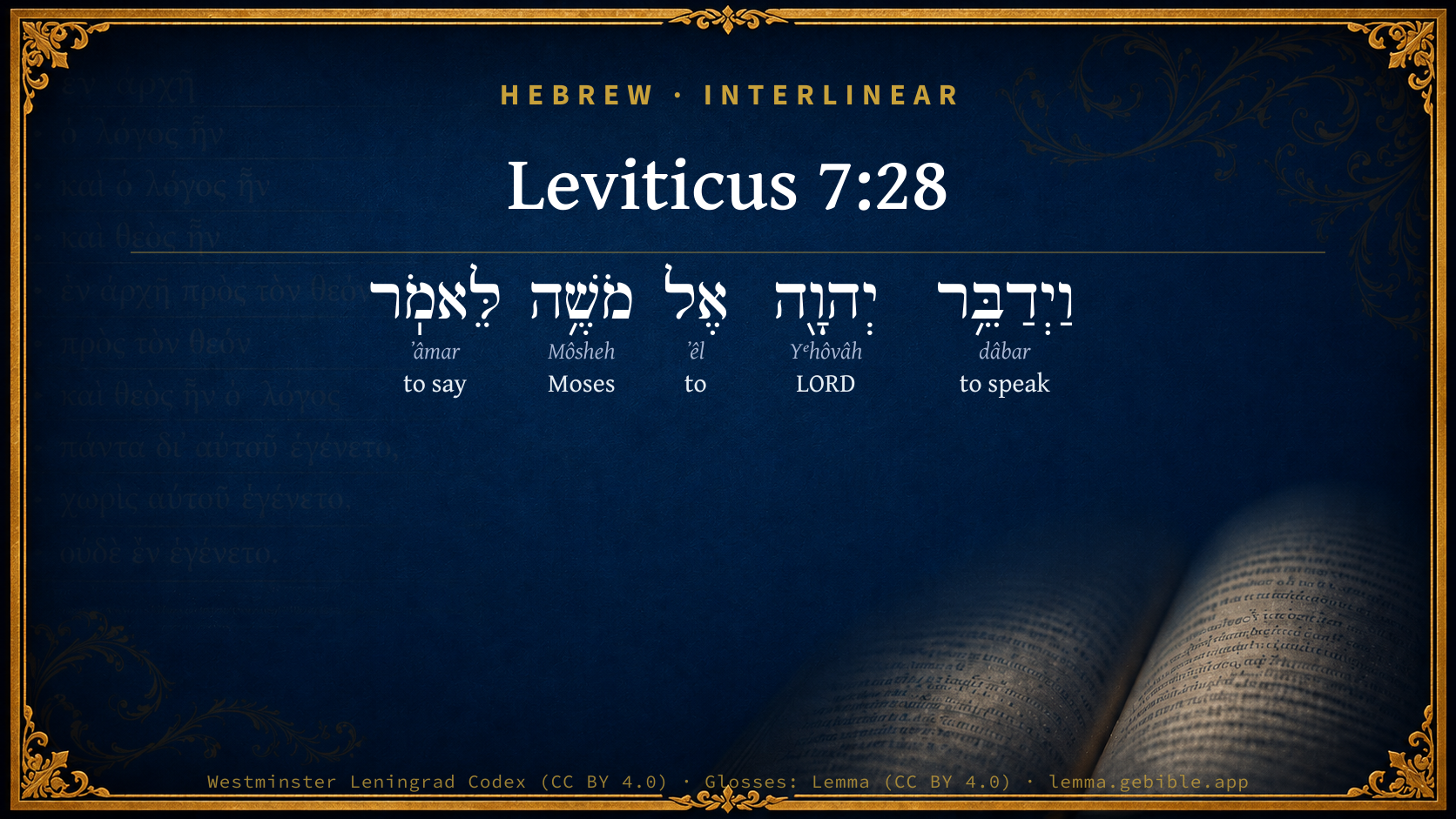
Leviticus 7:28

Hebrew (Westminster Leningrad Codex) Leviticus 7:28 appears in the Hebrew Old Testament. The text above is from the Westminster Leningrad Codex. Each word links to its Strong’s number, a concise gloss, and parsing drawn from the Open Scriptures Hebrew Bible morphology. Click any word for its full Brown-Driver-Briggs (BDB) entry.
Download image
Cite this verse

Leviticus 7:28 (World English Bible). Public Domain. Lemma interlinear Bible study tool, https://lemma.gebible.app/v/leviticus/7/28.

Show BibTeX & RIS
BibTeX
RIS
English Translation
Yahweh spoke to Moses, saying,
World English Bible · Public Domain
Download a study sheet

One document with this verse’s original text, its word-by-word gloss line, the meaning frame, cross-references with their text, attributed commentary, and full source and license credits — printable, and it pastes into notes with its structure intact.

This verse Autodidact and up

Study sheet (.html) Plain text (.txt)

A passage Seminary Student

Up to 50 verses in one chapter. A passage sheet keeps up to 6 commentary sources and 12 cross-references per verse, in the order this page ranks them, and says so on the sheet whenever that leaves anything out. Ask for a single verse and you get the Autodidact verse sheet above.

Everything on this page stays free to read, with no account — the sheet is a download of what is already on screen, not access to it.

Want to remove ads? Support Godless Engineer
Compare translations 3

The same verse in 3 English versions, stacked beneath the original-language interlinear above. Click any original word for its lexicon entry.

Each is an independent rendering of the whole verse — the interlinear is not word-aligned to these translations.

Highlighted words mark where these versions differ — a whole-verse word diff, not a word-by-word alignment.

  • World English Bible Public Domain
    Yahweh spoke to Moses, saying,
  • King James Version Public Domain
    And the LORD spake unto Moses, saying,
  • unfoldingWord Literal Text CC BY-SA 4.0
    And Yahweh spoke to Moses, saying,

unfoldingWord Literal Text — © unfoldingWord, licensed CC BY-SA 4.0. Word-aligned USFM3 via Door43 (git.door43.org/unfoldingWord/en_ult).

Versions to compare (up to 4)

3 of 4 selected

Show all 18 translations

Every available English version of this verse, each an independent rendering of the whole verse.

  • World English Bible Public Domain
    Yahweh spoke to Moses, saying,
  • Berean Standard Bible Public Domain
    Then the LORD said to Moses,
  • Majority Standard Bible Public Domain
    Then the LORD said to Moses,
  • King James Version Public Domain
    And the LORD spake unto Moses, saying,
  • American Standard Version (1901) Public Domain
    And Jehovah spake unto Moses, saying,
  • Revised Version (1885) Public Domain
    And the LORD spake unto Moses, saying,
  • Geneva Bible (1599) Public Domain
    And the Lord talked with Moses, saying,
  • Douay-Rheims (1899) Public Domain
    And the Lord spoke to Moses, saying:
  • Young's Literal Translation Public Domain
    And Jehovah speaketh unto Moses, saying,
  • Literal Standard Version CC BY-SA 4.0
    And YHWH speaks to Moses, saying,
  • Unlocked Literal Bible CC BY-SA 4.0
    So Yahweh spoke to Moses and said,
  • unfoldingWord Literal Text CC BY-SA 4.0
    And Yahweh spoke to Moses, saying,
  • Darby Bible Public Domain
    And Jehovah spoke to Moses, saying,
  • World Messianic Bible Public Domain
    The LORD spoke to Moses, saying,
  • Webster's Bible Public Domain
    And the LORD spoke to Moses, saying,
  • Free Bible Version CC BY-SA 4.0
    The Lord told Moses,
  • Bible in Basic English Public Domain
    And the Lord said to Moses,
  • JPS Tanakh (1917) Public Domain
    And the LORD spoke unto Moses, saying:

Literal Standard Version (2020), Covenant Press — licensed CC BY-SA 4.0. Text via the HelloAO Bible API (eBible.org). Unlocked Literal Bible (unfoldingWord) — licensed CC BY-SA 4.0. Text via the HelloAO Bible API (eBible.org). unfoldingWord Literal Text — © unfoldingWord, licensed CC BY-SA 4.0. Word-aligned USFM3 via Door43 (git.door43.org/unfoldingWord/en_ult). Free Bible Version, Dr. Jonathan Gallagher — licensed CC BY-SA 4.0. Text via the HelloAO Bible API (eBible.org).

Word by word

More ways to search: Search by grammar → Find every occurrence → Compare this word →

Practice this passage: Drill this verse → Learn its vocabulary →

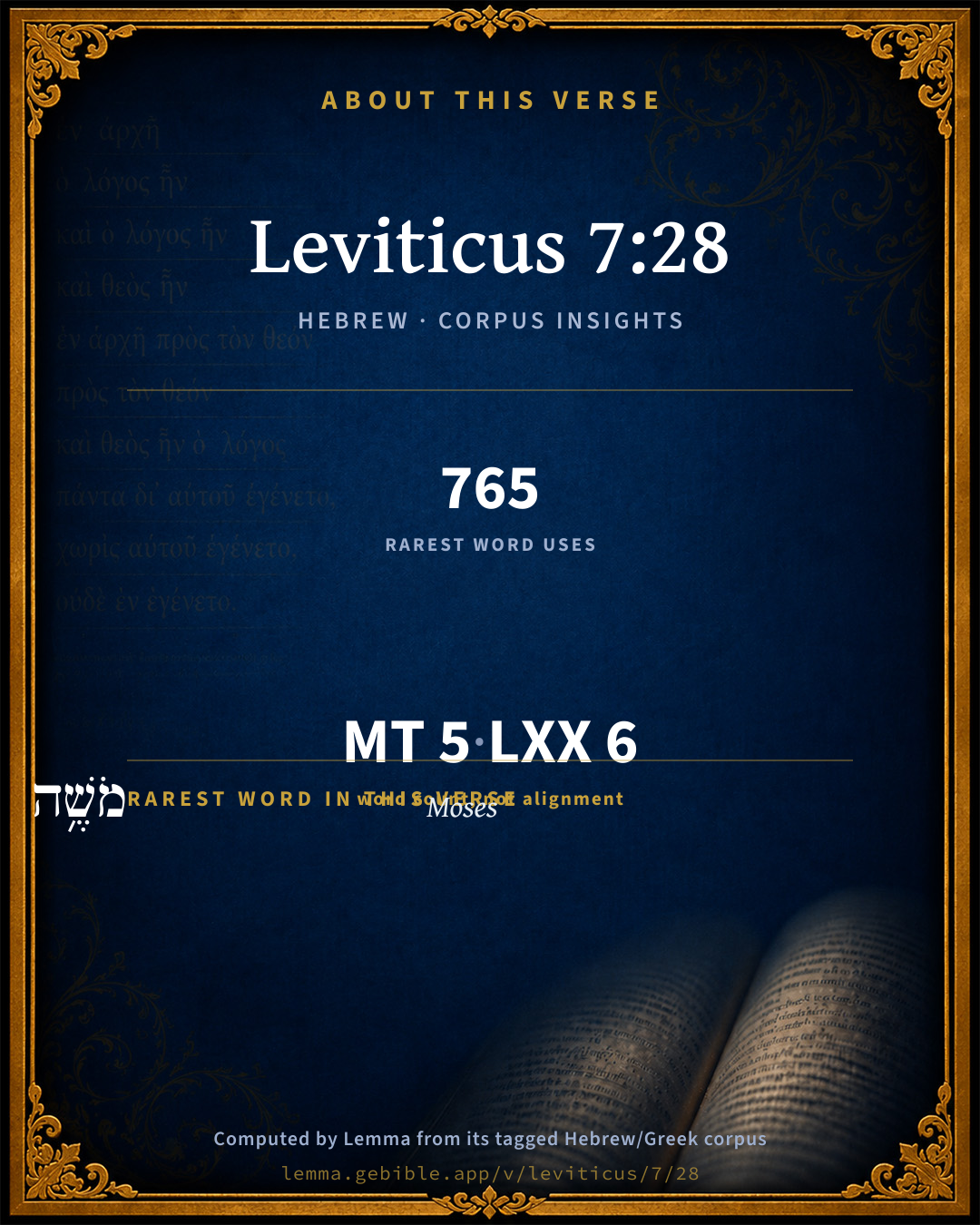
About this verse

These counts appear in no published source. They are computed here, from the morphology-tagged text and Lemma’s own curated glosses. What Lemma adds →

5
words
5
distinct lemmas
Pentateuch
section

Grammatical profile

  • 2 verbs
  • 2 nouns
  • 1 preposition

Verb forms

  • וַיְדַבֵּ֥ר Piel · Sequential Imperfect
  • לֵּאמֹֽר Qal · Infinitive Construct

Hebrew & Septuagint length

In English translation the verse runs 5 words from the Hebrew and 32 from the Septuagint (LXX English) — the Septuagint runs noticeably longer here. See the side-by-side →

A rough comparison of the two English renderings, which tokenize alike — not a word-level alignment.

Word counts can differ between the Hebrew and the Greek without any difference in meaning — e.g. the Hebrew direct-object marker אֵת has no separate Greek word, and Greek often adds the article ὁ.

In the original languages it is 5 Hebrew tokens and 6 Greek tokens — but the two are counted differently (Hebrew bundles its prefixes and suffixes into one token; the Greek is in lemma form), so that isn’t a like-for-like length.

Hebrew and Greek witnesses Masoretic Hebrew ↔ Greek Septuagint

The same verse in the two great witnesses to the Old Testament, shown verse-for-verse.

Here the Septuagint runs noticeably longer than the Hebrew — LXX2012 (modern English Septuagint) 32 words vs World English Bible 5. A rough length comparison of the two English translations, not a word-level alignment — read both below.

These are two independent witnesses, not word-aligned to each other, and the Septuagint is shown in lemma (dictionary) form.

Hebrew Leviticus 7:28 Masoretic · Westminster Leningrad Codex

וַיְדַבֵּ֥ר יְהוָ֖ה אֶל מֹשֶׁ֥ה לֵּאמֹֽר

Yahweh spoke to Moses, saying,

World English Bible · Public Domain

Greek LXX Leviticus 7:28 Septuagint · lemma form

καί λαλέω κύριος πρός μωυσῆς λέγω

as the Lord commanded Moses in the mount Sina, in the day in which he commanded the children of Israel to offer their gifts before the Lord in the wilderness of Sina.

LXX2012 (modern English Septuagint) · Public Domain

Hebrew: Westminster Leningrad Codex (CC BY 4.0). Greek: Septuagint (public domain); English from LXX2012 (modern English Septuagint) (Public Domain). How the Septuagint differs from the Hebrew →

Targum (Aramaic paraphrase)

2

The Targum is the ancient Jewish Aramaic paraphrase of the Hebrew Scriptures — an interpretive translation, not the Hebrew text itself. Onkelos (literal) and Pseudo-Jonathan (expansive) render the Torah, and Jonathan the Prophets. Coverage is partial: where no permissively-licensed English translation exists for a verse, only the Aramaic is shown. This is verse-level text, not a word-by-word alignment to the Hebrew.

  1. Targum Onkelos Torah (Genesis–Deuteronomy)
    וּמַלִיל יְיָ עִם מֹשֶׁה לְמֵימָר

    (no public-domain English translation for this verse)

    Targum Onkelos — Aramaic: “Onkelos Genesis” (public domain); “Onkelos Exodus” (public domain); “Onkelos Leviticus” (public domain); “Onkelos Numbers” (public domain); “Onkelos Deuteronomy” (public domain). English: “Sefaria Community Translation” (CC0 1.0 (public-domain dedication)); “J.W. Etheridge. The Targums of Onkelos and Jonathan Ben Uzziel on the Pentateuch. London: Longmans, Green, 1862” (public domain). Text via Sefaria.

  2. Targum Pseudo-Jonathan Torah (Genesis–Deuteronomy)
    וּמַלֵיל יְיָ עִם משֶׁה לְמֵימָר

    And the Lord spake with Mosheh, saying:

    Targum Pseudo-Jonathan — Aramaic: “Targum Jonathan on Genesis” (public domain); “Targum Jonathan on Exodus” (public domain); “Targum Jonathan on Leviticus” (public domain); “Targum Jonathan on Numbers” (public domain); “Targum Jonathan on Deuteronomy” (public domain). English: “The Targum of Jonathan ben Uzziel, trans. J. W. Etheridge, London, 1862” (public domain). Text via Sefaria.

Commentary

Notes on Leviticus 7:28 from classic Christian and Jewish commentators (each source and its license shown beneath its notes). The classic Christian expositions comment on the surrounding passage and are grouped to its opening verse, so a note may address several verses; the Jewish commentaries on the Tanakh (Rashi and others) are per-verse, so they appear only where the commentator wrote on this verse.

Lemma curates 59 commentaries, every one of them public domain or Creative Commons licensed, each selected and text-cleaned for this edition rather than reprinted as found. About our sources →

Ellicott's Commentary for English Readers

(28) And the Lord spake unto Moses.—With this formula, which, as we have seen, indicates a fresh communication made by the Lord to the lawgiver, additional precepts are introduced, regulating God’s portion of the peace offering.

A Bible Commentary for English Readers, edited by Charles John Ellicott (1878–1897) — public domain. Text from a community e-Sword module.

John Gill's Exposition

Speak unto the children of Israel, saying,.... Giving them the further instructions concerning their peace offerings:

he that offereth the sacrifice of his peace offerings unto the Lord; whether it he for thanksgiving, or as a vow, or a voluntary oblation, and whether it be of the herd or of the flock, an ox or a cow, a lamb or a goat:

shall bring his oblation unto the Lord of the sacrifice of his peace offerings; that is, the unleavened cakes, wafers, and fried cakes, and unleavened bread, which are called the whole oblation, Lev 7:10.

John Gill's Exposition of the Whole Bible (1746–1763) — public domain (CC PDM 1.0). Text via the HelloAO Bible API.

The Pulpit Commentary

Vers. 28-34. Continuation of the ritual of the peace offerings. (see note on Lev_3:1) The equal dignity of the peace offerings with the other offerings is vindicated by the command that the offerer shall bring it with his own hands, whereas it might have been regarded as merely the constituent part of a feast, and so sent by the hand of a servant. The breast and the right shoulder were to be waved and heaved (for "heaved" does not merely mean" taken off," as some have said). The waving consisted of the priest placing his hands beneath those of the offerer who held the piece to be waved, and moving them slowly backwards and forwards before the Lord, to and from the altar; the heaving was performed by slowly lifting the pieces heaved upwards and downwards. The movements were made to show that the pieces, though not burnt on the altar, were yet in a special manner consecrated to God"s service. The right shoulder was most probably the hind leg, perhaps the haunch. The Hebrew word is generally translated "leg". (Deu_28:35 Psa_147:10) This part was the perquisite of the officiating priest; the waved breast was given to the priests" common stock. Afterwards an addition was made to the priests" portion. (Deu_18:3; see 1Co_9:13)

Vers. 28-38. The service of the oblation.

In the service of the oblation of the peace offering there are two actors, viz. the offerer and the priest. These had their respective duties, which are severally brought under our notice in the text. We have

I THE DUTY OF THE OFFERER.

1. He had to bring his oblation unto the Lord.

(1) The "oblation" here is not the "sacrifice," but "of the sacrifice" (verses 28-30). It was that portion of the sacrifice which, more especially, was claimed by God, viz. the fat prescribed to be burnt upon the altar. It included also the breast and right shoulder.

(2) This he was to bring in person. "His own hands shall bring the offerings of the Lord made by fire," etc. This requisition is so express that even women, who under other circumstances never entered the court of the priests, did so when they had offerings to bring. The Hebrew name for oblation (brq, korban) is derived from a root (brq, koreb) which signifies to approach or draw near. By the introduction of our Great High Priest, we personally, under the gospel, "approach" or "draw nigh" unto God. (see Heb_7:19 Heb_10:21, Heb_10:22) We cannot save our souls by proxy. We cannot acceptably serve God by proxy.

2. He had to bring the fat laid upon the breast.

(1) What our version construes "the fat with the breast" (verse 30), may be better rendered, as it is by the learned Julius Bate, "the fat upon the breast," i.e. , laid upon the breast. (comp. Lev_8:26, Lev_8:27) The breast was that appointed to be waved before the Lord; and it would appear that it was waved with the fat laid upon it. The breast was the natural symbol of heartiness and willingness. This action would, therefore, express the cheerful and grateful willingness of the offerer, and his earnest desire that his offering might be graciously accepted. What we devote to God should be heartily given. (2Co_9:7)

(2) The "heave shoulder" was also brought. This was the right shoulder. It had its name from the ceremony in which it was moved tip and down before the Lord. As the "breast" symbolized affection, so the "shoulder" expressed action, and the "right" shoulder, action of the most efficient kind. Love expresses itself in deeds. (Mat_22:37-40 Luk_6:46 Rom_13:9 Gal_5:14 Jam_2:8)

II THE DUTY OF THE PRIEST.

1. He had to offer up the oblation.

(1) The Mishna says this was done by the priest placing his hands under those of the offerer, upon which the wave breast was laid, and then moving them to and fro. The priest certainly had a hand in the ceremony of waving the breast. (see Num_6:20) And if we regard him as a type of Christ in this, then the teaching appears to be that we should look to Jesus to sustain the fervency of our love in the offering of our oblations of prayer and praise and service.

(2) The priest in the next place, it appears, offered up the fat in the fire of the altar (verse 31). Then the right shoulder was "given to the priest for a heave offering" (verse 32). This, we are told, was moved up and down. Thus these motions of the wave breast and heave shoulder were at right angles, and so they formed the figure of a cross. Houbigant thinks that by this "was adumbrated the cross upon which that Peace Offering of the human race was lifted up, which was prefigured by all the ancient victims". (comp. Joh_21:18, 19 2Pe_1:14; together with the historical tradition concerning the crucifixion of Peter)

2. The breast and shoulder were then claimed by the priest.

(1) They had these by a Divine ordinance (verses 31-34). They were first given to God, and now became God"s gift to his ministers. What is given to sustain the ministry should not be regarded by the giver as a gratuity, but as a service loyally and faithfully rendered to God. (see Num_18:20-24) Ministers should receive their support as from the hand of God. (see 2Co_9:11 Php_4:18)

(2) They had it by a birthright. It was given to "Aaron and his sons." Those who were not sons of Aaron had no part nor lot in the matter. And true ministers of the gospel must be sons of Jesus; they must be spiritually born, or they are intruders into sacred functions. (see Psa_1:1 Act_1:25 Rom_1:5 1Ti_1:12 2Ti_4:5)

(3) They had it also by consecration. The sons of Aaron, though as their birthright were served from the altar, had no title to serve the altar until anointed for that service. So the birth of the Spirit, by which we become sons of Jesus, does not alone constitute ministers. For the ministry they must have a special vocation. Note: "Aaron presented his sons to minister unto the Lord," in which he acted as the type of Christ, who calls and qualifies those he sends. If the harvest be plenteous and the labourers few, the more urgently should we "pray the Lord of the harvest that he would send forth labourers. J.A.M.

Vers. 28-38. The wave breast and the heave shoulder

given to the priests. God"s share and his ministers" share must be both fully given and carefully set aside and publicly offered up. Generous support of the sanctuary.

I SERVICE OF GOD"S HOUSE REQUIRES SPECIAL OFFERINGS; which should be:

1. Large and freely bestowed. Reciprocal blessings; those that give receive, and as they give, they receive.

2. The ministry should be so provided for that the service rendered be joyful and unrestrained.

3. The subordinate arrangements of the sanctuary should partake of the cheerfulness which flows from abundance. A festival of worship.

II SANCTIFICATION OF GIFTS. Both by personal preparation and by systematic beneficence. Lay aside for God as we are prospered. God"s claims should precede all others. The blessing of the sanctuary overflows into common life.

III PUBLICITY A POWERFUL STIMULUS AND A BINDING PLEDGE. Waving, and heaving represented extent and elevation, Much in example. Our gifts should not be ostentatiously published, but yet, if held up to God, and so presented as to set forth the universality of our consecration to him, they will both glorify his Name and incite others to his service. R

The Pulpit Commentary (1880–1919), ed. H.D.M. Spence-Jones & Joseph S. Exell — public domain. Text from a community e-Sword module.

Keil & Delitzsch

C. F. Keil & F. Delitzsch

Jehovah's share of the peace-offerings. - Lev 7:29. The offerer of the sacrifice was to bring his gift (corban) to Jehovah, i.e., to bring to the altar the portion which belonged to Jehovah.

Keil & Delitzsch — Biblical Commentary on the Old Testament (1861–1891) — public domain (CC PDM 1.0). Text via the HelloAO Bible API. (Old Testament only.)

Kretzmann's Popular Commentary

Paul E. Kretzmann

The Portion of Jehovah

v. 28. And the Lord spake unto Moses, saying,

v. 29. Speak unto the children of Israel, saying, he that offereth the sacrifice of his peace-offerings unto the Lord shall bring his oblation unto the Lord of the sacrifice of his peace-offerings, that special gift which belonged to the Lord and was intended to establish the fellowship between Him and the worshiper.

v. 30. His own hands shall bring the offerings of the Lord made by fire, the parts consecrated to Jehovah, the fat with the breast, it shall he bring, in person, not by the hands of a servant or messenger, that the breast may be waved for a wave-offering before the Lord. This part of the animal is now known as the brisket, and it was offered to the Lord by moving the hands back and forth in a motion of weaving.

v. 31. And the priest shall burn the fat upon the altar; but the breast shall be Aaron’s and his sons’, the common property of the priestly order.

v. 32. And the right shoulder shall ye give unto the priest, the officiating priest alone, for an heave-offering of the sacrifices of your peace-offerings. The ceremony of offering here consisted in a simple lifting up of the gift on high.

v. 33. He among the sons of Aaron that offereth the blood of the peace-offerings and the fat shall have the right shoulder for his part.

v. 34. For the wave-breast and the heave-shoulder have I taken of the children of Israel from off the sacrifices of their peace-offerings, and have given them unto Aaron, the priest, and unto his sons by a statute forever from among the children of Israel. As long as the Aaronic priesthood was to endure, so long were the Israelites to make their payment of fees to the priests as here set forth.

v. 35. This is the portion of the anointing of Aaron and of the anointing of his sons, these are the parts of the animals which were set aside for their emoluments, out of the offerings of the Lord made by fire, in the day when he presented them to minister unto the Lord in the priest’s office, these were their fees beginning with the day that Moses inducted them into office;

v. 36. which the Lord commanded to be given them of the children of Israel in the day that he (Moses)anointed them, by a statute forever throughout their generations.

v. 37. This is the law of the burnt offering, of the meat-offering, and of the sin-offering, and of the trespass-offering, and of the consecrations, of the fillings of the hands which characterized the priest’s work, Exo 29:19-28; Lev 6:20, and of the sacrifice of the peace-offerings, the whole law of sacrifice having been given in the preceding Chapters;

v. 38. which the Lord commanded Moses in Mount Sinai, in the day that He commanded the children of Israel to offer their oblations, both their voluntary gifts and their stated sacrifices, unto the Lord, in the Wilderness of Sinai. All the sacrificial meals of the Old Testament were but weak types of the intimate fellowship with God which we, as the members of the household of God, enjoy in the Gospel, Luk 14:15; Luk 22:30.

Paul E. Kretzmann, Popular Commentary of the Bible (1921–1924) — public domain. Text from a community e-Sword module.

unfoldingWord translationNotes

Door43 World Missions Community

So Yahweh spoke to Moses and said, "Speak to the people of Israel and say, 'He who offers

This has a quotation within a quotation. A direct quotation can be stated as an indirect quotation. AT: "Then Yahweh spoke to Moses and told him to tell the people of Israel this: 'He who offers" (See:Quotes Within Quotes and Direct and Indirect Quotations)

The offering for Yahweh to be made by fire, his own hands must bring it

The statement "his own hands must bring it" can be placed at the beginning of the sentence. The phrase "to be made by fire" can be stated in active form. AT: "He himself must bring the offering that he plans to burn as a sacrifice to Yahweh" (See: Active or Passive)

his own hands must bring it

Here "hands" represents the whole person. AT: "he must bring it himself" (See: Synecdoche)

breast

the front part of the animal's body below the neck

so that the breast may be waved as a wave offering before Yahweh

This can be translated in active form. AT: "so that the priest can present it to Yahweh as a wave offering" (See: Active or Passive)

may be waved as a wave offering before Yahweh

Raising up the offering is a symbolic gesture that shows that the person is dedicating the sacrifice to Yahweh. (See: Symbolic Action)

translationWords

Yahweh

Moses

Israel

peace offering

fire

hand

raise

unfoldingWord translationNotes — © Distant Shores Media and the Door43 World Missions Community, licensed CC BY-SA 4.0. Source: git.door43.org/Door43/en_tn.

Lesson kit

Teaching starters — assembled from the data on this page, not authored interpretation. Every prompt links to the verse data it draws on. Edit before teaching.

Leviticus, in the Pentateuch, opens this verse with 5 words (5 distinct Hebrew lemmas). Its most distinctive word is Môsheh (“Moses”). The Greek Septuagint runs longer here. A historical commentator’s framing appears above. Read the whole chapter for the surrounding context.

Discussion questions

  1. The word Môsheh carries the sense “Moses.” How does it shape the verse?
  2. The Septuagint runs longer here than the Hebrew. What might account for the difference?
  3. The translations on this page render this verse differently — a whole-verse word diff, not a word-by-word alignment. What might account for the different wordings?
  4. «וַיְדַבֵּ֥ר» is a Piel Sequential Imperfect verb. How does that grammatical form shape the action described?
  5. Compare how Ellicott's Commentary for English Readers and John Gill's Exposition read this verse. Where do they agree or differ?

Things to notice

Reading settings

Reading text

Shown beneath each verse's original-language words.

Old Testament
Old Testament edition

Read the OT as the Masoretic Hebrew (MT) or the Greek Septuagint (LXX).

English shown for the Greek Septuagint (in the Hebrew ↔ Greek comparison).

Comparing translations? Open the Compare panel on any verse page to stack up to four side by side.