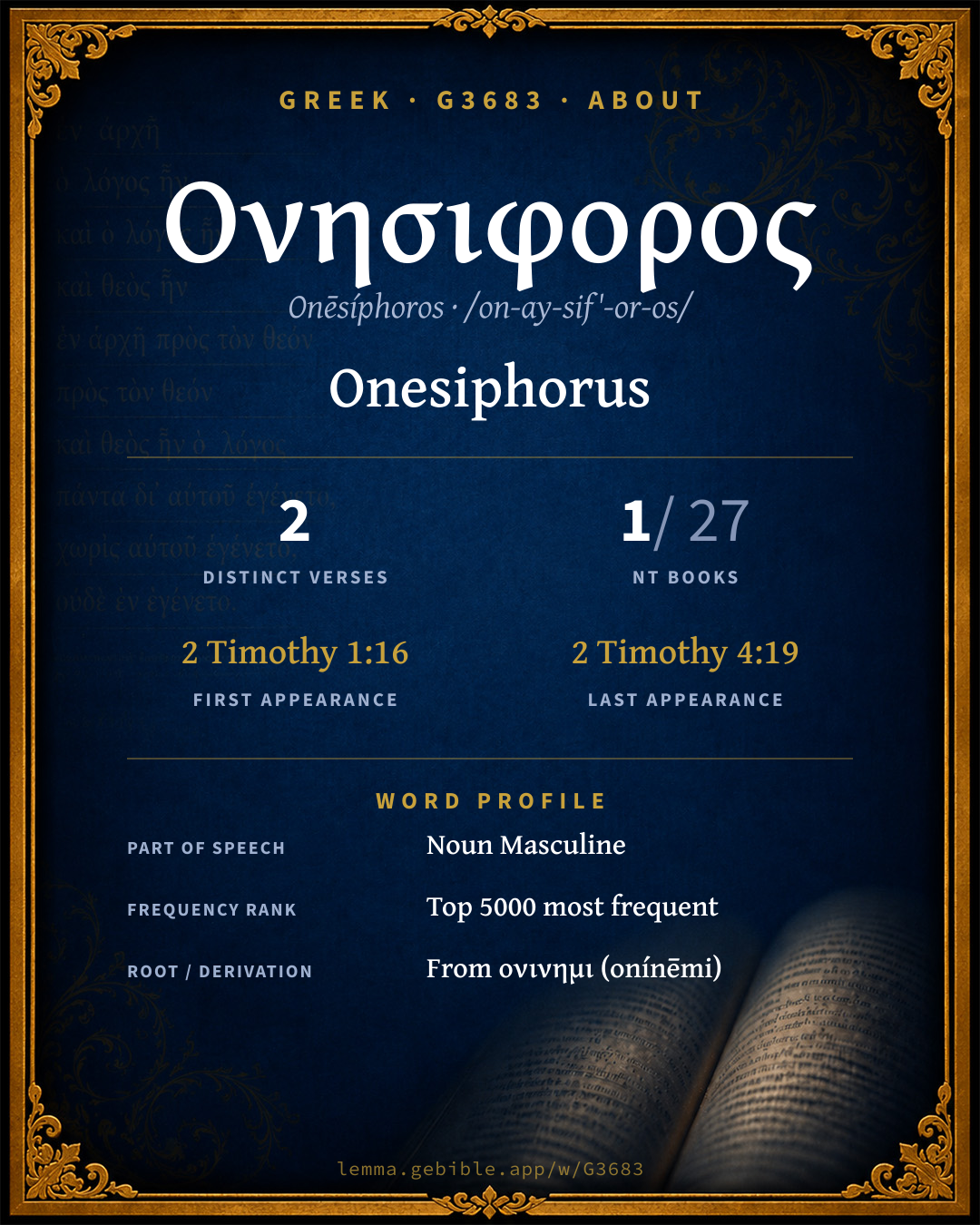
Ὀνησίφορος
Onesiphorus
Thayer's lists 2 entries for ‘Onesiphorus’ fuller range ↓
Full lexicon entry — Thayer's Greek Lexicon
From Thayer's Greek Lexicon
Where this word appears
Grammar key — what these labels mean
Part of speech
- Noun
- A naming word — a person, place, thing, or idea.
Case
- Genitive
- The case of source, possession, or “of” — answers “whose / from what.”
Gender
- Masculine
- Grammatically masculine.
Number
- Singular
- One.
Every verse where G3683 appears — 2 distinct verses across 1 book. Click any verse to open its interlinear word-by-word view. Verse text shown in the World English Bible for context — . Each verse’s Greek form is shown with its reference; the English is not keyword-highlighted, since the data carries no word-level English alignment. Use “Compare translations” on any verse to read it across multiple English versions. This concordance covers the Greek New Testament; Septuagint (Greek Old Testament) occurrences of this word are not indexed here.
2 Timothy 2 verses
About this entry
At a glance — auto-summarized from this page’s data, not written by a person. Every figure links to its source below. This summary describes the numbers; it doesn’t interpret them.
Ονησιφορος — transliterated Onēsíphoros — is a Greek name carrying the sense “Onesiphorus.” It is rare — just 2 verses in the entire Greek New Testament. More than three-quarters of its appearances fall in 2 Timothy. Debuting at 2 Timothy 1:16, it then recurs through the corpus. See 2-verse concordance and the renderings breakdown below.
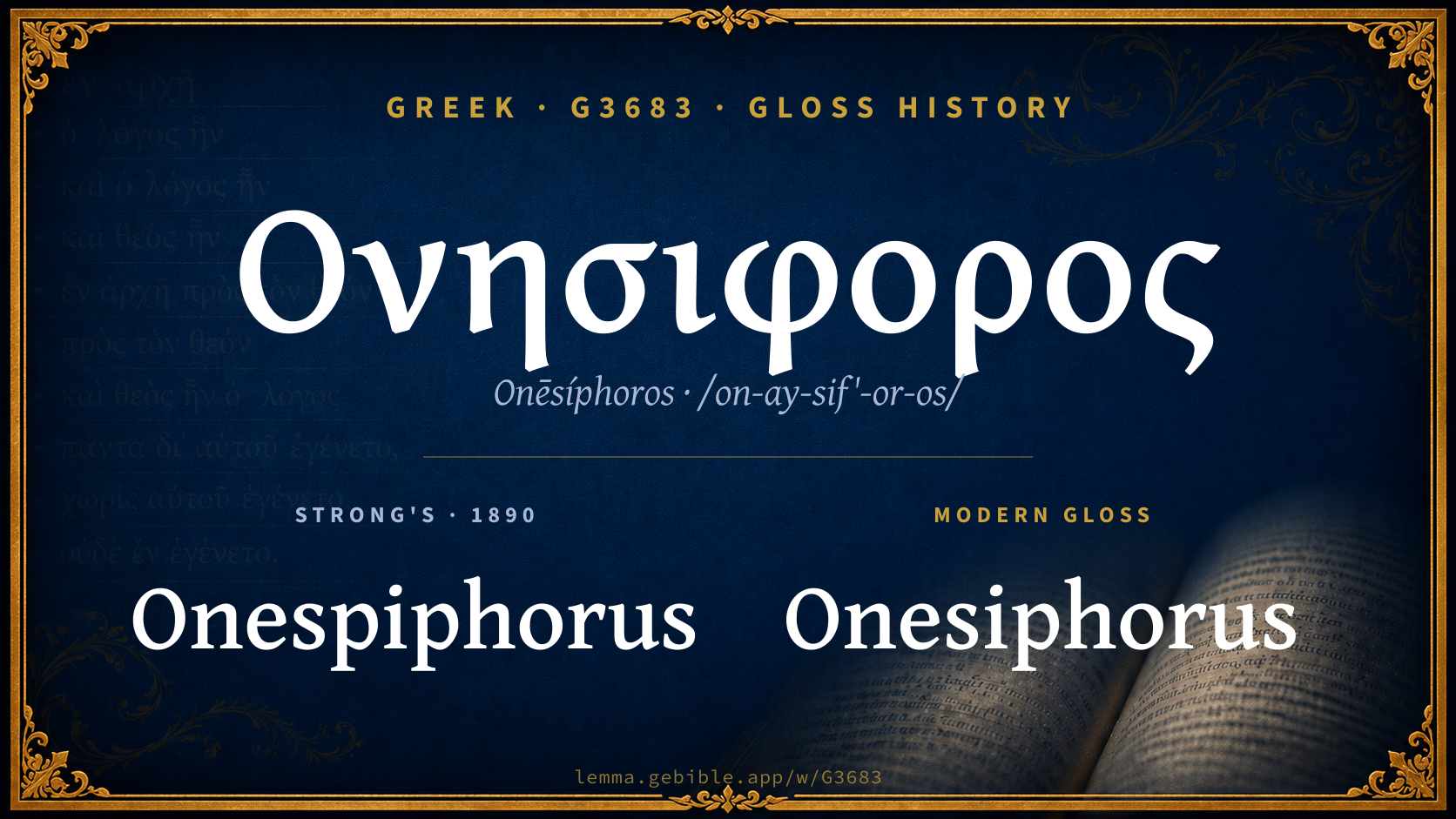
Gloss history
Strong's 1890 vs modern scholarship
About this word
Strong's G3683 catalogs a Greek word from the Greek New Testament.
These counts are not copied from any lexicon or concordance. They are computed here, from the morphology-tagged Greek New Testament. What Lemma adds →
- 2
- distinct verses
- The word appears in 2 distinct verses.
- 1 / 27
- NT books
- The word appears in 1 of 27 New Testament books.
- #2,678
- by frequency
- Top 5000 most frequent Greek words (rank 2,678 of 5,347 Greek words by occurrence).
View all 2 occurrences in the concordance →
Most concentrated in
- 2 Timothy 2 verses 100%
By section of the New Testament
By traditional corpus
Conventional, traditional groupings — biblical authorship is debated, so this is a traditional corpus grouping, not an authorship claim. Some books belong to more than one corpus (Luke is in both the Gospels and the Lukan corpus, and so on), so these shares overlap and need not total 100%. Each figure is a share of the word’s 2 distinct verses.
- Pauline corpus 2 verses · 100%
How translations render this word
Counts come from each version’s own published word-to-Strong’s tagging or interlinear alignment — an approximate guide to how each version renders this word, not a word-level alignment the data otherwise carries. Because each total is that version’s own tagged count, the per-version totals vary from one another and need not match the appearance or distinct-verse counts above. These counts may also differ from a printed concordance because Lemma counts each distinctly tagged rendering and does not collapse phrase taggings into a single head-word total. This is a fixed set of word-tagged versions (KJV, ASV, BSB, ULT) and does not change with the reading translation you choose elsewhere. Each version’s license is shown beside its name below (and on Sources).
- King James Version: Onesiphorus 2×
- American Standard Version: Onesiphorus 2×
- Berean Standard Bible: Onesiphorus 2×
- unfoldingWord Literal Text: Onesiphorus 2×
King James Version Public Domain
Renders G3683 across 2 tagged occurrences — most commonly:
American Standard Version Public Domain
Renders G3683 across 2 tagged occurrences — most commonly:
Berean Standard Bible Public Domain
Renders G3683 across 2 tagged occurrences — most commonly:
unfoldingWord Literal Text CC BY-SA 4.0
Renders G3683 across 2 tagged occurrences — most commonly:
Senses in Thayer's
The 2 senses Thayer's distinguishes for this word, in lexicon order (not ranked by frequency or importance). The full entry — with sub-senses — is in the Lexicon Entry tab.
- Onesiphorus = "bringing profit"
- the name of a certain Christian in 2 Ti. 1:16-18 , 4:19
Word origin
Derived from ονινημι (onínēmi) (G3685) — to profit.
Same root — word family
Other Thayer's entries built from the same root as G3683, grouped by Strong’s listed origin. These share a root / origin per the lexicon — not necessarily a shared meaning. Each links to that word’s own entry.
Derives from
Proper names from this root
People and places named from this root — a name, not an additional meaning of the word.
Compare all same-root words → 1 of the same-root words is a proper name (a person or place). They share a root, not necessarily a meaning.
Bible dictionary
Public-domain dictionary articles matched to this entry by name (Onesiphorus). A biblical name can be shared by more than one person or place, so an article may treat several.
Easton's Bible Dictionary · M. G. Easton, 1897
Bringing profit, an Ephesian Christian who showed great kindness to Paul at Rome. He served him in many things, and had oft refreshed him. Paul expresses a warm interest in him and his household (2 Tim. 1:16-18; 4:19).
Smith's Bible Dictionary · William Smith, 1863
(bringing profit) is named twice only in the New Testament, viz. (2 Timothy 1:16-18) and 2Tim 4:19 Paul mentions him in terms of grateful love as having a noble courage and generosity in his behalf, amid his trials as a prisoner at Rome, when others from whom he expected better things had deserted him. (2 Timothy 4:16) Probably other members of the family were also active Christians. (2 Timothy 4:19) It is evident from (2 Timothy 1:18) that Onesiphorus had his home at Ephesus. (A.D. 64.)
Hitchcock's Bible Names Dictionary · Roswell D. Hitchcock, 1869
who brings profit
Classic public-domain reference works; full attribution on Sources.