2 Chronicles 34:23

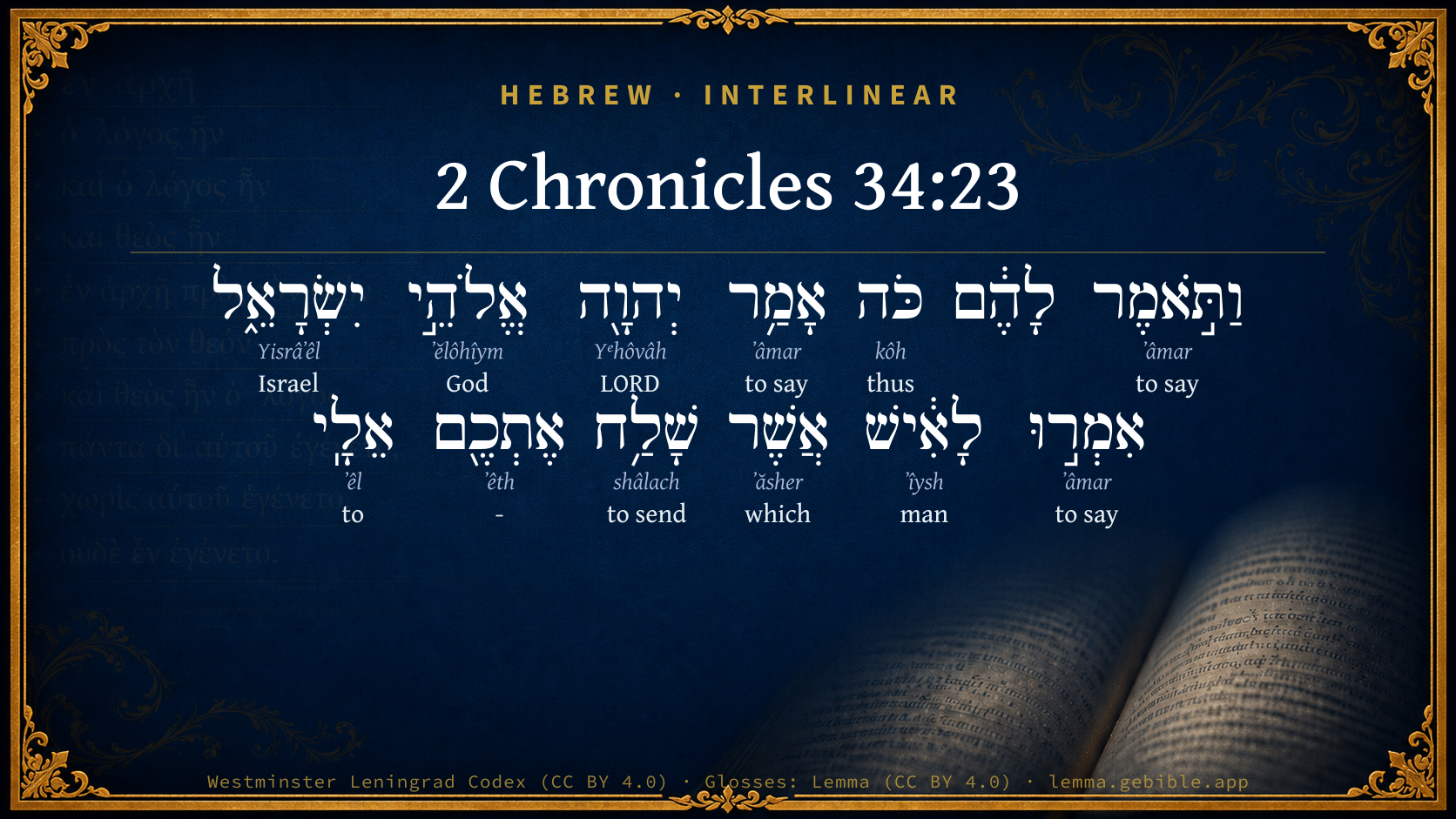
Hebrew (Westminster Leningrad Codex) 2 Chronicles 34:23 appears in the Hebrew Old Testament. The text above is from the Westminster Leningrad Codex. Each word links to its Strong’s number, a concise gloss, and parsing drawn from the Open Scriptures Hebrew Bible morphology. Click any word for its full Brown-Driver-Briggs (BDB) entry.
Download image
Cite this verse

2 Chronicles 34:23 (World English Bible). Public Domain. Lemma interlinear Bible study tool, https://lemma.gebible.app/v/2-chronicles/34/23.

Show BibTeX & RIS
BibTeX
RIS
English Translation
She said to them, Thus says Yahweh, the God of Israel: Tell you the man who sent you to me,
World English Bible · Public Domain
Download a study sheet

One document with this verse’s original text, its word-by-word gloss line, the meaning frame, cross-references with their text, attributed commentary, and full source and license credits — printable, and it pastes into notes with its structure intact.

This verse Autodidact and up

Study sheet (.html) Plain text (.txt)

A passage Seminary Student

Up to 50 verses in one chapter. A passage sheet keeps up to 6 commentary sources and 12 cross-references per verse, in the order this page ranks them, and says so on the sheet whenever that leaves anything out. Ask for a single verse and you get the Autodidact verse sheet above.

Everything on this page stays free to read, with no account — the sheet is a download of what is already on screen, not access to it.

Want to remove ads? Support Godless Engineer
Compare translations 3

The same verse in 3 English versions, stacked beneath the original-language interlinear above. Click any original word for its lexicon entry.

Each is an independent rendering of the whole verse — the interlinear is not word-aligned to these translations.

Highlighted words mark where these versions differ — a whole-verse word diff, not a word-by-word alignment.

  • World English Bible Public Domain
    She said to them, Thus says Yahweh, the God of Israel: Tell you the man who sent you to me,
  • King James Version Public Domain
    And she answered them, Thus saith the LORD God of Israel, Tell ye the man that sent you to me,
  • unfoldingWord Literal Text CC BY-SA 4.0
    And she said to them, “Thus says Yahweh, the God of Israel: Say to the man who sent you all to me,

unfoldingWord Literal Text — © unfoldingWord, licensed CC BY-SA 4.0. Word-aligned USFM3 via Door43 (git.door43.org/unfoldingWord/en_ult).

Versions to compare (up to 4)

3 of 4 selected

Show all 18 translations

Every available English version of this verse, each an independent rendering of the whole verse.

  • World English Bible Public Domain
    She said to them, Thus says Yahweh, the God of Israel: Tell you the man who sent you to me,
  • Berean Standard Bible Public Domain
    And Huldah said to them, “This is what the LORD, the God of Israel, says: ‘Tell the man who sent you
  • Majority Standard Bible Public Domain
    And Huldah said to them, “This is what the LORD, the God of Israel, says: ‘Tell the man who sent you
  • King James Version Public Domain
    And she answered them, Thus saith the LORD God of Israel, Tell ye the man that sent you to me,
  • American Standard Version (1901) Public Domain
    And she said unto them, Thus saith Jehovah, the God of Israel: Tell ye the man that sent you unto me,
  • Revised Version (1885) Public Domain
    And she said unto them, Thus saith the LORD, the God of Israel: tell ye the man that sent you unto me,
  • Geneva Bible (1599) Public Domain
    And shee answered them, Thus sayth the Lord God of Israel, Tell yee the man that sent you to me,
  • Douay-Rheims (1899) Public Domain
    And she answered them: Thus saith the Lord the God of Israel: Tell the man that sent you to me:
  • Young's Literal Translation Public Domain
    And she saith to them, `Thus said Jehovah, God of Israel, Say to the man who hath sent you unto me,
  • Literal Standard Version CC BY-SA 4.0
    And she says to them, “Thus said YHWH, God of Israel: Say to the man who has sent you to me,
  • Unlocked Literal Bible CC BY-SA 4.0
    She said to them, “This is what Yahweh, the God of Israel, says: Tell the man who sent you to me,
  • unfoldingWord Literal Text CC BY-SA 4.0
    And she said to them, “Thus says Yahweh, the God of Israel: Say to the man who sent you all to me,
  • Darby Bible Public Domain
    And she said to them, Thus saith Jehovah the God of Israel: Tell the man that sent you to me,
  • World Messianic Bible Public Domain
    She said to them, “The LORD, the God of Israel says: ‘Tell the man who sent you to me,
  • Webster's Bible Public Domain
    And she answered them, Thus saith the LORD God of Israel, Tell ye the man that sent you to me.
  • Free Bible Version CC BY-SA 4.0
    Huldah told them, “This is what the Lord, the God of Israel, says: Tell the man who sent you to me,
  • Bible in Basic English Public Domain
    And she said to them, The Lord, the God of Israel, has said, Say to the man who sent you to me,
  • JPS Tanakh (1917) Public Domain
    And she said unto them: 'Thus saith the LORD, the God of Israel: Tell ye the man that sent you unto me:

Literal Standard Version (2020), Covenant Press — licensed CC BY-SA 4.0. Text via the HelloAO Bible API (eBible.org). Unlocked Literal Bible (unfoldingWord) — licensed CC BY-SA 4.0. Text via the HelloAO Bible API (eBible.org). unfoldingWord Literal Text — © unfoldingWord, licensed CC BY-SA 4.0. Word-aligned USFM3 via Door43 (git.door43.org/unfoldingWord/en_ult). Free Bible Version, Dr. Jonathan Gallagher — licensed CC BY-SA 4.0. Text via the HelloAO Bible API (eBible.org).

Word by word

More ways to search: Search by grammar → Find every occurrence → Compare this word →

Practice this passage: Drill this verse → Learn its vocabulary →

כֹּה
kôh
H3541
“thus”
Adverb
Part of Speech
Adverb
Full BDB Definition

Origin: from the prefix k and H1931

TWOT: 955

thus, here, in this manner - thus, so - here, here and there - until now, until now...until then, meanwhile
  1. וַתֹּ֣אמֶר ʼâmar H559 “and · to say” Conjunction + Verb, Qal, Sequential Imperfect, 3rd Person, Feminine, Singular
  2. אָמַ֥ר ʼâmar H559 “to say” Verb, Qal, Perfect, 3rd Person, Masculine, Singular
  3. יְהוָ֖ה Yᵉhôvâh H3068 “LORD” Noun, Proper
  4. אֱלֹהֵ֣י ʼĕlôhîym H430 “God(s) of” Noun, Common, Masculine, Plural, Construct
  5. יִשְׂרָאֵ֑ל Yisrâʼêl H3478 “Israel” Noun, Proper
  6. אִמְר֣וּ ʼâmar H559 “say” Verb, Qal, Imperative, 2nd Person, Masculine, Plural
  7. לָאִ֔ישׁ ʼîysh H376 “to/for the · man” Preposition, Determined + Noun, Common, Masculine, Singular, Absolute
  8. אֲשֶׁר ʼăsher H834 “which” Particle, Relative
  9. שָׁלַ֥ח shâlach H7971 “to send” Verb, Qal, Perfect, 3rd Person, Masculine, Singular
  10. אֶתְכֶ֖ם ʼêth H853 “- · you” Particle, Direct Object + Suffix, Personal, 2nd Person, Masculine, Plural
  11. אֵלָֽי ʼêl H413 “to · me” Preposition + Suffix, Personal, 1st Person, Common, Singular

About this verse

These counts appear in no published source. They are computed here, from the morphology-tagged text and Lemma’s own curated glosses. What Lemma adds →

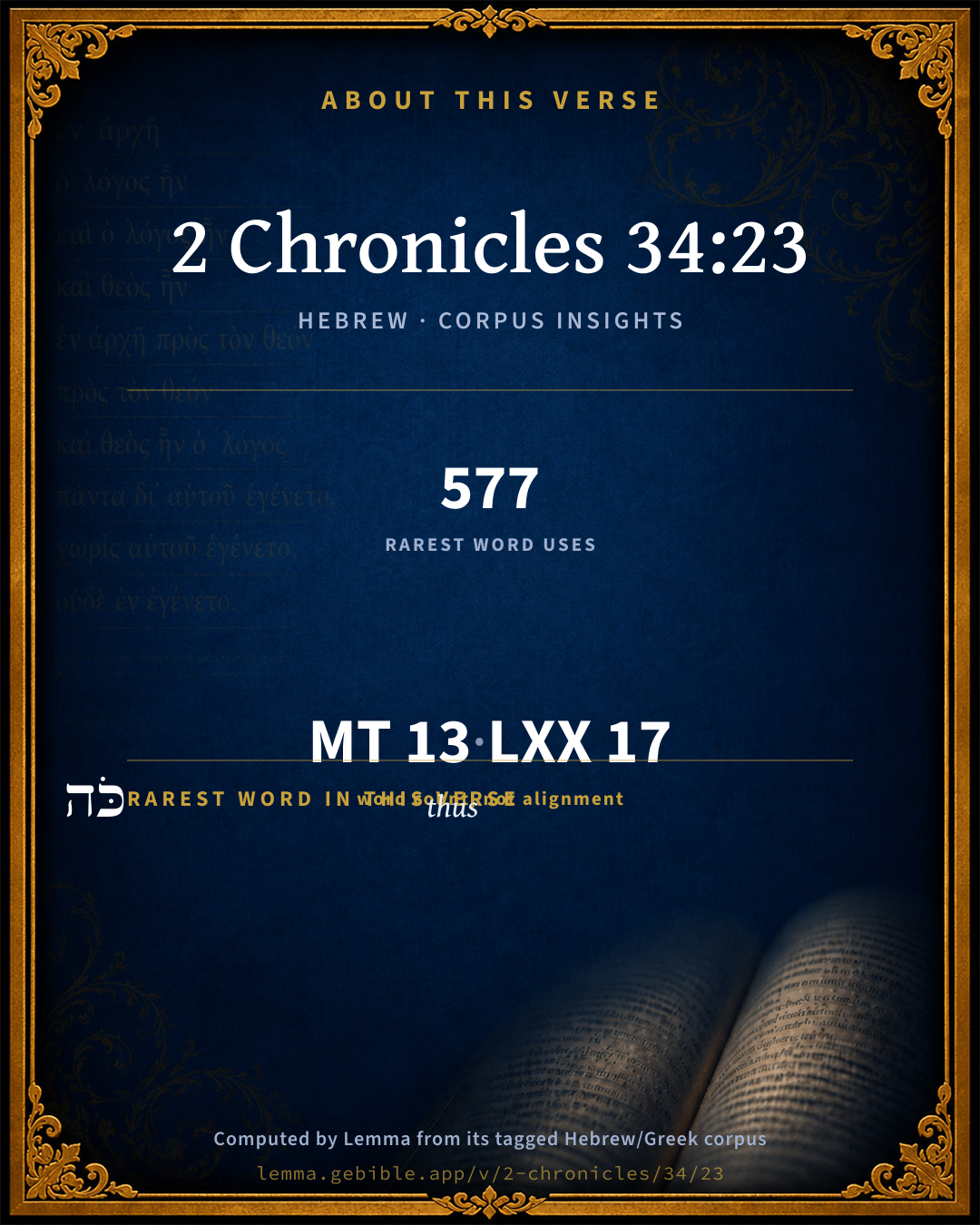
13
words
10
distinct lemmas
Historical
section

Grammatical profile

  • 4 verbs
  • 4 nouns
  • 2 prepositions
  • 1 adverb
  • 2 particles

Verb forms

  • וַתֹּ֣אמֶר Qal · Sequential Imperfect
  • אָמַ֥ר Qal · Perfect
  • אִמְר֣וּ Qal · Imperative
  • שָׁלַ֥ח Qal · Perfect

Repetition

A word recurs within this verse — often emphatic in Hebrew:

  • וַתֹּ֣אמֶר to say H559 ×3

Hebrew & Septuagint length

In English translation the verse runs 20 words from the Hebrew and 21 from the Septuagint (LXX English) — closely comparable.

A rough comparison of the two English renderings, which tokenize alike — not a word-level alignment.

Word counts can differ between the Hebrew and the Greek without any difference in meaning — e.g. the Hebrew direct-object marker אֵת has no separate Greek word, and Greek often adds the article ὁ.

In the original languages it is 13 Hebrew tokens and 17 Greek tokens — but the two are counted differently (Hebrew bundles its prefixes and suffixes into one token; the Greek is in lemma form), so that isn’t a like-for-like length.

Cross-references

3

Topical passages linked to 2 Chronicles 34:23 in the Treasury of Scripture Knowledge — connected by theme and wording, ordered by reader-vote popularity; previews shown in the World English Bible.

  • 2 Kings 22:15–20 She said to them, Thus says Yahweh, the God of Israel: Tell you the man who sent you to me,
  • Jeremiah 21:3–7 Then said Jeremiah to them, Thus shall you tell Zedekiah:
  • Jeremiah 37:7–10 Thus says Yahweh, the God of Israel, Thus shall you tell the king of Judah, who sent you to me to inquire of me: Behold, Pharaoh's army, which is come forth to help you, shall return to Egypt into their own land.

Cross-references courtesy of OpenBible.info (CC BY 4.0).

Hebrew and Greek witnesses Masoretic Hebrew ↔ Greek Septuagint

The same verse in the two great witnesses to the Old Testament, shown verse-for-verse.

These are two independent witnesses, not word-aligned to each other, and the Septuagint is shown in lemma (dictionary) form.

Hebrew 2 Chronicles 34:23 Masoretic · Westminster Leningrad Codex

וַתֹּ֣אמֶר לָהֶ֔ם כֹּה אָמַ֥ר יְהוָ֖ה אֱלֹהֵ֣י יִשְׂרָאֵ֑ל אִמְר֣וּ לָאִ֔ישׁ אֲשֶׁר שָׁלַ֥ח אֶתְכֶ֖ם אֵלָֽי

She said to them, Thus says Yahweh, the God of Israel: Tell you the man who sent you to me,

World English Bible · Public Domain

Greek LXX 2 Chronicles 34:23 Septuagint · lemma form

καί εἶπον αὐτός οὕτως εἶπον κύριος ὁ θεός ἰσραήλ εἶπον ὁ ἀνήρ ὁ ἀποστέλλω σύ πρός ἐγώ

And she said to them, Thus has the Lord God of Israel said, Tell the man who sent you to me,

LXX2012 (modern English Septuagint) · Public Domain

Hebrew: Westminster Leningrad Codex (CC BY 4.0). Greek: Septuagint (public domain); English from LXX2012 (modern English Septuagint) (Public Domain). How the Septuagint differs from the Hebrew →

Commentary

Notes on 2 Chronicles 34:23 from classic Christian and Jewish commentators (each source and its license shown beneath its notes). The classic Christian expositions comment on the surrounding passage and are grouped to its opening verse, so a note may address several verses; the Jewish commentaries on the Tanakh (Rashi and others) are per-verse, so they appear only where the commentator wrote on this verse.

Lemma curates 59 commentaries, every one of them public domain or Creative Commons licensed, each selected and text-cleaned for this edition rather than reprinted as found. About our sources →

Geneva Bible (1599)

Geneva Bible translators

That is, to the King.

Geneva Bible (1599) marginal notes — public domain. Text via Bolls.life.

The Cambridge Bible for Schools and Colleges

gen. ed. J. J. S. Perowne

23. she answered them] R.V. she said unto them.

The Cambridge Bible for Schools and Colleges (gen. ed. J. J. S. Perowne; Cambridge University Press, 1878–1918) — public domain. Text from a community e-Sword module.

The Pulpit Commentary

The oracular answer of Huldah, contained in this and the following five verses, is very closely paralleled by the six verses of 2Ki_22:15-20.

The Pulpit Commentary (1880–1919), ed. H.D.M. Spence-Jones & Joseph S. Exell — public domain. Text from a community e-Sword module.

unfoldingWord translationNotes

Door43 World Missions Community

the man who sent you to me

Here "the man" refers to King Josiah.

See

The word is used here as an idiom to draw the listener's attention to what is said next. AT: "Listen" (See: Idiom)

I am about to bring disaster on this place and on its inhabitants

Yahweh causing terrible things to happen is spoken of as if disaster were an object that he could bring to a place. AT: "I will soon cause terrible things to happen to this place and to those who live there" (See: Metaphor)

on this place

"to Jerusalem" This refers to the city of Jerusalem which represents the whole land of Judah. AT: "on Judah" (See: Synecdoche)

all the curses that have been written

This can be stated in active form. AT: "all the curses written" or "all the curses" (See: Active or Passive)

they have provoked me to anger

"they have made me angry"

therefore, my anger will be poured out on this place, and it will not be extinguished

Emotions such as anger are often spoken of in Scripture as if they were liquids. AT: "therefore, my anger against this place is like a fire, and nothing will stop it" (See: Metaphor)

my anger will be poured out

This can be stated in active form. AT: "I will pour out my anger" (See: Active or Passive)

on this place

Here "this place" refers to the people who live there. AT: "on these people" (See: Metonymy)

translationWords

Yahweh

God

Israel

curse

forsake

incense

false god

unfoldingWord translationNotes — © Distant Shores Media and the Door43 World Missions Community, licensed CC BY-SA 4.0. Source: git.door43.org/Door43/en_tn.

Rashi

Rabbi Shlomo Yitzchaki (Rashi)

Say to the man He wished to interrupt the prophecy of the people “upon this place and upon its inhabitants,” and when he finished that prophecy, he then delineates, “And concerning the king of Judah, who sent you,” and he deals briefly with the prophecy of the palace and its inhabitants and puts it aside and focuses upon the prophecy of the king, which is long.

Rashi on the Tanakh — English translations: “The Judaica Press complete Tanach with Rashi, translated by A. J. Rosenberg” (CC BY 4.0); “Pentateuch with Rashi's commentary by M. Rosenbaum and A.M. Silbermann, 1929-1934” (public domain); “The Metsudah Tanach series, Lakewood, N.J” (CC BY 4.0); and “The Book of Joshua, Metsudah Publications, 1997” (CC BY 4.0). Text via Sefaria.

Lesson kit

Teaching starters — assembled from the data on this page, not authored interpretation. Every prompt links to the verse data it draws on. Edit before teaching.

2 Chronicles, in the Historical, opens this verse with 13 words (10 distinct Hebrew lemmas). Its most distinctive word is kôh (“thus”). A historical commentator’s framing appears above. Read the whole chapter for the surrounding context.

Discussion questions

  1. What does “thus” (kôh) contribute to the verse as a whole?
  2. 2 Kings 22:15–20 shares this passage’s theme. How do the two illuminate each other?
  3. “to say” occurs 3× in this one verse. What is the effect of the repetition?
  4. These translations render this verse differently. What is at stake in choosing one wording over another?
  5. The verb «וַתֹּ֣אמֶר» is Qal Sequential Imperfect. How does its form color the action?
  6. Reading how Geneva Bible (1599) and The Cambridge Bible for Schools and Colleges read this verse, where do the two commentators agree and where do they part?

Things to notice

Reading settings

Reading text

Shown beneath each verse's original-language words.

Old Testament
Old Testament edition

Read the OT as the Masoretic Hebrew (MT) or the Greek Septuagint (LXX).

English shown for the Greek Septuagint (in the Hebrew ↔ Greek comparison).

Comparing translations? Open the Compare panel on any verse page to stack up to four side by side.