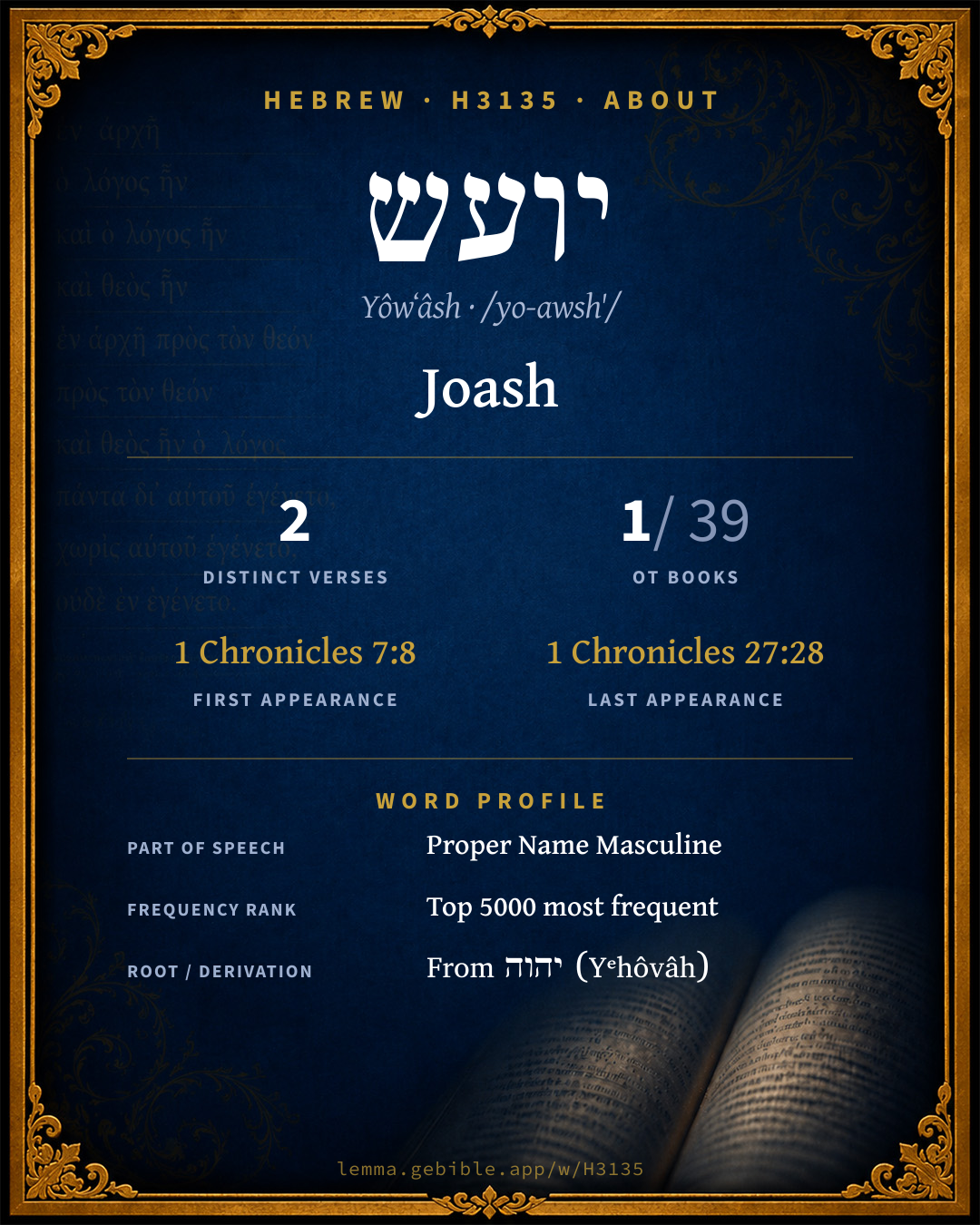
יוֹעָשׁ
Joash
BDB lists 3 entries for ‘Joash’ fuller range ↓
Full lexicon entry — Brown-Driver-Briggs (BDB)
From Brown-Driver-Briggs (BDB)
Where this word appears
Grammar key — what these labels mean
Part of speech
- Noun
- A naming word — a person, place, thing, or idea.
Noun type
- Proper
- A name of a specific person, place, or people (e.g. Abraham, Zion, Israel).
Every verse where H3135 appears — 2 distinct verses across 1 book. Click any verse to open its interlinear word-by-word view. Verse text shown in the World English Bible for context — . Each verse’s Hebrew form is shown with its reference; the English is not keyword-highlighted, since the data carries no word-level English alignment. Use “Compare translations” on any verse to read it across multiple English versions. This concordance covers the Hebrew Bible; Septuagint (Greek Old Testament) occurrences are not indexed here.
1 Chronicles 2 verses
- 1 Chronicles 7:8 וְ/יוֹעָ֡שׁ conj + n Proper The sons of Becher: Zemirah, and Joash, and Eliezer, and Elioenai, and Omri, and Jeremoth, and Abijah, and Anathoth, and Alemeth. All these were the sons of Becher.
- 1 Chronicles 27:28 יוֹעָֽשׁ n Proper and over the olive trees and the sycamore trees that were in the lowland was Baal Hanan the Gederite: and over the cellars of oil was Joash:
About this entry
At a glance — auto-summarized from this page’s data, not written by a person. Every figure links to its source below. This summary describes the numbers; it doesn’t interpret them.
“Joash” is the headline sense of the Hebrew name יועש (Yôwʻâsh). It is rare — just 2 verses in the entire Hebrew Bible. More than three-quarters of its appearances fall in 1 Chronicles. First canonically at 1 Chronicles 7:8, it enters the text early. See 2-verse concordance and the renderings breakdown below.
Gloss history
Strong's 1890 vs modern scholarship
About this word
Strong's H3135 catalogs a Hebrew word from the Hebrew Old Testament.
These counts are not copied from any lexicon or concordance. They are computed here, from the morphology-tagged Hebrew Old Testament. What Lemma adds →
- 2
- distinct verses
- The word appears in 2 distinct verses.
- 1 / 39
- OT books
- The word appears in 1 of 39 Old Testament books.
- #4,807
- by frequency
- Top 5000 most frequent Hebrew words (rank 4,807 of 8,640 Hebrew words by occurrence).
View all 2 occurrences in the concordance →
Most concentrated in
- 1 Chronicles 2 verses 100%
By section of the Old Testament
By traditional corpus
Conventional, traditional groupings — biblical authorship is debated, so this is a traditional corpus grouping, not an authorship claim. Each share is this word’s portion of its verses in that division of the Hebrew canon. Each figure is a share of the word’s 2 distinct verses.
- Writings (Ketuvim) 2 verses · 100%
How translations render this word
Counts come from each version’s own published word-to-Strong’s tagging or interlinear alignment — an approximate guide to how each version renders this word, not a word-level alignment the data otherwise carries. Because each total is that version’s own tagged count, the per-version totals vary from one another and need not match the appearance or distinct-verse counts above. These counts may also differ from a printed concordance because Lemma counts each distinctly tagged rendering and does not collapse phrase taggings into a single head-word total. This is a fixed set of word-tagged versions (KJV, ASV, BSB, ULT) and does not change with the reading translation you choose elsewhere. Each version’s license is shown beside its name below (and on Sources).
- King James Version: Joash 1×, Was joash 1×
- American Standard Version: Joash 1×, Was joash 1×
- Berean Standard Bible: Joash 2×
- unfoldingWord Literal Text: Joash 1×, Was joash 1×
King James Version Public Domain
Renders H3135 across 2 tagged occurrences — most commonly:
American Standard Version Public Domain
Renders H3135 across 2 tagged occurrences — most commonly:
Berean Standard Bible Public Domain
Renders H3135 across 2 tagged occurrences — most commonly:
unfoldingWord Literal Text CC BY-SA 4.0
Renders H3135 across 2 tagged occurrences — most commonly:
Senses in the full BDB
What do BDB’s symbols mean?
BDB uses these scholarly abbreviations:
| Symbol | Meaning |
|---|---|
| 𝔊 | the Septuagint (the ancient Greek translation, LXX) |
| 𝔙 | the Vulgate (the Latin translation) |
| 𝔖 | the Syriac version (the Peshitta) |
| 𝔗 | the Targum (the Aramaic translation) |
| ψ | the Psalms |
| √ | root (the underlying root or stem) |
| ‖ | parallel passage (a synonymous or contrasted parallel) |
| † | the dagger: every passage where the word occurs is cited |
The 2 senses and sub-senses the full Brown-Driver-Briggs lexicon distinguishes for this word, in lexicon order (not ranked by frequency), with BDB’s own verbatim wording and sub-sense lettering. Shown in Hebrew script with BDB’s own scholarly abbreviations. The condensed entry is in the Lexicon Entry tab. See also the Forms in the corpus table below.
- 1. a Benjamite, son of Becher 1 Ch 7:8. e.g. 1 Chronicles 7:8
- 2. an officer under David 1 Ch 27:28. e.g. 1 Chronicles 27:28
Senses from the full Brown-Driver-Briggs lexicon (Brown, Driver, Briggs; Oxford 1906 — public domain), digitized via Sefaria, supplemented by the OpenScriptures HebrewLexicon (CC BY 4.0). Full attribution on Sources.
Word origin
n.pr.m. 𝔊 Ἰωας (י׳ hath aided (?; cf. Arabic غَاثَ; comp. Sab. אלעֿותֿ DHM in MV)—
— Brown-Driver-Briggs (Oxford 1906, public domain), digitized via Sefaria, supplemented by the OpenScriptures HebrewLexicon (CC BY 4.0). See Sources.
Derived from יהוה (Yᵉhôvâh) (H3068) — LORD.
Forms in the corpus
The 2 distinct written forms H3135 takes in the Hebrew Bible, most frequent first — each parse links to that state’s occurrences in the concordance. Hebrew forms include their vowel points and cantillation, so a single lemma takes many written forms.
| Form | Parsing | Example | Uses |
|---|---|---|---|
| וְ/יוֹעָ֡שׁ | Noun, Proper | 1 Chronicles 7:8 | 1 |
| יוֹעָֽשׁ | Noun, Proper | 1 Chronicles 27:28 | 1 |
Same root — word family
Other BDB entries built from the same root as H3135, grouped by Strong’s listed origin. These share a root / origin per the lexicon — not necessarily a shared meaning. Each links to that word’s own entry.
Derives from
Proper names from this root
People and places named from this root — a name, not an additional meaning of the word.
- הושמע Hôwshâmâʻ H1953 Hoshama
- יה Yâhh H3050 Jah
- יהוא Yêhûwʼ H3058 Jehu
- יהואחז Yᵉhôwʼâchâz H3059 Jehoahaz
- יהואש Yᵉhôwʼâsh H3060 Jehoash
- יהוה Yᵉhôvih H3069 LORD
- יהוה יראה Yᵉhôvâh yirʼeh H3070 Jehovah-jireh
- יהוה נסי Yᵉhôvâh niççîy H3071 Jehovah-nissi
- יהוה צדקנו Yᵉhôvâh tsidqênûw H3072 a sacred name symbolically applied to
- יהוה שלום Yᵉhôvâh shâlôwm H3073 Jehovah-shalom
- יהוה שמה Yᵉhôvâh shâmmâh H3074 Jehovahshammah
- יהוזבד Yᵉhôwzâbâd H3075 Jehozabad
- יהוחנן Yᵉhôwchânân H3076 Jehohanan
- יהוידע Yᵉhôwyâdâʻ H3077 Jehoiada
- יהויכין Yᵉhôwyâkîyn H3078 Jehoiachin
- יהויקים Yᵉhôwyâqîym H3079 Jehoiakim
- יהויריב Yᵉhôwyârîyb H3080 Jehoiarib
- יהונדב Yᵉhôwnâdâb H3082 Jehonadab
- יהונתן Yᵉhôwnâthân H3083 Jonathan
- יהועדה Yᵉhôwʻaddâh H3085 Jehoadah
- יהועדין Yᵉhôwʻaddîyn H3086 Jehoaddan
- יהוצדק Yᵉhôwtsâdâq H3087 Jehozadak
- יהורם Yᵉhôwrâm H3088 Jehoram
- יהושבע Yᵉhôwshebaʻ H3089 Jehosheba
+11 more proper names from this root (not shown).
Compare all same-root words → Showing 4 of 37 — not the complete family. 36 of the same-root words are proper names (people or places). They share a root, not necessarily a meaning.
Bible dictionary
Public-domain dictionary articles matched to this entry by name (Joash). A biblical name can be shared by more than one person or place, so an article may treat several.
Easton's Bible Dictionary · M. G. Easton, 1897
Whom Jehovah bestowed. (1.) A contracted form of Jehoash, the father of Gideon (Judg. 6:11, 29; 8:13, 29, 32).
(2.) One of the Benjamite archers who joined David at Ziklag (1 Chr. 12:3).
(3.) One of King Ahab's sons (1 Kings 22:26).
(4.) King of Judah (2 Kings 11:2; 12:19, 20). (See JEHOASH .)
(5.) King of Israel (2 Kings 13:9, 12, 13, 25). (See JEHOASH .)
(6.) 1 Chr. 7:8.
(7.) One who had charge of the royal stores of oil under David and Solomon (1 Chr. 27:28).
Smith's Bible Dictionary · William Smith, 1863
(to whom Jehovah hastens, i.e. to help), contracted from Jehoash.
+ Son of Ahaziah king of Judah (B.C. 884), and the only one of his children who escaped the murderous hand of Athaliah. After his father's sister Jehoshabeath, the wife of Jehoiada the high priest, had stolen him from among the king's sons, he was hidden for six years in the chambers of the temple. In the seventh year of his age and of his concealment, a successful revolution, conducted by Jehoiada, placed him on the throne of his ancestors, and freed the country from the tyranny and idolatries of Athaliah. For at least twenty-three years, while Jehoiada lived, his reign was very prosperous; but after the death of Jehoiada, Joash fell into the hands of bad advisers, at whose suggestion he revived the worship of Baal and Ashtaroth. When he was rebuked for this by Zechariah, the son of Jehoiada, Joash caused him to be stoned to death in the very court of the Lord's house. (Matthew 23:35) That very year Hazael king of Syria came up against Jerusalem, and carried off a vast booty as the price of his departure. Joash had scarcely escaped this danger when he fell into another and fatal one. Two of his servants conspired against him and slew him in his bed and in the fortress of Millo. Joash's reign lasted forty years, from 878 to 838 B.C. + Son and successor of Jehoahaz on the throne of Israel from B.C. 840 to 825, and for two full years a contemporary sovereign with the preceding. (2 Kings 14:1) comp. with 2Kin 12:1; 13:10 When he succeeded to the crown the kingdom was in a deplorable state from the devastations of Hazael and Ben-hadad, kings of Syria. On occasion of a friendly visit paid by Joash to Elisha on his death-bed, the prophet promised him deliverance from the Syrian yoke in Aphek, (1 Kings 20:26-30) He then bade him smite upon the ground, and the king smote thrice and then stayed. The prophet rebuked him for staying, and limited to three his victories over Syria. Accordingly Joash did defeat Ben-hadad three times on the field of battle, and recovered from him the cities which Hazael had taken from Jehoahaz. The other great military event of Joash's reign was the successful war with Amaziah king of Judah. He died in the fifteenth year of Amaziah king of Judah. + The father of Gideon, and a wealthy man among the Abiezrites. (Judges 6:11) (B.C. before 1256.) + Apparently a younger son of Ahab, who held a subordinate jurisdiction in the lifetime of his father. (1 Kings 22:26; 2 Chronicles 18:25) (B.C. 896.) + A descendant of Shelah the son of Judah, but whether his son or the son of Jokim is not clear. (1 Chronicles 4:22) + A Benjamite, son of Shemaah of Gibeah, (1 Chronicles 12:3) who resorted to David at Ziklag. + One of the officers of David's household. (1 Chronicles 27:28) + Son of Becher and head of a Benjamite house. (1 Chronicles 7:8)
Hitchcock's Bible Names Dictionary · Roswell D. Hitchcock, 1869
who despairs or burns
Classic public-domain reference works; full attribution on Sources.
Septuagint verse parallels
This word appears in 2 verses that also exist in the Greek Old Testament (Septuagint), out of the 2 Hebrew verses it occurs in. You can read those verses in Greek by switching the Old Testament edition to the Septuagint.
Read these verses in the Septuagint
This is a verse-level parallel only — the same verses exist in both the Hebrew and Greek Old Testaments. No word-level Hebrew↔Greek correspondence is claimed: the data carries no such alignment, so no Greek word is shown as this Hebrew word’s translation. Coverage is not total — the Septuagint omits the deuterocanon and renumbers the Psalms, so some Hebrew verses have no direct Greek parallel.