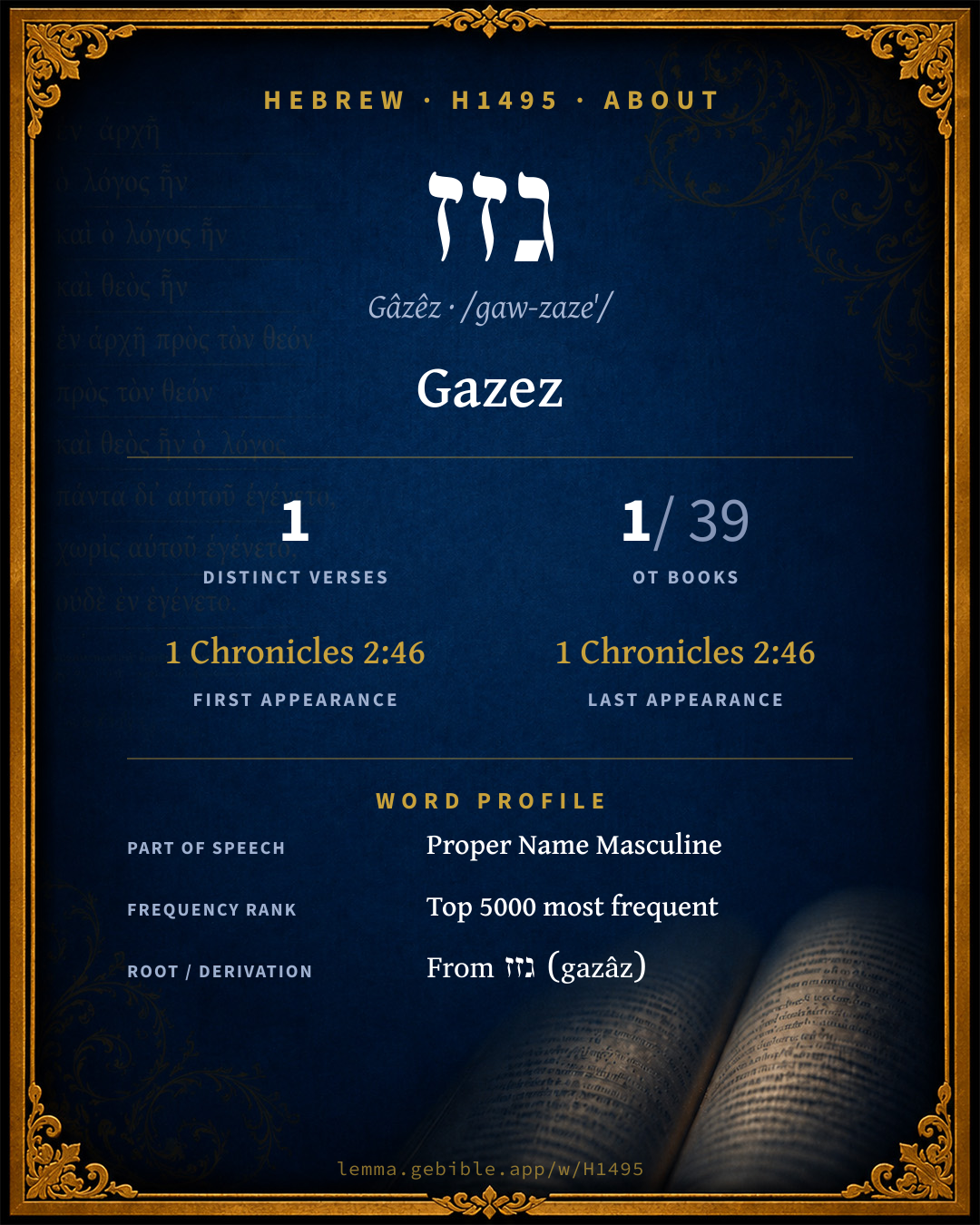
גָּזֵז
Gazez
BDB lists 3 entries for ‘Gazez’ fuller range ↓
Full lexicon entry — Brown-Driver-Briggs (BDB)
From Brown-Driver-Briggs (BDB)
Where this word appears
Grammar key — what these labels mean
Part of speech
- Noun
- A naming word — a person, place, thing, or idea.
Noun type
- Proper
- A name of a specific person, place, or people (e.g. Abraham, Zion, Israel).
Every verse where H1495 appears — 1 distinct verse across 1 book. Click any verse to open its interlinear word-by-word view. Verse text shown in the World English Bible for context — . Each verse’s Hebrew form is shown with its reference; the English is not keyword-highlighted, since the data carries no word-level English alignment. Use “Compare translations” on any verse to read it across multiple English versions. This concordance covers the Hebrew Bible; Septuagint (Greek Old Testament) occurrences are not indexed here.
1 Chronicles 1 verse
About this entry
At a glance — auto-summarized from this page’s data, not written by a person. Every figure links to its source below. This summary describes the numbers; it doesn’t interpret them.
גזז — transliterated Gâzêz — is a Hebrew name carrying the sense “Gazez.” It occurs a mere 1 verse across Scripture. Its uses cluster heavily in 1 Chronicles (100% of all occurrences). Scripture uses it exactly once, at 1 Chronicles 2:46. Each statement above links to its evidence; the full detail follows below.
Gloss history
Strong's 1890 vs modern scholarship
About this word
Strong's H1495 catalogs a Hebrew word from the Hebrew Old Testament.
These counts are not copied from any lexicon or concordance. They are computed here, from the morphology-tagged Hebrew Old Testament. What Lemma adds →
- 1
- distinct verses
- The word appears in 1 distinct verse.
- 1 / 39
- OT books
- The word appears in 1 of 39 Old Testament books.
- #4,807
- by frequency
- Top 5000 most frequent Hebrew words (rank 4,807 of 8,640 Hebrew words by occurrence).
View all 1 occurrence in the concordance →
Most concentrated in
- 1 Chronicles 1 verse 100%
By section of the Old Testament
By traditional corpus
Conventional, traditional groupings — biblical authorship is debated, so this is a traditional corpus grouping, not an authorship claim. Each share is this word’s portion of its verses in that division of the Hebrew canon. Each figure is a share of the word’s 1 distinct verse.
- Writings (Ketuvim) 1 verse · 100%
How translations render this word
Counts come from each version’s own published word-to-Strong’s tagging or interlinear alignment — an approximate guide to how each version renders this word, not a word-level alignment the data otherwise carries. Because each total is that version’s own tagged count, the per-version totals vary from one another and need not match the appearance or distinct-verse counts above. These counts may also differ from a printed concordance because Lemma counts each distinctly tagged rendering and does not collapse phrase taggings into a single head-word total. This is a fixed set of word-tagged versions (KJV, ASV, BSB, ULT) and does not change with the reading translation you choose elsewhere. Each version’s license is shown beside its name below (and on Sources).
- King James Version: Gazez 2×
- American Standard Version: Gazez 2×
- Berean Standard Bible: Gazez 2×
- unfoldingWord Literal Text: Gazez 2×
King James Version Public Domain
Renders H1495 across 2 tagged occurrences — most commonly:
American Standard Version Public Domain
Renders H1495 across 2 tagged occurrences — most commonly:
Berean Standard Bible Public Domain
Renders H1495 across 2 tagged occurrences — most commonly:
unfoldingWord Literal Text CC BY-SA 4.0
Renders H1495 across 2 tagged occurrences — most commonly:
Senses in BDB
The 3 senses BDB distinguishes for this word, in lexicon order (not ranked by frequency or importance). The full entry — with sub-senses — is in the Lexicon Entry tab.
- Gazez = "shearer"
- a son of Caleb by his concubine Ephah
- a son of Haran, the son of Caleb by his concubine Ephah (?)
Word origin
n.pr.m. son of עֵיפָה, concub. of Caleb 1 Ch 2:46(×2); v b says that חָרָן son of עיפה (and Caleb?) begat Gazez.
— Brown-Driver-Briggs (Oxford 1906, public domain), digitized via Sefaria, supplemented by the OpenScriptures HebrewLexicon (CC BY 4.0). See Sources.
Derived from גזז (gazâz) (H1494) — to shear.
Jastrow Dictionary
A second Hebrew/Aramaic lexicon for comparison, covering Aramaic and post-biblical (Talmudic, Targumic, Midrashic) usage that the biblical-Hebrew BDB does not. Matched by lemma rather than by Strong’s number, so a lemma may carry more than one Jastrow headword (shown separately below), and the entries cover usage well beyond the Bible.
גָּזַז
- (b. h.) to cut, shear. Pesik. R. s. 11 (play on גינת אגוז, Cant. V, 11) הגינה שאני גוזז אותה וכ׳ the garden which I trim at all times. Ib. when they sin מיד אני גוֹזְזָם I cut (punish) them at once; Yalk. Cant. 992.—Ḥull. 138ᵃ הא צאנו לָגוֹז but when he hires his (the gentile’s) sheep for shearing (Rashi לִגְזוֹז). Ib. לגזוז; a. e.—Part. pass. גָּזוּז (v. גִּזָּה) covered with fleece. Koh. R. to I, 9 a time will come when the wolf להיות ג׳ וכ׳ shall have a fleece of fine wool. e.g. Song of Solomon 5:11
- to be cut, trimmed, shorn. Ukts. I, 4 את שדרכם לִיגָּזֵז וכ׳ those plants which usually are cut but which have been taken out with their roots. Pesik. R. l. c.; Yalk. l. c. כל דבר שהוא נ׳ מיד וכ׳ whatever (plant) is cut (trimmed) soon drives new shoots and grows better. Cant. R. to VI, 11 מה האגוזה נִגְזֶזֶת וכ׳ as the nuttree is trimmed and shoots anew. Ib. כצפרנים הללו שנִּגְזָזִין וכ׳ as the nails are cut and grow again, כך כל מה שישראל נגזזין מעמלן וכ׳ so the more Israel is shorn of his worldly toil and given up to the toils of the study of the Law.
גְּזַז
- 1. same. Targ. Gen. XXXVIII, 13 למִיגַּז ed. Berl. (Y. למִיגַז). Targ. Deut. XV, 19 תִיגּוֹז ed. Berl. (Y. תֵיגוֹז); a. e.—Y. Sabb. VII, 10ᵃ. Succ. 30ᵃ bot. לא תִגְזְזוּ אתון לִגְזְזוּהָ אינהו וכ׳ (v. Rabb. D. S. a. l. note) do ye not cut (the myrtle) yourselves, but let them cut it. Ḥull. 138ᵃ מעידנא דאתחיל למֵיגַז from the time he commenced shearing; a. e.—Bets. 6ᵃ, v. גְּזִי. Nidd. 17ᵃ גָּז מידי וכ׳ if he cut something else afterwards.—Part. pass. גְּזִיז cut, broken, shortened. Targ. Ps. LXXII, 6 עסבא דג׳ (Ms. M. גייז) grass eaten up &c. (h. text גֵז). Targ. Cant. IV, 2. Targ. Job XIV, 1, v. גּוּצָא.—*Yoma 78ᵇ מאני גְזִיזֵי דפחרא defective earthen vessels (Ms. M. 1 פזיזי, 2 a. Ar. נזיזי, Ms. L. מאני, דפחרא בזוזא, v. Rabb. D. S. a. l.).
- 2. to cross, pass (v. גוז). Targ. Is. LI, 10; a. fr., v. גּוּז.—Ruth R. to III, 13 גָּזֵיז בשוקא וכ׳ passing the street on horse-back; (Koh. R. to VII, 8 גייז). Pes. 111ᵇ לגְזוּזֵי לה (v. Rabb. D. S. a. l. note) to go out of its way, v. גזי. Lev. R. s. 12 גזוז נטוריא Ar. ed. Koh. (oth. ed. גזון, differ. vers. in ed.) the watchmen are past.
- 3. to castrate. B. Mets. 90ᵇ top Ms. M., v. גְּנַח II.
- to cut into, interrupt. Lam. R. to I, 3 ג׳ סוגיא וכ׳ interrupts the study of the midday, v. בְּזַז I.
- to be cut. Targ. Am. VII, 1.
גַּזָּז
- (preced.) wool-cutter. — Pl. גַּזָּזִין. Gen. R. s. 86, end, will you import ג׳ בדמשק wool-cutters to Damascus? (Mat. K. גְּזָזִין wool).
A Dictionary of the Targumim, the Talmud Babli and Yerushalmi, and the Midrashic Literature (Marcus Jastrow; London, Luzac, 1903) — Public Domain. Digitized via Sefaria. Digitized via Sefaria. Full attribution on Sources.
Forms in the corpus
The 2 distinct written forms H1495 takes in the Hebrew Bible, most frequent first — each parse links to that state’s occurrences in the concordance. Hebrew forms include their vowel points and cantillation, so a single lemma takes many written forms.
| Form | Parsing | Example | Uses |
|---|---|---|---|
| גָּזֵ֑ז | Noun, Proper | 1 Chronicles 2:46 | 1 |
| גָּזֵֽז | Noun, Proper | 1 Chronicles 2:46 | 1 |
Same root — word family
Other BDB entries built from the same root as H1495, grouped by Strong’s listed origin. These share a root / origin per the lexicon — not necessarily a shared meaning. Each links to that word’s own entry.
Derives from
Shares the same root
Compare all same-root words → Showing 4 of 5 — not the complete family. They share a root, not necessarily a meaning.
Bible dictionary
Public-domain dictionary articles matched to this entry by name (Gazez). A biblical name can be shared by more than one person or place, so an article may treat several.
Smith's Bible Dictionary · William Smith, 1863
(shearer), a name which occurs twice in (1 Chronicles 2:46)--first as son of Caleb by Ephah his concubine, and second as son of Haran, the son of the same woman. The second is possibly only a repetition of the first (B.C. after 1688.)
Hitchcock's Bible Names Dictionary · Roswell D. Hitchcock, 1869
a passing over
Classic public-domain reference works; full attribution on Sources.
Septuagint verse parallels
This word appears in 1 verse that also exists in the Greek Old Testament (Septuagint), out of the 1 Hebrew verse it occurs in. You can read those verses in Greek by switching the Old Testament edition to the Septuagint.
Read these verses in the Septuagint
This is a verse-level parallel only — the same verses exist in both the Hebrew and Greek Old Testaments. No word-level Hebrew↔Greek correspondence is claimed: the data carries no such alignment, so no Greek word is shown as this Hebrew word’s translation. Coverage is not total — the Septuagint omits the deuterocanon and renumbers the Psalms, so some Hebrew verses have no direct Greek parallel.