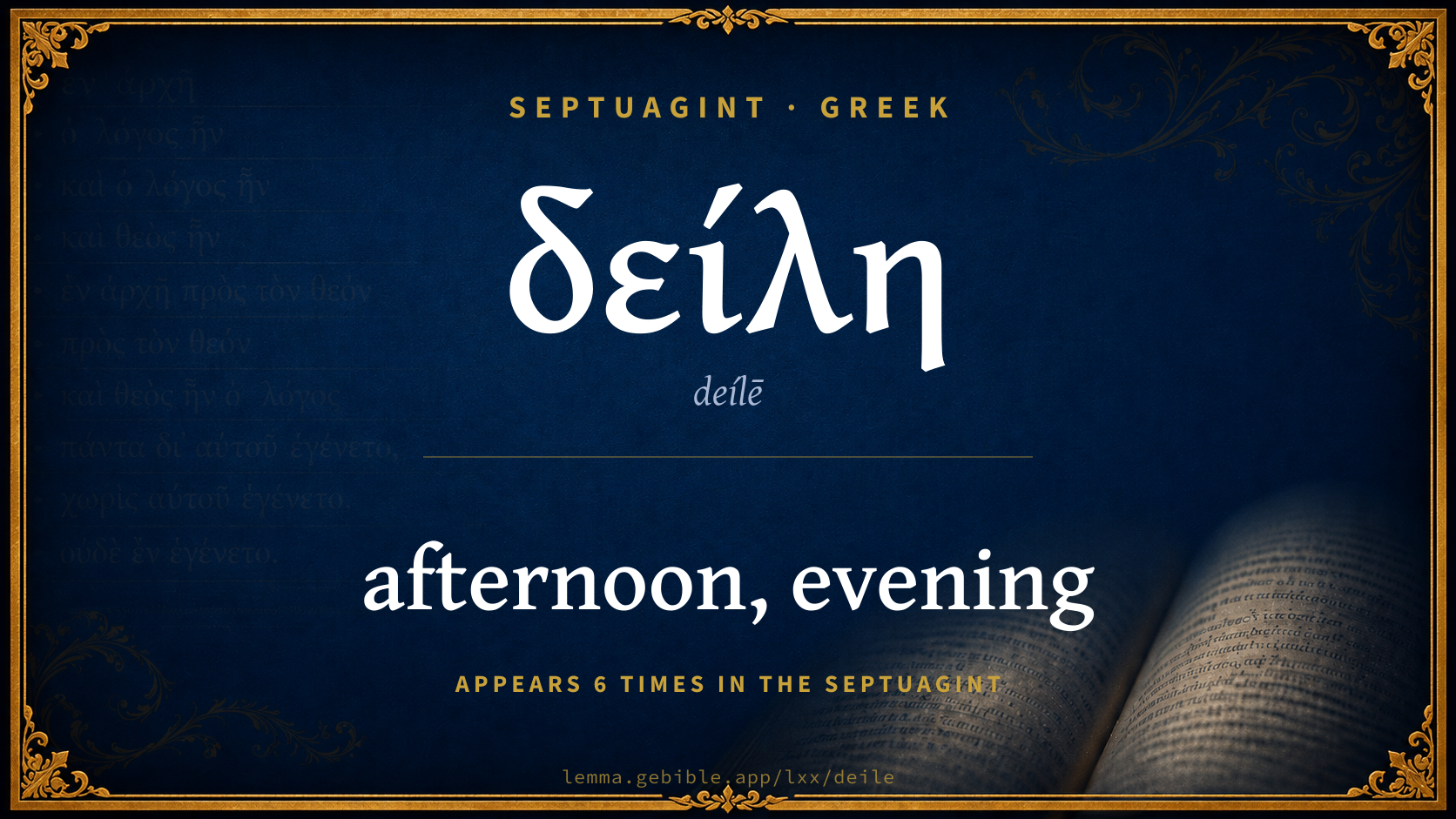
δείλη
afternoon, evening
Where this word appears
Every passage where δείλη appears in the Greek Septuagint — 6 occurrences in all. Click any verse to open its interlinear word-by-word view. Verse text is shown in the LXX2012 (modern English Septuagint) for context; the Greek form is the matched word — the English is not keyword-highlighted.
- Genesis 24:63 δείλη And Isaac went forth into the plain toward evening to meditate; and having lifted up his eyes, he saw camels coming.
- 1 Kings 17:6 δείλη And the ravens brought him loaves in the morning, and flesh in the evening and he drank water of the brook.
- 2 Chronicles 2:3 δείλη And Solomon sent to Chiram king of Tyre, saying, Whereas you did deal favourably with David my father, and did send him cedars to build for himself a house to dwell in,
- 2 Chronicles 13:11 δείλη they sacrifice to the Lord whole burnt offering, morning and evening, and compound incense, and set the show bread on the pure table; and there is the golden candlestick, and the lamps for burning, to light in the evening: for we keep the charge of the Lord God of our fathers; but you⌃ have forsaken him.
- 2 Chronicles 13:11 δείλη they sacrifice to the Lord whole burnt offering, morning and evening, and compound incense, and set the show bread on the pure table; and there is the golden candlestick, and the lamps for burning, to light in the evening: for we keep the charge of the Lord God of our fathers; but you⌃ have forsaken him.
- Esther 2:14 δείλη She enters in the evening, and in the morning she departs to the second women's apartment, where Gai the king's chamberlain is keeper of the women: and she goes not in to the king again, unless she should be called by name.
About this word
About this word
δείλη (deílē), “afternoon, evening,” is a word from the Greek Septuagint — the ancient Greek translation of the Hebrew Old Testament. It does not occur in the Greek New Testament, so it carries no Strong’s number from Thayer’s (New-Testament) lexicon; the gloss shown here is a curated modern-English sense rather than a Strong’s definition. It appears 6 times across the Septuagint — open the Appearances tab to read it in context.
The gloss above is Lemma’s own curated sense — this word carries no Strong’s number, so no lexicon we ship has an entry for it. The transliteration and this passage list are computed here from the tagged Septuagint text. What Lemma adds →