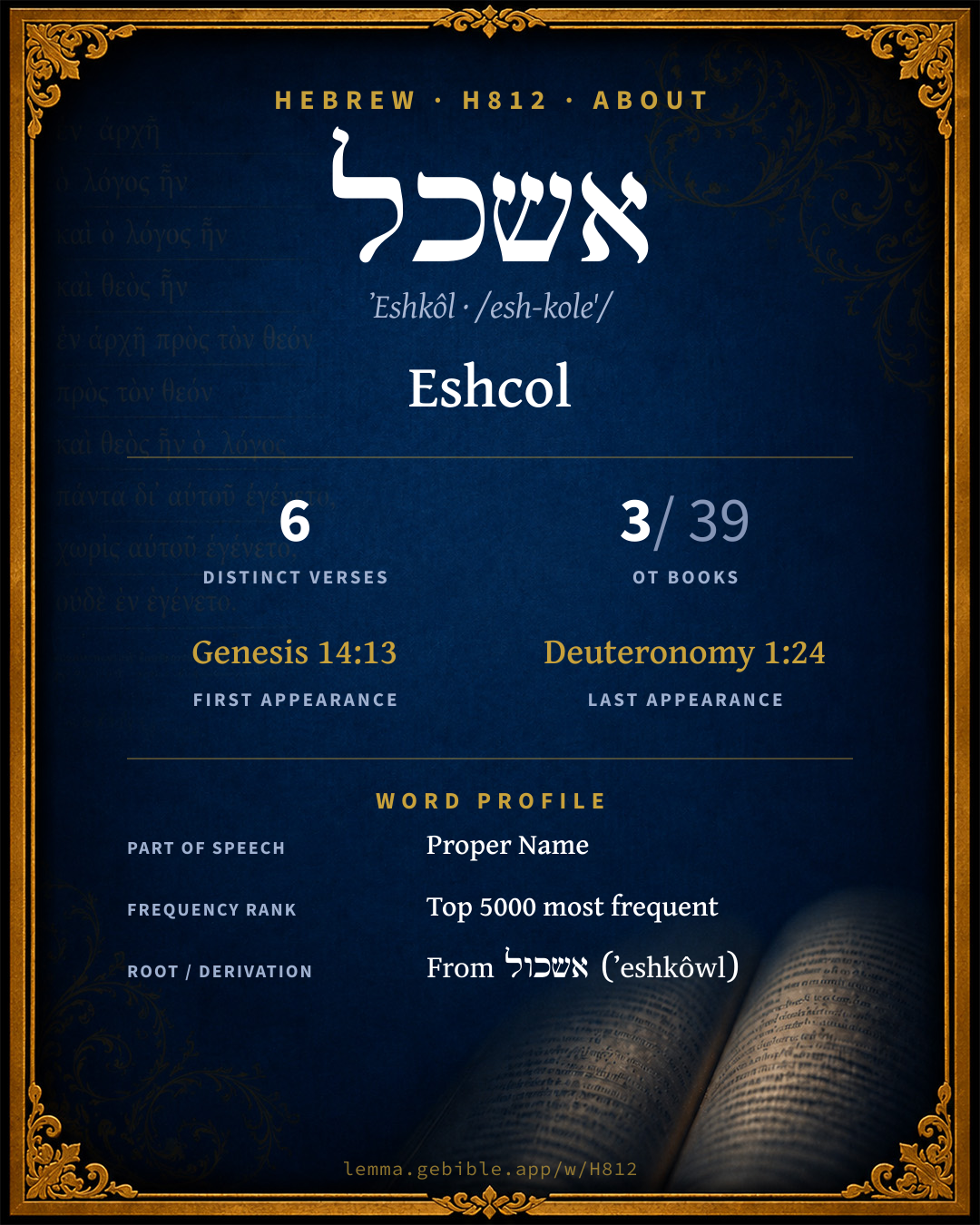
אֶשְׁכֹּל
Eshcol
BDB lists 3 entries for ‘Eshcol’ fuller range ↓
Full lexicon entry — Brown-Driver-Briggs (BDB)
From Brown-Driver-Briggs (BDB)
Where this word appears
Grammar key — what these labels mean
Part of speech
- Noun
- A naming word — a person, place, thing, or idea.
Noun type
- Proper
- A name of a specific person, place, or people (e.g. Abraham, Zion, Israel).
Every verse where H812 appears — 6 distinct verses across 3 books. Click any verse to open its interlinear word-by-word view. Verse text shown in the World English Bible for context — . Each verse’s Hebrew form is shown with its reference; the English is not keyword-highlighted, since the data carries no word-level English alignment. Use “Compare translations” on any verse to read it across multiple English versions. This concordance covers the Hebrew Bible; Septuagint (Greek Old Testament) occurrences are not indexed here.
Genesis 2 verses
- Genesis 14:13 אֶשְׁכֹּל֙ n Proper One who had escaped came and told Abram, the Hebrew. Now he lived by the oaks of Mamre, the Amorite, brother of Eshcol, and brother of Aner; and these were allies of Abram.
- Genesis 14:24 אֶשְׁכֹּ֣ל n Proper Except only that which the young men have eaten, and the portion of the men who went with me, Aner, Eshcol, and Mamre: let them take their portion."
Numbers 3 verses
- Numbers 13:23 אֶשְׁכֹּ֗ל n Proper They came to the valley of Eshcol, and cut down from there a branch with one cluster of grapes, and they bore it on a staff between two; [they brought] also of the pomegranates, and of the figs.
- Numbers 13:24 אֶשְׁכּ֑וֹל n Proper That place was called the valley of Eshcol, because of the cluster which the children of Israel cut down from there.
- Numbers 32:9 אֶשְׁכּ֗וֹל n Proper For when they went up to the valley of Eshcol, and saw the land, they discouraged the heart of the children of Israel, that they should not go into the land which Yahweh had given them.
Deuteronomy 1 verse
About this entry
At a glance — auto-summarized from this page’s data, not written by a person. Every figure links to its source below. This summary describes the numbers; it doesn’t interpret them.
“Eshcol” is the headline sense of the Hebrew name אשכל (ʼEshkôl). It clusters heavily in Numbers, which alone accounts for 50% of its uses. It turns up in 6 verses across 3 books, an uncommon footprint. Its earliest occurrence is Genesis 14:13. The sections below give every occurrence and version rendering.
Gloss history
Strong's 1890 vs modern scholarship
About this word
Strong's H812 catalogs a Hebrew word from the Hebrew Old Testament.
These counts are not copied from any lexicon or concordance. They are computed here, from the morphology-tagged Hebrew Old Testament. What Lemma adds →
- 6
- distinct verses
- The word appears in 6 distinct verses.
- 3 / 39
- OT books
- The word appears in 3 of 39 Old Testament books.
- #3,040
- by frequency
- Top 5000 most frequent Hebrew words (rank 3,040 of 8,640 Hebrew words by occurrence).
View all 6 occurrences in the concordance →
Most concentrated in
- Numbers 3 verses 50%
- Genesis 2 verses 33%
- Deuteronomy 1 verse 17%
By section of the Old Testament
By traditional corpus
Conventional, traditional groupings — biblical authorship is debated, so this is a traditional corpus grouping, not an authorship claim. Each share is this word’s portion of its verses in that division of the Hebrew canon. Each figure is a share of the word’s 6 distinct verses.
- Torah (Pentateuch) 6 verses · 100%
How translations render this word
Counts come from each version’s own published word-to-Strong’s tagging or interlinear alignment — an approximate guide to how each version renders this word, not a word-level alignment the data otherwise carries. Because each total is that version’s own tagged count, the per-version totals vary from one another and need not match the appearance or distinct-verse counts above. These counts may also differ from a printed concordance because Lemma counts each distinctly tagged rendering and does not collapse phrase taggings into a single head-word total. This is a fixed set of word-tagged versions (KJV, ASV, BSB, ULT) and does not change with the reading translation you choose elsewhere. Each version’s license is shown beside its name below (and on Sources).
BDB lists this Strong’s number as 2 distinct words (homographs). Each count above pools all of them and is not split by sense — see the Senses section below. A low-frequency rendering may belong to a different one of those words, not the primary meaning.
- King James Version†: Eshcol 6×
- American Standard Version†: Eshcol 5×
- Berean Standard Bible†: Eshcol 6×
- unfoldingWord Literal Text†: Eshkol 4×, Eshcol 2×
King James Version Public Domain
Renders H812 across 6† tagged occurrences — most commonly:
American Standard Version Public Domain
Renders H812 across 6† tagged occurrences — most commonly:
Plus 1 rendering that appears only once — usually multi-word phrases or single function words the recovered tagging swept in, not distinct renderings.
Berean Standard Bible Public Domain
Renders H812 across 6† tagged occurrences — most commonly:
unfoldingWord Literal Text CC BY-SA 4.0
Renders H812 across 6† tagged occurrences — most commonly:
Senses in the full BDB
What do BDB’s symbols mean?
BDB uses these scholarly abbreviations:
| Symbol | Meaning |
|---|---|
| 𝔊 | the Septuagint (the ancient Greek translation, LXX) |
| 𝔙 | the Vulgate (the Latin translation) |
| 𝔖 | the Syriac version (the Peshitta) |
| 𝔗 | the Targum (the Aramaic translation) |
| ψ | the Psalms |
| √ | root (the underlying root or stem) |
| ‖ | parallel passage (a synonymous or contrasted parallel) |
| † | the dagger: every passage where the word occurs is cited |
The 4 senses and sub-senses the full Brown-Driver-Briggs lexicon distinguishes for this word, in lexicon order (not ranked by frequency), with BDB’s own verbatim wording and sub-sense lettering. Shown in Hebrew script with BDB’s own scholarly abbreviations. The condensed entry is in the Lexicon Entry tab. See also the Forms in the corpus table below.
אשכל I
- 1. cluster of grapes, א׳ עֲנָבִים Nu 13:23 cf. v 24; vid. also Gn 40:10 הִבְשִׁילוּ א׳ עֲנָבִים its clusters ripened grapes; hence fig. of deeds of enemies of Israel, clusters of gall have they Dt 32:32 (‖ עִנְּבֵי רוֹשׁ); fig. of Isr. Is 65:8 יִמָּצֵא הַתִּירוֹשׁ בָּא׳; Mi 7:1 אֵין אֶשְׁכּוֹל לֶאֱכוֹל fig. of desolation of Israel under Yahweh’s judgment; Ct 7:9 in sim. שָׁדַיִךְ כְּאֶשְׁכְּלוֹת הַגֶּפֶן cf. v 8 (where Thes MV think of clusters of dates, v. תָּמָר palm-tree, ib.) e.g. Numbers 13:23
- 2. cluster of henna-flowers, א׳ הַכֹּפֶר (v. כפר), metaph. of the beloved one Ct 1:14. (Cf. GrünwaldIsrael. Letterbode, Amst., xi, 148 f.) e.g. Song of Solomon 1:14
אשכל II
- 1. m. an Amorite, brother of Mamre, dwelling in neighbourhood of Hebron Gn 14:13, 24. e.g. Genesis 14:13
- 2. in combination נַחַל אֶשְׁכֹּל Nu 13:23 Dt 1:24; נ׳ אֶשְׁכּוֹל Nu 13:24, 32:9;—valley of Eshcol, = valley of a cluster, region of Hebron (cf. 13:22); in 13:24 der. from א׳ cluster, q.v.; see however Di ad loc. e.g. Numbers 13:23
Senses from the full Brown-Driver-Briggs lexicon (Brown, Driver, Briggs; Oxford 1906 — public domain), digitized via Sefaria, supplemented by the OpenScriptures HebrewLexicon (CC BY 4.0). Full attribution on Sources.
Word origin
(אֶשְׁכֹּל Ct 1:14) n.m. Nu 13:23 cluster (Ethiopic አስካል Arabic إِثْكَالٌ, Aramaic אִיתְכְּלָא; etym. dub.; Thes MV sub √שׁכל, but no suitable meaning proven; Sta§ 258, 300 der. from √ אשׁך c. afformat. ל)—א׳ abs. Nu 13:24 +; cstr. v 23 +; pl. אַשְׁכֹּלוֹת Ct 7:8; cstr. אַשְׁכְּלֹת Dt 32:32, אֶשְׁכְּלוֹת Ct 7:9; sf. אַשְׁכְּלֹתֶיהָ Gn 40:10;—
— Brown-Driver-Briggs (Oxford 1906, public domain), digitized via Sefaria, supplemented by the OpenScriptures HebrewLexicon (CC BY 4.0). See Sources.
Derived from אשכול (ʼeshkôwl) (H811) — cluster.
Jastrow Dictionary
A second Hebrew/Aramaic lexicon for comparison, covering Aramaic and post-biblical (Talmudic, Targumic, Midrashic) usage that the biblical-Hebrew BDB does not. Matched by lemma rather than by Strong’s number, so a lemma may carry more than one Jastrow headword (shown separately below), and the entries cover usage well beyond the Bible.
אֶשְׁכֹּל
- , v. אֶשְׁכּוֹל
A Dictionary of the Targumim, the Talmud Babli and Yerushalmi, and the Midrashic Literature (Marcus Jastrow; London, Luzac, 1903) — Public Domain. Digitized via Sefaria. Digitized via Sefaria. Full attribution on Sources.
Forms in the corpus
The 6 distinct written forms H812 takes in the Hebrew Bible, most frequent first — each parse links to that state’s occurrences in the concordance. Hebrew forms include their vowel points and cantillation, so a single lemma takes many written forms.
| Form | Parsing | Example | Uses |
|---|---|---|---|
| אֶשְׁכּ֑וֹל | Noun, Proper | Numbers 13:24 | 1 |
| אֶשְׁכּ֗וֹל | Noun, Proper | Numbers 32:9 | 1 |
| אֶשְׁכֹּ֑ל | Noun, Proper | Deuteronomy 1:24 | 1 |
| אֶשְׁכֹּ֗ל | Noun, Proper | Numbers 13:23 | 1 |
| אֶשְׁכֹּ֣ל | Noun, Proper | Genesis 14:24 | 1 |
| אֶשְׁכֹּל֙ | Noun, Proper | Genesis 14:13 | 1 |
Bible dictionary
Public-domain dictionary articles matched to this entry by name (Eshcol). A biblical name can be shared by more than one person or place, so an article may treat several.
Easton's Bible Dictionary · M. G. Easton, 1897
Bunch; brave. (1.) A young Amoritish chief who joined Abraham in the recovery of Lot from the hands of Chedorlaomer (Gen. 14:13, 24).
(2.) A valley in which the spies obtained a fine cluster of grapes (Num. 13:23, 24; "the brook Eshcol," A.V.; "the valley of Eshcol," R.V.), which they took back with them to the camp of Israel as a specimen of the fruits of the Promised Land. On their way back they explored the route which led into the south (the Negeb) by the western edge of the mountains at Telilat el-Anab, i.e., "grape-mounds", near Beersheba. "In one of these extensive valleys, perhaps in Wady Hanein, where miles of grape-mounds even now meet the eye, they cut the gigantic clusters of grapes, and gathered the pomegranates and figs, to show how goodly was the land which the Lord had promised for their inheritance.", Palmer's Desert of the Exodus.
Smith's Bible Dictionary · William Smith, 1863
(cluster of grapes), brother of Mamre the Amorite and of Aner, and one of Abraham's companions in his pursuit of the four kings who had carried off Lot. (Genesis 14:13,24) (B.C. 1912.).
Hitchcock's Bible Names Dictionary · Roswell D. Hitchcock, 1869
bunch of grapes
Classic public-domain reference works; full attribution on Sources.
Septuagint verse parallels
This word appears in 6 verses that also exist in the Greek Old Testament (Septuagint), out of the 6 Hebrew verses it occurs in. You can read those verses in Greek by switching the Old Testament edition to the Septuagint.
Read these verses in the Septuagint
This is a verse-level parallel only — the same verses exist in both the Hebrew and Greek Old Testaments. No word-level Hebrew↔Greek correspondence is claimed: the data carries no such alignment, so no Greek word is shown as this Hebrew word’s translation. Coverage is not total — the Septuagint omits the deuterocanon and renumbers the Psalms, so some Hebrew verses have no direct Greek parallel.