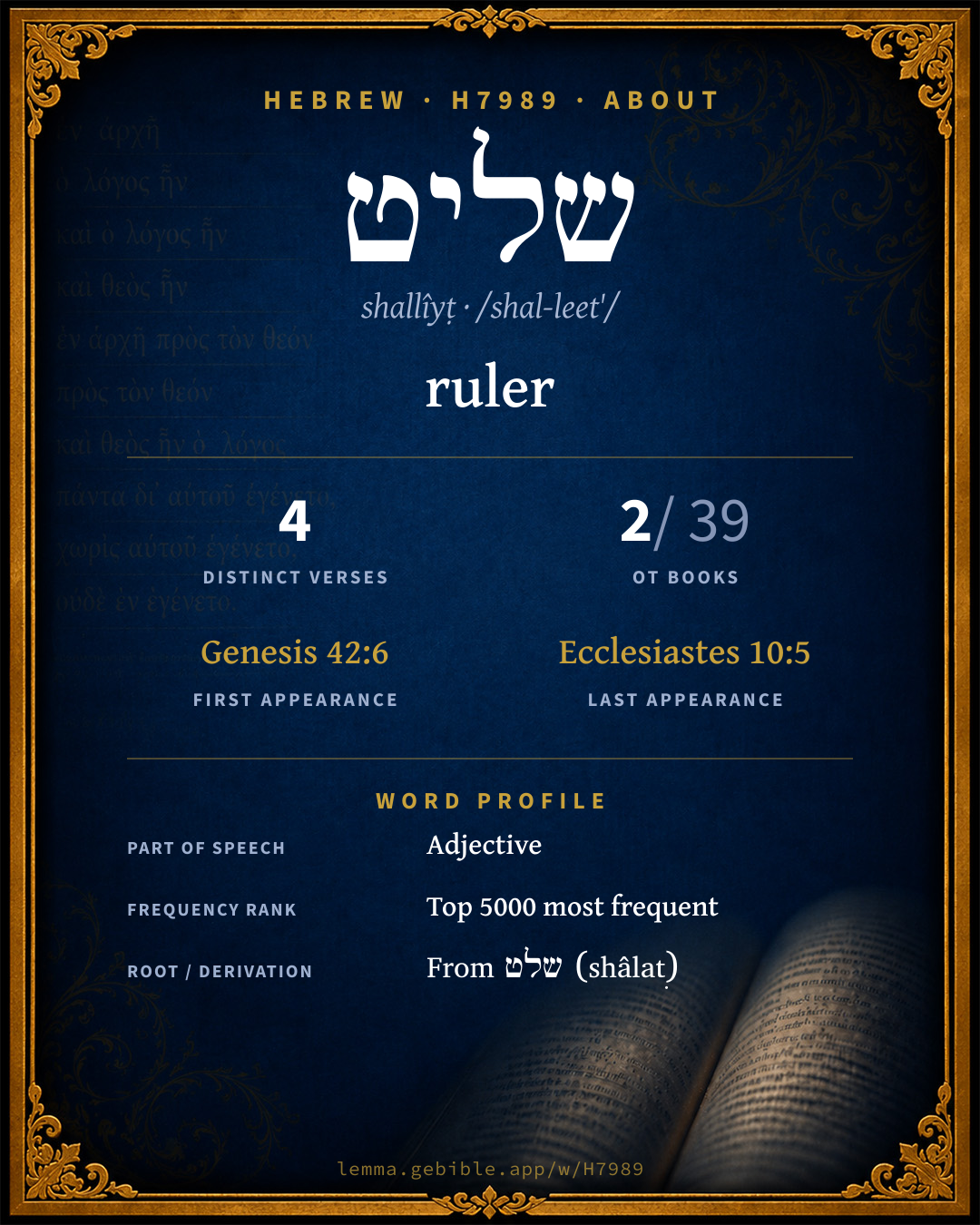
שַׁלִּיט
ruler
‘ruler’ is one of 3 main senses fuller range ↓
Full lexicon entry — Brown-Driver-Briggs (BDB)
From Brown-Driver-Briggs (BDB)
Where this word appears
Grammar key — what these labels mean
Part of speech
- Adjective
- A word that describes or qualifies a noun.
State
- Absolute
- The independent form of a noun, not bound to a following word.
Gender
- Masculine
- Grammatically masculine.
Number
- Singular
- One.
- Plural
- More than one (in Hebrew, generally three or more).
Every verse where H7989 appears in the Book of Ecclesiastes — 3 distinct verses. Click any verse to open its interlinear word-by-word view. Verse text shown in the World English Bible for context — . Each verse’s Hebrew form is shown with its reference; the English is not keyword-highlighted, since the data carries no word-level English alignment. Use “Compare translations” on any verse to read it across multiple English versions. This concordance covers the Hebrew Bible; Septuagint (Greek Old Testament) occurrences are not indexed here.
Ecclesiastes
- Ecclesiastes 7:19 שַׁלִּיטִ֔ים adj Adjective mp Wisdom is a strength to the wise man more than ten rulers who are in a city.
- Ecclesiastes 8:8 שַׁלִּ֤יט adj Adjective ms There is no man who has power over the spirit to contain the spirit; neither does he have power over the day of death. There is no discharge in war; neither shall wickedness deliver those who practice it.
- Ecclesiastes 10:5 הַ/שַּׁלִּֽיט ptcl def.art + Adjective Adjective ms There is an evil which I have seen under the sun, the sort of error which proceeds from the ruler.
About this entry
At a glance — auto-summarized from this page’s data, not written by a person. Every figure links to its source below. This summary describes the numbers; it doesn’t interpret them.
“ruler” is the headline sense of the Hebrew adjective שליט (shallîyṭ). A scarce word — 4 verses in all of the Hebrew Bible. More than three-quarters of its appearances fall in Ecclesiastes. First canonically at Genesis 42:6, it enters the text early. Carrying more than one sense, it rewards its full sense range. The sections below give every sense, occurrence, and version rendering.
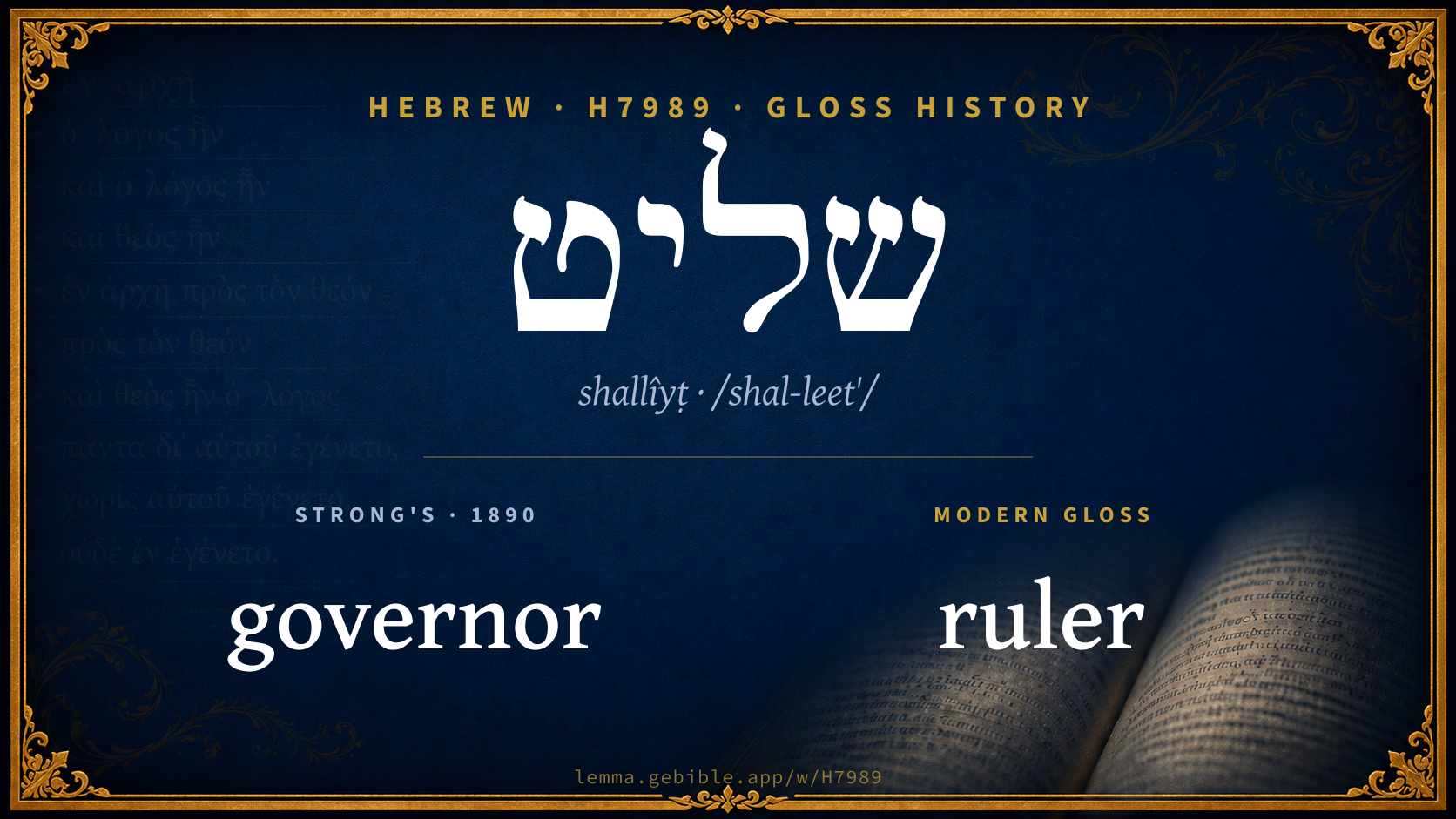
Gloss history
Strong's 1890 vs modern scholarship
About this word
Strong's H7989 catalogs a Hebrew word from the Hebrew Old Testament.
These counts are not copied from any lexicon or concordance. They are computed here, from the morphology-tagged Hebrew Old Testament. What Lemma adds →
- 4
- distinct verses
- The word appears in 4 distinct verses.
- 2 / 39
- OT books
- The word appears in 2 of 39 Old Testament books.
- #3,696
- by frequency
- Top 5000 most frequent Hebrew words (rank 3,696 of 8,640 Hebrew words by occurrence).
View all 4 occurrences in the concordance →
Most concentrated in
- Ecclesiastes 3 verses 75%
- Genesis 1 verse 25%
By section of the Old Testament
By traditional corpus
Conventional, traditional groupings — biblical authorship is debated, so this is a traditional corpus grouping, not an authorship claim. Each share is this word’s portion of its verses in that division of the Hebrew canon. Each figure is a share of the word’s 4 distinct verses.
- Writings (Ketuvim) 3 verses · 75%
- Torah (Pentateuch) 1 verse · 25%
How translations render this word
Counts come from each version’s own published word-to-Strong’s tagging or interlinear alignment — an approximate guide to how each version renders this word, not a word-level alignment the data otherwise carries. Because each total is that version’s own tagged count, the per-version totals vary from one another and need not match the appearance or distinct-verse counts above. These counts may also differ from a printed concordance because Lemma counts each distinctly tagged rendering and does not collapse phrase taggings into a single head-word total. This is a fixed set of word-tagged versions (KJV, ASV, BSB, ULT) and does not change with the reading translation you choose elsewhere. Each version’s license is shown beside its name below (and on Sources).
- King James Version: Hath power 1×, Mighty 1×, Ruler 1×
- American Standard Version: Hath power 1×, Ruler 1×, Rulers 1×
- Berean Standard Bible: Ruler 2×
- unfoldingWord Literal Text: Authority 1×, Authorized 1×, Rulers 1×
King James Version Public Domain
Renders H7989 across 4 tagged occurrences — most commonly:
American Standard Version Public Domain
Renders H7989 across 4 tagged occurrences — most commonly:
Berean Standard Bible Public Domain
Renders H7989 across 4 tagged occurrences — most commonly:
Plus 2 renderings that appear only once — usually multi-word phrases or single function words the recovered tagging swept in, not distinct renderings.
unfoldingWord Literal Text CC BY-SA 4.0
Renders H7989 across 4 tagged occurrences — most commonly:
Senses in the full BDB
What do BDB’s symbols mean?
BDB uses these scholarly abbreviations:
| Symbol | Meaning |
|---|---|
| 𝔊 | the Septuagint (the ancient Greek translation, LXX) |
| 𝔙 | the Vulgate (the Latin translation) |
| 𝔖 | the Syriac version (the Peshitta) |
| 𝔗 | the Targum (the Aramaic translation) |
| ψ | the Psalms |
| √ | root (the underlying root or stem) |
| ‖ | parallel passage (a synonymous or contrasted parallel) |
| † | the dagger: every passage where the word occurs is cited |
The 2 senses and sub-senses the full Brown-Driver-Briggs lexicon distinguishes for this word, in lexicon order (not ranked by frequency), with BDB’s own verbatim wording and sub-sense lettering. Shown in Hebrew script with BDB’s own scholarly abbreviations. The condensed entry is in the Lexicon Entry tab. See also the Forms in the corpus table below.
- 1. having mastery: אֵין אָדָם שׁ׳ בָּרוּחַ Ec 8:8; elsewhere as subst. הַשּׁ׳ the ruler 10:5, so (c. עַל־הָאָרֶץ) Gn 42:6 (prob. late substitution for original word of E); pl. as subst. שַׁלִּיטִים Ec 7:19 (specif. of Alex.’s successors PerlesAnal. 42). e.g. Ecclesiastes 8:8
- 2. domineering, imperious, fs. (Köii 1. 201) אִשָּׁה זוֹנָה שַׁלָּ֑טֶת Ez 16:30 (Jerusalem personified). e.g. Ezekiel 16:30
Senses from the full Brown-Driver-Briggs lexicon (Brown, Driver, Briggs; Oxford 1906 — public domain), digitized via Sefaria, supplemented by the OpenScriptures HebrewLexicon (CC BY 4.0). Full attribution on Sources.
Word origin
adj. having mastery, domineering;—
— Brown-Driver-Briggs (Oxford 1906, public domain), digitized via Sefaria, supplemented by the OpenScriptures HebrewLexicon (CC BY 4.0). See Sources.
Derived from שלט (shâlaṭ) (H7980) — to dominate.
Jastrow Dictionary
A second Hebrew/Aramaic lexicon for comparison, covering Aramaic and post-biblical (Talmudic, Targumic, Midrashic) usage that the biblical-Hebrew BDB does not. Matched by lemma rather than by Strong’s number, so a lemma may carry more than one Jastrow headword (shown separately below), and the entries cover usage well beyond the Bible.
שַׁלִּיט
- having control, ruler. Y. Sabb. III, beg. 5ᶜ, v. שָׁלַט. Gen. R. s. 3 שני … אחד ש׳ ביום וכ׳ two commanders, one being on duty by day, and one by night. M. Kat. 18ᵃ, a. fr. מלפני הש׳, v. שְׁגָגָה; a. e.—Pl. שַׁלִּיטִים, שַׁלִּיטִין. Num. R. s. 1412 כנגד עשרה ש׳ שבאדם corresponding to the ten rulers in man (organs of the body regulating vitality, v. Koh. R. to VII, 19).—Fem. שַׁלִּיטָה. Yalk. Ex. 287 אני שליט בקנאה ואין הקנאה ש׳ בי I (the Lord) control jealousy, but jealousy does not control me; ואין התנומה ש׳ בי but slumber has no power over me; (Mekh. Yithro, Baḥod., s. 6 שׁוֹלֶטֶת).
שַׁלִּיט ²
- Targ. Y. Gen. XXVII, 29. Targ. Koh. V, 1; a. e.—Pl. שַׁלִּיטִין, שַׁלִּיטֵי. Targ. Y. I Gen. XLIX, 10. Targ. Prov. XXIII, 1. Ib. VIII, 15 וש׳ אנא וכ׳ (Ms. ושליטיינא, corr. acc.) and rulers do I anoint in righteousness.—Fem. שַׁלִּיטָא. Targ. II Esth. I, 2 (3) ed. Lag. (oth. ed. שַׁלִּיטְיָא; ed. Vien. טַיָא …, corr. acc.).
A Dictionary of the Targumim, the Talmud Babli and Yerushalmi, and the Midrashic Literature (Marcus Jastrow; London, Luzac, 1903) — Public Domain. Digitized via Sefaria. Digitized via Sefaria. Full attribution on Sources.
Forms in the corpus
The 4 distinct written forms H7989 takes in the Hebrew Bible, most frequent first — each parse links to that state’s occurrences in the concordance. Hebrew forms include their vowel points and cantillation, so a single lemma takes many written forms.
| Form | Parsing | Example | Uses |
|---|---|---|---|
| הַ/שַּׁלִּ֣יט | Adjective, Adjective, Masculine, Singular, Absolute | Genesis 42:6 | 1 |
| הַ/שַּׁלִּֽיט | Adjective, Adjective, Masculine, Singular, Absolute | Ecclesiastes 10:5 | 1 |
| שַׁלִּ֤יט | Adjective, Adjective, Masculine, Singular, Absolute | Ecclesiastes 8:8 | 1 |
| שַׁלִּיטִ֔ים | Adjective, Adjective, Masculine, Plural, Absolute | Ecclesiastes 7:19 | 1 |
Same root — word family
Other BDB entries built from the same root as H7989, grouped by Strong’s listed origin. These share a root / origin per the lexicon — not necessarily a shared meaning. Each links to that word’s own entry.
Derives from
Shares the same root
- שלט shᵉlêṭ H7981 to rule
- שלט sheleṭ H7982 shield
- שלטון shilṭôwn H7983 mastery
- שלטת shalleṭeth H7986 domineering
Derived from this word
Compare all same-root words → Showing 4 of 7 — not the complete family. They share a root, not necessarily a meaning.
Septuagint verse parallels
This word appears in 4 verses that also exist in the Greek Old Testament (Septuagint), out of the 4 Hebrew verses it occurs in. You can read those verses in Greek by switching the Old Testament edition to the Septuagint.
Read these verses in the Septuagint
This is a verse-level parallel only — the same verses exist in both the Hebrew and Greek Old Testaments. No word-level Hebrew↔Greek correspondence is claimed: the data carries no such alignment, so no Greek word is shown as this Hebrew word’s translation. Coverage is not total — the Septuagint omits the deuterocanon and renumbers the Psalms, so some Hebrew verses have no direct Greek parallel.