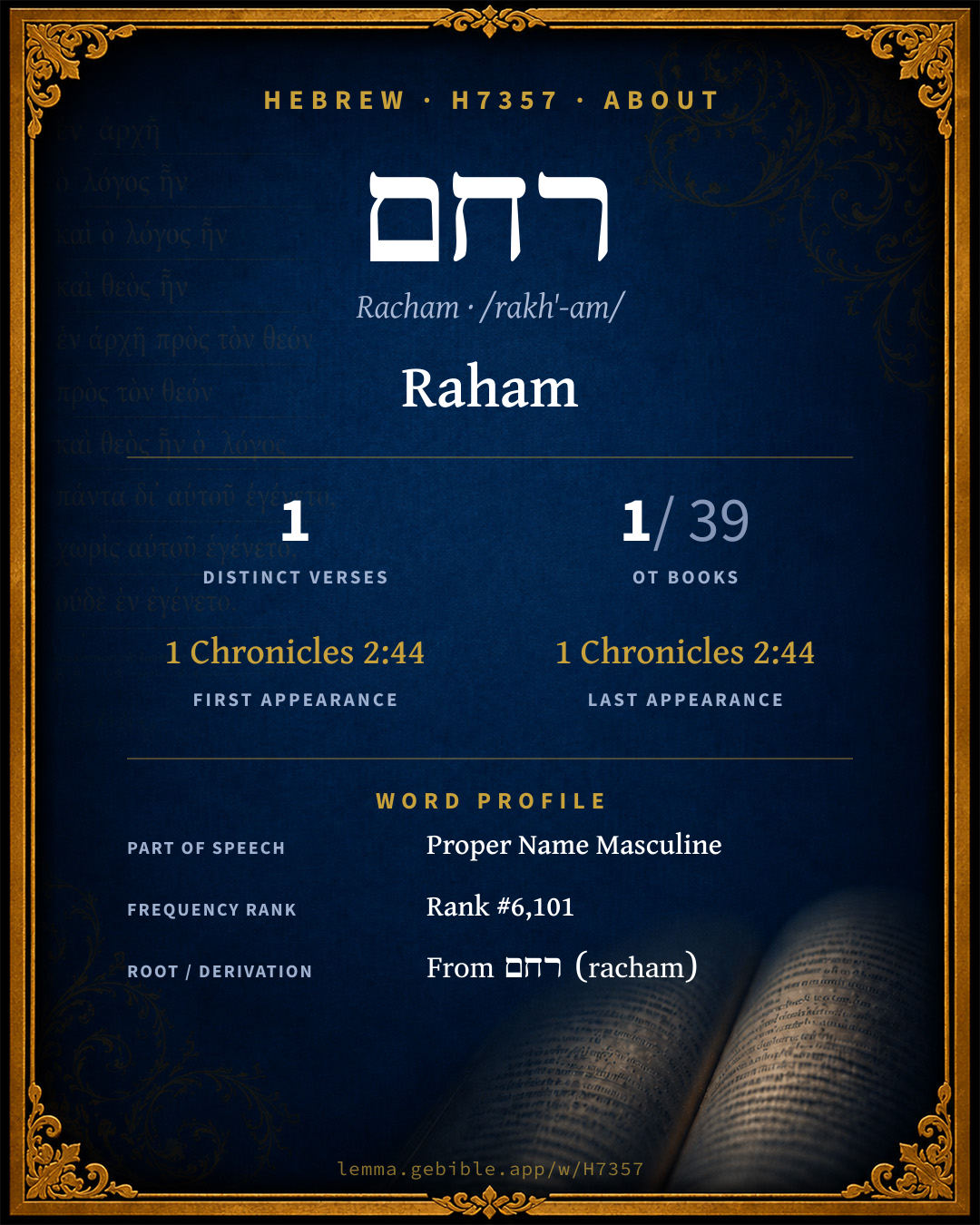
רַ֫חַם
Raham
BDB lists 2 entries for ‘Raham’ fuller range ↓
Full lexicon entry — Brown-Driver-Briggs (BDB)
From Brown-Driver-Briggs (BDB)
Where this word appears
Grammar key — what these labels mean
Part of speech
- Noun
- A naming word — a person, place, thing, or idea.
Noun type
- Proper
- A name of a specific person, place, or people (e.g. Abraham, Zion, Israel).
Every verse where H7357 appears — 1 distinct verse across 1 book. Click any verse to open its interlinear word-by-word view. Verse text shown in the World English Bible for context — . Each verse’s Hebrew form is shown with its reference; the English is not keyword-highlighted, since the data carries no word-level English alignment. Use “Compare translations” on any verse to read it across multiple English versions. This concordance covers the Hebrew Bible; Septuagint (Greek Old Testament) occurrences are not indexed here.
1 Chronicles 1 verse
About this entry
At a glance — auto-summarized from this page’s data, not written by a person. Every figure links to its source below. This summary describes the numbers; it doesn’t interpret them.
The Hebrew name רחם centers on the idea of “Raham.” A scarce word — 1 verse in all of the Hebrew Bible. The word gravitates to 1 Chronicles (100%). Its lone occurrence is 1 Chronicles 2:44. Dig into 1-verse concordance and the renderings breakdown below.
Gloss history
Strong's 1890 vs modern scholarship
About this word
Strong's H7357 catalogs a Hebrew word from the Hebrew Old Testament.
These counts are not copied from any lexicon or concordance. They are computed here, from the morphology-tagged Hebrew Old Testament. What Lemma adds →
- 1
- distinct verses
- The word appears in 1 distinct verse.
- 1 / 39
- OT books
- The word appears in 1 of 39 Old Testament books.
- #6,101
- by frequency
- Rank #6,101 (rank 6,101 of 8,640 Hebrew words by occurrence).
View all 1 occurrence in the concordance →
Most concentrated in
- 1 Chronicles 1 verse 100%
By section of the Old Testament
By traditional corpus
Conventional, traditional groupings — biblical authorship is debated, so this is a traditional corpus grouping, not an authorship claim. Each share is this word’s portion of its verses in that division of the Hebrew canon. Each figure is a share of the word’s 1 distinct verse.
- Writings (Ketuvim) 1 verse · 100%
How translations render this word
Counts come from each version’s own published word-to-Strong’s tagging or interlinear alignment — an approximate guide to how each version renders this word, not a word-level alignment the data otherwise carries. Because each total is that version’s own tagged count, the per-version totals vary from one another and need not match the appearance or distinct-verse counts above. These counts may also differ from a printed concordance because Lemma counts each distinctly tagged rendering and does not collapse phrase taggings into a single head-word total. This is a fixed set of word-tagged versions (KJV, ASV, BSB, ULT) and does not change with the reading translation you choose elsewhere. Each version’s license is shown beside its name below (and on Sources).
BDB lists this Strong’s number as 2 distinct words (homographs). Each count above pools all of them and is not split by sense — see the Senses section below. A low-frequency rendering may belong to a different one of those words, not the primary meaning.
- King James Version†: Raham 1×
- American Standard Version†: Raham 1×
- Berean Standard Bible†: Raham 1×
- unfoldingWord Literal Text†: Raham 1×
King James Version Public Domain
Renders H7357 across 1† tagged occurrence — most commonly:
American Standard Version Public Domain
Renders H7357 across 1† tagged occurrence — most commonly:
Berean Standard Bible Public Domain
Renders H7357 across 1† tagged occurrence — most commonly:
unfoldingWord Literal Text CC BY-SA 4.0
Renders H7357 across 1† tagged occurrence — most commonly:
Senses in the full BDB
What do BDB’s symbols mean?
BDB uses these scholarly abbreviations:
| Symbol | Meaning |
|---|---|
| 𝔊 | the Septuagint (the ancient Greek translation, LXX) |
| 𝔙 | the Vulgate (the Latin translation) |
| 𝔖 | the Syriac version (the Peshitta) |
| 𝔗 | the Targum (the Aramaic translation) |
| ψ | the Psalms |
| √ | root (the underlying root or stem) |
| ‖ | parallel passage (a synonymous or contrasted parallel) |
| † | the dagger: every passage where the word occurs is cited |
The 2 senses and sub-senses the full Brown-Driver-Briggs lexicon distinguishes for this word, in lexicon order (not ranked by frequency), with BDB’s own verbatim wording and sub-sense lettering. Shown in Hebrew script with BDB’s own scholarly abbreviations. The condensed entry is in the Lexicon Entry tab.
רחם I
- 1. womb, Gn 49:25 (J) Je 20:17; Jb 24:20; מֵרחם i.e. from birth Je 20:17 ψ 22:11; 58:4; Jb 3:11 (מִנִּי), Is 46:3, fig. ψ 110:3; בָּרֶחֶם Jb 31:15; יצא מֵר׳ go forth from womb in birth Je 1:5; 20:18 Jb 38:8, cf. 10:18; מֵר׳ אֵם Nu 12:12 (E); פתח ר׳ open the womb, in order to childbirth Gn 29:31; 30:22 (JE); כָּל־פֶּטֶר רחם all that first opens womb (of men and animals) Ex 13:12, 15; 34:19 (J) Nu 18:15 (P) Ez 20:26; פטר ר׳ Nu 3:12 (P), פִּטְרַת כל ר׳ Nu 8:16; פטר כל ר׳ Ex 13:2 (P); on the other hand, ר׳ מַשְׁכִּיל Ho 9:14 miscarrying womb; עֹצֶר ר׳ Pr 30:16 restraint (i.e. barrenness) of womb (so ψ 107:36 PerlesAnal. 85); עָצַר בְּעַד ר׳ (of God) Gn 20:18 (E); סָגַר (בְּעַר) ר׳ 1 S 1:5, 6, preventing childbirth. e.g. Genesis 49:25
- 2. womb-man, woman-slave: רַחַם רַחֲמָהַיִם Ju 5:30 a woman, two women. e.g. Judges 5:30
רחם II m. (girl(-like)?)
Senses from the full Brown-Driver-Briggs lexicon (Brown, Driver, Briggs; Oxford 1906 — public domain), digitized via Sefaria, supplemented by the OpenScriptures HebrewLexicon (CC BY 4.0). Full attribution on Sources.
Word origin
I. n.m. Ho 9:14 womb (f. Je 20:17, unless הֲרַת a noun, cf. AlbrZAW xvi. 81 SS);—abs. ר׳ Gn 20:18 +, רַ֫חַם Ju 5:30, רָ֑חֶם Je 20:17 +, רָ֑חַם Gn 49:25 +; cstr. רֶ֫חֶם Nu 12:12 Jb 3:11; sf. רַחְמָהּ Gn 29:31 +, רַחְמָהֿ Je 20:17 (Ges§ 91e; >f. abs. Köii. 1, 159); du. רַחֲמָתַיִם Ju 5:30;—
I. n.pr.m. (girl(-like)?);—in Judah, 1 Ch 2:44; Ραμεε, A Ραεμ῾, 𝔊L Ρααμ.
— Brown-Driver-Briggs (Oxford 1906, public domain), digitized via Sefaria, supplemented by the OpenScriptures HebrewLexicon (CC BY 4.0). See Sources.
Derived from רחם (racham) (H7356) — compassion.
Jastrow Dictionary
A second Hebrew/Aramaic lexicon for comparison, covering Aramaic and post-biblical (Talmudic, Targumic, Midrashic) usage that the biblical-Hebrew BDB does not. Matched by lemma rather than by Strong’s number, so a lemma may carry more than one Jastrow headword (shown separately below), and the entries cover usage well beyond the Bible.
רָחַם
- (b. h.) to love.
- 1. (with (with על) to have compassion on, pity; to befriend. Ber. 33ᵃ כל מי … אסור לרַחֵם עליו you must not befriend him who has no sense (ref. to Is. XXVII, 11). Sabb. 151ᵇ כל המְרַחֵם … מְרַחֲמִין עליו וכ׳ he who shows mercy to creatures (men), will be shown mercy in heaven (ref. to Deut. XIII, 18), v. רַחֲמָן. Ab. Zar. 18ᵃ מן השמים יְרַחֵמוּ heaven will have mercy (protect me); Nidd. 45ᵃ. Sot. VIII, 1 יְרַחֲמוּ עליכם they will have mercy on you (spare your lives); a. fr.—Trnsf. to give suck to a strange animal. Bekh. 24ᵃ אינה מְרַחֶמֶת אלא וכ׳ no dam gives suck to a stranger, unless she has had a child of her own. Ib. מרחמת אע"פ וכ׳ she may give suck, even if she has never given birth. e.g. Isaiah 27:11
- 2. to stimulate the maternal instinct (v. רֶחֶם) of an animal after confinement by inserting a lump of salt into the womb. Tosef. Sabb. XV (XVI), 2 מְרַחֲמִין היינו בהמה טהורה ביו"ט ed. Zuck. (Var. על בהמה) we (in my father’s house) used to stimulate &c. on a Holy Day; Sabb. 128ᵇ על בהמה; Y. ib. XVIII, end, 16ᶜ על הבהמה.
- to have pity. Num. R. s. 924 אם נופלים אנו … מִתְרַחֵם עלינו אין אנו מִתְרַחֲמִים עליו if we fall into David’s hands, he will have pity on us, but if David fall into our hands, we shall have no pity on him; Y. Sot. I, 17ᵇ bot. הוא מרחם … אנו מרחמין).
רְחֵם
- 1. to love (h. אהב). Targ. Gen. XXII, 2. Ib. XXXVII, 3. Targ. O. Deut. VI, 5. Targ. Prov. IV, 6 (ed. Wil. רָחֲמָהּ Pa.); a. fr.—Midr. Till. to Ps. XVIII, 2 (expl. ארחמך, ib.) רַחֲמִית יתך וכ׳ I love thee (ref. to Targ. Deut. l. c.); Yalk. ib. 671 רַחְמָאִי יתך. Y. Ber. IX, 14ᵇ bot. (R. Akiba speaking to his pupils before his death) רְחִמְתֵּיה בכל לבי ורחמתיה וכ׳ I loved him with all my heart, and I loved him with all I possessed, but how to love him with all my soul (life) I could not understand, and now &c. Sabb. 23ᵇ דרָחֵים רבנן וכ׳ he who loves scholars shall have children that are scholars. Y. ib. XIV, 14ᵈ bot. חד בר נש ר׳ אתתא וכ׳ a man fell in love with a woman … and grew dangerously ill; Y. Ab. Zar. II, 40ᵈ bot. Lev. R. s. 25 שמעית דמלכא רַחְמָא וכ׳ I heard that the king loves figs; Koh. R. to II, 20 רחים; ib. רחימא; ib. רחמיה (corr. acc.). Y. Ab. Zar. II, 41ᵃ bot. דהוות רַחְמָא מצוותא who loved to be charitable; Y. Ter. VIII, 45ᶜ bot. הוו רחמנא וכ׳ (corr. acc.). Keth. 105ᵇ אם מִרְחַם כולהו רַחְמוּ לי וכ׳ if there is love (among them), they all love me &c., v. סְנֵי. Snh. 89ᵇ תרוייהו רַחֲמִינִי להו I love both of them (Isaac und Ishmael); a. fr.
- 2. (with על) to have compassion on, pity. Targ. Ps. CIII, 13. Targ. Prov. XXVIII, 13; a. fr.
- 1. to love. Targ. Gen. XXIX, 32 (O. ed. Vien. Pe.). Targ. Y. Deut. VI, 5; a. e.—Keth. l. c. האי … דמְרַחְמִין ליה וכ׳ if the people of a place love a teacher, it is not because he is a good man, but because he does not reprove them on heavenly matters (for neglect of religious duties). Y. Ter. VIII, 45ᶜ אילולי דאתון מרחמין שמועתא וכ׳ but for your loving traditions (you would not ask such questions); is it not a Mishnah?; Y. Ab. Zar. II, 41ᵃ רחמין; a. e.—Trnsf. to give suck (v. preced.). Bekh. 24ᵃ or shall we say, דידה מְרַחְמָא דלא וכ׳ a dam gives suck to her own young, but not to a stranger. Ib. דילמא רַחוּמֵי רחים perhaps this is a case when one gives suck to a stranger (although having a child of her own); v. שְׁבַק.
- 2. (with על) to compassionate, pity. Targ. Jer. XXXI, 19. Targ. O. Num. VI, 25 וירחם עלך ed. Lisb. (oth. ed. ויר׳ יתך; in ed. Berl. untranslated). Targ. Deut. VII, 2; a. fr.—Macc. 23ᵇ מדהא מְרַחַמְתָּא והא לא מרחמתא (Solomon found out which was the true mother of the living child,) because the one showed compassion, and the other did not. Y. Taan. II, 65ᵇ אמרין … מִתְרַחֵם עלינן לינן מְרַחְמִין וכ׳ the men of Niniveh said, if thou wilt have no mercy on us, we shall have no mercy on them (the beasts and the children); a. fr.
- 1. to be loved, beloved. Targ. Prov. XV, 9.
- 2. (with על) to be pitied, be shown mercy. Targ. Y. Ex. XXXIII, 19. Targ. Gen. XLIII, 29. Targ. Hos. XIV, 4; a. e.
- 3. to be moved to mercy, have pity. Targ. Jer. XXXI, 18 (19) מתרחם ed. Lag. (oth. ed. מתנחם; h. text נחמתי).—Y. Taan. l. c., v. supra; a. e.
רָחָם
- (b. h.) raḥam, name of an unclean bird, giereagle or vulture. Ḥull. 63ᵃ ר׳ זו שרקרק ולמה … ר׳ כיון שבא ר׳ וכ׳ raḥam (Lev. XI, 18) is the sh’raḳraḳ, and why is it called raḥam (love)? Because when the r. comes, mercy comes upon the world (it betokens rain). e.g. Leviticus 11:18
רָחֵם
- friend, v. רַחֲמָא III.
רֶחֶם
- (b. h.) orifice of the matrix; womb. B. Bath. 16ᵇ, a. e. רַחְמָהּ צר, v. אַיָּלָה. Num. R. s. 105 קבלה הר׳ וכ׳ (fem.) the womb conceived &c. Ḥull. 70ᵃ כותלי בית הר׳ the sides of the womb; a. fr.—Gen. R. s. 37; Yalk. Ps. 869 (ref. to Ps. CX, 3) מרַחְמוֹ של אולם שחרתיך לי from the womb of the world (sunrise, east) did I choose thee for me.—Pl. רְחָמִים. Ḥull. l. c. Ber. 32ᵇ פטרי ר׳ the firstborn; a. e. e.g. Psalms 110:3
A Dictionary of the Targumim, the Talmud Babli and Yerushalmi, and the Midrashic Literature (Marcus Jastrow; London, Luzac, 1903) — Public Domain. Digitized via Sefaria. Digitized via Sefaria. Full attribution on Sources.
Same root — word family
Other BDB entries built from the same root as H7357, grouped by Strong’s listed origin. These share a root / origin per the lexicon — not necessarily a shared meaning. Each links to that word’s own entry.
Derives from
Shares the same root
Compare all same-root words → They share a root, not necessarily a meaning.
Bible dictionary
Public-domain dictionary articles matched to this entry by name (Raham). A biblical name can be shared by more than one person or place, so an article may treat several.
Easton's Bible Dictionary · M. G. Easton, 1897
Merciful, one of the descendants of Caleb, the son of Hezron (1 Chr. 2:44).
Smith's Bible Dictionary · William Smith, 1863
(belly). In the genealogy of the descendants of Caleb the son of Hezron, (1 Chronicles 2:44) Raham is described as the son of Shema and father of Jorkoam.
Hitchcock's Bible Names Dictionary · Roswell D. Hitchcock, 1869
compassion; a friend
Classic public-domain reference works; full attribution on Sources.
Septuagint verse parallels
This word appears in 1 verse that also exists in the Greek Old Testament (Septuagint), out of the 1 Hebrew verse it occurs in. You can read those verses in Greek by switching the Old Testament edition to the Septuagint.
Read these verses in the Septuagint
This is a verse-level parallel only — the same verses exist in both the Hebrew and Greek Old Testaments. No word-level Hebrew↔Greek correspondence is claimed: the data carries no such alignment, so no Greek word is shown as this Hebrew word’s translation. Coverage is not total — the Septuagint omits the deuterocanon and renumbers the Psalms, so some Hebrew verses have no direct Greek parallel.